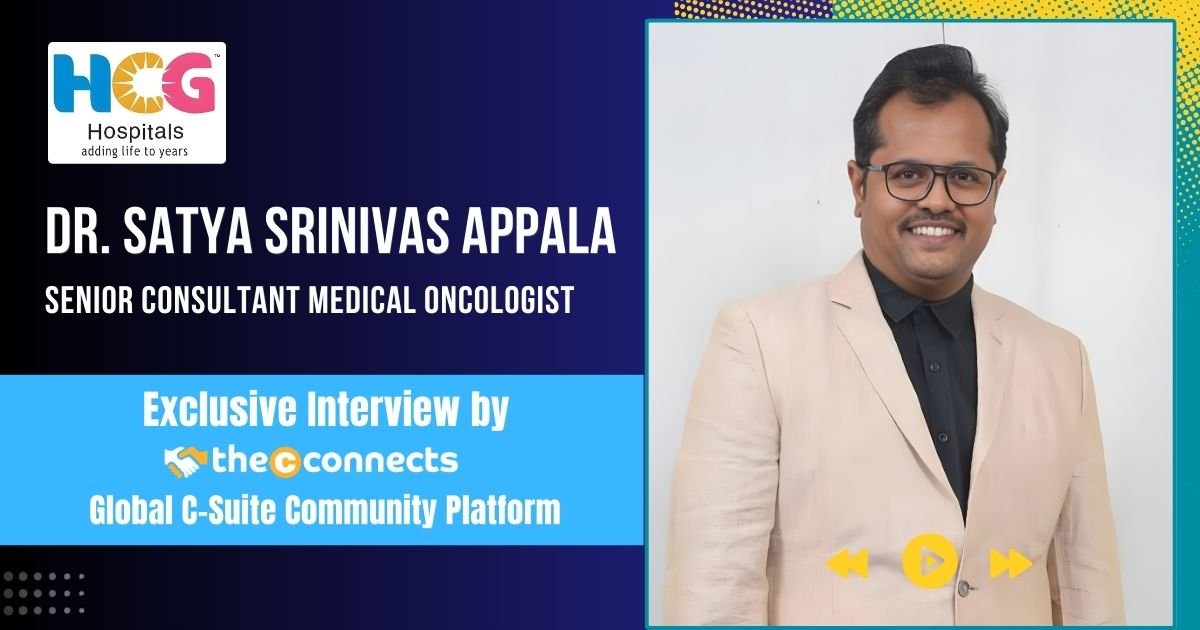

TheCconnects: Dr. Satya Srinivas, your academic and professional journey reflects deep commitment and discipline. Take us back to the beginning-how did your journey in medicine start, and what led you to specialize in oncology?
Dr. Satya Srinivas Appala:
Medicine, for me, was never just a career choice-it was a calling shaped early by exposure to human suffering and resilience. I completed my MBBS from Government Medical College, Anantapur, followed by an MD in General Medicine, where I secured a university rank. During my postgraduate years, I was deeply involved in managing chronic and life-threatening illnesses, and that’s when oncology drew my attention.
Cancer is not just a disease; it affects families, livelihoods, and emotional well-being. I felt that oncology demanded not only scientific rigor but also immense compassion and communication. This realization led me to pursue DNB in Medical Oncology at Apollo Cancer Hospitals. Those years shaped my clinical thinking, ethical grounding, and commitment to evidence-based care.
TheCconnects: Oncology is one of the most demanding specialties. What were some defining moments during your training and early practice?
Dr. Satya Srinivas Appala:
One defining moment was during my residency when I treated a young patient with an advanced malignancy. Despite the odds, the patient responded remarkably well to treatment. That experience reinforced my belief in personalized, protocol-driven oncology.
Equally defining were moments of loss. Oncology teaches humility. You learn that while medicine can do a lot, it cannot do everything. Those moments taught me the importance of honest conversations, palliative care integration, and supporting families beyond prescriptions and protocols.
TheCconnects: You’ve worked across teaching hospitals and leading cancer centers. How have these diverse roles influenced your approach as a clinician today?
Dr. Satya Srinivas Appala:
Each role added a layer to my professional identity. As an Assistant Professor, I learned the importance of mentoring and structured learning. At tertiary cancer centers like Apollo and Omega Hospitals, I was exposed to high-volume, complex cases and multidisciplinary decision-making.
Later, working at American Oncology Institute and now as Consultant Senior Medical Oncologist at HCG Vijayawada, I’ve been able to combine clinical depth with patient-centered care. Today, my approach balances precision oncology with accessibility and empathy.
TheCconnects: Cancer care in India comes with unique challenges. What have been the biggest obstacles you’ve faced, and how have you addressed them?
Dr. Satya Srinivas Appala:
One major challenge is late-stage presentation. Many patients still come to us when the disease is advanced, often due to lack of awareness or fear. Another challenge is affordability and access to timely care.
I’ve addressed this by actively engaging in community outreach. Over the years, I’ve conducted more than 1,000 cancer awareness programs, particularly in rural and semi-urban areas. Prevention and early detection can dramatically change outcomes, and education is the first step.
TheCconnects: Your involvement in cancer awareness and HPV vaccination programs stands out. Why is prevention so close to your heart?
Dr. Satya Srinivas Appala:
Because many cancers are preventable. Cervical cancer, for example, can be drastically reduced through HPV vaccination and regular screening. Conducting HPV vaccination drives for rural schoolchildren was deeply fulfilling-it felt like protecting the next generation before disease even had a chance.
As doctors, we often focus on treatment, but prevention is where the real victory lies. Awareness empowers people to seek help early, and that saves lives.
TheCconnects: You’re also a principal investigator in multiple clinical trials. How important is research in advancing cancer care?
Dr. Satya Srinivas Appala:
Research is the backbone of progress in oncology. Clinical trials allow us to evaluate new therapies, optimize treatment protocols, and offer patients access to cutting-edge options. Being a principal investigator has strengthened my belief in evidence-based medicine.
It also instills discipline-adhering to protocols, monitoring outcomes meticulously, and constantly updating one’s knowledge. Ultimately, research ensures that patient care keeps evolving with science.
TheCconnects: Technology is rapidly transforming healthcare. How has it influenced your clinical practice?
Dr. Satya Srinivas Appala:
Technology has enhanced precision and safety in oncology. From electronic health records and chemotherapy management systems to advanced diagnostics, these tools improve coordination and reduce errors.
However, technology should never replace human connection. A well-informed patient who trusts their doctor will always have better outcomes. I see technology as an enabler-not a substitute-for compassionate care.
TheCconnects: With such an intense profession, how do you maintain balance outside the hospital?
Dr. Satya Srinivas Appala:
Balance is essential to longevity in oncology. I spend time reading medical literature and mentoring younger doctors, which I find intellectually refreshing. I also value quiet time with family-it helps me recharge emotionally.
Community work gives me a sense of purpose beyond the clinic. When you see awareness translating into early diagnosis, it reinforces why you chose this path.
TheCconnects: What lessons has oncology taught you-not just as a doctor, but as a human being?
Dr. Satya Srinivas Appala:
Oncology teaches patience, humility, and gratitude. It teaches you to listen-truly listen-to patients. It also teaches resilience. Every day, you witness courage in its rawest form.
Professionally, I’ve learned that continuous learning is non-negotiable. Personally, I’ve learned not to take time for granted. These lessons shape how I practice medicine and how I live life.
TheCconnects: What advice would you give to young doctors aspiring to specialize in oncology?
Dr. Satya Srinivas Appala:
First, choose oncology only if you’re ready for lifelong learning and emotional commitment. Second, build a strong foundation in internal medicine-it’s critical. Third, never lose empathy. Patients may forget the drug names, but they’ll remember how you made them feel.
Finally, remember that impact is not measured only in survival statistics but also in dignity, comfort, and trust.
TheCconnects: Looking ahead, what is your vision for cancer care in India?
Dr. Satya Srinivas Appala:
I envision an India where cancer is detected early, treated equitably, and discussed openly without stigma. Strengthening screening programs, expanding vaccination, and integrating research with routine care will be key.
Personally, I want to continue combining clinical excellence with community engagement-because meaningful healthcare extends beyond hospital walls.
TheCconnects: Thank you, Dr. Satya Srinivas, for sharing your journey and insights. Your work is truly inspiring.
Dr. Satya Srinivas Appala:
Thank you. If this conversation encourages even one person to seek early screening or pursue oncology with purpose, it will have been worthwhile.