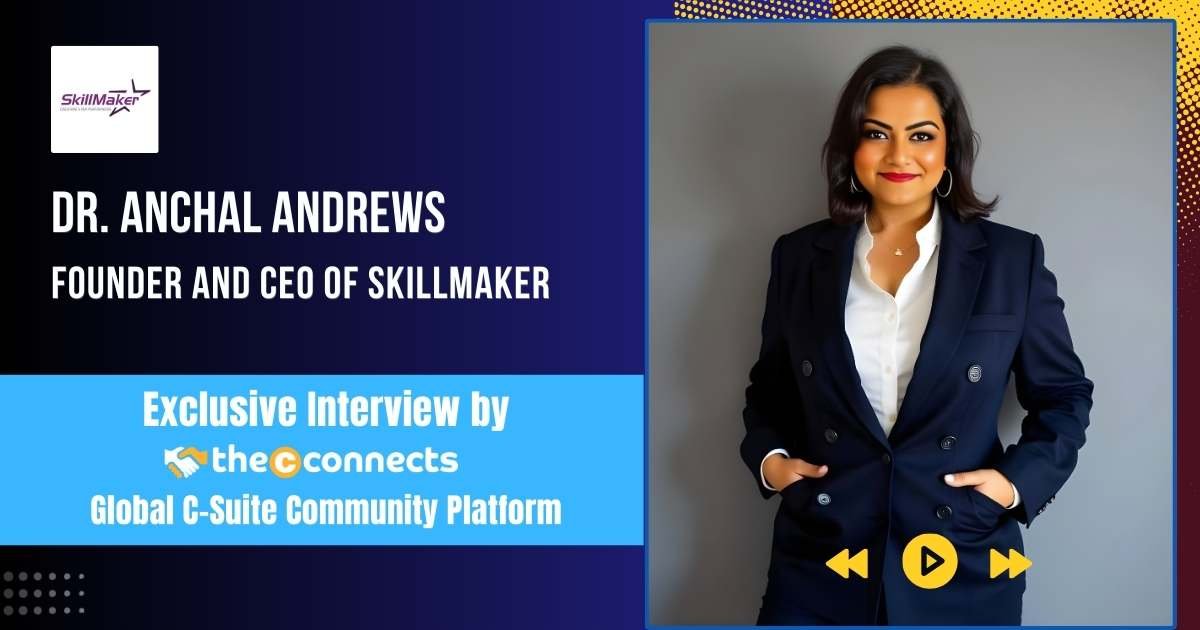

In the world of corporate strategy, there are theorists, and then there are practitioners. Dr. Anchal Andrews belongs firmly to the latter category. With a career that spans generating AED 95 Million in monthly revenue for luxury automotive brands to influencing landmark legislation like POCSOA in India, her trajectory is nothing short of cinematic. As the Founder of SkillMaker Consultancy, she has spent over a decade proving that “human capital” isn’t a soft metric-it’s the hardest, most reliable lever for P&L growth. We sat down with Dr. Andrews to deconstruct her “double the effort” philosophy and her vision for the future of business.
TheCconnects: Dr. Andrews, looking at your profile, it’s a fascinating mix of high-stakes commerce and deep social impact. You’ve gone from managing luxury brands like Bentley and Bugatti in the UAE to leading HR for NGOs and founding Skill Maker. How would you describe the “red thread” that connects these seemingly different worlds?
Dr. Anchal Andrews: It’s a pleasure to be here. If I had to name “red thread,” it would be measurable transformation. Whether I was at Al Habtoor Group driving revenue or at Sakshi fighting for social justice, the core challenge was the same: How do we take a complex human system and move it toward a specific, high-value outcome? In the UAE, the outcome was revenue and market share. In the social sector, it was systemic change and protection for the vulnerable. My journey hasn’t been a series of pivots, but rather a continuous expansion of the same mission-converting human potential into predictable, tangible value. I’ve always believed that if you can’t measure the impact of your strategy on a person’s life or a company’s bottom line, you aren’t really strategizing; you’re just dreaming.
TheCconnects: You’ve often said, “It didn’t take me long, it just took double the effort.” That feels very grounded compared to the “overnight success” narratives we often see. Can you talk about a specific time when that “double effort” was the only thing between success and failure?
Dr. Andrews: (Laughs) The “overnight success” is a myth that sells books but ruins businesses. For me, that “double effort” was most evident during my time as a Country Business Manager in the UAE. We were looking at generating AED 90 Million in a three-month sprint from one shop floor.
In that environment, you don’t just work harder; you work deeper. I was diving into the psychology of the frontline teams, the friction in the customer journey, and the cold-calling scripts that most leaders think are “beneath” them. I’ve never been afraid to get my hands dirty. I remember one of my early mentors, Brian Cosgrave, noted that I was a “natural on the phone” during cold-calling phases. That wasn’t talent; it was the result of making meaning conversations with whom I would call and this is what truly makes a customer say “yes.”
TheCconnects: Speaking of “yes,” your work with SkillMaker Consultancy focuses heavily on Business Transformation and L&D. You’ve managed to lift client bottom lines by 16% through people-centric strategies. How do you bridge the gap between “Learning & Development” (which many CEOs see as a cost) and “Revenue” (which they see as a result)?
Dr. Andrews: That gap exists because L&D is often treated as a “check-the-box” activity. At SkillMaker, we treat it as an ROI center. When we go into a firm, we don’t just “train” people; we audit customer touchpoints.
For instance, in 2014, I designed a customer charter that moved profits from 15% to 26% in just three months. We didn’t do that by teaching people to smile more; we did it by aligning incentives across sales and operations and creating a culture of “Frontline Excellence.” My book, Beyond Frontline Excellence, explores this deeply. I believe customer experience and employee experience are two sides of the same profitability coin. If your employees aren’t empowered, your customers will feel the friction, and your P&L will show the bruises.
TheCconnects: You’ve also been deeply involved with the NGO Sakshi, contributing to the work that led to the POCSOA 2012. How does your corporate strategy mindset translate into the world of social justice and HR in the non-profit sector?
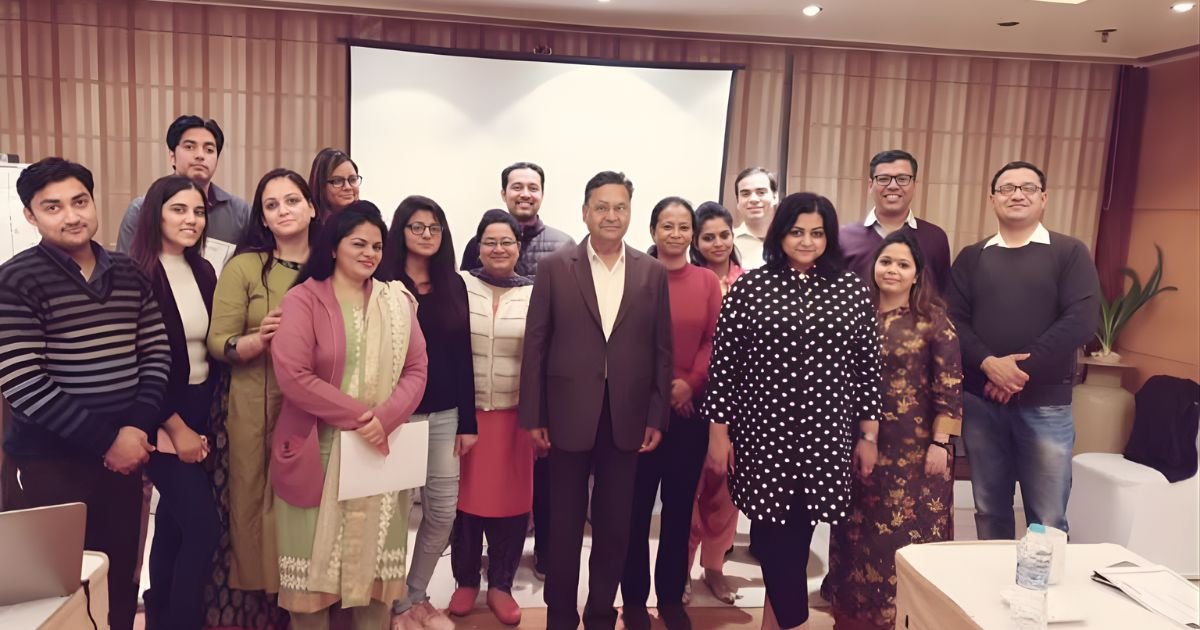
Dr. Andrews: It’s about building systems that protect and empower. At Sakshi, as Director of HR & Operations, the stakes were much higher than a quarterly report. We were dealing with human rights and legislative change. However, the operational needs are identical: you need high-performance teams, clear communication, and a strategic vision that can withstand immense pressure.
Working on the frontline of social change teaches you a level of resilience that no boardroom can. It reminds you that “leadership” isn’t about the title-it’s about the responsibility you take for the people under your care. That’s a lesson I bring back to every corporate client I consult for.
TheCconnects: Let’s talk about your creative side. You’re an abstract artist, working with complex techniques like Impasto and Sgraffito. Does your art influence your business strategy, or is it an escape from it?
Dr. Andrews: It’s definitely not an escape; it’s a parallel language. Abstract art is about finding order in chaos-much like a business turnaround. When I’m using an aerial perspective or action painting, I’m experimenting with how different elements interact to create a cohesive whole.
In business, we often get stuck in “linear thinking.” Art forces you to look at the “negative space”-the things that aren’t being said in a meeting or the data points that are missing. My art helps me maintain that “Visionary” edge. It keeps my mind flexible. You can’t solve modern business problems with a 1990s mindset; you need the fluidity of an artist and the precision of a surgeon.
TheCconnects: We are moving into an era dominated by AI. As a founder involved in the “Next Big Thing Club,” how are you integrating AI into your strategy, especially with your role at Oneclean Concierge?
Dr. Andrews: AI is a tool for leverage, not a replacement for judgment. At Oneclean Concierge, we used strategic planning to become the highest-selling startup in our first six months. AI allows us to de-risk these ventures by analyzing market gaps faster than ever.
However, my focus remains on the “Human” in the loop. As we look toward SkillMaker and funding/investments, the “biggest challenge” for brands today isn’t tech-it’s authenticity. In a world of AI-generated noise, a brand that offers a genuine, high-value human relationship becomes a premium asset. We use AI to handle the volume, but we use human strategy to handle the value.
TheCconnects: For the aspiring entrepreneurs reading this-especially those who feel they have to choose between being a “business person” or a “creative/social advocate”-what is your core piece of advice?
Dr. Andrews: Don’t choose. Integrate. Your diverse interests are your competitive advantage. The world doesn’t need more one-dimensional CEOs; it needs “Game Changers” who understand psychology, art, social impact, and hard-core economics.
My second piece of advice is tactical: Measure everything. If you have a passion project, find the KPIs that prove it’s working. Passion without metrics is just a hobby. If you want to change the world-or just change your industry-you have to be willing to do “double the effort” on the boring stuff: the operations, the spreadsheets, and the strategy.
TheCconnects: Finally, what does a typical day of “free time” look like for someone who wears so many hats?
Dr. Andrews: Free time is a bit of a misnomer! (Laughs). But when I’m not in the boardroom or the factory, you’ll find me with my canvases. Painting is where I recharge. I also spend a lot of time reading and writing, I summarize social and spiritual topics. For me, “rest” isn’t doing nothing; it’s doing something that nourishes a different part of my soul.