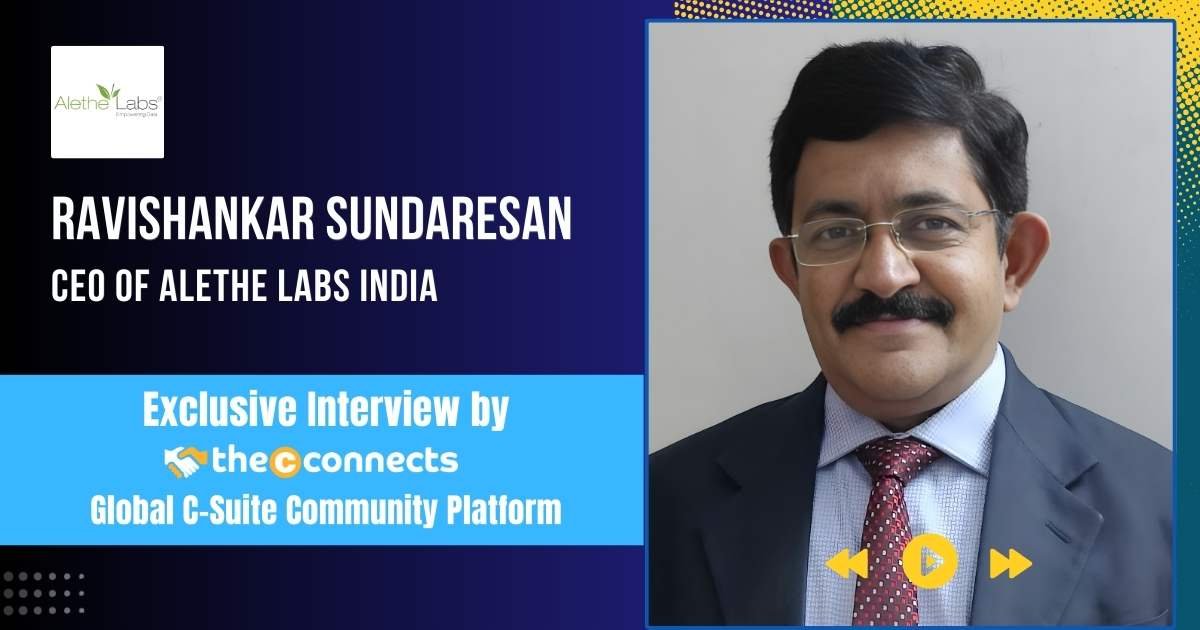

In the high-risk, high-responsibility world of energy and infrastructure, the difference between “digital adoption” and “digital intelligence” is the difference between temporary efficiency and long-term resilience. While many organizations are still experimenting, developing and managing with multiple apps development, data silos, multiple levels of reports and dashboards, Ravishankar Sundaresan is quietly helping rebuild the operating backbone of the industry itself with a holistic approach to digital transformation.
With over 38 years of leadership across public sector giants, private energy corporations, consulting firms, and now AI-driven technology companies, Ravishankar brings a rare depth of operational credibility to the digital transformation conversation. As the CEO of Alethe Labs India, he is not merely introducing AI into energy systems – he is redefining how intelligence, safety, sustainability, and governance coexist inside mission-critical industrial environments.
From gas pipelines and LNG ecosystems to project management consulting to digital twins, AI-powered operational intelligence to OT cyber security, his career reflects a deliberate evolution: from executing projects to architecting systems that think, predict, and protect. What sets him apart is not just technological foresight, but a deeply human leadership philosophy rooted in growth, governance, ESG, institutional integrity, and the belief that experience has value only when it enables others to grow.
A respected industry voice, board-level advisor, author, and governance leader, Ravishankar has consistently operated at the intersection of strategy, values, and execution. Whether shaping / building performance-driven organizations, or enabling companies to manage digital risks or advising socially impactful projects, his work carries one defining theme: transformation must be intelligent, responsible, and measurable.
Today, TheCconnects sits down with Ravishankar Sundaresan to explore the future of AI in energy and infrastructure, why digital transformation without domain depth is dangerous, how ESG and technology must evolve together, and why the most important leadership skill in the coming decade is not speed – but clarity of intent and intelligent execution.
TheCconnects: Ravishankar, looking at your trajectory-from leadership at GAIL and Reliance Power to heading a project management consulting company to a cutting-edge AI firm like Alethe Labs – it’s an incredible evolution. Could you share the “defining moment” when you realized that traditional energy infrastructure was no longer enough without a digital rebirth?
Ravishankar Sundaresan: It’s a pleasure to be here. That moment wasn’t a sudden bolt of lightning, but a realization born from years in the field. I saw a recurring pattern: we had massive, multi-billion dollar physical assets, but our decision-making was often reactive. We were managing by looking in the rear view mirror-fixing things after they broke or optimizing based on last month’s data.
I realized that in the ever expanding and integrating energy and infrastructure global landscape, the complexity of energy markets and the urgency of the energy transition meant that human intuition alone wasn’t enough. We needed “Operational Intelligence.” I decided to move from managing the assets to architecting the “intelligence” that makes them efficient and safe and protects them.
TheCconnects: You’ve operated at the highest levels of both public and private sectors. How do leadership challenges differ across these environments, or is the “industrial pain point” universal?
Ravishankar: While the organizational culture differs-the public sector focuses on balanced approach involving massive scale, business growth and social responsibility, while the relatively large private sector prioritizes scale, agility and strategic growth-the core challenges are universal. Whether it’s a state-run utility or a private power producer, leaders face the same challenges: growth imperative, risk management, aging infrastructure, improved operational efficiency and safety and the multiple stakeholder management. The need for safety, transparency, and high-performance systems is a global language that doesn’t change with the company logo. In the case of medium sized private outfits, it is slightly different – technology adoption and systems and processes will always face the question: whether now or later?
TheCconnects: We are in 2026, and AI is the current reality. You’ve been a vocal advocate for AI in the energy and infrastructure space. How do you answer the skeptics who fear that AI might “automate away” the human expertise that has run these industries for decades?
Ravishankar: It’s actually the opposite. AI and Digital Twin is the best thing to happen to the “human” side of energy and infrastructure because it removes the cognitive overload of monitoring thousands of data islands and multi-locational manual processes blending with the existing automated processes. Human Intelligence (HI) and Judgement will always be supreme. At Alethe Labs, we use integrated data platform and analytics, real time operational data capture and AI engine to perform near real-time meter diagnostics, equipment monitoring and anomaly detection, leak detection, in much faster time, leading to predictive operations and maintenance. Automation of field level manual data collection makes the system much more robust. This allows the humans-the engineers and site managers-to focus on the high-level, empathetic work of safety leadership, innovative interventions, and strategic problem-solving. AI provides the intelligence, near real time diagnosis, faster anomaly reporting; humans provide the intent, developing a robust digital system, effective use of the system to derive the best results and deliver enhanced safety of operations leveraging the new-age technologies. That’s why I often quote: AI + HI = ROI.
TheCconnects: You often talk about “Operational Intelligence” rather than just “Software Solutions.” Can you explain that distinction to a board-level executive?
Ravishankar: Think of a software solution as an application to enhance the efficiency of a particular process – gas supply management, invoicing and any such process, In an organisation, multiple such software applications may be operational with some getting integrated with the ERP system or some standalone ones. Besides, there are multiple manual field level processes in the organisation which can be automated through e-log book systems. Can you notice the multiplicity of applications and processes in the organisations? Large multi-locational operations are monitored centrally using robust SCADA systems. No doubt, the system and automation have grown leaps and bounds in the last two decades, driven by software revolution. But what we are talking today is going beyond the current SCADA and system and process software. That’s what is Operational Intelligence which in its advanced level, will ensure end to end automation, real time or near real time operational parametric data capture through a performance digital twin, continuous performance analytics and anomaly detection of equipment and instrumentation and ultimately predictive analytics using AI. Given the extensive exposure of operations to the external environment through control systems and IoT devices, there is a need for an over-riding multi-level OT Cyber security. Could you see the complexity and foresee the need for a holistic digital transformation? Effectively, Operational Intelligence is the nervous system which is going to ensure intelligent, efficient, safe and secure operations dramatically reducing the human errors and protecting the critical assets from failure or any adverse safety incident. Early diagnostics and anomaly detection in a multi-locational operation, will enable timely action and prevent major safety incidents or expensive shutdowns. That’s why, I recommend a holistic approach to digital transformation, which one can,…..rather should implement in phases with a clear long term road map and planned integration with existing enterprise systems and applications.
TheCconnects: You are a member of the ASME India Industry Advisory Board and a jury member for the CSR Times Awards. How do ESG and AI and digital transformation converge in your vision for the future?
Ravishankar: Yes, AI can significantly improve the effectiveness, credibility, and timeliness of ESG monitoring and reporting, especially for mid-to-large companies that struggle with fragmented data, manual reporting, inconsistent metrics and evolving regulations. I believe that all the major AI and new-age applications lead to better operational efficiency, accurate diagnosis, real time alarms and hence operational safety. Therefore, in a broader sense, ESG gets embedded into this system. One has to plan how to integrate the ESG parametric monitoring into the operational digital solutions and other functional systems in the organisation. ESG is often seen as a compliance burden, but I see it as a value creator. Digital integration supported by AI can definitely make ESG measurable and amenable to effective monitoring. For example, our work in Digital Twin integrated Leak Detection Systems (LDS) directly impacts the “E” and “S” in ESG by accurately diagnosing the leaks and emissions on a near real time and taking quick actions to mitigate the emission and safety risks. Our focus on Integrated Data Platform, Enterprise Risk Management software and OT Cyber Security addresses the “G” by enabling continuous monitoring of policies, controls, and compliance and ensuring the integrity of critical infrastructure. When you integrate AI with ESG, you move from “reporting on the past” to “protecting the future.” But one must understand: AI does not replace ESG judgment.
It makes ESG measurable, timely, and decision-relevant.
TheCconnects: In your 38+ years, what is the biggest professional hurdle you’ve faced, and what did it teach you about the “GROW” mantra you often speak of?
Ravishankar: The most significant challenge was the shift from being a “successful executive” to a “transformation leader.” As an executive, you deliver results within an existing system. As a transformation leader, you have to dismantle the old system while it’s still running. I have seen this challenge when working with a transformational leader two decades ago in a PSU and also later when heading mid-sized organisations, with inherent penchant for growth.
It taught me that resilience isn’t about standing still; it’s about constant evolution. My “GROW” mantra – which stands for growth in every pursuit – both professionally and personally – comes from realizing that there is no finish line in life. When executives move away from “Fixed Mindset” to “Growth Mindset”, they will see things happening around them. True leadership is about building a legacy of leaders who can think for themselves long after you’ve left the room.
TheCconnects: If you were sitting across from an aspiring entrepreneur today in the Energy-Tech space, what would be your “non-negotiable” advice?
Ravishankar: Don’t build technology for the sake of technology; solve a “domain pain.” Think holistic and long term when it comes to digital intervention. New technologies must integrate with the existing operational technologies and applications used by the customers, to give the best value to them.
Also, understand that in our industry, Trust is the only currency. Domain / Operations experts in the company have to be an integral part of the digital transformation journey. You can have a brilliant algorithm, but if an operator doesn’t trust that your AI will keep their operations robust and people safe, they won’t use it. Build your domain credibility before you build your code.
TheCconnects: With such a demanding schedule-CEO, Board Member, Author, and Mentor-how do you decompress? What does Ravishankar Sundaresan do when he isn’t “optimizing” the energy grid?
Ravishankar: (Laughs) I am a lifelong student. My “free time” often involves exploring and learning about new-age technologies or mentoring young professionals through various training initiatives. I’ve trained over 7,000 professionals over the years along with my expert network of thought leaders, and that gives me immense energy. I believe, Thinking and Learning are the biggest assets of a human being – put it to the best and constructive use. But I also value the “quiet”-time for reflection, family, and simple joys. I have also learnt to enjoy the beauty in imperfections around me. To lead with clarity, you need a balanced mind.
TheCconnects: Finally, looking toward 2027 and 2028, what is the “Next Big Thing” for Alethe Labs?
Ravishankar: We are doubling down on Predictive Resilience. I foresee rapid growth in digital twin and AI technologies combined with OT Security in energy and infrastructure operations going forward and predictive diagnosis and mitigation will be the name of the game. These technologies will not just evolve, they will expand much more rapidly than what we could think of. Alethe Labs aspires to play a significant and transformative role in this industrial digital revolution. We want to make digital intelligence invisible – it should just be a layer of efficiency, intelligence and safety that empowers every worker to do their job with total confidence.