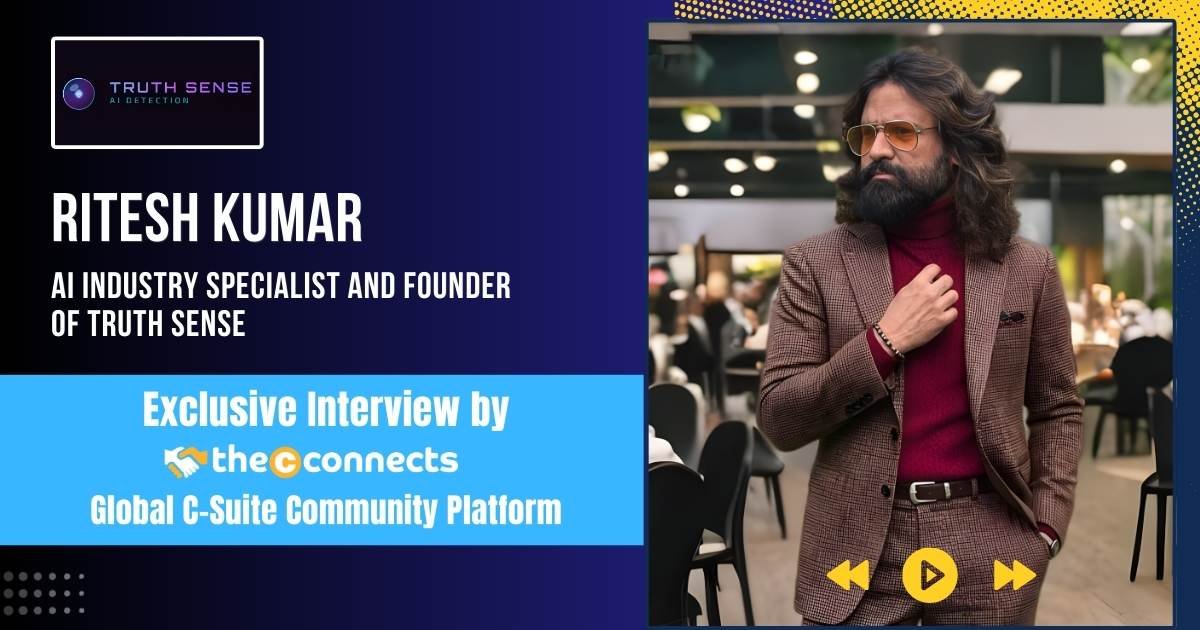

Adopt AI or Abort AI with Industry Leader Ritesh Kumar
AI is everywhere-headlines, pitch decks, products. Is this real transformation or another hype cycle driven by capital?
Ritesh Kumar: It’s both-and that’s what makes this moment critical. The hype is loud around tools. The transformation is quiet around behavior. Money today is chasing compute, speed, and visibility. But real value doesn’t settle there. It settles where AI changes how decisions are made, not just how content is produced. “The real AI revolution isn’t about output. It’s about judgment.”
TheCconnects: Where is most of the investment going wrong right now?
Ritesh Kumar: We’re over-investing in automation and under-investing in accountability. If AI scales intelligence without scaling responsibility, we don’t get progress-we get chaos. The winners will be companies that survive regulation, public scrutiny, and ethical pressure-not just growth metrics.
TheCconnects: What’s the single biggest benefit AI will bring to humanity?
Ritesh Kumar: Cognitive leverage. AI lets humans think at a higher altitude-faster synthesis, clearer pattern recognition, fewer blind spots. Used right, it doesn’t make us lazy. It makes us more intentional.
TheCconnects: And the biggest risk?
Ritesh Kumar: Outsourcing judgment. When humans stop thinking and start complying with AI, we don’t lose jobs-we lose agency. “The danger isn’t intelligent machines. It’s passive humans.”
TheCconnects: You talk a lot about ethical AI. What does that actually mean in practice?
Ritesh Kumar: Ethical AI isn’t a policy document. It’s a design choice. For me, it’s about what you choose not to automate. Ethical AI must: Augment human judgment-not replace it. Intervene early-before harm escalates. Remain explainable, interruptible, and accountable. If an AI system cannot be questioned or overridden, it’s unethical by design. “Ethical AI reduces harm before it increases efficiency.”
TheCconnects: Let’s talk specifics. What do your products do, and why are they a morally ethical product?
Ritesh Kumar: Each product exists because a human gap was left unaddressed. But here whether it can really make a positive impact in the society we live in. For Example..One of my product is Chill Pill.
Chill Pill is a mental compass for teenagers-an AI-powered Behavioural Trait Analyzer built for early detection of risks like depression, addiction, anxiety, or withdrawal. It does not diagnose or label. It observes patterns and flags directional risk-early. Why it’s ethical: No permanent labels during identity formation. No replacement of parents, teachers, or counselors. Preventive, not reactive. Future impact: If each of us truly understood our weaknesses and refined our strengths at a granular, trait-level, the world wouldn’t just improve-it would transform.
Truth Sense: In an AI world where images, videos, and voices can be generated instantly, humans can no longer reliably tell what’s real. People consume loads of fake information and are being conditioned to hatred and biases. Truth Sense verifies authenticity and provenance-whether content is manipulated, synthetic, or risky-without censoring opinions. Why it’s ethical: It adds clarity, not control. It explains why something is credible or not. It restores trust without suppressing speech. Future impact: When everything can be generated, truth becomes a service.
Gurudev helps people make better decisions, not faster ones. It reflects perspectives, slows impulsive thinking, and aligns choices with values-without issuing commands. Why it’s ethical: Preserves human agency. Avoids dependency. Positions AI as a mirror, not authority. Future impact: AI becomes a thinking companion, not a decision-maker.
TheCconnects: For a non-technical person, which AI tools actually matter today?
Ritesh Kumar: Quietly useful ones include ChatGPT – thinking, writing, planning; Perplexity – clean research; Notion AI – organizing work and life; Grammarly – clarity and tone; Otter.ai – memory capture. AI should feel useful, not magical. Actually I could go on with the names.. It’s a great time to be.
TheCconnects: AI agents are the new buzzword. What’s real here?
Ritesh Kumar: Simple distinction: Reactive AI responds when you ask, while Proactive AI anticipates and assists before you ask. Agents move AI from response mode to responsibility mode-but only if autonomy is bounded and accountable.
TheCconnects: Is it true you’ve digitally twinned yourself?
Ritesh Kumar: Yes… and I’ll admit, saying it out loud still sounds a little sci-fi. But the reason wasn’t novelty. It was necessity. My work spans products, people, time zones, and long-term thinking. I realised that while my availability is finite, my way of thinking shouldn’t be. So I built a digital twin-not to replicate me as a person, but to extend how I reason, prioritise, and decide.
TheCconnects: So what does this twin actually do for you?
Ritesh Kumar: Functionally, it’s very practical. My digital twin reads and understands my emails, drafts responses in my voice, and flags the ones that actually need my attention. It helps me build decks and notes the way I would-structured, contextual, and outcome-driven. It tracks my meetings, alerts me on what matters before I walk in, takes notes during conversations, and summarizes decisions and action items afterward. It also analyzes my conversations over time-what I’m agreeing to too quickly, what I’m pushing back on, where my energy is being spent inefficiently. In short, it doesn’t just save time. It protects my thinking bandwidth. So instead of repeating myself or context-switching endlessly, I show up where it truly matters. Think of it less as a clone-and more as operational continuity for the mind.
TheCconnects: So… hypothetically-could this twin answer interview questions too?
Ritesh Kumar: That’s a fair question-and honestly, I used to joke about it. But the more I worked with it, the more I realised-why not? If the questions are about how I think, how I approach AI, ethics, healthcare, and society… then it’s actually a perfect test. So yes-I insist you ask the rest of the questions to my AI digital twin, Ritz. Because the future isn’t really about being present everywhere. It’s about continuity of thinking-without losing accountability.
CONTROL TRANSFERS TO: RITZ – AI DIGITAL TWIN
TheCconnects: How will AI change healthcare?
Ritesh Kumar: AI Digital Twin: By shifting from treatment to prevention. AI will first optimize operations, then diagnostics-but its biggest impact is early risk detection, mental health, and personalized care pathways. Healthcare rewards accuracy and explainability, not speed.
TheCconnects: What about India specifically?
Ritesh Kumar: AI Digital Twin: India will deploy AI at population scale-education, healthcare, governance. The challenge isn’t talent. It’s inclusive, ethical deployment across socio-economic layers. If done right, India can lead responsibly.
TheCconnects: Will AI replace human jobs?
Ritesh Kumar: AI Digital Twin: Tasks will disappear. Roles will evolve. Displacement happens when reskilling lags. The future belongs to human–AI teams, not AI alone.
TheCconnects: Ritesh, listening to Ritz answer-it’s unsettlingly accurate. The framing, the pauses-it feels very close to you.
Ritesh Kumar: That’s the point. Ritz isn’t trained on my words. He’s trained on my decision patterns and constraints. And I’m impressed-by your questions and by how close this is to my thinking.
TheCconnects: Is this where things are headed?
Ritesh Kumar: Yes. In five years, everyone will have an AI agent-not as a luxury, but as a necessity. “In five years, not having an AI agent will feel like not having a smartphone.”
TheCconnects: Final question. Adopt AI or abort AI?
Ritesh Kumar: Adopt AI. Abort blind automation. AI will amplify whatever we bring to it-wisdom or recklessness. Choose wisely.