
From patents and publications to quiet humanitarian service, a global conversation on responsibility, legacy, and conscious leadership.
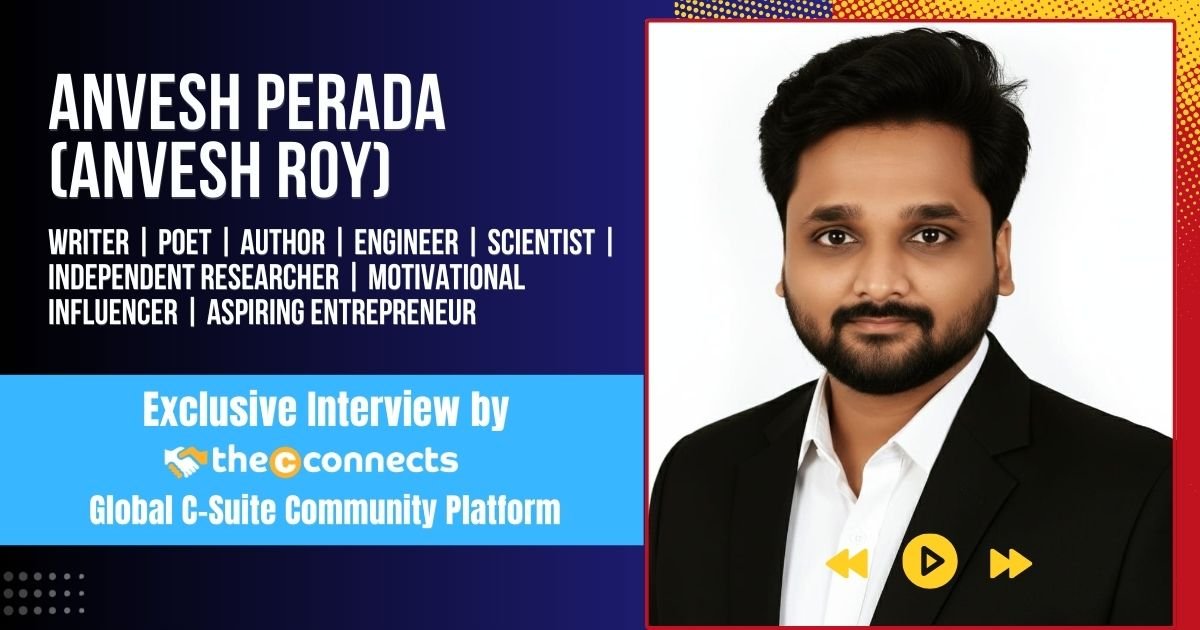
In an era shaped by speed, visibility, and constant comparison, Anvesh Perada (Anvesh Roy) represents a quieter, more grounded form of leadership-one anchored in responsibility, empathy, and ethical clarity.
A Writer, Poet, Author, Engineer, Scientist, Independent Researcher, Motivational Influencer, and Aspiring Entrepreneur, his journey bridges science and society, innovation and integrity, progress and compassion.
This conversation with TheCconnects explores how knowledge gains meaning only when guided by conscience, why leadership must remain accountable to humanity, and how real impact often unfolds away from the spotlight. From patents and publications to grassroots service and reflective writing, Anvesh Roy’s story offers a timely reminder: the future belongs not to the loudest voices, but to the most responsible ones.
TheCconnects: This is your second interview after nearly eight months. How do you describe this phase of your life compared to the previous one?
Anvesh Roy: This phase of my life feels significantly more grounded, reflective, and intentional. Before I speak about growth, I would like to sincerely acknowledge and apologise for the delay in this conversation.
Since last July, I faced certain health challenges that required me to slow down, prioritise recovery, and give my full attention to healing. It was not an easy phase, but it was a necessary one.
Interestingly, that pause became transformative. Earlier, my journey was largely about exploration-learning continuously, expanding across disciplines, questioning systems, and understanding how society functions. That phase built intellectual breadth. This recent phase, shaped partly by health and reflection, deepened something more important: perspective.
I learned that progress does not always come from movement; sometimes it comes from stillness. Stepping back forced me to reassess priorities, commitments, and the pace at which I was living. I became more conscious of alignment-between values and actions, ambition and wellbeing, contribution and responsibility. What once felt like urgency gradually evolved into clarity.
Today, I am more selective with where I invest my energy, more patient with processes, and more aware of impact. Growth now feels quieter but stronger. It is less about doing more and more about doing what truly matters-with balance, responsibility, and integrity. I’m grateful to be in better health now and to return with renewed focus, resilience, and purpose.
“Sometimes growth begins when we are forced to pause-clarity often arrives not through speed, but through reflection and healing.”
TheCconnects: Looking back over this period, what internal shift has mattered more to you than any external achievement?
Anvesh Roy: The most significant internal shift for me has been a deeper acceptance of patience-both with myself and with the process of life.
Earlier, like many driven individuals, I measured progress through visible outcomes: completed projects, recognitions, milestones. While those markers are not meaningless, I’ve come to realise they are incomplete indicators of growth.
This period taught me the value of conscious pacing. I learned to listen more carefully-to my body, my mind, and the quiet signals that often get ignored in the rush to perform. Patience, I discovered, is not passive waiting; it is active trust. It allows you to make decisions that are thoughtful rather than reactive, and purposeful rather than impulsive.
Another important shift has been moving from self-expectation to self-understanding. Instead of asking, “What must I achieve next?”, I began asking, “What is required of me right now to remain ethical, balanced, and useful?”
That question changed how I approached work, service, and relationships. It reduced noise and increased clarity. This internal recalibration has made me more resilient. External achievements fluctuate, but inner stability sustains direction. When purpose is anchored internally, outcomes follow naturally-and more sustainably.
“Inner stability outlasts external success; when patience guides purpose, progress becomes sustainable.”
TheCconnects: Your academic journey is unusually extensive and interdisciplinary. Could you explain your complete education and the philosophy behind it?
Anvesh Roy: My academic journey was never driven by the pursuit of credentials; it evolved organically as a response to real questions I encountered while observing society, systems, and human behaviour. Each stage of learning emerged because the previous one revealed a deeper gap in understanding.
My foundation began with a B.Tech (Bachelor of Technology) in Electrical & Electronics Engineering, from a college affiliated to Jawaharlal Nehru Technological University, Kakinada. Engineering gave me clarity in logic, systems thinking, and accountability. It taught me that even minor decisions can have long-term structural consequences.
This led me toward advanced technical understanding through an M.Tech (Master of Technology) in Power Systems & Automation at GITAM University, where I explored how technology interacts with infrastructure, sustainability, and planning at scale. As my exposure widened, I realised that technological efficiency alone does not ensure meaningful progress.
To understand organisations and leadership dynamics, I pursued an MBA (Master of Business Administration) in Human Resource Management and an MBA in Operations Management, both at GITAM University. These disciplines helped me understand how people, processes, and ethics influence institutional outcomes.
My focus then moved deeper into the human dimension through an M.Sc (Master of Science) in Clinical Psychology at Jain (Deemed-to-be) University. This phase profoundly reshaped my understanding of mental health, emotional resilience, and the psychological foundations of decision-making and leadership.
To understand how ideas, information, and governance shape society, I undertook an MA (Master of Arts) in Journalism & Mass Communication, followed by an MA in Political Science and an MA in Economics, all from Andhra University. These areas helped me engage with public discourse, power structures, policy frameworks, and socio-economic realities.
Most recently, I have taken up an LLB (Bachelor of Laws) at Visakha Law College, Visakhapatnam, which I am currently pursuing. Law represents a convergence point-where technology, psychology, governance, ethics, and justice translate into accountability and action.
Each academic pursuit was not an endpoint, but a response to a deeper question. For me, education is not about knowing more than others; it is about understanding enough to act responsibly in an increasingly complex world. Interdisciplinary learning has taught me that leadership today demands technical clarity, human empathy, ethical reasoning, and legal awareness-together, not in isolation.
“True education is not the accumulation of degrees, but the courage to understand systems, people, and responsibility as one.”
TheCconnects: At what point did you realise that single-discipline thinking was insufficient for real-world leadership?
Anvesh Roy: The realisation did not come at a single moment; it unfolded gradually through lived experience. Early in my journey, I believed that strong technical expertise could solve most problems. However, as I began engaging with organisations, communities, and institutions, I noticed a recurring pattern-many challenges persisted even when the technical solutions were sound.
I observed situations where systems were well designed, yet outcomes failed because human behaviour, communication gaps, or ethical considerations were overlooked. Technical efficiency alone could not address emotional stress, social inequality, governance failures, or institutional resistance. That is when it became clear to me that leadership requires more than mastery of one discipline-it requires the ability to connect perspectives.
Real-world leadership operates at the intersection of technology, psychology, policy, economics, and ethics. Without this integration, decisions remain fragmented and short-sighted. Understanding multiple disciplines does not dilute expertise; it strengthens judgment. It allows leaders to anticipate consequences beyond immediate results and make choices that are both effective and humane.
This realisation reshaped how I approached learning and leadership. Instead of asking, “What solution works fastest?”, I began asking, “What solution remains responsible over time?”
“Single-discipline expertise may solve problems temporarily, but integrated thinking builds solutions that endure.”
TheCconnects: How do you decide when to keep learning formally versus learning through lived experience?
Anvesh Roy: I see formal learning and lived experience not as opposites, but as complementary forces. Formal education provides structure, language, and frameworks-it helps you understand why things function the way they do. Lived experience, on the other hand, teaches you how those frameworks behave in reality, especially under pressure.
I turn to formal learning when I realise that experience alone is not giving me clarity. When questions become repetitive or complex-about mental health, governance, organisational ethics, or justice-I seek structured study to avoid assumptions. Formal education disciplines thought; it prevents intuition from becoming bias.
At the same time, there are moments when no classroom can teach what reality demands. Human suffering, leadership dilemmas, moral conflict, and service on the ground are best understood through presence and humility. Lived experience keeps theory honest and grounded.
The balance comes from awareness. When learning becomes detached from reality, it needs experience. When experience becomes chaotic or emotionally overwhelming, it needs structure. Moving consciously between the two has helped me remain adaptable without losing depth.
“Formal learning gives structure to thought; lived experience gives truth to learning.”
TheCconnects: How does your interdisciplinary foundation shape your approach to research and innovation?
Anvesh Roy: My interdisciplinary foundation acts as a constant checkpoint in how I approach research and innovation. It prevents me from seeing innovation as an isolated technical exercise. Every idea, no matter how advanced, exists within a social, psychological, economic, and ethical context. Ignoring that context may accelerate development, but it also increases the risk of unintended harm.
Engineering and technology taught me precision and feasibility, but psychology taught me vulnerability and human limits. Management and economics helped me understand scale and efficiency, while journalism and political science sharpened my awareness of narrative, power, and public impact. Law, which I am currently pursuing, adds a layer of accountability-reminding me that innovation must ultimately answer to justice and responsibility.
Because of this integration, my research questions are never limited to “Can this be done?”. They extend to “Should this be done, for whom, and under what safeguards?”.
Interdisciplinary thinking slows impulsive innovation and replaces it with conscious design. It encourages long-term thinking over short-term success. In a world racing toward automation and disruption, this approach ensures that progress remains humane. Innovation should not merely advance capability; it should elevate responsibility.
“Innovation gains its true value only when intelligence is guided by ethics and accountability.”
TheCconnects: In your view, where do many modern innovations fail ethically-even when they succeed technically?
Anvesh Roy: Many modern innovations fail ethically at the point where efficiency is prioritised over empathy. Technically, a system may function flawlessly-optimised, scalable, profitable-but ethically, it may overlook human dignity, consent, long-term consequences, or unequal impact. Success is often measured by adoption rates or market value, not by the quality of life it creates.
One common failure lies in designing solutions for people rather than with people. When affected communities are excluded from decision-making, innovation becomes extractive rather than inclusive.
Another failure occurs when speed overrides scrutiny. In the rush to be first, ethical safeguards, mental health implications, data privacy, and environmental consequences are treated as secondary concerns.
There is also a tendency to assume neutrality in technology. But technology reflects the values and biases of those who design it. When those biases remain unexamined, innovation can unintentionally reinforce inequality, exclusion, or harm-despite technical brilliance.
Ethical innovation requires slowing down at critical moments, asking uncomfortable questions, and accepting responsibility beyond immediate success. Progress that ignores conscience is not advancement; it is displacement of responsibility.
“Technical success without ethical scrutiny may impress the present, but it burdens the future.”
TheCconnects: How should researchers and innovators balance ambition with responsibility in a competitive global environment?
Anvesh Roy: Ambition is not the problem-unchecked ambition is. In a competitive global environment, ambition drives discovery, progress, and excellence. However, when ambition is detached from responsibility, it becomes dangerous. The balance lies in redefining what ambition actually means.
For me, responsible ambition is ambition with foresight. It asks not only “How far can we go?” but also “What happens after we get there?”. Researchers and innovators must accept that being first is less important than being right. Long-term trust, social legitimacy, and ethical credibility matter far more than short-term advantage.
Another key element is accountability. Innovation should not end at deployment; it must include monitoring, correction, and willingness to admit limitations. Competitive pressure often discourages pauses, but ethical leadership requires the courage to slow down when consequences are unclear.
Ultimately, ambition should be guided by purpose. When purpose is aligned with human well-being, responsibility does not limit ambition-it elevates it. True leadership in innovation is demonstrated not by how fast one advances, but by how consciously one advances.
“Ambition guided by responsibility does not slow progress-it ensures that progress is worth sustaining.”
TheCconnects: Fame and recognition often change people. How have you personally navigated recognition?
Anvesh Roy: I’ve learned to treat recognition as a moment of reflection rather than a moment of arrival. Fame has the ability to subtly shift focus-from purpose to perception, from service to self. Being conscious of that risk has helped me remain grounded.
For me, recognition has never been a goal; it has been a consequence. I remind myself that awards and visibility do not define the value of work-they merely acknowledge a phase of effort. What truly matters is whether the work continues to serve people ethically and responsibly after the applause fades.
I also try to see recognition as a reminder of accountability. When more eyes are watching, the margin for error narrows-not because of fear, but because responsibility increases. Recognition should never inflate ego; it should deepen humility and discipline. If it does not make one more careful, more ethical, and more human, then it has failed its purpose.
“Recognition should never elevate the ego-it should elevate responsibility.”
TheCconnects: How do you ensure that awards and recognition do not distract you from your core purpose?
Anvesh Roy: I consciously treat awards as checkpoints, not destinations. The moment recognition becomes a source of comfort, it begins to dilute purpose. To prevent that, I regularly return to the fundamentals-why I started, who the work is meant to serve, and what responsibility accompanies visibility.
One practice that helps me stay grounded is separating appreciation from identity. Recognition is something I receive; it is not who I am. When identity becomes attached to awards, fear of losing relevance replaces commitment to service. I make it a point to continue engaging in work that has no visibility-quiet service, listening, learning, and on-ground involvement-because that keeps intention honest.
I also remind myself that recognition amplifies consequences. Every decision made after visibility carries greater impact. This awareness naturally pulls focus back to ethics, restraint, and long-term responsibility rather than short-term validation.
“Awards acknowledge effort, but purpose survives only through humility and discipline.”
TheCconnects: Your journey has been recognised through several national and global honours, along with notable media features. Could you share these recognitions and explain how you interpret their significance?
Anvesh Roy: I have always viewed recognition as a reflection of responsibility rather than a measure of arrival. While I receive these honours with gratitude, I remain conscious that they are acknowledgements of direction-not destinations.
In recent years, my interdisciplinary work across research, humanitarian engagement, and ethical innovation has been recognised through several national and global platforms. These include:
- Icons of India (2024) – Featured by Fames India Magazine
- Best Researcher Award (2024) – SIPH International Faculty Awards
- Best Emerging Scientist Award (2024) – Asian Excellence Awards
- Best Emerging Scientist Award (2025) – Global Leadership Awards
- Infinity Renaissance Catalyst Vanguard Award (2025) – awarded at the Growth Stories Summit & Awards, July 2025
- Global Multidisciplinary Humanitarian Polymath & Ethical Innovation Excellence Award (2025) – awarded at the Growth Stories Summit & Awards, December 2025
- The Global Human Advancement Laureate of the Year (2025) – Pride Bharat Awards
In addition to these honours, I have been featured twice by TheCconnects Magazine-in the July 2025 and December 2025 editions-as a “Visionary Global Innovator uniting compassion and science.”
These features positioned my work within a global conversation on interdisciplinary leadership, emphasising that innovation gains real meaning only when guided by empathy, ethics, and service. I value this recognition not for visibility, but for the message it amplifies-that progress must remain human-centric.
Ultimately, such acknowledgements remind me that visibility narrows the margin for error. They reinforce the need for humility, consistency, and ethical clarity. Achievements, in my view, are not celebrations of completion-they are invitations to deeper accountability.
“Honours are not destinations-they are reminders to remain accountable to purpose, people, and conscience.”
TheCconnects: Do you believe recognition creates pressure-and if so, how do you manage it consciously?
Anvesh Roy: Yes, recognition does create pressure-but I don’t see that pressure as something negative. I see it as a signal that responsibility has increased. When work becomes visible, the consequences of decisions become wider, and that naturally demands greater awareness, discipline, and restraint.
Earlier in my journey, pressure came from external expectations-deadlines, comparisons, and the need to prove capability. Over time, I learned that external pressure is unstable; it fluctuates with attention. What sustains balance is internal accountability.
I manage recognition-related pressure by constantly returning to first principles: ethics, purpose, and service. Another important way I manage pressure is by maintaining spaces where recognition does not exist at all-quiet service, study, reflection, and listening. These spaces remind me that value is not created only on stages or in publications, but in consistency and conduct. They keep ego in check and intention clear.
I’ve also learned to accept pressure without reacting to it. Not every expectation requires a response. Discernment-knowing when to act and when to remain still-has been essential. Pressure becomes manageable when it is reframed as stewardship rather than stress.
“Recognition brings pressure, but awareness turns pressure into responsibility rather than burden.”
TheCconnects: Your humanitarian work is largely quiet and away from the spotlight. Why is this approach important to you?
Anvesh Roy: For me, service has always been a matter of conscience, not visibility. Human suffering does not announce itself, and responding to it does not require an audience. Whether it involves feeding the homeless, rescuing animals, caring for stray dogs, participating in disaster relief, or engaging in mental health awareness, these acts are rooted in presence and empathy, not recognition.
I believe that when service becomes performative, it begins to lose its essence. Kindness driven by validation risks becoming conditional, selective, or short-lived. Quiet service, on the other hand, cultivates consistency and sincerity. It allows one to act without expectation, which is often where the deepest impact occurs.
Working away from the spotlight also keeps intention honest. It ensures that actions are guided by empathy rather than applause. In my experience, real change often begins invisibly-through trust, listening, and sustained effort-long before it is acknowledged publicly.
“Service that seeks attention weakens its purpose; service guided by conscience strengthens humanity.”
TheCconnects: How has grassroots human rights work reshaped the way you understand power and leadership?
Anvesh Roy: Grassroots human rights work has fundamentally reshaped my understanding of power. It taught me that real power is not institutional-it is relational. On the ground, power is experienced through access to justice, dignity, and voice. When those are absent, authority becomes meaningless to the people it is meant to serve.
Working closely with communities exposed me to the gap between policy and reality. Laws and frameworks may exist, but their impact depends entirely on how humanely they are implemented. This is where leadership is tested-not in conference rooms, but in uncomfortable, often invisible spaces where people seek fairness, recognition, and protection.
Grassroots engagement also stripped leadership of illusion. It showed me that leadership is not about being in control; it is about being accountable. It requires listening before acting, humility before authority, and courage to challenge systems when they fail the vulnerable. The closer you are to the ground, the less room there is for ego-and the more space there is for responsibility.
This experience reinforced a simple truth: leadership is not defined by position, but by proximity to human reality.
“Power without empathy isolates; leadership grounded in humanity restores dignity.”
TheCconnects: In moments where institutions or systems fail people, what role should individuals play?
Anvesh Roy: When institutions fail, individuals become the first line of humanity. Systems are important, but they are built and sustained by people-and when they falter, moral responsibility does not disappear. In such moments, individuals have a duty to respond not with anger alone, but with conscience, courage, and constructive action.
This does not mean replacing institutions or acting recklessly. It means refusing to be indifferent. It means speaking up when silence enables harm, offering support where access is denied, and using whatever capacity one has-knowledge, time, skills, or voice-to restore dignity. Small actions, when rooted in integrity, often become the foundation for larger systemic change.
Individual responsibility also involves holding institutions accountable without becoming hostile to the idea of systems themselves. Change requires engagement, persistence, and ethical resistance-not withdrawal. History shows that meaningful reform often begins with individuals who chose responsibility over comfort.
“When systems fail, individual conscience becomes the bridge between injustice and dignity.”
TheCconnects: Sports have been part of your life since childhood. How did they shape your character and emotional discipline?
Anvesh Roy: Sports shaped my character long before formal leadership roles or academic frameworks did. From an early age, engaging in cricket and football during schooling, and later cricket, kabaddi, and chess in college, taught me lessons that extend far beyond the playing field. Sport became a quiet classroom for discipline, patience, teamwork, and emotional regulation.
What sports taught me most was how to respond under pressure. You learn quickly that outcomes are uncertain, effort does not always guarantee success, and composure matters as much as skill. These experiences instilled emotional discipline-the ability to stay balanced during both success and failure. Winning taught humility; losing taught resilience.
Sports also cultivated respect-for teammates, opponents, rules, and limits. They reinforced the importance of preparation, consistency, and ethical conduct. These values naturally translated into how I approach leadership and decision-making today. The field taught me that character is revealed not when everything goes right, but when circumstances test your restraint and integrity.
“Sport teaches discipline in action-how to stay grounded when pressure demands reaction.”
TheCconnects: How do you carry lessons from sport into leadership, especially during pressure or criticism?
Anvesh Roy: Sport taught me that pressure is not an interruption-it is part of the process. On the field, pressure demands presence. You learn to focus on what is within your control, to read situations calmly, and to respond rather than react. I carry this mindset directly into leadership.
When criticism arises, I approach it the way one approaches a challenging moment in sport: first, by stabilising emotionally, then by assessing what is valid, and finally by acting with intention. Not all criticism requires defence; some require reflection. Sport taught me that losing composure often causes more damage than losing a point.
Another lesson is accountability. In team sports, responsibility cannot be outsourced. If something fails, you own your role and move forward. In leadership, this translates into transparency and resilience. Pressure becomes manageable when ego steps aside and purpose takes the lead.
Ultimately, sport instilled the discipline to stay steady under scrutiny and the humility to keep learning-both of which are essential for ethical leadership.
“Pressure tests skill, but discipline determines character.”
TheCconnects: Writing and reflection play an important role in your life. Why do you write?
Anvesh Roy: I write because it creates space for honesty. In a world driven by speed and instant reactions, writing allows me to slow down and listen-to my own thoughts, responsibilities, and inner voice. It gives room for reflection before expression, and depth before opinion. Writing, for me, is not an escape; it is a way of staying grounded and truthful.
I regularly share reflections and poems on LinkedIn, where writing gradually moved beyond a personal habit and became a meaningful dialogue with people across countries, professions, and cultures. The appreciation and recognition I’ve received globally have been humbling-not because the writing seeks attention, but because it resonates with shared human experiences such as kindness, struggle, integrity, and hope.
Alongside this, I run a LinkedIn newsletter titled Relatable Realities, where I share long-form articles about life-its quiet lessons, emotional truths, ethical questions, and everyday realities that often go unnoticed. The newsletter is intentionally simple and honest. It does not attempt to impress; it aims to reflect. Through Relatable Realities, I’ve connected with a thoughtful and empathetic readership that values sincerity over spectacle.
I am deeply grateful for the community that has grown around this writing-especially the LinkedIn community that engages with respect, reflection, and depth. Their responses reaffirm my belief that even in fast-paced digital spaces, people still seek meaning. Above all, I remain thankful-to the readers who take time to reflect, and to God, for the clarity, strength, and purpose that allow me to express honestly.
“When words are written with sincerity, they don’t chase attention-they create connection.”
TheCconnects: What responsibility do thinkers and writers carry in an age of misinformation and outrage culture?
Anvesh Roy: In an age dominated by misinformation, outrage, and instant judgment, thinkers and writers carry a profound responsibility-to slow the conversation down. When emotions are amplified and facts are distorted, words can either inflame division or restore perspective. Silence, too, becomes a choice, because unchecked misinformation fills the gaps where thoughtful voices withdraw.
Thinkers and writers must prioritise truth over popularity and depth over virality. This does not mean claiming moral superiority; it means exercising restraint, verification, and empathy. Every word published has the potential to influence perception, reinforce bias, or open space for understanding. In such an environment, responsible writing is not about winning arguments-it is about protecting clarity.
There is also a responsibility to humanise discourse. Outrage culture often reduces people to labels and issues to extremes. Thoughtful writing resists this by acknowledging complexity and refusing to dehumanise. Writers must remember that behind every topic are real lives, emotions, and consequences.
Most importantly, thinkers must be willing to be unpopular at times. Ethical writing may not always align with trends, but it builds trust over time. In a noisy world, calm, well-reasoned voices do not dominate immediately-but they endure.
“In an age of noise, the most responsible voice is the one that restores clarity, not outrage.”
TheCconnects: You often speak about “awakened intelligence.” What does this concept mean in today’s world?
Anvesh Roy: Awakened intelligence, to me, is intelligence guided by awareness, empathy, and ethical responsibility. In today’s world, intelligence is often measured by speed, efficiency, and output-how fast we process information, how much we produce, or how effectively we compete. While these aspects matter, they are incomplete without consciousness.
Awakened intelligence recognises that knowledge without awareness can become dangerous. It asks not only “What can we do?” but “What should we do, and why?”. It integrates emotional intelligence, moral reasoning, and social responsibility into decision-making. In a time where artificial intelligence is advancing rapidly, awakened intelligence reminds us that human judgment must mature alongside technological capability.
This concept also emphasises self-awareness. Being intelligent is not enough if one is unaware of biases, privilege, or the consequences of one’s actions. Awakened intelligence requires humility-the willingness to listen, to learn continuously, and to correct course when necessary. It is intelligence that remains alert to human dignity.
In essence, awakened intelligence is the ability to use knowledge in a way that uplifts rather than dominates, heals rather than exploits, and serves rather than controls.
“Intelligence reaches its highest form when it is guided by awareness, empathy, and ethical restraint.”
TheCconnects: As artificial intelligence advances, what concerns you more-technological misuse or human indifference?
Anvesh Roy: What concerns me more than technological misuse is human indifference. Technology itself is neutral-it reflects the intentions, values, and priorities of those who design and deploy it. Misuse can often be traced, corrected, or regulated. Indifference, however, is far more dangerous because it normalises harm and silences accountability.
When people disengage ethically-when convenience outweighs conscience-technology begins to operate without moral supervision. Decisions become automated, biases become invisible, and responsibility becomes diffused. Indifference allows misuse to persist quietly, without resistance or reflection. It is not the power of machines that threatens society, but the absence of human vigilance guiding that power.
As artificial intelligence grows more capable, the need for human awareness becomes more urgent. We must remain actively involved-questioning outcomes, protecting dignity, and ensuring that innovation serves people rather than replaces compassion. Progress without participation leads to erosion of values.
Ultimately, technology should amplify human judgment, not replace it. The moment humans stop caring is the moment innovation loses its moral compass.
“Technology becomes dangerous not when it is powerful, but when humans become indifferent to its consequences.”
TheCconnects: What failure or setback taught you the most about yourself?
Anvesh Roy: The setback that taught me the most was not a single public failure, but a period where my body and mind forced me to slow down. Facing health challenges was humbling because it disrupted momentum, plans, and expectations I had set for myself. It reminded me that resilience is not always about pushing forward-sometimes it is about knowing when to pause.
During that phase, I had to confront my own limits. I realised how often we equate worth with productivity and progress with constant motion. When that motion stops, it can feel unsettling. But that stillness taught me self-compassion, patience, and the importance of listening-especially to signals we often ignore.
This experience reshaped how I define strength. Strength is not just endurance; it is awareness. It is the ability to acknowledge vulnerability without self-judgment and to rebuild with intention rather than urgency. That setback ultimately deepened my empathy for others navigating invisible struggles and reinforced the importance of balance in leadership and life.
“The setbacks that slow us down often teach us how to move forward with wisdom.”
TheCconnects: Across education, research, service, and leadership, what inner quality matters more than intelligence or talent?
Anvesh Roy: The inner quality that matters more than intelligence or talent is self-awareness. Intelligence and talent determine what we are capable of doing, but self-awareness determines how responsibly we use those abilities. Without awareness, intelligence can become reckless and talent can become self-serving.
Self-awareness allows us to recognise our limitations, biases, and blind spots. It encourages humility and continuous learning. In leadership and service, this quality becomes especially critical, because decisions often affect people beyond our immediate view. Being aware of one’s influence helps prevent misuse of power and promotes ethical judgment.
Self-awareness also creates emotional balance. It helps us respond thoughtfully rather than react impulsively. In moments of success, it keeps ego in check; in moments of failure, it prevents despair. Over time, self-awareness transforms competence into wisdom and ambition into responsibility.
“Self-awareness turns ability into wisdom and power into responsibility.”
TheCconnects: How do you personally recalibrate when you feel disconnected from purpose?
Anvesh Roy: When I feel disconnected from purpose, I return to stillness before action. Disconnection is often a signal-not of failure, but of misalignment. Instead of pushing harder, I pause and listen. I reassess my motivations, commitments, and the pace at which I am operating. Purpose cannot be recovered through urgency; it requires honesty.
Recalibration, for me, begins with simplifying. I step back from noise-digital, professional, and emotional-and reconnect with fundamentals: health, reflection, learning, and service. Acts of quiet service have a grounding effect; they remind me why intention matters more than recognition. I also revisit writing and reflection, which help me articulate what feels unsettled and why.
Importantly, recalibration involves humility-the willingness to admit that direction may need adjustment. Purpose evolves as we grow. Staying aligned means allowing that evolution without guilt or resistance. When clarity returns, it does so gently, not forcefully, and action regains meaning.
“Purpose is not rediscovered through urgency, but through honest pause and realignment.”
TheCconnects: Your work also includes patents and academic publications across multiple domains. How do you view research outputs such as patents and publications in the broader context of social responsibility and impact?
Anvesh Roy: For me, patents and publications are not endpoints of intellectual achievement; they are instruments of responsibility. Research carries meaning only when it contributes to understanding, problem-solving, or long-term societal preparedness. A patent or a publication is valuable not because it exists, but because of what it enables-dialogue, innovation, policy insight, or ethical reflection.
My research interests have spanned technical, organisational, and conceptual domains, reflecting my interdisciplinary approach. However, I’ve always believed that research should remain connected to real-world context. A patent should not merely demonstrate novelty; it should reflect foresight. A publication should not only add to literature; it should encourage critical thinking and responsible application.
In today’s world, where metrics often overshadow meaning, it is easy to treat research outputs as credentials. I consciously resist that mindset. I see research as a living responsibility-something that must remain open to scrutiny, evolution, and societal relevance. Whether in technology, organisational behaviour, or emerging interdisciplinary fields, the intent has always been to contribute thoughtfully rather than accumulate citations.
Ultimately, research is a form of service. When conducted with integrity, it informs decisions far beyond the laboratory or journal-it shapes how societies prepare for the future.
“Research finds its true value not in recognition, but in the responsibility, it carries toward society and the future.”
TheCconnects: Your work spans patents, publications, innovation, and leadership. How do you view success and legacy in the broader journey of responsibility and service?
Anvesh Roy: For me, success and legacy are inseparable from responsibility. Research outputs-whether patents, publications, or books-are not milestones of personal achievement; they are instruments of service. With over 45 patents across India, the United Kingdom, and Canada, and 30+ Scopus-indexed publications, my contributions span electric mobility, renewable energy systems, quantum algorithms, and organizational behavior. While these domains may appear diverse, they are unified by a single belief: innovation must ultimately serve humanity.
My books reflect this philosophy clearly. Works such as Employee Engagement, Theory of Evolution: From Darwin to Modern Synthesis, Electric Vehicles: Prospects and Challenges, and Hybrid Algorithms for Quantum Computing and Artificial Intelligence were not written merely to advance technical or academic discourse. They were written to explore how knowledge, systems, and innovation intersect with ethics, sustainability, human behaviour, and long-term societal well-being.
Across these books, the underlying question remains consistent: Does progress strengthen humanity, or does it merely accelerate capability? For me, technology and theory are meaningful only when they uplift people, strengthen ethical decision-making, and address real societal needs.
Patents represent foresight rather than ownership. Publications represent dialogue rather than authority. Both carry an obligation-to anticipate consequences, invite scrutiny, and encourage responsible application.
At the same time, fame never pulled me away from my first calling: humanity. While recognition followed my interdisciplinary work, it never defined my purpose. My service journey has always been rooted in lived responsibility-feeding the homeless, participating in animal rescue missions, caring for and feeding stray dogs, supporting disaster relief efforts, and engaging in sustained mental health awareness initiatives.
Importantly, these efforts were never shaped for visibility. There were no campaigns built around compassion, no performances of charity, and no intention to be seen for doing what felt fundamentally human. Much of this service happens quietly, without announcements, cameras, or expectations of credit.
I believe service is not an identity to display, but a responsibility to live. Kindness loses its meaning when driven by validation, and real impact is measured not by applause, but by presence. In an age where visibility often overshadows sincerity, this approach may seem understated-but it is the only way I know to remain honest.
This commitment to human dignity naturally extends into my human rights work. Serving as General Secretary (South India) of the Human Rights Council for India, I remain closely connected to grassroots realities-working on equality, legal awareness, and social justice. What distinguishes this engagement is its on-ground nature, bridging policy-level conversations with everyday human concerns. Leadership, in this sense, becomes less about authority and more about trust, empathy, and accountability.
For me, legacy is not defined by how much is achieved, patented, or published, but by whether one’s work leaves people stronger, systems fairer, and progress more humane. Innovation without compassion is incomplete, and leadership without service is hollow.
“True legacy is not built through recognition, but through responsibility-when knowledge serves humanity and leadership remains anchored in conscience.”
TheCconnects: How do you view awards and recognitions in the larger journey of life and responsibility?
Anvesh Roy: I view awards and recognitions as moments of reflection rather than moments of arrival. They acknowledge effort, but they do not define purpose. In the larger journey of life, recognition is meaningful only if it deepens responsibility rather than inflating ego.
Every award brings with it an unspoken question: What will you do next, and how responsibly will you do it? Recognition amplifies visibility, and with visibility comes greater accountability. It narrows the margin for error and raises expectations-not for perfection, but for integrity. I remind myself that being recognised does not make one exceptional; it makes one answerable.
I also believe that recognitions are collective in nature. Behind any individual honour are countless influences-teachers, colleagues, communities, and lived experiences. Forgetting this creates detachment. Remembering it creates humility. Awards should never become shields from criticism; they should become mirrors that reflect whether one is staying true to values.
In a world that often confuses achievement with worth, I consciously separate the two. Awards may mark a chapter, but responsibility determines the direction of the story that follows.
“Recognition is not a reward for arrival-it is a reminder of the responsibility that follows visibility.”
TheCconnects: You’ve been featured by national and international magazines. How do you view media recognition and visibility?
Anvesh Roy: I view media recognition as a platform for responsibility rather than personal validation. Visibility has the power to shape narratives, influence perception, and amplify ideas far beyond individual reach. Because of that, I believe it must be handled with restraint and intention.
Being featured by national and international platforms is meaningful not because it highlights an individual, but because it brings certain values into public conversation-interdisciplinary thinking, ethical innovation, compassion-driven leadership, and human-centric progress. Media attention, at its best, should not celebrate personalities; it should elevate principles that matter to society.
At the same time, visibility carries risk. It can easily distort priorities if one begins to perform for attention rather than remain anchored in purpose. I consciously remind myself that media presence is temporary, but credibility is built quietly over time. The work must continue with the same sincerity when the spotlight moves elsewhere.
For me, the true measure of media recognition is whether it encourages thoughtful dialogue, inspires responsibility, and reminds people that progress without humanity is incomplete. When visibility serves those ends, it becomes meaningful. When it doesn’t, it must be resisted.
“Visibility has value only when it amplifies values-not when it replaces them.”
TheCconnects: How would you redefine success for future generations, and why does that definition matter today?
Anvesh Roy: I believe success for future generations must be redefined beyond accumulation-of wealth, titles, or attention-and reframed around alignment: alignment between knowledge and ethics, ambition and well-being, progress and humanity. The definitions we pass on matter deeply because they shape not only goals, but mental health, social priorities, and collective behaviour.
Today, success is often portrayed as speed-how fast one rises, how early one achieves, how visibly one is recognised. This narrative creates pressure, comparison, and burnout, while neglecting depth, patience, and responsibility. If future generations inherit this definition unchanged, they may achieve more yet feel less fulfilled, more connected digitally yet more disconnected humanly.
I would redefine success as the ability to live with integrity while contributing meaningfully to the world. Success should include emotional balance, ethical clarity, and the capacity to uplift others-not just personal advancement. A successful life, in this sense, is one that leaves people better than it found them and systems fairer than they were inherited.
This redefinition matters today because we are shaping a future where technology will amplify both our intelligence and our values. If our values are shallow, the amplification will be dangerous. If they are grounded, the impact will be transformative.
“True success is not how far one rises alone, but how responsibly one rises-and who is uplifted along the way.”
TheCconnects: What do you hope your work contributes to the world ten or twenty years from now?
Anvesh Roy: Ten or twenty years from now, I don’t hope my work is remembered for volume or visibility, but for direction. I hope it contributes to a way of thinking that values integration over isolation-where science, ethics, policy, and compassion are not treated as separate pursuits, but as interconnected responsibilities.
If my work leaves behind anything meaningful, I hope it helps normalise the idea that innovation must be human-centric, that leadership must be accountable, and that progress should never come at the cost of dignity. Whether through research, education, human rights engagement, or writing, my intention has always been to ask better questions-questions that encourage foresight, empathy, and restraint.
I also hope my journey reassures people that it is possible to grow without losing humility, to succeed without abandoning service, and to think globally while remaining grounded locally. In a future shaped by rapid technological change, I hope my contributions remind people that conscience must evolve alongside capability.
Ultimately, if even a small part of my work encourages individuals or institutions to act more responsibly, listen more deeply, or place humanity at the centre of decision-making, that would be a legacy worth leaving.
“The most meaningful contribution is not what we leave behind, but the values we leave alive in the future.”
TheCconnects: In a world driven by speed, competition, and comparison, how can individuals remain grounded in kindness and integrity?
Anvesh Roy: Remaining grounded in kindness and integrity today requires conscious resistance-to speed without reflection, competition without conscience, and comparison without context. Much of modern pressure comes from external noise telling people who they should be, how fast they should move, and what success should look like. Kindness and integrity survive when individuals choose awareness over autopilot.
Groundedness begins with slowing down internally, even when life moves fast externally. When we pause before reacting, we give integrity space to guide our actions. Kindness is not weakness; it is clarity. It allows us to see others not as competitors, but as fellow humans navigating their own struggles-often invisible ones.
Integrity, similarly, is strengthened through consistency in small, unseen choices. It is easier to be ethical when watched; it is meaningful when no one is observing. In a culture of comparison, remembering one’s values-and not outsourcing them to public approval-is essential. When actions align with conscience rather than applause, grounding follows naturally.
Ultimately, kindness and integrity are not traits we display; they are habits we practice daily. The world may reward speed, but it remembers character.
“In a fast world, integrity slows us just enough to choose humanity over haste.”
TheCconnects: How can people contribute meaningfully when their efforts go unnoticed or unacknowledged?
Anvesh Roy: Meaningful contribution does not depend on recognition; it depends on intention. Some of the most important acts in society happen quietly-without applause, documentation, or validation. When efforts go unnoticed, it is easy to question their value, but true contribution is not diminished by invisibility.
People contribute meaningfully by anchoring their actions in purpose rather than outcome. When the motivation is conscience instead of credit, effort remains sincere and sustainable. History reminds us that many changes began with individuals who were unseen in their time but indispensable in their impact.
There is also a deeper freedom in unnoticed contribution. It allows people to act without performance, to remain consistent without pressure, and to stay aligned with values rather than external approval. When recognition is absent, integrity becomes the only measure-and that is often the most reliable one.
Every act of quiet responsibility strengthens the moral fabric of society. Even when unseen, such efforts ripple outward in ways we may never witness.
“The value of an action is not measured by who notices it, but by who is strengthened because of it.”
TheCconnects: What would you say to young people struggling with self-doubt and pressure to succeed quickly?
Anvesh Roy: To anyone struggling with self-doubt or the pressure to succeed quickly, I would first say this: your worth is not measured by speed. We live in a culture that celebrates early achievement and visible milestones, but growth does not follow a universal timeline. Comparing your beginning to someone else’s middle only deepens anxiety and distorts self-belief.
Self-doubt often arises not because you are incapable, but because you are constantly measuring yourself against external standards. Instead of asking “How fast am I moving?”, ask “Am I moving with integrity and understanding?”. Depth takes time. Character takes time. Confidence built slowly is far more resilient than confidence borrowed from applause.
It’s also important to allow yourself to be a learner. Pressure to appear successful too early can prevent real learning and self-awareness. Mistakes, pauses, and detours are not signs of failure; they are part of becoming grounded. Success that arrives before clarity often creates emptiness, while clarity that arrives first creates sustainable success.
Above all, be patient with yourself. You are not behind-you are becoming.
“You are not late; you are learning-and that matters more than speed.”
TheCconnects: As technology advances rapidly, what human values must be protected at all costs?
Anvesh Roy: As technology advances, the most essential human values we must protect are empathy, dignity, integrity, and responsibility. Technology can enhance intelligence and efficiency, but it cannot replace moral judgment. Without these values, advancement risks becoming detached from humanity.
Empathy ensures that innovation remains people-centered. It reminds us that behind every dataset, system, or algorithm are real human lives. Dignity protects individuals from being reduced to metrics, outputs, or commodities. Integrity safeguards truth and fairness in a time when manipulation and misinformation can be scaled effortlessly. Responsibility ensures that power-especially technological power-is exercised with restraint and accountability.
What concerns me most is not that technology will surpass human capability, but that human values may fail to mature alongside it. When convenience overrides conscience, progress becomes hollow. The future demands not just smarter systems, but wiser humans-individuals willing to question impact, acknowledge bias, and accept accountability.
Protecting these values is not the job of technologists alone. It is a shared responsibility-across education, governance, industry, and everyday life. Technology should amplify our humanity, not replace it.
“The true measure of progress is not how advanced our technology becomes, but how deeply our humanity is preserved.”
TheCconnects: When future generations look back at this era, what do you hope they remember about how we lived, led, and treated one another?
Anvesh Roy: When future generations look back at this era, I hope they remember that amid rapid change, uncertainty, and disruption, we did not abandon our humanity. This period will likely be remembered for technological acceleration, social transitions, and global challenges-but I hope it is also remembered for conscious effort, reflection, and moral responsibility.
I hope they see that we questioned ourselves, not just our tools. That we recognised the risks of speed without wisdom and chose, at crucial moments, to pause and act with conscience. I hope they remember leaders who listened more than they spoke, institutions that evolved to become more inclusive, and individuals who chose empathy even when it was inconvenient.
Most of all, I hope they remember that we understood progress as more than growth-more than numbers, rankings, or reach. That we tried, imperfectly but sincerely, to treat one another with dignity, fairness, and compassion. History is shaped not only by what societies achieve, but by how they treat their most vulnerable.
If future generations inherit a world that is not only more advanced, but also more humane, then this era will have been worth living through.
“History remembers us not for how fast we advanced, but for how human we remained while doing so.”
TheCconnects: Finally, what single message would you like to leave for humanity at this moment in history?
Anvesh Roy: At this moment in history, I would remind humanity of something simple yet profound: we are born not merely to exist, but to uplift one another. In an age of extraordinary capability, the true test of our progress lies not in what we can build, but in how we choose to live together.
We are surrounded by speed, comparison, and constant evaluation, yet the most transformative forces remain quiet-kindness, empathy, integrity, and responsibility. These are not abstract ideals; they are daily choices. Every decision we make, no matter how small, either strengthens or weakens the moral fabric of our shared future.
I believe the future does not need more brilliance without conscience or innovation without compassion. It needs individuals willing to pause, reflect, and act with awareness. When kindness guides our actions, empathy shapes our decisions, and integrity anchors our lives, we don’t just create a better world-we become worthy of the future we are building.
“We are born not just to exist, but to uplift each other. When kindness guides our actions, empathy shapes our decisions, and integrity anchors our lives, we don’t just build a better future-we become worthy of it.”