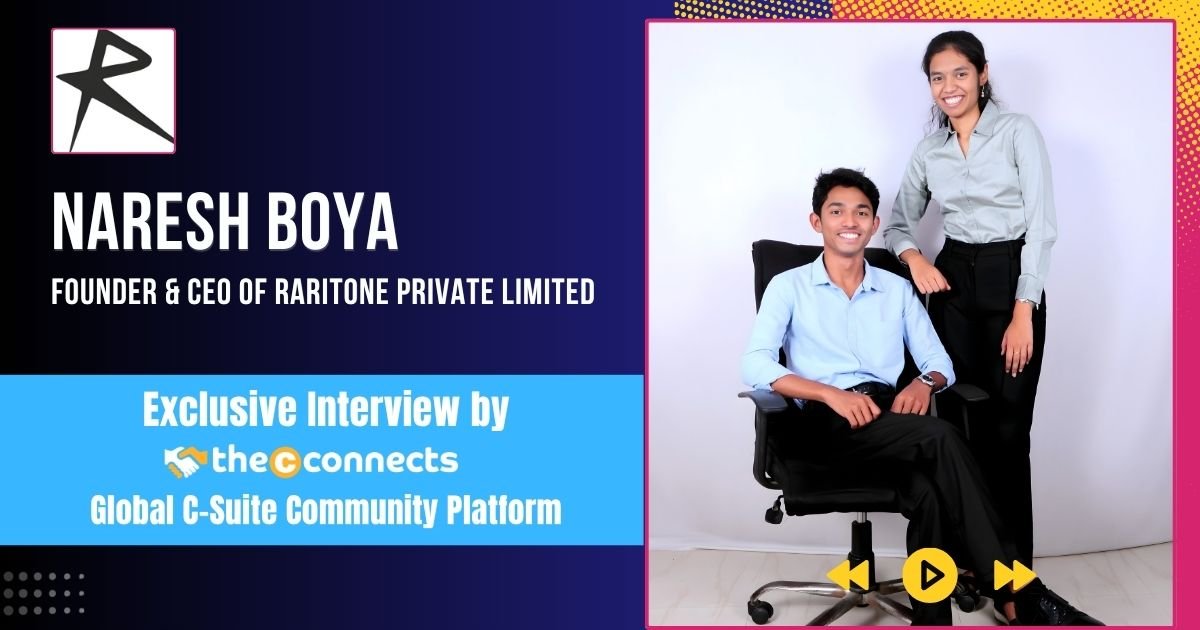

The “size and fit” problem is the Achilles’ heel of the fashion e-commerce industry. Despite the massive growth in online shopping, high return rates-often exceeding 30%-continue to bleed margins for retailers and frustrate consumers. Naresh Boya, a Computer Engineering talent and the visionary behind Raritone, believes the solution lies in the intersection of pixels and personalized fit.
From the tech hubs of Hyderabad, Naresh is architecting an AI-powered ecosystem that allows users to scan their bodies and virtually “wear” clothes before hitting the checkout button. In this deep dive with TheCconnects, Naresh discusses the technical hurdles of virtual retail, the future of digital body scanning, and why the next frontier of fashion is immersive.
TheCconnects: Naresh, thank you for joining us. You’ve transitioned from a background in Computer Engineering to tackling one of the most stubborn problems in retail. Let’s start with the “why”: What was the specific moment of friction that convinced you to build Raritone?
Naresh Boya: Thanks for having me. The “why” actually came from a place of observation and engineering logic. As an engineer, I see inefficiencies as problems waiting for a solution. In fashion e-commerce, the inefficiency is staggering. I saw people ordering three different sizes of the same shirt because they didn’t trust the size chart, only to return two of them.
That’s a logistical nightmare and a sustainability disaster. I realized that the “missing link” was visualization. We’ve had online shopping for decades, but it’s still 2D. I wanted to build a bridge-a way for a smartphone camera to act as a 3D tailor. That was the spark for Raritone: turning a flat screen into a virtual dressing room.
TheCconnects: Building a virtual try-on (VTO) platform isn’t just about pretty graphics; it’s about high-level AI body scanning. How does Raritone actually solve the “fit” problem differently than the static size charts we see today?
Naresh Boya: Static size charts are essentially a guessing game. Every brand’s “Large” is different. At Raritone, we’ve moved past measurements to morphology.
Our platform uses the smartphone camera to perform a body scan that generates accurate measurements and a digital avatar. But the real magic is the AI cloth-simulation engine. It doesn’t just overlay an image of a shirt; it calculates how the fabric drapes, where it might be tight on the shoulders, and how the length falls based on your specific height. We’re moving from “Is this my size?” to “How does this look on me?”
TheCconnects: You are currently in the pre-seed phase and preparing for a funding round. In the competitive Indian startup landscape, what has been the biggest challenge in convincing stakeholders that VTO is the “new standard” rather than a luxury feature?
Naresh Boya: The biggest challenge is shifting the perception from “gimmick” to “utility.” Early VTO attempts in the industry were often clunky and didn’t provide real value. To overcome this, we focus on the data.
When I talk to investors, I don’t just show them the cool visuals; I show them the projected reduction in return rates. If we can reduce a brand’s returns by even 10%, that’s millions of dollars added to their bottom line. We are positioning Raritone as an ROI-driven tool for retailers and a confidence-building tool for shoppers. Once people see the tech working seamlessly in their hands, the “luxury” tag drops and the “necessity” tag takes over.
TheCconnects: Who has influenced your journey as a founder the most? Who do you look up to when the pressure of building a market-entry product gets intense?
Naresh Boya: I am deeply influenced by founders who build at the intersection of deep tech and everyday problems. I look at leaders who didn’t just iterate on an existing idea but fundamentally changed how an industry functions.
However, my greatest influence is the collaborative energy of my team in Hyderabad. As a founder, you have the vision, but your engineers and designers are the ones who turn that vision into a functioning algorithm. Their commitment to solving the technical hurdles of 3D modeling on a mobile device is what keeps me grounded and motivated.
TheCconnects: Brands are struggling with “digital fatigue.” Consumers are tired of traditional ads. How does Raritone help a brand stand out in a crowded digital space?
Naresh Boya: The biggest challenge for brands today is engagement without friction. Most digital marketing is “look at this.” Raritone changes it to “experience this.”
By integrating our smart digital screens into offline stores and our app into online storefronts, we create an Immersive Retail Experience. Imagine walking past a store and seeing how a jacket looks on your digital avatar via a smart screen without ever stepping inside. It turns a passive observer into an active participant. We address the pain point of “Buyer’s Remorse” before the purchase even happens. That level of interaction creates a brand loyalty that a standard Instagram ad simply can’t match.
TheCconnects: What are the key lessons you’ve learned in your professional career-from being a computer engineer to becoming a CEO?
Naresh Boya: The first lesson is that Code is easy; People are hard. Building the technology is only 20% of the battle; the rest is building the ecosystem, the trust, and the market relevance.
Second, I’ve learned the value of Pivot Readiness. In AI, the technology moves so fast that you can’t be married to one specific way of doing things. You have to be obsessed with the problem (bad fit/high returns), not the tool. Finally, I’ve learned that in the startup world, speed is a feature. You have to move fast enough to lead the market, but accurately enough to maintain trust.
TheCconnects: When you aren’t in the Raritone lab or meeting with investors, how does a tech founder “unplug”?
Naresh Boya: To be honest, as an early-stage founder, your mind never fully shuts off! But I find that I recharge by staying curious about other fields of technology. I’m a fan of exploring emerging AI trends outside of fashion-things like robotics or space-tech. It gives me a fresh perspective that I can often bring back to Raritone. Beyond that, I value the simplicity of a good conversation with fellow entrepreneurs. Hyderabad has a great startup community, and those informal meetups are where the best ideas are often stress-tested.
TheCconnects: For the aspiring entrepreneurs-especially those in the Indian AI and e-commerce space-what is your “Golden Rule” for 2026?
Naresh Boya: Don’t build AI for the sake of AI; build it for the sake of the user. The market is flooded with AI startups right now. My advice is to find a problem that is “painfully boring” to most people-like size charts or return logistics-and use technology to make it exciting. Also, focus on Market Resilience. Build something that solves a problem today but is flexible enough to handle the hardware of tomorrow, like AR glasses. Start with the problem, master the technology, and never stop talking to your potential users.
TheCconnects: Naresh, thank you. This has been an incredibly insightful look into the future of retail. It was truly nice to talk with you.
Naresh Boya: The pleasure was all mine. If we can help even one person feel more confident in their purchase, we’ve done our job.