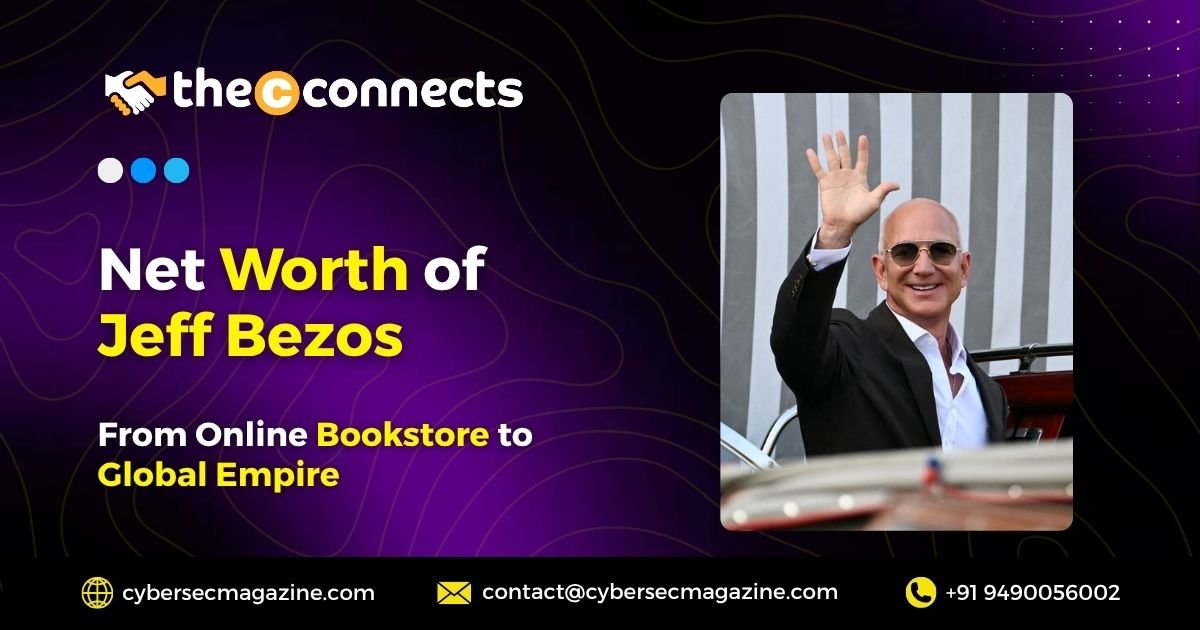

In the span of a single generation, Jeff Bezos has transformed from a bold online‑bookstore founder into one of the world’s most influential business figures. For the audience of TheCconnects Magazine-entrepreneurs, executives and enterprise strategists-his trajectory offers more than biography. It is a case study in vision‑driven enterprise building, wealth creation through platform ownership, and strategic diversification. In this article, we examine Bezos’s estimated net worth in 2025, analyse the engines of his wealth, outline the strategic inflection points, and extract lessons for senior leaders.

1. Current Estimate of Jeff Bezos’s Net‑Worth
According to Forbes, Bloomberg and other major wealth‑trackers, Jeff Bezos is estimated to hold a net worth in the region of US$200 to US$250 billion in 2025. For instance:
- Wikipedia notes that as of May 2025, his estimated net worth exceeded US$220 billion.
- Benzinga reports a figure of US$241 billion as of August 2025.
- Other sources place him at around US$229 billion.
Clearly, Bezos remains among the global ultra‑high‐net‐worth individuals. But the number itself is only one dimension-what matters for business readers is how he built this fortune, where the value exists, and what the implications are for enterprise building.
2. The Foundations: Amazon and Platform Ownership
Bezos founded Amazon.com, Inc. in 1994 as an online bookstore, and took the company public in 1997. Over time Amazon expanded from e‑commerce to cloud computing (AWS), streaming, logistics, devices and more. His ownership stake in Amazon remains the core engine of his wealth. As of early 2025 filings, Bezos held in excess of 1 billion shares in Amazon – the exact value of which fluctuates with stock price.
Because the majority of his wealth is tied to Amazon equity, Bezos’s net worth rises and falls with the performance of a single enterprise. That characteristic-owning a platform rather than earning a wage-is what differentiates his wealth‑model from that of an executive or traditional entrepreneur.
3. Strategic Diversification: Beyond E‐Commerce
While Amazon remains the centerpiece, Bezos has diversified his holdings across multiple domains that matter for long‑term strategic value:
a) Space & infrastructure: Blue Origin – Founded by Bezos in 2000, Blue Origin is his bet on the future of space travel and infrastructure. Though privately held and illiquid, its valuation adds meaningful shadow value to his wealth.
b) Media/Publishing: The Washington Post – In 2013 Bezos acquired this iconic media asset. While small in terms of his total portfolio, it represents strategic brand positioning and credibility in the public sphere.
c) Technology Investments & Ventures: Bezos Expeditions – Through his personal investment firm, Bezos has backed early‑stage companies, further expanding his exposure to future platforms and innovation.
d) Real Assets & Real‑Estate – Bezos owns significant property holdings and other real assets which contribute to his net worth set‑aside beyond equity holdings.
In short: Bezos’s model is not simply “one company, one fortune”; it is “platform ownership + emerging platforms + legacy assets” – a structure that many corporate strategists will recognise as best practice for enterprise‑value generation.
4. Key Inflection Points in the Wealth Journey
Business leaders can learn from the major strategic leaps in Bezos’s career:
- 1994‑1997: Founding Amazon and orienting it around customer obsession, low‑cost structure, and rapid iteration.
- 2003‑2016: Expansion into AWS, Prime membership, global logistics network – moving beyond books to full e‑commerce and cloud dominance.
- 2021: Bezos stepped down as CEO of Amazon and became Executive Chairman, signalling significant shift from operator to portfolio‑owner.
- 2020s: Increasing focus on Blue Origin, climate philanthropy, and long‑term bets. The shift in his focus highlights how wealth transitions from active build to legacy build.
These moments underscore that building a fortune at Bezos’s scale requires not just operational excellence, but vision for new platforms, timing, and persistent reinvestment.
5. What Entrepreneurs & C‑Suite Executives Can Learn
From the Bezos story, several strategic lessons emerge:
Ownership is the highest lever – Bezos’s wealth accrues from his ownership of a massive global platform rather than a salary. For CEO‑leaders, this underscores the importance of equity and stake‑holding.
Scale early, reinvest relentlessly – Amazon’s growth was driven by reinvestment of earnings into growth, infrastructure and innovation rather than chasing short‑term profits. Many corporates can learn from that mindset.
Platform thinking beats product thinking – Amazon isn’t just a retailer: it’s a logistics, cloud, media and device ecosystem. Leaders should build enterprises that can host multiple value‑streams and leverage network effects.
Diversify but stay aligned – Bezos’s non‑Amazon ventures (Blue Origin, media, investments) are different, but all align to his worldview of innovation, infrastructure and future‑oriented business. For senior leaders, diversification should align to core strategic themes.
Legacy and future value matter – Bezos increasingly invests in long‑term bets (space, climate, media). For companies, thinking beyond the next fiscal year-toward the next decade-is essential.
6. Challenges & Strategic Risks
Even a fortune of hundreds of billions is not free from risk. Business professionals should note these strategic threats:
Concentration risk – With most of his wealth tied to Amazon equity, Bezos is exposed to the fortunes of one company. A significant drop in Amazon stock would materially impact his paper wealth.
Execution & innovation risk – Blue Origin and other non‑public ventures face high technological and market risk. For large‑scale enterprises, the bigger the ambition, the higher the risk.
Regulatory & public policy risk – Amazon is under intense regulatory scrutiny globally (antitrust, labor practices, data privacy). Such risks affect enterprise value and, by extension, founder wealth.
Reputation & stakeholder risk – As societies increasingly scrutinise inequality, corporate practices and CEO wealth, Bezos’s public image and his companies’ social license may impact long‑term value.
7. Why Bezos’s Net Worth Matters for Corporate Strategy
When an individual’s net worth hits the hundreds‑of‑billions mark, it signals not just personal wealth but enterprise‑systems at scale. For C‑Suite professionals:
- Bezos’s fortune underscores the power of platform ownership – companies that control infrastructure (logistics, cloud, retail) command outsized value.
- The wealth model reflects how tech‑driven businesses create value now: cloud, data, network effects, global scale.
- It illustrates transition from founder/operator to ecosystem‑builder and investor – a pathway many high‑growth executives will follow.
- It emphasises that wealth accumulation at this scale is tied to controlling assets, not just generating profit – something CEOs and boards should internalise when positioning their companies for long‑term value.
8. Final Thoughts
Jeff Bezos’s net worth, estimated at around US$200‑250 billion in 2025, is far more than a headline figure. It represents the outcome of a strategic journey: building a global platform, reinvesting for scale, diversifying into future markets, and shifting from founder‑operator to portfolio architect. For the readers of TheCconnects Magazine-leaders, innovators, strategists-the Bezos case offers a blueprint: build ownership, invest in platforms, think long‑term, and extend influence beyond the core.
Would you like to build a featured article, guest commentary or case‑study for TheCconnects? We specialise in thought‑leadership content that reaches entrepreneurs, executives and media channel partners globally.
📩 Email: contact@thecconnects.com
📞 Call: +91 91331 10730
💬 WhatsApp: https://wa.me/919133110730
s.