
Workplace focus has become one of the most consequential and least systematically addressed performance variables in modern organizations. The problem is not that people are lazy or undisciplined. It is that the environments in which most people work, physically and digitally, have been designed in ways that systematically undermine the sustained attention that meaningful work requires.
Microsoft’s Work Trend Index has documented what most professionals experience personally: the average knowledge worker is interrupted or switches tasks every few minutes. Notifications, impromptu meetings, open-plan office noise, and the always-on expectation of messaging platforms collectively create an environment where deep, focused work is the exception rather than the default.
The business consequences are measurable. Research published in the Journal of Experimental Psychology found that even brief interruptions, as short as two to three seconds, can double error rates for the task being performed. Gloria Mark’s research at the University of California, Irvine, has consistently found that it takes an average of 23 minutes to fully regain focused attention after an interruption. When the typical work environment generates dozens of interruptions daily, the cumulative productivity loss is substantial.
For business leaders, the most important reframe is this: workplace focus is not a personal discipline problem. It is an organizational design and leadership problem. Addressing it systematically produces measurable improvements in output quality, error reduction, and employee wellbeing.
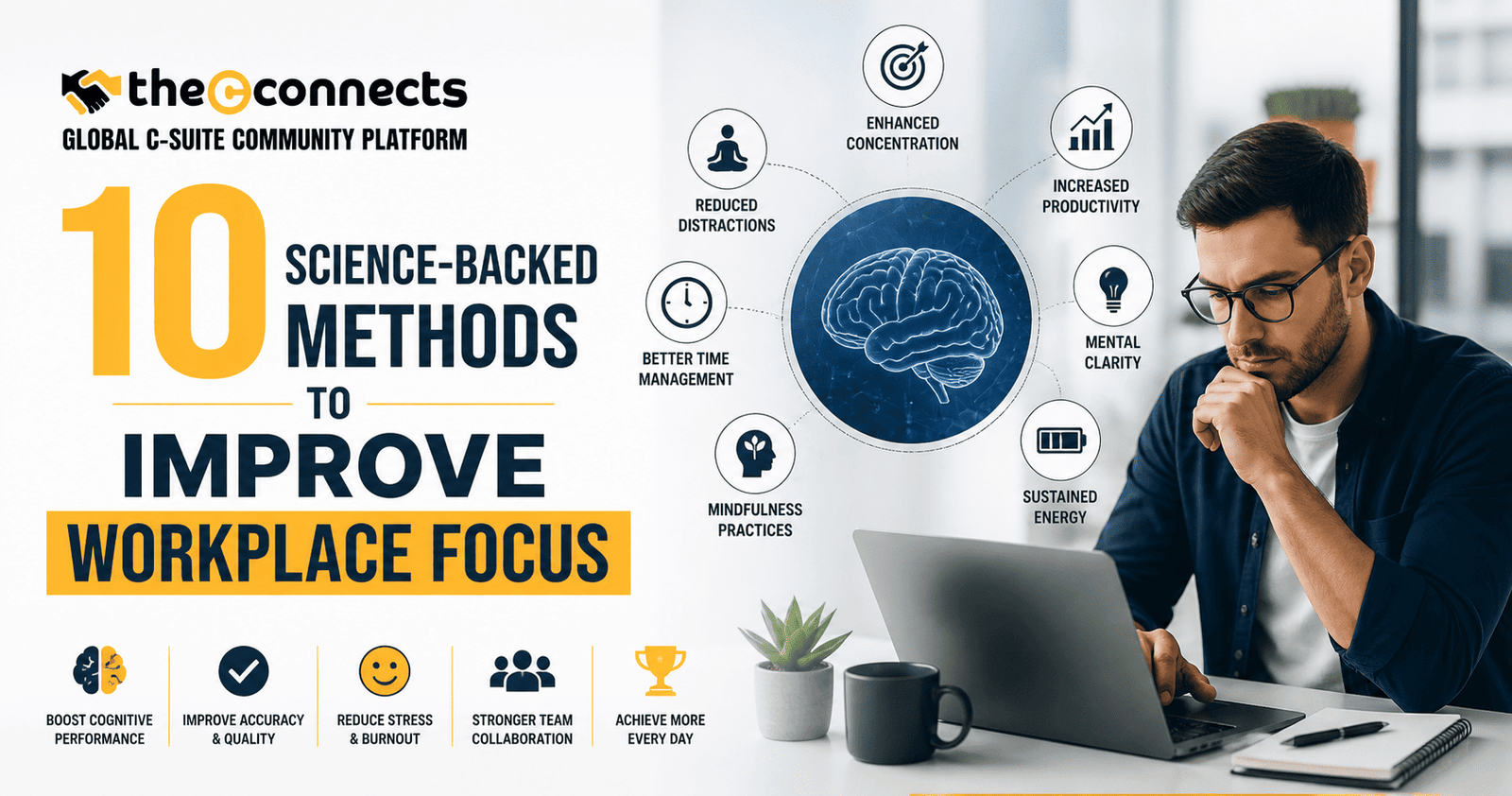
These 10 science-backed methods to improve workplace focus are grounded in that understanding, practical, evidence-based, and applicable to the full range of team environments that modern organizations operate.
1. Protect Deep Work Blocks From Interruptions
What it is: Designating specific periods of the workday as protected focus time, during which meetings are not scheduled, notifications are silenced, and communication response is deliberately delayed.
Why it works: Cal Newport’s research on deep work has demonstrated that cognitively demanding tasks requiring sustained concentration produce disproportionately high-value outputs, and that the capacity for deep work is both trainable and progressively uncommon in environments that normalize constant availability.
How to apply it: Implement shared calendar conventions that identify blocked focus periods. Establish organizational norms that these periods are not to be interrupted except for genuine urgency. Leaders should model this behavior visibly, protecting their own focus blocks communicates that the organization takes focused work seriously.
Example: A product development team at a fintech company implemented “focus mornings”, the first two hours of each workday protected from meetings and internal messages. Within six weeks, the team reported completing complex technical work that had previously been pushed to evenings and weekends.
Measurable benefit: Teams with protected focus time consistently report faster delivery of cognitively demanding work and reduced after-hours work to compensate for day-time interruptions.
2. Reduce Context Switching and Task Overload
What it is: Limiting the number of active projects, workstreams, and responsibilities that team members manage simultaneously, enabling deeper engagement with fewer things rather than shallow engagement with many.
Why it works: The APA’s research on task-switching has established that attempting to manage multiple complex tasks simultaneously reduces performance quality for each individual task. The “switching cost”, the cognitive overhead of transitioning between different types of work, accumulates into significant daily performance loss.
How to apply it: Review individual workloads and reduce active project load where possible. Implement work-in-progress limits for teams using visual workflow tools. Sequence complex tasks to allow completion before introducing new high-context work.
Example: A marketing team that reduced each member’s simultaneous active campaigns from six to three reported that creative quality improved significantly, because team members had sufficient cognitive space to engage deeply with each campaign rather than managing shallow familiarity with six.
3. Use Clear Daily Priorities and Single-Tasking
What it is: Beginning each workday with a single, explicitly identified most important task, and structuring the day to complete it before moving to other work.
Why it works: Research on goal-setting theory, developed by Locke and Latham, has consistently demonstrated that specific, hierarchically ordered goals improve performance. Single-tasking, sequential deep engagement with one task before moving to the next, produces higher quality output than simultaneous multitasking.
How to apply it: Implement a team norm of identifying a single “MIT” (Most Important Task) at the start of each day. Protect the first focused work block for this task. Defer reactive work, email responses, meeting requests, administrative tasks, until the priority work is complete or meaningfully advanced.
Practical note: This requires calendar and notification management that prevents reactive work from interrupting priority work during the morning focus window.
4. Limit Unnecessary Meetings and Meeting Fatigue
What it is: Systematically auditing meeting load and eliminating or reducing meetings that do not advance specific decisions or outputs, replacing them with asynchronous alternatives where appropriate.
Why it works: Microsoft’s Work Trend Index documented a significant increase in meeting load following the shift to hybrid work, with a substantial proportion of employees reporting that meetings fragment their workday into too-short blocks for meaningful focused work. Meeting fatigue is a well-documented cognitive phenomenon that degrades decision quality and attention capacity.
How to apply it: Conduct a quarterly meeting audit. Require all recurring meetings to justify continued existence with a specific purpose. Introduce meeting-free periods, half-days or full Fridays, that create extended focus time for the whole team simultaneously.
Example: A consulting firm eliminated all internal status-update meetings and replaced them with a structured asynchronous weekly update tool. The change recovered an average of four hours per person per week, time reallocated to deep client work.
5. Design Workspaces for Fewer Distractions
What it is: Intentionally designing physical and digital work environments to reduce the frequency and impact of distractions, including ambient noise management, visual privacy, and device configuration.
Why it works: Environmental psychology research consistently demonstrates that workspace design directly affects cognitive performance. Noise, visual movement, and physical interruption all activate attentional processes that compete with focused task engagement.
How to apply it: For physical offices, provide quiet focus zones alongside collaborative spaces, ensuring workers have environmental choice based on the type of work they are doing. For digital environments, configure default notification settings to reduce alert frequency. Standardize on communication channels that allow asynchronous response rather than real-time interruption as the default expectation.
Remote note: For home-based workers, organizational support for creating a dedicated work environment, including guidance on workspace setup and noise management, produces measurable focus benefits.
6. Use Breaks Strategically to Restore Attention
What it is: Scheduling deliberate recovery breaks during the workday, not as a concession to laziness, but as an evidence-based strategy for maintaining sustained attention quality across the full workday.
Why it works: Research on ultradian rhythms, biological cycles of approximately 90 to 120 minutes, suggests that the brain naturally cycles between higher and lower states of alertness. Working with these cycles rather than against them, taking brief recovery breaks at natural attention dip points, maintains sustained performance quality more effectively than forcing continuous attention.
How to apply it: Encourage team members to take short breaks every 90 minutes. Make break-taking a visible, normalized organizational behavior rather than something people feel they need to hide. Brief physical movement during breaks, a short walk, stretching, has been shown to particularly improve subsequent cognitive performance.
Example: A software development team that implemented structured 10-minute breaks every 90 minutes reported fewer late-afternoon bugs in code reviews, a quality indicator that improved measurably compared to the preceding quarter’s data.
7. Improve Sleep, Energy, and Workload Rhythms
What it is: Recognizing the direct relationship between sleep quality, energy management, and cognitive performance, and building organizational practices that support rather than undermine these biological foundations of sustained focus.
Why it works: The NIH’s extensive sleep research has established that cognitive performance, including attention, working memory, and decision quality, degrades meaningfully with insufficient sleep. McKinsey research has estimated that leaders who are sleep-deprived make worse decisions, but often do not recognize their own impairment.
How to apply it: Avoid scheduling high-stakes meetings or decision-making activities at times when teams are likely to be at peak fatigue, late afternoon, after long travel, immediately following intensive project sprints. Create cultural permission for energy management, including appropriate rest, as a performance practice rather than a weakness.
8. Batch Similar Tasks to Reduce Mental Friction
What it is: Grouping cognitively similar tasks, email responses, administrative approvals, document reviews, into defined time blocks rather than addressing them as they arrive throughout the day.
Why it works: Each transition between cognitively different task types requires the brain to reconfigure its working context, a process that consumes cognitive resources and time. Batching similar tasks together reduces the cumulative cost of these transitions and allows the brain to develop and maintain a focused working state for a particular type of activity.
How to apply it: Define specific time blocks for different task categories, email responses, administrative work, creative work, analytical work, and encourage team members to batch their work accordingly. Communicate response time norms to internal and external stakeholders to manage expectations around batched communication.
9. Use Notifications and Devices More Intentionally
What it is: Establishing deliberate, reduced notification configurations, for both personal and organizational communication tools, that allow sustained attention without constant interruption from incoming messages, updates, and alerts.
Why it works: Research on smartphone and notification use has consistently found that the mere presence of a phone on a desk reduces available cognitive capacity, even when the phone is not being used. Notification-driven interruptions trigger the same attentional response as physical interruption, pulling cognitive resources away from the current task.
How to apply it: Encourage team members to configure notification settings for asynchronous response rather than real-time alert. Establish organizational standards for which communication channels are appropriate for urgent matters, typically phone calls, versus non-urgent matters that can wait for scheduled response windows.
10. Train Managers and Teams to Respect Focus Time
What it is: Building focus time respect into management practices, team culture, and organizational norms, so that protecting attention is a shared organizational value rather than an individual practice that requires constant negotiation.
Why it works: Individual focus strategies are undermined when the organizational culture does not support them. Amy Edmondson’s research on psychological safety suggests that people will not protect their focus time if doing so is perceived as unresponsive, uncommitted, or career-limiting in their organizational culture.
How to apply it: Include focus time management in leadership development programs. Make focus-friendly behaviors visible in leadership role modeling. Address cultures that reward constant availability over focused output. Recognize and celebrate focus outcomes, quality and impact of work, rather than presence and activity metrics.
Conclusion:
The 10 science-backed methods to improve workplace focus covered in this guide collectively represent the evidence base for what high-performing, focus-aware organizations actually do differently. The common thread is not demanding more discipline from individuals, it is building organizational conditions in which sustained, high-quality attention is the natural default rather than a constant struggle against the environment.
Leaders who treat focus as an organizational design challenge, rather than a personal productivity issue, build teams that produce better work, with fewer errors, in less time, with lower burnout rates. That is not a productivity hack. It is a competitive advantage.
Contact TheCconnects
If you have practical experience in improving workplace focus, reducing distractions, managing hybrid teams, or building high-performance work environments, your insights can help organizations solve one of today’s most critical productivity challenges.
We welcome contributions from leaders, HR professionals, productivity experts, and team managers who can share actionable strategies, real-world experiences, and proven methods that help teams achieve deeper focus and better outcomes.
If you’d like to publish your article on this platform or expand your reach across other leading platforms, feel free to reach out to us.
📧 Email: contact@thecconnects.com
📞 Phone: +91 91331 10730
💬 WhatsApp: https://wa.me/919133110730