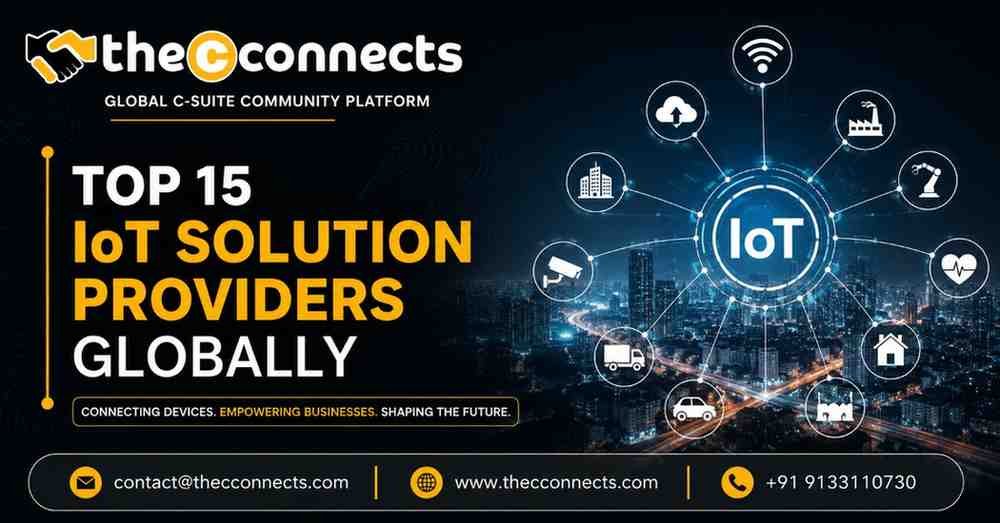

The Internet of Things (IoT) landscape has evolved from simple connectivity to an AI-driven, edge-computing ecosystem that forms the backbone of Industry 4.0. As we navigate 2026, the market is no longer just about connecting devices; it is about “Intelligence of Things.” Enterprises are increasingly shifting toward predictive maintenance, digital twins, and autonomous operations. With global connected devices projected to hit 40 billion by 2030, the vendors highlighted below are the architects of this transformation, providing the scale, security, and analytics needed to convert raw sensor data into strategic business outcomes.
1. Microsoft Corporation
- Founders: Bill Gates, Paul Allen
- Founded Year: 1975
- Headquarters: Redmond, Washington, USA
- Product Categories: Azure IoT Hub, IoT Central, Digital Twins, Edge Computing.
- Description: Microsoft dominates the IoT landscape through its Azure platform, offering a comprehensive suite of cloud-based services. By integrating AI and machine learning directly into the IoT pipeline, Microsoft enables organizations to move from simple monitoring to autonomous, intelligent systems. Their focus on hybrid cloud and edge capabilities ensures that businesses can process data where it is most efficient, maintaining low latency for critical industrial operations while benefiting from the massive analytical power of the Azure cloud ecosystem.
- Key Features:
- Seamless integration with existing enterprise IT ecosystems.
- Advanced Digital Twin technology for real-time asset modeling.
- Robust security protocols with Azure IoT Edge protection.
- Extensive AI/ML integration for predictive maintenance.
- Scalable architecture for smart cities and healthcare.
2. Amazon Web Services (AWS)
- Founders: Jeff Bezos
- Founded Year: 2006
- Headquarters: Seattle, Washington, USA
- Product Categories: AWS IoT Core, IoT Greengrass, IoT SiteWise, FreeRTOS.
- Description: AWS has cemented its position as a leading IoT SaaS provider by offering a flexible, highly expandable infrastructure. Their IoT services focus on connecting billions of devices to the cloud securely, allowing for real-time data analysis and remote management. AWS is particularly favored for its breadth of services, which allow developers to build specialized applications ranging from home automation to complex industrial manufacturing dashboards with minimal infrastructure overhead.
- Key Features:
- Secure data exchange via AWS IoT Core.
- Edge intelligence capabilities through AWS Greengrass.
- Industrial data collection with AWS IoT SiteWise.
- Comprehensive support for low-power devices with FreeRTOS.
- Pay-as-you-go pricing model for cost-effective scaling.
3. Cisco Systems, Inc.
- Founders: Leonard Bosack, Sandy Lerner
- Founded Year: 1984
- Headquarters: San Jose, California, USA
- Product Categories: Cisco IoT Control Center, Industrial Routers, Security Solutions.
- Description: As a global networking leader, Cisco provides the “plumbing” of the IoT world. Their IoT Control Center (formerly Jasper) is the industry standard for connectivity management. Cisco excels in providing secure, high-performance network infrastructure that connects sensors and devices across challenging industrial environments, from factories to remote utility sites. Their focus remains heavily on cybersecurity and robust network performance, ensuring that data is protected during transmission.
- Key Features:
- World-class Connectivity Management Platform (CMP).
- Deep focus on industrial cybersecurity and encryption.
- High-durability hardware for harsh industrial environments.
- AI-driven network orchestration and automation.
- Massive scale capabilities for global enterprise deployments.
4. Siemens AG
- Founders: Werner von Siemens, Johann Georg Halske
- Founded Year: 1847
- Headquarters: Munich, Germany
- Product Categories: MindSphere (Industrial IoT as a Service), Industrial Edge, SIMATIC.
- Description: Siemens is the titan of Industrial IoT (IIoT). Their platform, MindSphere, is specifically designed for the manufacturing sector, providing deep integration with the physical machinery on the shop floor. Siemens excels at bridging the gap between Operational Technology (OT) and Information Technology (IT), allowing manufacturers to optimize production efficiency, reduce downtime, and implement circular economy principles through data-driven insights.
- Key Features:
- Deep integration with industrial machinery and PLCs.
- Open PaaS architecture for third-party application development.
- Advanced analytics for production optimization.
- Strong focus on OT/IT convergence.
- Global ecosystem of industrial partners and developers.
5. IBM Corporation
- Founders: Charles Ranlett Flint
- Founded Year: 1911
- Headquarters: Armonk, New York, USA
- Product Categories: IBM Maximo, Watson IoT, Hybrid Cloud integration.
- Description: IBM has shifted its IoT focus toward AI-powered asset management and operational insights. Their flagship solution, IBM Maximo, is the gold standard for enterprise asset management, enabling companies to track the health, performance, and maintenance needs of their critical equipment. By combining this with the analytical prowess of Watson AI, IBM provides businesses with the ability to foresee failures before they happen, significantly reducing operational expenses.
- Key Features:
- Industry-leading Enterprise Asset Management (EAM).
- Watson-powered predictive maintenance analytics.
- Robust data security and hybrid cloud flexibility.
- Deep expertise in manufacturing and energy sectors.
- Scalable AI models for operational optimization.
6. PTC Inc.
- Founders: Samuel B. Geisberg
- Founded Year: 1985
- Headquarters: Boston, Massachusetts, USA
- Product Categories: ThingWorx Industrial IoT Platform, Vuforia (AR).
- Description: PTC is a pioneer in the Industrial IoT space, with its ThingWorx platform serving as an end-to-end solution for industrial connectivity and application development. PTC distinguishes itself by integrating Augmented Reality (AR) into the IoT workflow, allowing maintenance workers to see real-time data overlaid on physical machinery. This human-centric approach to IoT data makes maintenance faster, safer, and more accurate, directly impacting the bottom line of industrial enterprises.
- Key Features:
- Low-code application development for rapid deployment.
- Advanced Augmented Reality integration (Vuforia).
- Seamless connectivity with industrial automation systems.
- Robust workflow automation and orchestration.
- Real-time operational dashboard and analytics.
7. SAP SE
- Founders: Dietmar Hopp, Hans-Werner Hector, Hasso Plattner, Klaus Tschira, Claus Wellenreuther
- Founded Year: 1972
- Headquarters: Walldorf, Germany
- Product Categories: SAP Digital Manufacturing, SAP IoT, Business Technology Platform.
- Description: SAP brings IoT into the core of enterprise business processes. Unlike standalone IoT platforms, SAP’s solutions are designed to feed real-time sensor data directly into the ERP (Enterprise Resource Planning) system. This means that a sensor alert on a machine can automatically trigger a work order in SAP, reorder spare parts, and adjust production schedules, creating a truly closed-loop, automated supply chain.
- Key Features:
- Direct integration with enterprise ERP systems.
- Automated business process triggering from IoT events.
- Comprehensive supply chain and inventory visibility.
- Industry-specific IoT templates for quick onboarding.
- Strong data governance and enterprise-grade reporting.
8. Bosch Group
- Founders: Robert Bosch
- Founded Year: 1886
- Headquarters: Gerlingen, Germany
- Product Categories: Bosch IoT Suite, Sensors, Industrial AI.
- Description: As a manufacturer of both sensors and industrial equipment, Bosch brings a unique hardware-software perspective to IoT. The Bosch IoT Suite is a comprehensive software platform that supports the entire lifecycle of IoT projects, from device management to cloud-based application logic. Their solutions are widely used in automotive, energy, and building technology sectors, leveraging their decades of engineering experience to provide highly reliable, industrial-grade connectivity.
- Key Features:
- Holistic hardware-to-cloud IoT ecosystem.
- Extensive experience in automotive and smart home sensors.
- Flexible software modules for device management.
- High focus on data privacy and security standards.
- Proven track record in high-volume industrial deployments.
9. ABB
- Founders: ASEA and Brown, Boveri & Cie (Merger)
- Founded Year: 1988
- Headquarters: Zurich, Switzerland
- Product Categories: ABB Ability, Industrial Robotics, Electrification systems.
- Description: ABB is a leader in energy and automation technologies, with its “ABB Ability” platform serving as a unified digital ecosystem. Their IoT solutions are heavily focused on energy management, robotics, and industrial automation. By connecting electrical grids, motors, and robotic arms to their cloud-based analytics platform, ABB helps industries optimize their energy usage, improve robot performance, and ensure the reliability of critical infrastructure.
- Key Features:
- Unified “Ability” digital ecosystem.
- Leading-edge expertise in robotics and automation.
- Advanced energy management and grid optimization.
- Real-time remote monitoring and diagnostic tools.
- Strong presence in utility and power sectors.
10. Schneider Electric
- Founders: Adolphe Schneider, Joseph-Eugène Schneider
- Founded Year: 1836
- Headquarters: Rueil-Malmaison, France
- Product Categories: EcoStruxure, Energy Management software.
- Description: Schneider Electric specializes in the digital transformation of energy management and automation. Their “EcoStruxure” architecture is an IoT-enabled, plug-and-play open framework that connects everything from sensors to controllers to the cloud. By focusing on sustainability and efficiency, Schneider Electric helps data centers, buildings, and industrial plants reduce their carbon footprint while improving uptime and operational cost-effectiveness.
- Key Features:
- EcoStruxure open, scalable architecture.
- Deep focus on energy efficiency and sustainability.
- IoT-enabled hardware for power and building management.
- Robust predictive maintenance for electrical equipment.
- Strong integration with building management systems.
11. Huawei Technologies
- Founders: Ren Zhengfei
- Founded Year: 1987
- Headquarters: Shenzhen, China
- Product Categories: OceanConnect, 5G Industrial IoT, Smart City solutions.
- Description: Huawei is a primary driver of 5G-enabled IoT. Their OceanConnect platform is designed to handle the massive data throughput requirements of modern industrial environments. By leveraging their global leadership in telecommunications and 5G infrastructure, Huawei provides the low-latency, high-capacity networks required for autonomous vehicles, smart ports, and large-scale industrial automation, making them a preferred vendor for capital-intensive infrastructure projects.
- Key Features:
- Global leadership in 5G and connectivity infrastructure.
- High-capacity platform for data-intensive IoT apps.
- Proven success in massive-scale Smart City projects.
- Edge-to-cloud computing synergy.
- Comprehensive support for industrial automation protocols.
12. Oracle Corporation
- Founders: Larry Ellison, Bob Miner, Ed Oates
- Founded Year: 1977
- Headquarters: Austin, Texas, USA
- Product Categories: Oracle IoT Cloud, Fusion Cloud SCM.
- Description: Oracle integrates IoT directly into its powerful suite of cloud applications. Their IoT Cloud provides the necessary data ingestion and analysis to feed into Oracle’s SCM (Supply Chain Management) and ERP platforms. This makes Oracle an ideal choice for enterprises that want to use IoT data to improve inventory management, logistics, and supply chain transparency across a global footprint.
- Key Features:
- Tight integration with SCM and ERP applications.
- Enterprise-grade data analysis and reporting.
- Strong capabilities in logistics and inventory tracking.
- Automated maintenance and service management tools.
- Scalable cloud infrastructure for large organizations.
13. Honeywell
- Founders: Mark Honeywell
- Founded Year: 1906
- Headquarters: Charlotte, North Carolina, USA
- Product Categories: Honeywell Forge, Building controls, Process automation.
- Description: Honeywell is an industrial giant that has successfully transitioned into the software-driven IoT space. Its “Honeywell Forge” platform is an enterprise performance management solution that uses IoT data to improve the operations of buildings, industrial plants, and warehouses. By focusing on the “Outcome-based” model, Honeywell helps companies achieve specific goals, such as 10% lower energy costs or 5% higher throughput, through direct software intervention.
- Key Features:
- Outcome-focused enterprise performance management.
- Deep domain expertise in HVAC and building controls.
- Advanced analytics for industrial process optimization.
- Strong cybersecurity focus for critical infrastructure.
- End-to-end support for workers and operational assets.
14. Advantech
- Founders: K.C. Liu
- Founded Year: 1983
- Headquarters: Taipei, Taiwan
- Product Categories: Industrial IoT Gateways, Edge Computing, Embedded Systems.
- Description: Advantech is a powerhouse in the hardware side of the IoT world. They provide the ruggedized gateways, embedded computers, and industrial servers that actually capture and process data at the edge. As more IoT applications shift toward edge computing to reduce latency and bandwidth costs, Advantech’s hardware-first approach makes them an essential partner for companies looking to deploy reliable, high-performance local data processing.
- Key Features:
- Industry-leading ruggedized IoT hardware.
- Broad range of industrial edge computing solutions.
- Excellent support for a wide range of industrial protocols.
- Customizable hardware for specialized industrial needs.
- Strong global logistics and support network.
15. SAP (Cumulocity IoT)
- Founders: Dietmar Hopp et al. (Software AG Acquisition)
- Founded Year: 1972
- Headquarters: Walldorf, Germany
- Product Categories: Cumulocity IoT Platform.
- Description: While often associated with enterprise software, the Cumulocity IoT platform (under the Software AG umbrella, now integrated into the SAP ecosystem) remains a go-to choice for rapid IoT deployment. It is highly valued for its “Device Management” capabilities and ease of use, allowing organizations to connect virtually any device in minutes. It is a favored tool for mid-to-large enterprises that need to scale their IoT efforts without the complexity of managing hyper-scale cloud platforms.
- Key Features:
- Rapid, low-code application development.
- Excellent device connectivity and management.
- User-friendly data visualization and dashboards.
- Highly flexible and vendor-neutral architecture.
- Proven performance in remote monitoring applications.
Get Featured
If you have any feedback on this list, or if you believe your company or product is eligible to be featured in our upcoming editions of TheCconnects Magazine, please reach out to us. We love showcasing innovators in the industrial and enterprise IoT space!
📧 Email us: contact@thecconnects.com
📞 Call us: +91 9133110730
💬 WhatsApp us: https://wa.me/919133110730