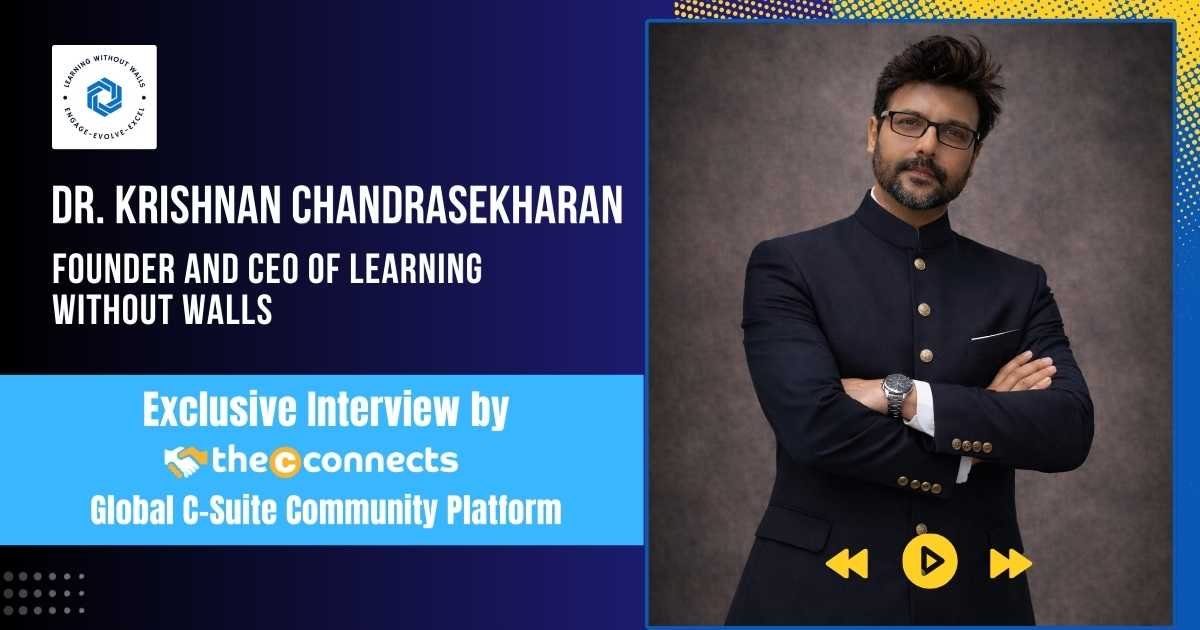

In the high-stakes world of corporate evolution, there is a distinct difference between “training” and “capability.” While many organizations are content with checking boxes on a curriculum, Dr. Krishnan Chandrasekharan is busy rebuilding the engine itself.
As the Founder and CEO of Learning Without Walls, Dr. Krishnan has spent over 25 years at the intersection of human behavior and organizational strategy. Having coached and developed over 150,000 professionals across the globe-from fresh graduates to seasoned CXOs-he has become a primary voice in how AI and Emotional Intelligence (EI) must converge to create the leaders of tomorrow.
Today, TheCconnects sits down with Dr. Krishnan to discuss the “boundaryless” future of learning, the myth of the “AI takeover,” and why the most important leadership skill in 2026 is one we often overlook.
TheCconnects: Dr. Krishnan, looking at your trajectory-from the University of Canterbury to IIM Calcutta and now leading a global L&D ecosystem-it’s quite a journey. Could you share the “defining moment” when you realized that traditional corporate training was no longer enough?
Dr. Krishnan Chandrasekharan: It’s a pleasure to be here. That “aha” moment actually came from frustration. Years ago, I was delivering high-energy workshops where the feedback was 5-star across the board. But when I checked back with those same teams three months later, nothing had changed. The “learning” stayed in the classroom.
I realized that we were treating people like buckets to be filled with content rather than systems that need to evolve. That was the seed for Learning Without Walls. I wanted to move away from “events” and toward “ecosystems.” My journey has been about dismantling those physical and mental walls that prevent a person from applying a new skill the moment they walk back to their desk.
TheCconnects: You’ve worked across the UK, US, EMEA, and India. How do leadership challenges differ across these geographies, or is the “human element” universal?
Dr. Krishnan: While the cultural nuances vary-for instance, how feedback is delivered or how hierarchy is respected-the core “pain points” are remarkably universal. Whether I’m in London or Hyderabad, leaders struggle with the same things: decision paralysis, the “loneliness at the top,” and the challenge of managing multi-generational teams. The human need for psychological safety and clear purpose doesn’t change with a passport.
TheCconnects: We are in 2026, and AI is no longer a “future trend”-it’s our current reality. You’ve been a vocal advocate for AI-enabled L&D. How do you answer the skeptics who fear AI will “dehumanize” leadership development?
Dr. Krishnan: It’s actually the opposite. AI is the best thing to happen to the “human” side of work because it takes over the administrative and analytical heavy lifting.
At Learning Without Walls, we use AI to perform Enterprise Training Needs Analysis (TNA) in days. In the past, that took months of manual interviews. By the time you had the data, it was obsolete. Now, AI identifies skill gaps in real-time, which allows us-the humans-to focus on the deep, empathetic work of coaching and cultural transformation. AI provides the intelligence; humans provide the intent.
TheCconnects: You often talk about “Learning Architectures” rather than “Training Programs.” Can you explain that distinction to a CEO who just wants their team to “work better”?
Dr. Krishnan: Think of a training program like a coat of paint. It looks great for a while, but it doesn’t fix a crumbling wall. A Learning Architecture is the structural blueprint. It involves AI-enabled diagnostics to see where the cracks are, personalized learning journeys so the CEO isn’t getting the same training as a first-time manager, and measurable KPIs that link learning directly to the P&L. If you can’t show me how a leadership intervention improved decision quality or reduced time-to-competency, it’s just a hobby, not a strategy.
TheCconnects: You founded the “4% Trainer Community.” That’s a very specific number. What happens to the other 96%, and how do you help trainers move into that elite bracket?
Dr. Krishnan: The 96% are caught in the “commodity trap.” They sell hours for dollars. They deliver off-the-shelf content that belongs to someone else. They have visibility, but no real authority.
The 4% Trainer is someone who builds their own Intellectual Property (IP), leverages technology to scale, and focuses on results rather than “edu-tainment.” We created this community to help facilitators become business owners. We teach them that their value isn’t in how well they speak on stage, but in how well their clients perform after they leave the stage.
TheCconnects: In your 25+ years, what is the biggest professional hurdle you’ve faced, and what did it teach you about resilience?
Dr. Krishnan: The most significant challenge was the shift from being a “successful consultant” to a “founder.” As a consultant, you are the product. As a founder, you have to build a system that works without you.
There was a period where I was stretched too thin, trying to be everywhere at once. I had to apply my own coaching principles to myself. I had to learn to delegate, to trust the AI-enabled systems I was building, and to realize that “Learning Without Walls” also meant learning without my ego being at the center of every intervention. It taught me that true leadership is about building a legacy that is self-sustaining.
TheCconnects: If you were sitting across from an aspiring entrepreneur today, particularly in the HR-Tech or Ed-Tech space, what would be your “non-negotiable” advice?
Dr. Krishnan: Don’t fall in love with your solution; fall in love with the problem. Many entrepreneurs build fancy AI tools that solve problems nobody actually has.
Also, understand that in our industry, Trust is the only currency. You can have the best algorithm, but if a CHRO doesn’t trust that you understand their culture, they won’t let you near their people. Build your credibility before you build your software.
TheCconnects: With such a demanding schedule-managing a global firm, coaching CXOs, and leading a community-how do you decompress? What does Dr. Krishnan do when he isn’t “optimizing” others?
Dr. Krishnan: (Laughs) I’m a big believer in “Physical and Mental Fitness” as a leadership pillar. I spend time on mindfulness and staying active. But honestly, I’m a lifelong learner. My “free time” often involves exploring new tech or diving into NLP (Neuro-Linguistic Programming) research. I also find great joy in mentoring young students. There is something incredibly grounding about helping a “Campus-to-Corporate” candidate find their confidence.
TheCconnects: Finally, looking toward 2027 and 2028, what is the “Next Big Thing” for Learning Without Walls?
Dr. Krishnan: We are doubling down on Predictive Capability. Instead of reacting to a skill gap, our goal is to use data to tell a CEO, “In six months, your team will lack the decision-making framework for this specific market shift-here is the intervention to prevent that.”
We want to make learning invisible. It shouldn’t be something you “go to”; it should be a layer of intelligence that supports you while you work.
TheCconnects: A powerful vision, Dr. Krishnan. Thank you for showing us that while the walls of the traditional workplace are falling, the potential for what we can build in their place is limitless.