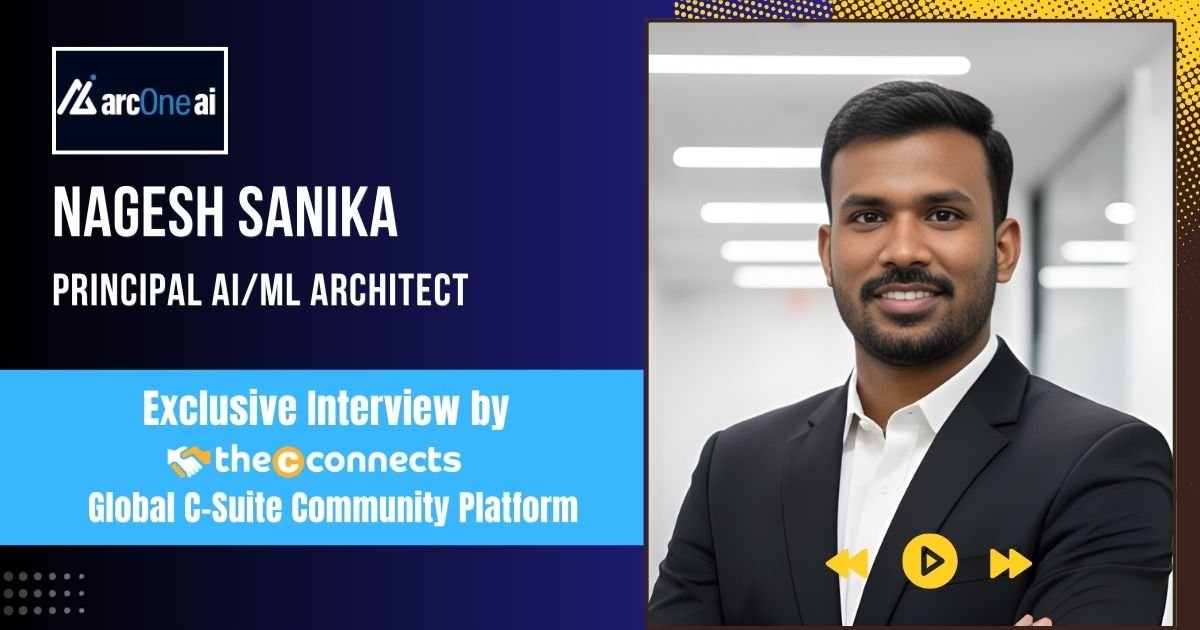

TheCconnects: Nagesh, your work sits at the intersection of architecture, intelligence, and enterprise transformation. Before we get into the technical depth, tell us-how did your professional journey begin, and what led you to where you are today?
Nagesh Sanika: My journey has been less about chasing titles and more about chasing problems worth solving. I started my career deeply rooted in engineering fundamentals-data, systems, and scale. Early on, I realized that building software wasn’t enough; the real challenge was designing systems that could adapt, learn, and evolve alongside businesses. Over time, as machine learning matured and AI moved from experimentation to production, I naturally gravitated toward architecture roles where I could shape not just models, but entire intelligent ecosystems. Today, as a Principal AI/ML Architect at ArcOne AI, I focus on designing agentic AI systems that don’t just analyze data-they act on it.
TheCconnects: You often speak about “agentic AI” as a shift, not just an upgrade. What sparked that perspective?
Nagesh Sanika: Working with large enterprises teaches you one thing very quickly-static intelligence doesn’t survive real-world complexity. Traditional AI models are excellent at prediction, but enterprises don’t operate in isolated predictions; they operate in workflows, exceptions, constraints, and regulations. I saw teams drowning in dashboards and alerts without clarity on what to do next. That’s where agentic AI came in. The idea is simple but powerful: AI agents should reason, collaborate, and orchestrate decisions across systems. They shouldn’t just inform humans-they should work alongside them as autonomous collaborators. That realization fundamentally changed how I think about AI architecture.
TheCconnects: Every architect faces resistance when proposing new paradigms. What were some of the biggest challenges you encountered along the way?
Nagesh Sanika: The biggest challenge wasn’t technology-it was mindset. Enterprises are comfortable with incremental improvements, not architectural leaps. When you talk about autonomous agents or AI-driven orchestration, the immediate concerns are trust, explainability, and control. I’ve learned that you overcome this not by pushing harder, but by designing responsibly. Embedding transparency, auditability, and human-in-the-loop mechanisms builds confidence. Another challenge was scale-making sure these systems work not just in demos, but across millions of transactions and real operational pressure. That’s where strong engineering discipline and DevOps maturity become non-negotiable.
TheCconnects: Your nomination for the Innovative AI Architect Award highlights responsibility as much as innovation. Why is responsible AI so central to your work?
Nagesh Sanika: Because unchecked intelligence is just risk at scale. AI systems increasingly influence revenue, customer trust, and regulatory compliance. If you can’t explain why an agent made a decision, you shouldn’t deploy it. I firmly believe responsible AI isn’t a constraint-it’s an enabler. When fairness, accountability, and transparency are built into the architecture, adoption accelerates. Enterprises trust the system, regulators understand it, and users feel empowered rather than replaced.
TheCconnects: From your vantage point, what do you see as the biggest challenge for enterprises and brands operating in today’s digital and AI-driven landscape?
Nagesh Sanika: Fragmentation. Brands are running dozens of tools, models, and platforms that don’t talk to each other. This creates operational blind spots and decision fatigue. The challenge isn’t data availability-it’s decision coherence. Enterprises need intelligence that connects signals across the organization and translates them into prioritized action. That’s where unified AI architectures and agent-driven workflows become critical. Without them, digital transformation becomes digital noise.
TheCconnects: How does the work you’re doing at ArcOne AI address these pain points in a tangible way?
Nagesh Sanika: At ArcOne, we’re reimagining revenue intelligence as a living system. We design agentic workflows that detect, prioritize, resolve, and forecast issues across complex revenue lifecycles. Instead of siloed analytics, our agents orchestrate decisions across pricing, forecasting, billing, and collections. What excites me most is the Agentic Experience Layer-interfaces that adapt in real time based on context and intent. Users don’t hunt for insights; insights come to them, along with recommended actions and traceable reasoning.
TheCconnects: That’s a powerful shift-from systems that report to systems that act. What lessons has your career taught you about building such complex platforms?
Nagesh Sanika: Three lessons stand out. First, architecture is about empathy-understanding how humans, systems, and businesses interact. Second, simplicity is a result of hard work, not a lack of depth. The best systems hide complexity without reducing capability. Third, no architecture survives without strong teams. Cross-functional collaboration is where ideas are stress-tested and refined. Great AI systems are built by people who respect both technology and the domain they’re operating in.
TheCconnects: Outside of work, how do you disconnect from such an intense, fast-moving field?
Nagesh Sanika: I try to stay curious beyond technology. Reading-especially philosophy and systems thinking-helps me see patterns beyond code. I also enjoy mentoring younger engineers; it keeps me grounded and reminds me why I started. And, of course, stepping away from screens whenever possible. Some of the best architectural ideas come when you’re not actively chasing them.
TheCconnects: Many young professionals aspire to work in AI and architecture. What advice would you give them?
Nagesh Sanika: Don’t rush to tools-build fundamentals first. Understand data, systems, and trade-offs. AI is evolving rapidly, but strong architectural thinking is timeless. Also, focus on impact, not hype. Ask yourself: does this solution actually make someone’s work easier, faster, or more trustworthy? Lastly, stay ethical. The decisions you encode today will shape how organizations and societies operate tomorrow.
TheCconnects: Finally, when you look ahead, what excites you most about the future of AI architecture?
Nagesh Sanika: We’re moving toward ecosystems that don’t just react but anticipate. AI systems that learn continuously, adapt responsibly, and collaborate seamlessly with humans. That future isn’t about replacing people-it’s about augmenting decision-making at a scale we’ve never seen before. Being part of shaping that future is both a privilege and a responsibility, and that’s what keeps me motivated every day.
TheCconnects: Nagesh, thank you for sharing such thoughtful insights. It’s been a fascinating conversation.
Nagesh Sanika: Thank you. These conversations are important-they help ensure innovation stays grounded in purpose.