
Most businesses have a significant gap between the SEO performance their content could achieve and the performance it is currently delivering. The gap is rarely caused by a lack of quality content or insufficient investment in creation. It is caused by the accumulation of small, fixable technical and on-page issues that nobody has prioritized because they were never individually urgent enough to demand attention.
That calculation has changed. Google’s increasingly sophisticated quality signals, Core Web Vitals, helpfulness assessments, user experience metrics, and intent alignment, mean that pages with preventable technical and on-page issues are being measurably disadvantaged in ways they were not five years ago. Meanwhile, the competitive density of search results in most business categories has intensified. The pages that rank today are not necessarily those with the most content, they are those with the fewest unforced errors.
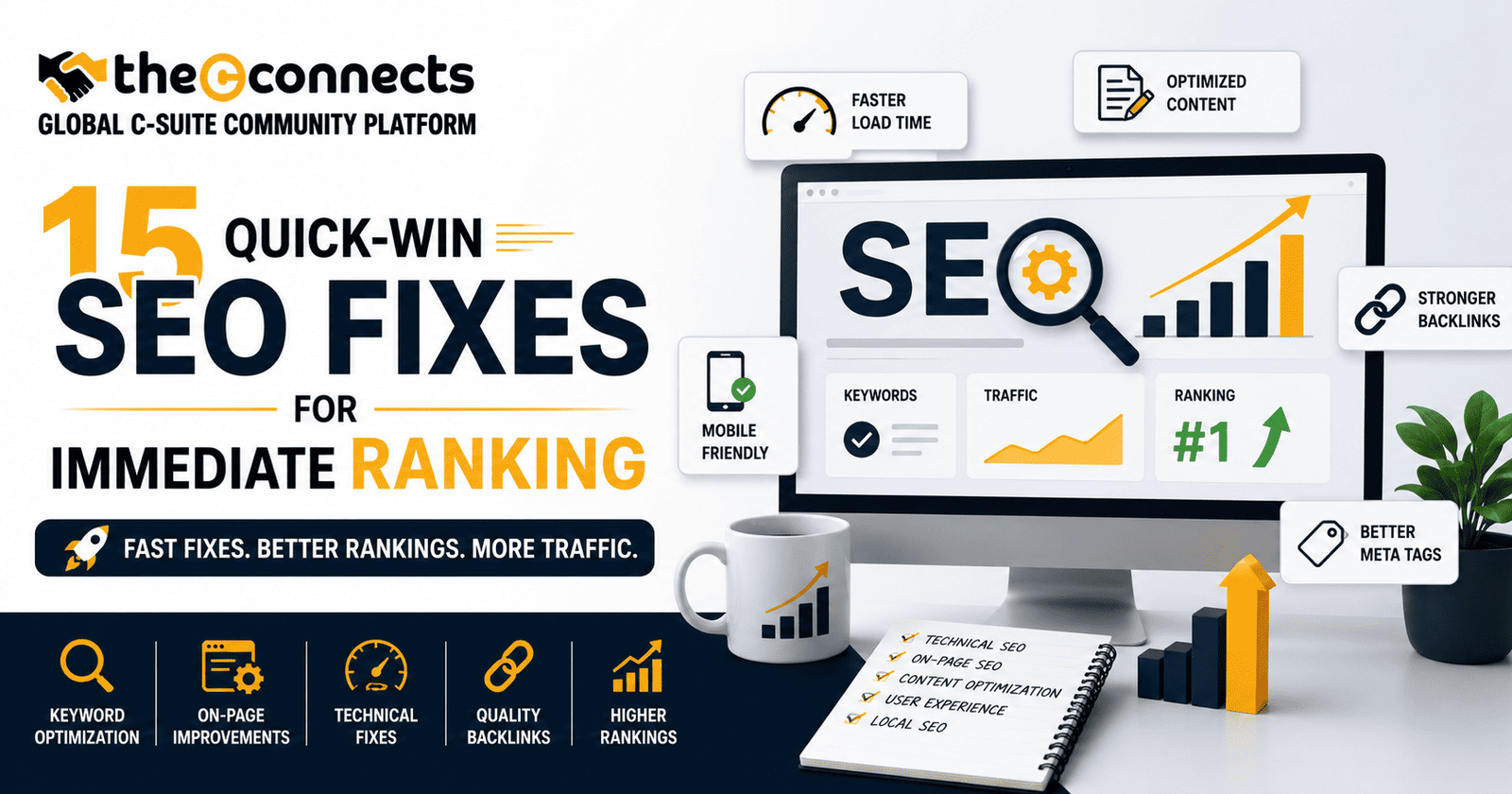
The 15 quick-win SEO fixes for immediate ranking covered in this guide are not shortcuts or manipulative tactics. They are the legitimate, Google-endorsed on-page and technical improvements that consistently move the needle, faster than new content creation, faster than link-building campaigns, and at a fraction of the cost.
Fix 1: Rewrite Title Tags for Search Intent
What it is: The HTML title tag is the single most directly weighted on-page ranking signal and the primary text displayed as the headline in search results. Misaligned, generic, or truncated title tags are among the most common fixable ranking problems.
Why it works: Title tags that precisely match the search intent of a target query, reflecting what someone searching that query actually wants to find, signal strong topical relevance to both users and Google. Higher relevance scores mean higher rankings and higher click-through rates simultaneously.
How to implement it: Review the title tags of your highest-potential pages. Ensure each title includes the primary target keyword near the beginning, describes what the page actually delivers, stays within approximately 55 to 60 characters to avoid truncation, and is unique across your site. Replace generic titles like “Services | Company Name” with specific titles like “Corporate Tax Advisory Services for Indian Businesses | Company Name.”
Key risk: Avoid keyword-stuffing title tags. Google increasingly rewrites titles it considers unhelpful, which means stuffed or misleading tags may not appear as written.
Fix 2: Improve Meta Descriptions for Click-Through Rate
What it is: The meta description is not a direct ranking factor, but it significantly affects click-through rate, which is itself a quality signal. Missing or duplicate meta descriptions are found on a surprisingly high proportion of business web pages.
Why it works: A compelling meta description that communicates specific value, includes the target keyword (which Google bolds in results), and includes a clear call to action consistently outperforms generic descriptions in click-through rate testing.
How to implement it: Write unique meta descriptions for every page with meaningful search traffic potential. Keep them between 150 and 160 characters. Lead with the most compelling benefit or differentiator. Include a natural mention of the primary keyword. Avoid duplicating descriptions across pages.
Fix 3: Add the Primary Keyword in the H1 and First Paragraph
What it is: Ensuring that the page’s primary target keyword appears in the H1 heading and within the first 100 words of body text, the sections that search engines weight most heavily for topical relevance assessment.
Why it works: Google uses the H1 and opening content to establish what a page is primarily about. Pages where the target keyword is absent from these positions are frequently outranked by pages where it appears naturally, even when the overall content quality is comparable.
How to implement it: Review your target pages and confirm that the H1 includes the primary keyword naturally. Revise the opening paragraph to introduce the keyword within the first 100 words in a way that reads naturally for the human reader.
Fix 4: Fix Thin or Duplicate Content
What it is: Thin content, pages with insufficient substance to genuinely answer a search query, and duplicate content, multiple pages with identical or near-identical text, are among the most consistently cited factors in poor ranking performance.
Why it works: Google’s Helpful Content system assesses whether pages provide original, substantive value that genuinely serves the reader’s need. Pages that fail this assessment are systematically disadvantaged in rankings, particularly since the September 2023 Helpful Content update.
How to implement it: Audit your site for pages with fewer than 300 words of substantive content. Identify pages with significantly overlapping content and consolidate them through canonical tags, redirects, or content differentiation. Expand thin pages with genuine additional value, not filler text.
Fix 5: Add Internal Links to Relevant Pages
What it is: Internal linking, hyperlinks connecting related pages within your own domain, is one of the most underutilized SEO levers available to most business websites. Well-structured internal linking distributes page authority, aids crawling, and signals topical relationships between pages.
Why it works: Pages with strong internal link equity from relevant, high-authority pages on the same domain consistently outrank isolated pages with similar external backlink profiles. Internal links are entirely within your control and cost nothing to implement.
How to implement it: Identify your highest-value pages, those with strong backlinks or high traffic, and add contextual links from them to related pages you want to rank more strongly. Use descriptive anchor text that describes what the linked page contains, rather than generic “click here” links.
Example: A consulting firm’s high-traffic “About Us” page adds contextual internal links to three service pages targeting specific business keywords, immediately improving the link equity distribution to those service pages.
Fix 6: Improve Image Alt Text and File Names
What it is: Alt text is the descriptive text attribute applied to images that communicates image content to search engines and screen readers. Generic or absent alt text is a widespread missed opportunity across most business websites.
Why it works: Images with descriptive, keyword-relevant alt text contribute to the topical relevance signals of the page and can drive incremental traffic through Google Image Search. Descriptive filenames, “corporate-tax-advisory-india.jpg” rather than “IMG_00347.jpg”, reinforce the same signals.
How to implement it: Audit images across your highest-potential pages. Replace missing or generic alt text with concise, descriptive alternatives that accurately describe the image content and naturally incorporate relevant keywords where appropriate. Rename image files before upload to include relevant descriptive terms.
Fix 7: Reduce Page Load Issues and Improve Core Web Vitals
What it is: Core Web Vitals, Largest Contentful Paint (LCP), Interaction to Next Paint (INP), and Cumulative Layout Shift (CLS) , are Google’s user experience metrics that directly affect search ranking through the page experience signals.
Why it works: Google has confirmed Core Web Vitals as ranking signals. Pages with poor performance scores are disadvantaged against comparable pages with better performance, particularly in competitive query categories.
How to implement it: Use Google PageSpeed Insights and Chrome User Experience Report to identify your pages with the lowest Core Web Vitals scores. Prioritize the highest-traffic pages with the worst scores. Common fixes include image compression and next-generation format conversion, reducing render-blocking scripts, implementing lazy loading, and improving server response times.
Fix 8: Make Content Easier to Scan With Headings and Bullets
What it is: Restructuring content for improved readability, using H2 and H3 subheadings to organize content into clearly labeled sections, and using bullets or numbered lists for enumerable information, improves both user experience metrics and Google’s ability to extract featured snippet content.
Why it works: Google’s natural language processing increasingly rewards content that is well-organized and easy for readers to navigate. Pages with clear content structure generate better engagement metrics, lower bounce rates, higher time on page, that contribute to ranking quality signals.
How to implement it: Review your most important pages and assess whether the content is organized with clear, descriptive subheadings at logical intervals. Break up dense text blocks. Use bulleted lists for genuinely list-type content. Ensure each heading is descriptive rather than generic.
Fix 9: Add FAQ Schema or Other Relevant Structured Data
What it is: Structured data markup, particularly FAQ schema and HowTo schema, is code added to page HTML that communicates specific content information to search engines, enabling rich results in search displays.
Why it works: FAQ schema can generate expanded search results that occupy significantly more visual space in search results pages, increasing visibility and click-through rate for the same ranking position. Google Search Central explicitly documents the types of structured data they support and use.
How to implement it: Identify pages with genuine FAQ content. Add JSON-LD FAQ schema markup following Google’s current structured data documentation. Test implementation using Google’s Rich Results Test before and after deployment.
Fix 10: Refresh Outdated Content With Current Examples
What it is: Systematically updating older content, particularly evergreen articles, guides, and pillar pages, with current statistics, examples, and information that makes the content more accurate, more relevant, and more genuinely helpful.
Why it works: Google assesses content freshness as a quality signal for time-sensitive topics. Updated content dates, current examples, and accurate statistics consistently outperform stale versions of otherwise comparable pages for competitive queries.
How to implement it: Identify your highest-ranking older pages and audit them for outdated statistics, superseded examples, or obsolete recommendations. Update substantively, adding genuinely new value, rather than changing only the publication date.
Fix 11: Strengthen Introductions and Conclusions
What it is: Rewriting page introductions to immediately address the reader’s query intent, confirming that they have found what they searched for, and improving conclusions with clear next steps or calls to action.
Why it works: Google assesses how successfully a page satisfies search intent, partly through behavioral signals. Users who find what they need in the first paragraph are less likely to return to search results, a behavior that signals high quality and contributes to ranking sustainability.
How to implement it: Rewrite page openings to lead with the answer or the direct value proposition rather than with context-setting preamble. Ensure conclusions provide clear guidance on next steps rather than simply trailing off.
Fix 12: Improve Mobile Usability
What it is: Ensuring that all pages render correctly, are fully usable, and provide a genuinely positive experience on mobile devices, verified through Google Search Console’s Mobile Usability report and manual testing.
Why it works: Google operates mobile-first indexing for all new websites, meaning the mobile version of your content is the version Google primarily uses for indexing and ranking assessment. Mobile usability issues directly affect ranking performance.
How to implement it: Review Google Search Console’s Mobile Usability report for identified issues. Test target pages manually across multiple device sizes. Common issues include touch targets that are too small, content wider than the screen, and unplayable embedded content.
Fix 13: Clean Up Broken Links and Redirect Problems
What it is: Identifying and resolving internal and external links that point to non-existent pages (404 errors), redirect chains (multiple redirects in sequence), and redirect loops, all of which waste crawl budget and degrade user experience.
Why it works: Broken links waste the crawl budget Google allocates to your site, time spent crawling dead ends is time not spent crawling and indexing valuable content. Redirect chains slow page load and dilute link equity.
How to implement it: Use Google Search Console’s Coverage report to identify crawl errors. Use a site auditing tool to identify broken internal links and redirect chains. Implement direct 301 redirects from broken URLs to the most relevant live page. Update internal links to point directly to their destination rather than through redirect chains.
Fix 14: Clarify Page Intent and Topical Focus
What it is: Reviewing pages that are attempting to rank for multiple disconnected topics, or for topics not clearly reflected in their content, and restructuring them to serve a single, clear search intent with appropriate depth.
Why it works: Google’s understanding of search intent has become increasingly sophisticated. Pages that conflate informational, commercial, and transactional intent on the same URL consistently underperform single-intent pages for competitive queries.
How to implement it: Audit your most important pages against the specific search intent of their target queries. Split pages that conflate multiple distinct intents into focused, separate pages. Revise pages where the content does not clearly serve the stated intent.
Fix 15: Optimize URLs, Slugs, and Anchor Text
What it is: Reviewing page URLs for descriptiveness, length, and keyword relevance, ensuring slugs clearly communicate page content, and auditing anchor text across internal links for specificity and accuracy.
Why it works: Descriptive, keyword-relevant URLs provide clear topical signals to both users and search engines. Over-optimized, stuffed, or irrelevant anchor text in internal links misrepresents linked content and creates keyword confusion.
How to implement it: Review URLs across high-priority pages. Shorten unnecessarily long slugs. Include the primary keyword in the URL naturally. Update internal link anchor text to be descriptive of the linked page’s actual content rather than generic phrases.
Conclusion:
The 15 quick-win SEO fixes for immediate ranking covered in this guide collectively address the most common and most fixable reasons that business pages underperform their potential. None of them require new content creation. None of them involve manipulative tactics. All of them are grounded in Google’s current guidance for helpful, people-first content.
The organizations that act on these fixes systematically, prioritizing by impact and implementing with appropriate care, consistently see measurable ranking and traffic improvements within weeks, not months. The ones that continue deferring them continue leaving organic performance on the table.
Start with the highest-impact fixes for your highest-priority pages. Measure. Build from there.
Contact TheCconnects
If you are an SEO expert, digital marketing strategist, website optimization professional, or business leader with insights on search rankings, content performance, technical SEO, or organic growth strategies, TheCconnects welcomes your expertise and industry perspective.
And if you would like to publish your article, SEO insights, case studies, business expertise, or thought leadership content on this platform or any other leading media platform, please feel free to reach out to us.
📧 Email: contact@thecconnects.com
📞 Phone: +91 91331 10730
💬 WhatsApp: https://wa.me/919133110730