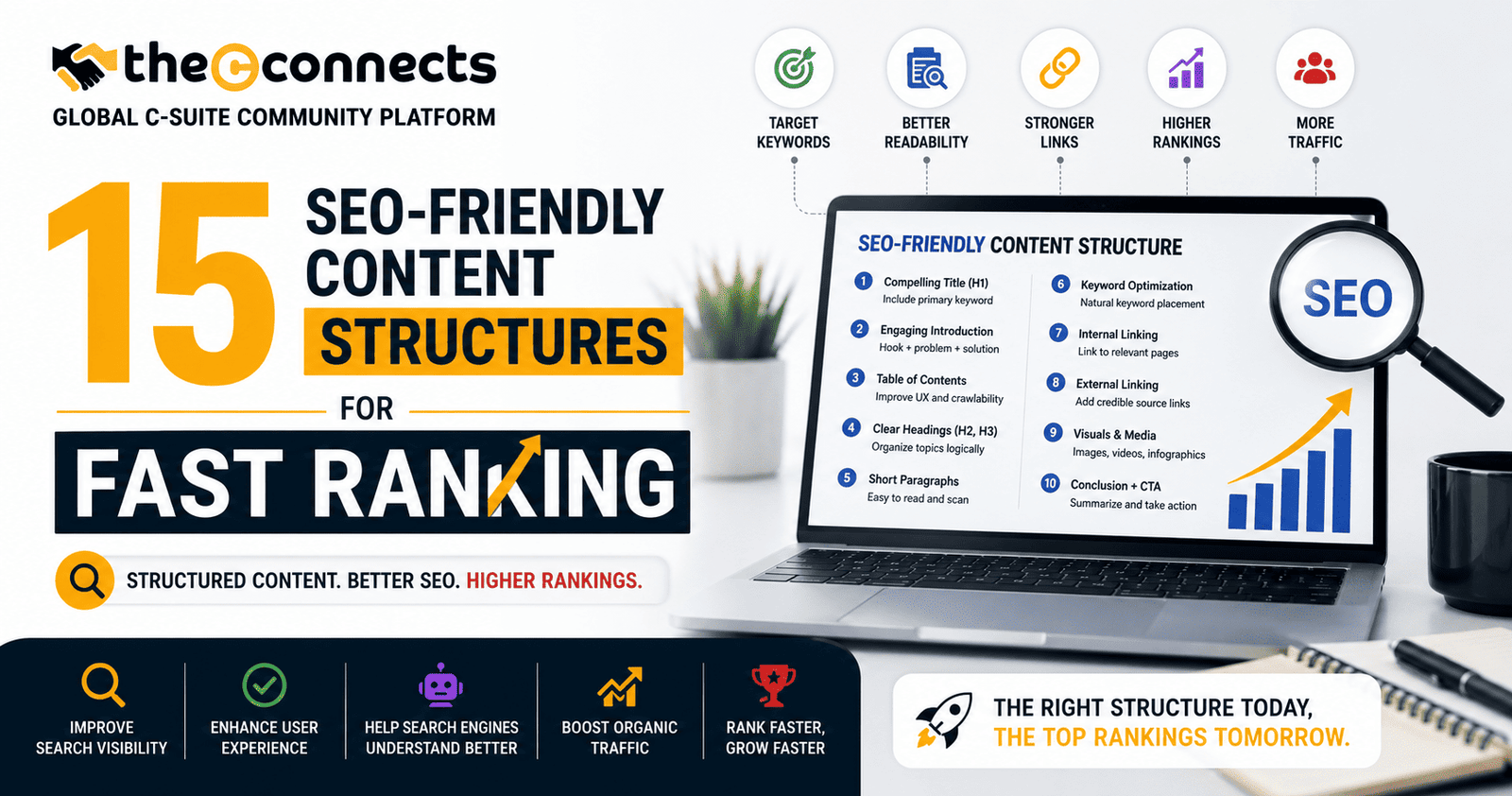

There is a persistent misconception in content marketing that quality content will rank regardless of how it is organized. The reality is more nuanced. Google’s systems are exceptionally good at evaluating whether content is genuinely helpful, but they also assess how well that content is organized, how clearly it addresses the searcher’s intent, and how effectively its structure communicates relevance to the specific query being answered.
Content structure is not a workaround or a technical trick. It is the organizational framework that determines whether your expertise reaches the people searching for it, and whether those people stay long enough to find what they need. In 2026, as AI-generated content floods search results and editorial differentiation becomes increasingly valuable, well-structured content is both a quality signal and a genuine reader service.
The 15 SEO-friendly content structures for fast ranking covered in this guide are formats that have demonstrated consistent alignment with how search engines assess relevance and how readers engage with content, not ranking shortcuts, but proven editorial frameworks worth understanding and applying deliberately.
1. The Numbered List Format (Listicle)
What it is: Content organized around a numbered sequence of items, tips, tools, examples, or strategies, with each item given a distinct subheading and consistent treatment.
Why it works for search: Listicle formats directly match high-volume search queries that begin with number words, “10 ways to…”, “15 strategies for…”, “20 tools that…”, and are frequently extracted for featured snippets. The numbered format also signals a defined scope of content that readers can evaluate before committing to the full article.
How to use it: Each numbered item should have a subheading, a concise explanation, and a practical example. Avoid padding items with redundant information, the strength of a listicle is the quality of each item, not the quantity.
Best for: Tool roundups, strategy guides, tip lists, resource compilations.
2. The How-To Step-by-Step Guide
What it is: A sequential format that walks the reader through a process in a specific, ordered sequence of steps, each step building on the previous.
Why it works for search: How-to content is among the most searched content types on the internet. Google’s HowTo structured data supports rich result display for this format, and step-based content is frequently extracted for featured snippets when clearly written.
How to use it: Number your steps explicitly. Start each step with an action verb. Provide enough context to complete each step without assuming prior knowledge. Implement HowTo schema markup for search engine communication of the format.
Best for: Technical tutorials, process guides, skill development content, product usage documentation.
3. The Problem-Solution Format
What it is: Content structured around a clearly named problem, followed by its causes or contributing factors, followed by a specific, actionable solution or range of solutions.
Why it works for search: Search behavior is fundamentally problem-motivated, most queries represent a user trying to solve something. Content that mirrors this problem-solution structure in its organization creates an immediate relevance signal for searchers arriving with that intent.
How to use it: Name the problem precisely in your headline. Validate the problem’s scope or consequences briefly. Provide solutions with enough specificity to be immediately applicable.
Best for: Business strategy content, troubleshooting guides, consulting-oriented topics, professional development advice.
4. The Comparison or Versus Format
What it is: Content that directly compares two or more options, tools, approaches, platforms, strategies, across a consistent set of criteria.
Why it works for search: Comparison queries (“X vs Y,” “best alternative to X”) are high-intent, frequently near the decision point in a buyer journey. Comparison content that is comprehensive and genuinely neutral consistently ranks for these queries and attracts qualified traffic.
How to use it: Define your comparison criteria explicitly before evaluating each option. Use a consistent structure for each option evaluated. Consider a summary table for scannable overview, followed by expanded treatment of key differentiators.
Best for: Software comparisons, methodology contrasts, market positioning content, decision-support resources.
5. The Beginner’s Guide Format
What it is: Content structured progressively from fundamental concepts to more advanced application, designed for readers who are new to a topic and need a foundational understanding before more nuanced information is useful.
Why it works for search: Beginner guides address high-volume, low-competition queries from audiences at the awareness stage. They also build topical authority and provide natural internal linking to more advanced content on related topics.
How to use it: Start with the most basic definition of the topic. Build progressively in complexity. Use plain language and avoid jargon without explanation. Link to more advanced related content throughout.
Best for: Topic introductions, educational content, onboarding materials, audience development.
6. The Case Study Format
What it is: Content structured around a specific, real-world example, typically presenting a challenge, the approach taken, the specific actions implemented, and the measurable results achieved.
Why it works for search: Case studies attract long-tail queries from readers at the consideration and decision stages of a buyer journey. They also rank well for industry-specific problem queries because of their specificity and authenticity.
How to use it: Structure the narrative clearly: context and challenge, approach and implementation, results and learnings. Include specific, verifiable details, vague case studies fail the authenticity test for both readers and search engines.
Best for: B2B content marketing, professional services, technology platforms, consultancy practices.
7. The Checklist Format
What it is: A scannable list of specific action items, verification points, or requirements, organized around completing a task or ensuring a process is followed correctly.
Why it works for search: Checklist-format content is highly practical and generates strong engagement metrics. Readers return to checklists repeatedly, a behavioral pattern that contributes to strong page performance signals.
How to use it: Organize checklist items into logical categories. Make each item specific and binary, either done or not done. Include a downloadable or copyable version where appropriate to increase utility.
Best for: Process compliance content, launch preparation, quality assurance topics, task management advice.
8. The FAQ Format
What it is: Content structured as a series of questions, ideally drawn from actual searches or common audience questions, each followed by a concise, authoritative answer.
Why it works for search: FAQ content is among the most frequently extracted for featured snippets. FAQ schema markup communicates the format directly to Google, enabling rich result display. FAQ structure also directly mirrors the conversational query format common in voice search and AI-assisted search.
How to use it: Source questions from Google’s “People Also Ask” boxes, from your sales and customer service teams, and from keyword research tools that surface question-format queries. Write answers that are complete enough to be genuinely useful as standalone responses.
Best for: Topic overview pages, product or service explanation content, knowledge base articles.
9. The Pillar Page and Hub-and-Spoke Format
What it is: A comprehensive topic overview page (pillar) that covers a broad subject at a high level and links to a cluster of more detailed supporting pages (spokes) that each address a specific aspect of the topic in depth.
Why it works for search: This structure builds topical authority, the demonstration that a site has comprehensive, organized knowledge about a topic, which is a significant factor in how Google evaluates domain authority for competitive queries.
How to use it: Identify a broad topic that your business has genuine expertise in. Create a pillar page that covers all major subtopics at an overview level. Create supporting cluster content for each subtopic. Link bidirectionally between pillar and cluster content.
Best for: Established sites building topical authority, content programs with sustained publishing capacity, competitive keyword categories.
10. The Expert Tips and Insights Format
What it is: Content that aggregates advice, perspectives, or recommendations from multiple subject-matter experts, structured as a series of attributed insights with explanatory context.
Why it works for search: Expert roundup content generates genuine backlinks from participants sharing the piece, increasing its authority signal. It also provides inherent credibility through attributed expertise.
How to use it: Gather genuine, original insights from real experts in the field. Provide context that frames each insight and its relevance. Avoid the common mistake of publishing quotes without explanatory value.
11. The Mistakes-to-Avoid Format
What it is: Content structured around specific errors, missteps, or misconceptions, naming each one clearly and explaining why it occurs, what damage it causes, and how to avoid it.
Why it works for search: Mistakes-to-avoid content matches a high-intent search pattern where people are trying to prevent a bad outcome. These queries often convert at high rates because the searcher is actively trying to improve their approach.
How to use it: Name mistakes with precision, not “common mistake #3” but the specific, recognizable description of the error. Explain why the mistake is made (usually not incompetence but a reasonable-seeming shortcut). Provide specific alternative approaches.
12. The Ultimate Guide Format
What it is: A comprehensive, long-form treatment of a topic that aims to be the most thorough and authoritative resource on that subject available online.
Why it works for search: Ultimate guides target head keywords for competitive topics and generate backlinks because they serve as reference resources. Their comprehensiveness signals topical authority to search engines.
How to use it: The ultimate guide format requires genuine depth, not length for its own sake, but comprehensive coverage that leaves no significant question unanswered. Internal navigation (table of contents, anchor links) is essential for reader experience.
13. The Template and Swipe File Format
What it is: Content that provides ready-to-use frameworks, templates, or examples that readers can adapt directly to their own work.
Why it works for search: Template content drives strong engagement because it provides immediate, tangible utility. Readers save and return to templates, behavior that creates strong engagement signals.
How to use it: Make templates genuinely adaptable, clearly marking the elements readers should customize. Provide brief guidance on how each template section functions.
14. The Trends and Predictions Format
What it is: Content that identifies, explains, and contextualizes emerging patterns in a specific field, organized around distinct trends, each supported by evidence and analysis.
Why it works for search: Trend content captures high-volume seasonal and annual search spikes. “Trends in X for [Year]” queries generate significant traffic at predictable points in the calendar.
How to use it: Base trend identification on genuine research, industry reports, data, expert consensus, not speculation. Publish ahead of the period the content is designed to address.
15. The Best Practices and Playbook Format
What it is: Content structured as a professional playbook, providing a set of established, tested practices that represent the current standard of excellence for a process or discipline.
Why it works for search: Best practices content attracts experienced practitioners looking to benchmark or improve their approach. It signals authoritative domain knowledge and frequently earns backlinks from other content referencing it as a standard.
How to use it: Ground each practice in reasoning, explaining why it works, not just what to do. Include common variations and when specific practices apply or do not apply.
Conclusion:
The 15 SEO-friendly content structures for fast ranking covered in this guide are not ranking formulas. They are editorial frameworks that align how you organize information with how readers seek and consume it, and, consequently, with how search engines evaluate relevance.
The most search-effective content programs are built by teams that choose structures based on what genuinely serves the reader’s intent, then implement those structures with the technical precision that makes them accessible to search engines. In that order. Always.
Build your content for the reader who is searching. The rankings are the result, not the objective.
Contact TheCconnects
If you have valuable expertise, actionable strategies, case studies, or thought leadership content related to SEO, digital marketing, content strategy, or business growth, TheCconnects would love to feature your voice.
Looking to publish your article on this platform or any other platform please feel free to reach out to us
📧 Email: contact@thecconnects.com
📞 Phone: +91 91331 10730
💬 WhatsApp: https://wa.me/919133110730