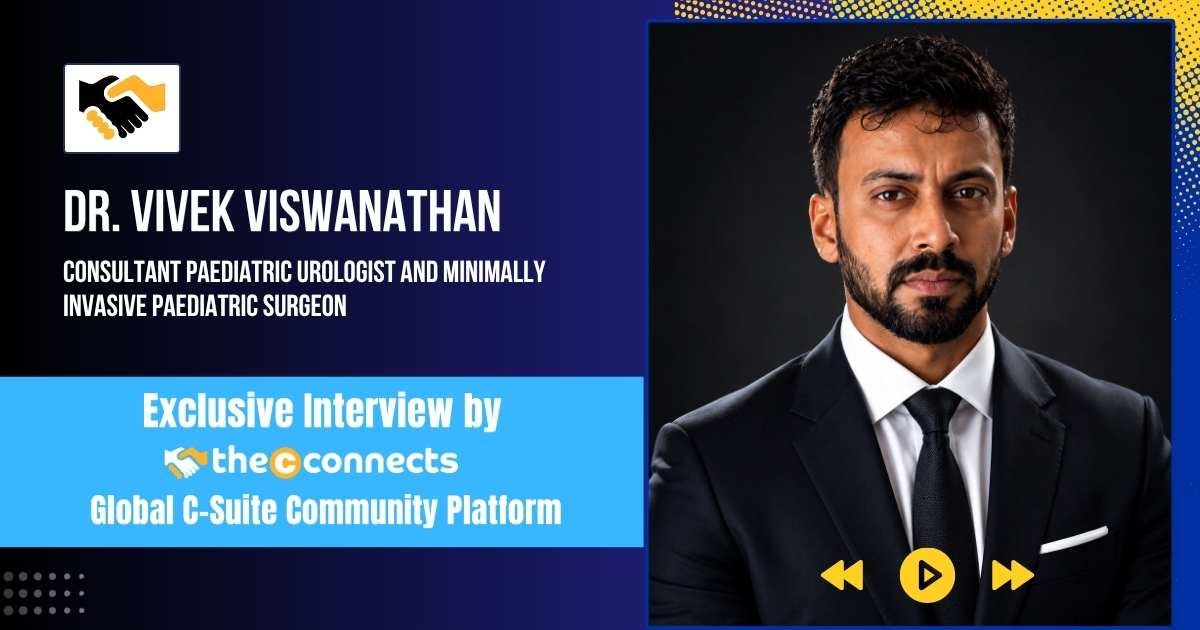

When a child needs surgery, the entire world stops for their parents. The anxiety is paralyzing, and the medical jargon often makes it worse. Enter Dr. Vivek Viswanathan-a Gold Medalist, Consultant Paediatric Urologist, Minimally Invasive Paediatric Surgeon, and Assistant Professor at Sumandeep Vidyapeeth in Vadodara.
Dr. Viswanathan is redefining what pediatric surgery looks like in India. From performing complex robotic procedures that leave scars smaller than a fingernail to holding a Guinness World Record in Healthcare AI, his resume is as formidable as it is diverse. Yet, what truly sets him apart is his deep-seated belief that surgical excellence must be accompanied by plain-language communication and profound empathy.
TheCconnects recently sat down with Dr. Vivek Viswanathan to discuss his transition from government hospital wards to cutting-edge robotic theatres, the realities of artificial intelligence in medicine, and why he believes technology must always strengthen-not replace-the human connection.
TheCconnects: Dr. Vivek Viswanathan, it is an absolute honor to have you with us. Your journey from a Gold Medalist medical student in Baroda to one of Gujarat’s most trusted Paediatric Urologists and Robotic Surgeons is remarkable. Can you tell our readers how you came to your current role?
Dr. Vivek Viswanathan: Thank you for having me; it’s a privilege to speak with you. My journey has been a blend of intense training and a continuous search for where I could make the most meaningful impact. After securing gold medals during my MBBS and MS in General Surgery at Baroda Medical College and Sir Sayajirao General Hospital, I managed an incredibly high-volume caseload. It built my clinical resilience, but I soon realized that adults weren’t my calling.
Children are not miniature adults. They require a completely different physiological and psychological approach. This led me to pursue my DrNB in Paediatric Surgery at Chacha Nehru Bal Chikitsalaya in New Delhi, followed by intensive work in robotic pediatric urology at Kokilaben Dhirubhai Ambani Hospital in Mumbai. Today, as an Assistant Professor at Sumandeep Vidyapeeth and a Consultant at Bhailal Amin General Hospital and Savita Hospital in Vadodara, I get to blend my three passions: operating, teaching the next generation of surgeons, and advancing clinical research.
TheCconnects: Operating on infants and young children requires nerves of steel. Who or what has influenced you the most in your life to choose this path?
Dr. Vivek Viswanathan: My greatest influence has been the unconditional trust of the parents who hand their children over to me. There is no more grounding work in the world than operating on someone’s child; the stakes are absolute.
I was also deeply influenced by my mentors early in my career who taught me the “hidden curriculum” of the operating room. They showed me that while a surgeon must have flawless technical skills, their true worth is measured by their compassion. A scalpel can cure a physical defect, but it is the surgeon’s empathy that heals a terrified family.
TheCconnects: What are the biggest challenges you have faced in your career, particularly in such a high-stakes specialty, and how did you overcome them?
Dr. Vivek Viswanathan: One of the most significant challenges is managing parental anxiety. When parents hear terms like “hypospadias,” “hydronephrosis,” or “vesicoureteral reflux,” they understandably panic. Historically, the medical community hasn’t been great at breaking down this jargon.
I overcame this by stepping out of the operating room and into the digital space. I started my blog and YouTube channel to create plain-language educational content. I want parents to understand exactly what is happening to their child without needing a medical dictionary. The second major challenge was the sheer physical toll of traditional open surgeries on children. We overcame this by aggressively adopting minimally invasive and robotic surgeries, reducing massive incisions to scars smaller than a fingernail, allowing kids to go home the very next day.
TheCconnects: You were recently part of a Guinness World Record for Healthcare AI. What do you see as the biggest challenge for healthcare professionals and brands in the digital space today?
Dr. Vivek Viswanathan: The biggest challenge in the digital space today is the rapid spread of medical misinformation and “Dr. Google”-induced panic. Parents often search for a minor symptom and are presented with worst-case scenarios, leading to immense stress before they even step into my clinic.
For healthcare brands and professionals, the challenge is fighting this noise with accurate, empathetic, and accessible information. Regarding Artificial Intelligence-which tied into the Guinness World Record-the challenge is ethical integration. AI is not here to replace doctors. But if an AI algorithm can help me catch a subtle anomaly on a scan at 2 AM, or help explain a diagnosis more clearly, then it belongs in my operating theatre. The challenge is ensuring we use it to enhance human care, not automate it.
TheCconnects: How exactly do your services-both in the OR and online-address your patients’ biggest pain points?
Dr. Vivek Viswanathan: The primary pain points for a parent are fear of the surgery, fear of the pain their child will endure, and fear of the unknown.
Clinically, my expertise in Laparoscopic and Robotic Paediatric Surgery directly addresses the fear of pain and scarring. We use pinpoint precision that minimizes tissue trauma, ensuring a radically faster, less painful recovery. Educationally, my platform addresses the fear of the unknown. Whether it’s a video explaining post-operative scar care or a blog post on childhood constipation, I provide parents with a verified roadmap so they are never walking in the dark.
TheCconnects: After years of navigating complex surgeries and teaching medical students, what key lessons have you learned from your professional career?
Dr. Vivek Viswanathan: The most profound lesson I’ve learned is that surgery is just as much about knowing when not to operate as it is about knowing how to operate. Precision in the OR is mandatory, but patience is a virtue.
Secondly, I’ve learned that education is a responsibility that extends far beyond medical colleges. If we, as specialists, do not educate the public, we are failing our communities.
TheCconnects: Between teaching at the university, performing complex surgeries, and writing, do you ever have free time? What do you do to recharge?
Dr. Vivek Viswanathan: (Laughs) Free time is definitely a luxury, but I fiercely protect it because it makes me a better surgeon. I am a trained Hindustani Classical Vocalist and a Tabla player. There is an incredible parallel between music and surgery-both require intense discipline, a sense of rhythm, and the ability to find harmony in complex situations. I am also a bibliophile, constantly reading outside of medicine to keep my perspective grounded and broad.
TheCconnects: Finally, do you have any advice for aspiring surgeons, medical students, or healthcare entrepreneurs entering this rapidly evolving industry?
Dr. Vivek Viswanathan: Yes. Never lose your humanity in the pursuit of technology.
We are entering an era of AI, robotics, and precision medicine. You must master these tools-be a lifelong learner, adapt to algorithms, and understand robotics. But always remember that at the end of the day, there is a frightened human being sitting across from you. Technology should strengthen the human connection in medicine, never replace it. Treat the patient, not just the disease.
TheCconnects: Dr. Vivek Viswanathan, your dedication to child-centered healthcare and your holistic approach to medicine are truly inspiring. Thank you so much for taking the time to share your insights with our readers today.
Dr. Vivek Viswanathan: The pleasure was entirely mine. Thank you for giving me this platform to advocate for pediatric health and the future of compassionate medicine.