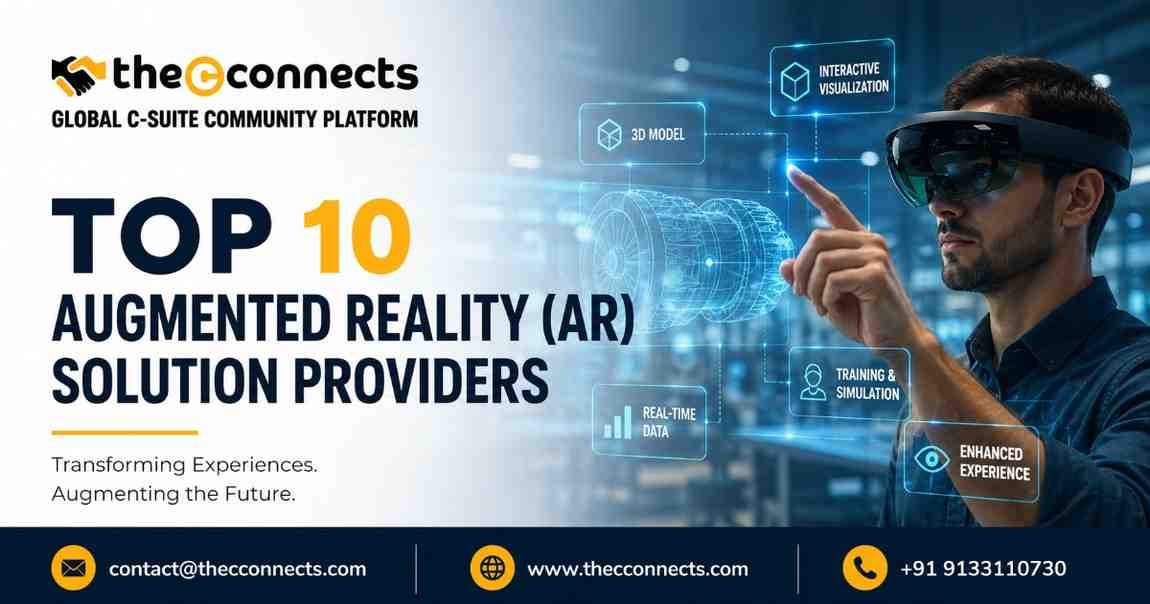

The global Augmented Reality (AR) landscape has officially broken free from its “novelty” and gaming roots. We have entered the era of institutionalized spatial computing and agentic AI integration. Industrial enterprise, field logistics, corporate education, and high-fidelity product design are driving massive demand for AR environments.
Driven by hardware updates like the widespread adoption of wearable waveguides and the integration of generative AI pipelines that can build 3D industrial overlays on the fly, AR platforms are showing real ROI. The target is no longer just simple visual effects; it is frontline intelligence, microservices-driven digital twins, and remote collaborative orchestration that lowers overhead while lifting operational accuracy.
This market research briefing details the top 10 AR solution providers engineering the enterprise spatial computing framework.
1. PTC Inc. (Vuforia)
- Founders: Samuel Geisberg (PTC); Vuforia was originally created by Qualcomm and acquired by PTC in 2015.
- Founded Year: 1985 (PTC Corporation)
- Headquarters: Boston, Massachusetts, United States
- Product Categories: Vuforia Chalk, Vuforia Expert Capture, Vuforia Studio, Vuforia Engine, CAD/PLM Integrations.
- Company Description: PTC is an industrial software giant that has positioned its Vuforia platform as a gold standard in enterprise AR. Vuforia is designed explicitly for Industry 4.0 applications, bridging digital design data directly with factory floors and complex field machinery. PTC enables manufacturers to transform standard CAD/PLM models into highly interactive AR work instructions and digital twin overlays, helping companies protect domain knowledge, speed technician training, and cut unscheduled downtime.
- Key Features:
- Industrial CAD Auto-Ingestion: Allows teams to port native 3D engineering designs directly into AR scenes without manual optimization.
- Vuforia Chalk Remote Guidance: Employs spatial over-the-shoulder digital ink annotations that stick dynamically to real-world machinery during support calls.
- Expert Capture Workflows: Simplifies rapid knowledge transfer by recording expert technician steps via wearable devices to generate training guides automatically.
- Advanced Model Targets: Recognizes and tracks complex industrial components based on 3D geometry rather than relying on flat visual markers.
- Deep PLM Ecosystem Integration: Connects AR workflows seamlessly to PTC Windchill and major enterprise resource planning platforms.
2. Magic Leap, Inc.
- Founders: Rony Abovitz
- Founded Year: 2010
- Headquarters: Plantation, Florida, United States
- Product Categories: Magic Leap 2 Headset, Silicon Photonics Waveguides, Spatial Collaboration Suites, Enterprise OS Solutions.
- Company Description: Having successfully pivoted from its early consumer entertainment ambitions, Magic Leap stands as a premier enterprise spatial computing hardware and software vendor. Its flagship device, Magic Leap 2, features cutting-edge optics and a proprietary dynamic dimming feature specifically built to perform in intensely lit industrial environments. The company works closely with health networks, defense infrastructure, and heavy industry to deploy high-precision spatial tracking models that require zero-latency processing.
- Key Features:
- Dynamic Optical Dimming: Automatically adjusts display brightness, enabling virtual elements to stay solid in bright outdoor or factory light.
- Expanded Field of View: Provides a large diagonal field of view to reduce optical cropping during complex tasks.
- Silicon Photonics Waveguides: Proprietary optics deliver precise 3D digital content overlayed cleanly on top of the physical world.
- Open Platform Architecture: Runs an Android-based OS built to support custom enterprise apps and OpenXR standards.
- High-Fidelity Spatial Audio: Delivers critical acoustic positioning cues for interactive training or team simulations.
3. Scope AR
- Founders: Scott Montgomerie, David Rawlins, Graham Calder
- Founded Year: 2011
- Headquarters: San Francisco, California, United States
- Product Categories: WorkLink Platform, WorkLink Create, WorkLink Assist, AI-Enabled Work Instruction Authoring.
- Company Description: Scope AR is an industry pioneer dedicated entirely to enterprise-class augmented reality training and remote collaboration solutions. Its flagship product ecosystem, WorkLink, delivers a zero-code authoring tool that lets non-technical staff create rich, 3D-aware step-by-step instructions from standard web browsers. Scope AR serves rigorous aerospace, energy, and medical manufacturing companies, maintaining deep security compliance parameters to run within tightly guarded cloud frameworks.
- Key Features:
- No-Code Authoring Tools: Enables non-developers to create interactive AR manuals through a web browser using drag-and-drop actions.
- Cross-Device Consistency: Publishes unified AR content once to run across iOS, Android, and popular enterprise headsets.
- Frontline Intelligence & AI Capture: Employs integrated AI to speed up documentation creation and automate mistake-detection workflows.
- Strict Security Compliance: Built securely around SOC 2 Type II certifications and NIST verification pipelines.
- Built-in Productivity Tracking: Gathers concrete engagement data to let operations managers review training completion and assembly error rates.
4. TeamViewer SE (Frontline)
- Founders: Tino Marbusch, Thilo Kujawski (TeamViewer base corporate ecosystem)
- Founded Year: 2005 (Acquired Upskill and Ubimax to build the Frontline suite)
- Headquarters: Göppingen, Germany
- Product Categories: TeamViewer Frontline, xPick, xMake, xInspect, xAssist.
- Company Description: Globally known for remote desktop software, TeamViewer has built a dominant presence in industrial AR through its specialized Frontline platform. By acquiring leading industrial AR startups, TeamViewer assembled a powerful suite tailored for deskless workers. TeamViewer Frontline focuses on optimizing logistics sorting, quality assurance steps, and real-time step guidance via smart glasses, providing a complete platform that drops right into existing warehouse management networks.
- Key Features:
- Vision-Based Order Picking (xPick): Replaces hand scanners with visual HUD indicators to guide logistics workers through hands-free warehouse sorting.
- Step-by-Step Assembly Guides (xMake): Overlays visual checking routines directly onto workbenches to minimize manual assembly errors.
- Digital Inspection Frameworks (xInspect): Displays localized equipment testing routines and compliance forms right in the field worker’s field of view.
- Instant Remote Expert Support (xAssist): Connects remote technicians to field staff via low-bandwidth, live video feeds featuring spatial annotations.
- Native ERP Hookups: Feeds operational data directly back to backend systems like SAP and Oracle out of the box.
5. Google LLC (ARCore)
- Founders: Larry Page, Sergey Brin
- Founded Year: 1998
- Headquarters: Mountain View, California, United States
- Product Categories: ARCore SDK, Geospatial API, Scene Semantics API, Cloud Anchors.
- Company Description: Google operates as a foundational engine of the broader AR market via its ubiquitous software ecosystem. Its ARCore software development kit acts as the core architecture powering augmented reality across more than a billion active Android devices globally. Google focuses heavily on global spatial understanding, giving developers access to its mapping data to create stable location-based AR overlays that map perfectly to physical geography.
- Key Features:
- Massive Android Reach: Powers cross-device, highly scaled deployments using standard mobile hardware footprints.
- Google Maps Geospatial API: Allows developers to anchor digital models to exact longitudes and latitudes across the globe.
- Advanced Motion Tracking: Employs internal sensors and video feeds to evaluate how a device moves relative to a room.
- Intelligent Depth Sensing: Generates real-time depth maps without specialized LiDAR sensors, enabling realistic virtual occlusion.
- Environmental Light Estimation: Evaluates ambient light states to match virtual asset reflections with true workspace lighting.
6. Microsoft Corporation (HoloLens & Mesh)
- Founders: Bill Gates, Paul Allen
- Founded Year: 1975
- Headquarters: Redmond, Washington, United States
- Product Categories: HoloLens 2, Dynamics 365 Guides, Dynamics 365 Remote Assist, Microsoft Mesh, Azure Spatial Anchors.
- Company Description: Microsoft remains a central force in enterprise mixed reality and spatial computing infrastructure. Its HoloLens 2 head-mounted display combined with the Dynamics 365 cloud environment provides companies with out-of-the-box business solutions. Microsoft centers its current spatial roadmap around the “industrial metaverse,” leveraging its Azure cloud engine to host highly secure digital twins, multi-user collaboration spaces, and AI-driven spatial data models for distributed global teams.
- Key Features:
- Dynamics 365 Guides Integration: Delivers holographic instructional cues to workers during complex manufacturing workflows.
- Microsoft Mesh Ecosystem: Connects distributed teams inside shared virtual rooms using avatars and synchronized 3D assets.
- Azure Spatial Anchors: Creates precise, multi-user digital waypoints that persist across platforms over long periods.
- Secure Biometric Authentication: Uses Windows Hello iris scanning for hands-free, enterprise-secure system sign-ins.
- Ergonomic Flip-Up Visor Design: Allows workers to instantly switch between full holographic immersion and clear physical sight lines.
7. Apple Inc. (ARKit & Vision Pro)
- Founders: Steve Jobs, Steve Wozniak, Ronald Wayne
- Founded Year: 1796 (Corporate base era: 1976)
- Headquarters: Cupertino, California, United States
- Product Categories: ARKit SDK, Apple Vision Pro, visionOS, Reality Composer Pro.
- Company Description: Apple has significantly reshaped the premium spatial computing market with its visionOS device ecosystem. On the mobile software front, its long-running ARKit framework remains an elite toolkit for high-fidelity iOS tracking. By combining micro-OLED technology with powerful custom silicon chips, Apple provides an incredibly high-resolution passthrough experience, allowing corporate developers to create stunningly realistic designs, collaborative workflows, and immersive education spaces.
- Key Features:
- Ultra-High Resolution Passthrough: Utilizes dual micro-OLED displays to render physical environments with unmatched visual clarity.
- Intuitive Eye and Hand Tracking: Replaces physical controllers entirely with natural hand gestures and eye movement monitoring.
- Advanced ARKit Framework: Delivers fast surface tracking, skin detection, and human occlusion for iOS and visionOS tools.
- High-Fidelity Room Mapping: Employs advanced LiDAR structures to dynamically generate precise 3D mesh layouts of indoor spaces.
- Unified App Store Ecosystem: Enables rapid porting of corporate iPad and iOS apps straight into spatial fields.
8. MobiDev
- Founders: Oleg Malyeyev
- Founded Year: 2009
- Headquarters: Atlanta, Georgia, United States
- Product Categories: Custom AR Application Engineering, Computer Vision Models, WebAR Platform Architectures, Enterprise XR Integrations.
- Company Description: MobiDev is a premier tech consulting and custom software development agency specializing in deep-tech AR engineering. The firm sets itself apart from creative marketing agencies by focusing on full-stack, enterprise-ready immersive products that connect directly to complex backends. MobiDev combines custom computer vision, AI model training, and standard AR tools (like ARKit, ARCore, and WebAR) to build tailored systems for retail planning, remote industrial checks, and logistics operations.
- Key Features:
- Bespoke AR Development: Engineers custom spatial software applications tailored to unique enterprise business metrics.
- AI and Machine Learning Integration: Combines object recognition models with AR overlays to automate real-world object inspections.
- WebAR Development Competency: Builds lightweight, browser-based AR experiences that eliminate the friction of app downloads.
- Cross-Platform Architecture: Minimizes development cycles by deploying unified code structures across multiple platforms.
- Disciplined Delivery Lifecycles: Leverages an experienced bench of senior engineers to safely migrate outdated systems to cloud spaces.
9. Squint
- Founders: Devin Bhushan
- Founded Year: 2021
- Headquarters: San Francisco, California, United States
- Product Categories: Squint Shop Floor Platform, AI-Driven Procedure Generation, Hands-Free Voice Integrations.
- Company Description: Squint is an agile, fast-growing startup focused on modernizing manufacturing shop floor procedures through intuitive AR and generative AI. The platform allows supervisors to map factory environments quickly and tie digital instructions directly to physical machinery without messy setup tasks. Squint stands out by making spatial data capturing incredibly accessible, letting floor workers access context-aware manuals and report production anomalies on the spot.
- Key Features:
- Rapid Space Mapping: Enables operators to link training videos and checklists to real objects in minutes via mobile devices.
- AI-Powered Procedure Creation: Generates structured operational guides out of standard technical PDFs automatically.
- Hands-Free Siri Integration: Allows floor operators to query specific manuals using conversational voice commands.
- Dynamic Localization Methods: Identifies shop floor locations quickly without needing static QR codes stuck to machines.
- Real-Time Shift Hand-offs: Lets floor workers drop spatial notes directly onto machines to notify incoming shifts of line status.
10. Zappar
- Founders: Caspar Thykier, Connell Gauld, Simon Taylor
- Founded Year: 2011
- Headquarters: London, United Kingdom
- Product Categories: Zapworks Suite, Mattercraft, Zapvision, Zapbox hardware.
- Company Description: Zappar is a pioneering AR technology vendor offering a comprehensive array of content authoring tools and hardware solutions. Its signature developer tool, Zapworks, provides both low-code design spaces and robust JavaScript environments to build immersive WebAR activations. Zappar excels in large-scale commercial implementations, smart packaging designs, and accessible computer vision models, making it a favorite for consumer brands and enterprises looking to launch lightweight, browser-based interactive experiences worldwide.
- Key Features:
- Zapworks Designer & Mattercraft: Offers visual editors alongside advanced 3D code sandboxes to build modern web experiences.
- High-Performance WebAR Tracking: Delivers fast face, image, and instant world tracking directly inside standard mobile browsers.
- Accessible Zapvision Integration: Patented scanning technology designed to help visually impaired users interact with product packaging.
- Zapworks Spaces Framework: Delivers specialized code tooling to set up precise AR indoor navigation and mapping routes.
- Affordable Prototyping Hardware: Offers budget-friendly smartphone-powered components to test spatial interactions easily.
Market Head Assessment: Framework Selection Strategy
When evaluating an AR vendor for your corporate ecosystem, prioritize long-term compatibility over visual flair.
- For Heavy Industrial Deployments: Focus on deep data links. Choose platforms like PTC Vuforia or Scope AR that connect directly into your core PLM and ERP networks.
- For Lightweight Frontline Training: Prioritize rapid onboarding. Choose platforms like Squint or TeamViewer Frontline to quickly digitize manual checklists without requiring specialized developers.
- For Cross-Platform Customer Facing Products: Focus on frictionless web access. Prioritize vendors like MobiDev or Zappar that deliver rich WebAR experiences directly inside mobile web browsers.
📬 Let’s Connect!
✍️ If you have any feedback regarding this market research, possess updated corporate data, or believe your own AR platform is eligible to be featured in our upcoming analysis, please connect with our editorial team:
- 📧 Email Us: contact@thecconnects.com
- 📞 Call Us: +91 9133110730
- 💬 WhatsApp Us: https://wa.me/919133110730