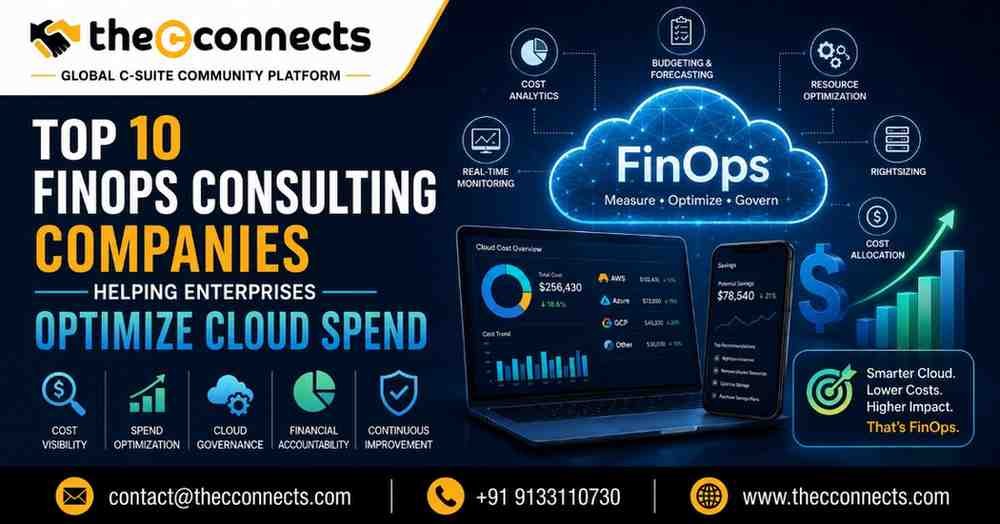

As cloud expenditures continue to skyrocket across multicloud and AI-heavy enterprise workloads, financial management in the cloud has shifted from a periodic accounting exercise to a continuous, engineering-led discipline. FinOps-or Cloud Financial Operations-bridges the traditional disconnect between engineering, finance, and procurement teams. Rather than treating cloud costs as an unpredictable variable expense, leading enterprises leverage FinOps to institute cost transparency, accountability, and real-time architectural cost controls.
However, building an internal FinOps capability from scratch presents significant hurdles. Complex hyperscaler billing models (AWS, Azure, Google Cloud, and emerging AI specialized clouds), sprawling Kubernetes clusters, and opaque unit economics make cost allocation difficult. Consequently, enterprise tech leaders increasingly rely on specialized FinOps consulting firms and FinOps Certified Service Providers (FCSPs) to establish governance models, negotiate strategic commitments, and optimize cloud unit costs without compromising application velocity.
Market Research Insights: Key Trends Reshaping FinOps in 2026
Enterprise cloud spending dynamics have evolved rapidly over the past few years. Key trends driving demand for specialized FinOps advisory include:
- AI Workload Cost Management & Model Economics: The widespread enterprise adoption of Generative AI, custom LLMs, and high-performance GPU clusters has introduced a new layer of cloud expenditure. Unlike predictable compute infrastructure, AI inference and training costs fluctuate wildly. FinOps consultancies are building specialized practice areas dedicated to GPU utilization tracking, prompt token cost attribution, and model-level unit economics.
- Adoption of FOCUS™ (FinOps Open Cost & Usage Specification): The standardization of cloud billing through the Linux Foundation’s FinOps Foundation has revolutionized multi-cloud cost visibility. Consultants are helping enterprises migrate from proprietary billing schemas to FOCUS-compliant data pipelines, allowing unified cost modeling across AWS, Azure, GCP, OCI, and SaaS platforms.
- Shift from Cost Reduction to Value Realization: Mature enterprises no longer define FinOps success solely by cost reduction. Modern FinOps strategies focus on unit metrics-such as cost per active user, cost per API call, or cost per transaction-enabling leadership to understand the direct gross margin impact of technical decisions.
- Automated Continuous Optimization: Human-driven commitment management (Savings Plans, Reserved Instances) is rapidly giving way to automated rate and usage optimization. Consulting partners assist enterprises in implementing automated guardrails, anomaly detection algorithms, and automated rightsizing engines.
Top 10 FinOps Consulting Companies
1. SoftwareOne
- Company Name: SoftwareOne AG
- Founders: Daniel Von Stockar, Patrick Winter
- Founded Year: 2000
- Headquarters: Stans, Switzerland
- Product Categories: FinOps Advisory & Assessment, Managed Cloud Financial Services, Software & Cloud Asset Management (SAM/CAM), Cloud Procurement & Licensing Optimization
- Description: SoftwareOne is a global leader in software and cloud portfolio management, presence across 70+ countries, helping over 70,000 customers navigate complex multi-cloud ecosystems. As a premier FinOps Certified Service Provider, SoftwareOne combines deep commercial licensing knowledge with cloud financial management expertise. Their FinOps consulting practice helps organizations evaluate cloud maturity, establish allocation tagging standards, and enforce showback/chargeback models across AWS, Microsoft Azure, and Google Cloud. By unifying cloud procurement, software licensing, and operational FinOps, SoftwareOne ensures enterprises maximize their cloud ROI.
- Key Features:
- Comprehensive FinOps Assessment: Benchmarks cloud financial maturity against FinOps Foundation standards.
- Unified Licensing & Cloud Procurement: Optimizes hybrid licensing rights (e.g., Azure Hybrid Benefit, AWS BYOL) alongside cloud compute usage.
- Managed FinOps Services: Dedicated cloud financial analysts providing continuous, monthly cost optimization governance.
- Multi-Cloud Billing Normalization: Standardizes disparate hyperscaler invoices into actionable executive reporting dashboards.
- Automated Anomaly Detection: Real-time alerting models catching unexpected spend spikes before billing cycle close.
- Strategic Commitment Portfolio Management: Expert management of Savings Plans, Reserved Instances, and Committed Use Discounts.
- Global-Local Delivery Model: Localized financial and regulatory compliance consulting across 7 global regions.
2. Deloitte (Cloud FinOps Services)
- Company Name: Deloitte Touche Tohmatsu Limited
- Founders: William Welch Deloitte
- Founded Year: 1845
- Headquarters: London, United Kingdom (Global Operations: New York, NY, USA)
- Product Categories: Cloud FinOps Advisory & Transformation, IT Financial Management (ITFM), Cloud Operating Model Design, Enterprise Cost Optimization
- Description: Deloitte is a global professional services powerhouse whose Cloud FinOps practice delivers enterprise-grade cloud financial governance tied directly to corporate accounting standards. Deloitte combines technical cloud architecture insights with corporate finance, tax, and risk advisory to treat cloud spend as a strategic business driver. Their team of certified FinOps practitioners works with Fortune 500 organizations to align engineering behavior with financial goals, establish chargeback models, and optimize massive multi-hyperscaler footprints. Deloitte excels in highly regulated industries requiring strict auditability in cloud cost allocation.
- Key Features:
- Business-Led FinOps Roadmap: Aligns cloud spend with corporate financial planning, tax structuring, and audit compliance.
- Unit Economics & KPI Modeling: Establishes granular metrics such as cost per customer transaction or cost per digital service.
- Front-Door Governance Models: Implements policy guardrails that prevent over-provisioning during resource creation.
- Discount Instrument Maximization: Optimizes enterprise discount agreements (EDAs) and custom hyperscaler commitments.
- Organizational Change Enablement: Persona-based training for finance, engineering, and product management teams.
- Generative AI Cost Structuring: Specialized frameworks for tracking and allocating enterprise AI model consumption.
3. Accenture
- Company Name: Accenture plc
- Founders: Clarence DeLany
- Founded Year: 1989
- Headquarters: Dublin, Ireland
- Product Categories: Cloud First FinOps Consulting, Cloud Value Optimization, Accenture MyNav Platform, Enterprise Cloud Modernization & Governance
- Description: Accenture is a global leader in technology strategy and managed services, leveraging its Cloud First initiative to drive value from enterprise cloud adoption. Accenture’s FinOps practice integrates deep engineering capabilities with financial operating models, utilizing its proprietary Accenture MyNav platform to simulate, optimize, and track cloud economic performance. Accenture assists large-scale enterprises in restructuring legacy IT budgeting into dynamic, cloud-native financial models, ensuring that cloud migrations deliver measurable gross margin improvements and sustainable unit cost efficiencies.
- Key Features:
- MyNav Platform Integration: Proprietary platform for benchmarking, mapping, and continuously tracking cloud economics.
- Enterprise Cloud Governance: Establishes centralized FinOps Centers of Excellence (CoE) for multinational corporations.
- Green FinOps Acceleration: Tracks environmental impact and carbon emissions alongside cloud financial metrics.
- Continuous Modernization Refactoring: Identifies architectural refactoring opportunities (serverless, containerization) to lower baseline spend.
- Managed FinOps Operations: Outsourced FinOps team delivering ongoing cost remediation and rate negotiation.
- AI-Driven Cloud Forecasting: Predictive machine learning models anticipating seasonal capacity needs and capacity reservation needs.
4. McKinsey & Company
- Company Name: McKinsey & Company
- Founders: James O. McKinsey
- Founded Year: 1926
- Headquarters: New York City, New York, United States
- Product Categories: Tech Forward Strategic Advisory, Enterprise Cloud Transformation, Digital Infrastructure Economics, Executive FinOps Strategy
- Description: McKinsey & Company is a world-renowned management consulting firm whose McKinsey Digital practice advises C-suites on cloud economics and technology transformation. McKinsey’s approach to FinOps goes beyond tactical rightsizing; it focuses on unlocking enterprise growth, optimizing technology unit economics, and aligning cloud architecture with strategic business outcomes. Serving boardrooms and enterprise executives, McKinsey helps organizations embed cloud cost consciousness into product engineering roadmaps, corporate budgeting cycles, and M&A integration strategies, ensuring technology investments generate clear business returns.
- Key Features:
- Strategic Value Realization: Connects technical cloud metrics directly to EBITDA and enterprise valuation metrics.
- C-Suite & Board Alignment: Bridges communication gaps between Chief Financial Officers, Chief Information Officers, and Chief Technology Officers.
- Zero-Based Cloud Budgeting: Restructures annual technology spend from the ground up using consumption-based logic.
- Cloud Economic Benchmarking: Compares enterprise cloud efficiency ratios against global peer group datasets.
- Vendor Contract Restructuring: Strategic advisory on multi-year, multi-hundred-million-dollar hyperscaler commitment negotiations.
- Product-Led Cost Attribution: Direct mapping of infrastructure resources to specific business lines and product features.
5. Duckbill (formerly The Duckbill Group)
- Company Name: Duckbill (Duckbill HQ)
- Founders: Mike Julian, Corey Quinn
- Founded Year: 2019
- Headquarters: San Francisco, California, United States
- Product Categories: AWS & Multi-Cloud Cost Optimization, Skyway FP&A Platform, FinOps Retainer Advisory, Cloud Contract Negotiation
- Description: Duckbill is a boutique cloud financial management consultancy and software firm specializing in complex, multi-million-dollar cloud environments. Founded by cloud economics experts Mike Julian and Corey Quinn, Duckbill combines deep technical infrastructure audits with strategic financial analysis. The firm is famous for its practical, engineering-friendly guidance that respects developer velocity while fixing billing architecture flaws. Through its expert services and Skyway FP&A platform, Duckbill assists enterprises spending tens to hundreds of millions annually in understanding, forecasting, and negotiating their largest cloud commitments.
- Key Features:
- Skyway Cloud FP&A Platform: Unified software platform normalizing billing data across clouds and neoclouds.
- Hyperscaler Contract Negotiation: Leveraging insights from billions in negotiated commitments to advise during cloud contract renewals.
- Fix-It-First Engineering Reviews: Identifies root-cause architectural misconfigurations driving wasted spend.
- AI & Neocloud Spend Tracking: Specialized monitoring for AI inference, training clusters, and specialized GPU providers.
- No-Lock-In FinOps Assessments: High-impact, objective reviews without pushing third-party vendor software reselling.
- Developer-Friendly Remediation: Provides actionable engineering tickets rather than generic recommendation spreadsheets.
6. Capgemini
- Company Name: Capgemini SE
- Founders: Serge Kampf
- Founded Year: 1967
- Headquarters: Paris, France
- Product Categories: Cloud FinOps Advisory Services, Sustainable Cloud Financial Governance, Cloud Asset Management, Hybrid Cloud Financial Operations
- Description: Capgemini is a European multinational IT services and consulting enterprise known for its expertise in digital transformation, cloud engineering, and smart industry solutions. Capgemini’s FinOps practice focuses on establishing sustainable, transparent, and scalable cloud financial practices across global corporate operations. They assist enterprise clients in building cross-functional FinOps practices that combine cloud architectural best practices with strict financial controls. Capgemini stands out for integrating environmental sustainability (Green IT) metrics into FinOps cost optimization dashboards.
- Key Features:
- Sustainable FinOps (Green IT): Correlates carbon footprint metrics directly with compute consumption and cost efficiency.
- Hybrid & Multi-Cloud Financial Control: Standardizes cost tracking across on-premises datacenters, private clouds, and public clouds.
- FinOps Culture & Training Programs: Custom change-management frameworks to build cost awareness across developer teams.
- Automated Tagging Governance: Automated tools ensuring 100% cloud resource tag compliance for accurate showback.
- Enterprise ERP Integration: Direct integration of cloud billing data streams into enterprise financial systems (SAP, Oracle).
- Container & Kubernetes Cost Allocation: Deep pod-level cost visibility across multi-tenant OpenShift and EKS/AKS clusters.
7. Cognizant
- Company Name: Cognizant Technology Solutions Corporation
- Founders: Kumar Mahadeva, Wijeyaraj Mahadeva
- Founded Year: 1994
- Headquarters: Teaneck, New Jersey, United States
- Product Categories: Cloud Financial Management, Managed FinOps Operations, Cloud360 Management Platform, Enterprise Cloud Infrastructure Services
- Description: Cognizant is a leading global provider of custom technology services, software engineering, and digital cloud operations. Cognizant’s FinOps practice helps enterprise clients in healthcare, financial services, retail, and media control expanding cloud operational budgets. Leveraging its proprietary Cloud360 management platform, Cognizant delivers end-to-end FinOps implementation-ranging from initial cost maturity diagnostics to ongoing 24/7 managed cost optimization. Cognizant is frequently praised by enterprise clients for its pragmatic hands-on account management and focus on driving ticket deflection and automated rightsizing.
- Key Features:
- Cloud360 Multi-Cloud Governance: Automated single-pane-of-glass dashboard for monitoring cloud health, security, and spend.
- Application-Centric Cost Attribution: Traces infrastructure line items back to specific software applications and business owners.
- Continuous Storage & Compute Optimization: Automated lifecycle policies for unattached disks, snapshot bloat, and idle compute.
- FinOps Center of Excellence (CoE) Setup: Builds internal FinOps capabilities and operational cadences within client teams.
- Flexible Managed Sourcing: Scalable FinOps analysts operating as an extension of internal enterprise teams.
- Regulated Industry FinOps: Specialized cost allocation methodologies adhering to HIPAA, SOC2, and PCI-DSS compliance frameworks.
8. Nordcloud (An IBM Company)
- Company Name: Nordcloud Oy
- Founders: Fernando Herrera, Esa Kinnunen
- Founded Year: 2011
- Headquarters: Helsinki, Finland
- Product Categories: Cloud FinOps Advisory, Klarity Financial Management Platform, Multi-Cloud Managed Services, Cloud Migration & Architecture
- Description: Nordcloud, acquired by IBM, is a European leader in cloud implementation, application modernization, and managed cloud services. Operating as a cloud-native pioneer, Nordcloud holds triple-certified status across AWS, Microsoft Azure, and Google Cloud. Nordcloud’s FinOps practice leverages its proprietary Klarity platform to provide real-time cost visibility, predictive forecasting, and automated policy enforcement. By integrating FinOps directly into cloud engineering build cycles, Nordcloud ensures that enterprise cloud migrations are architected for cost efficiency from day one.
- Key Features:
- Nordcloud Klarity Platform: Integrated multi-cloud governance suite combining security posture with financial management.
- Triple-Certified Cloud Expertise: Premier partner capabilities across AWS, Azure, and Google Cloud Platform.
- Native Kubernetes FinOps: Granular pod, namespace, and label-level cost attribution for container workloads.
- Cloud-Native Architecture Reviews: Identifies modernization opportunities (e.g., migrating relational DBs to serverless aurora/cosmos).
- Proactive Rate Optimization: Automated lifecycle management for commitment discounts across regional cloud regions.
- European Data Sovereignty Focus: Ensures cloud financial data streams comply with strict European privacy and sovereignty laws.
9. Slalom
- Company Name: Slalom, Inc.
- Founders: Brad Jackson, John Tobin, Troy Johnson
- Founded Year: 2001
- Headquarters: Seattle, Washington, United States
- Product Categories: FinOps Practice Building, Cloud Value Strategy, Cloud Governance & Modernization, Modern Data Architecture
- Description: Slalom is a purpose-led business and technology consulting firm known for its high-touch, local-market engagement model combined with global technical build capabilities. Slalom’s FinOps practice focuses on human-centered change management, empowering engineering and finance teams to co-own cloud economics. Slalom helps mid-market and enterprise organizations build sustainable internal FinOps practices, implement automated tagging architectures, and establish transparent unit metrics. Their collaborative delivery model makes them a preferred partner for firms seeking capability building rather than outsourced lock-in.
- Key Features:
- Human-Centered Change Management: Drives cultural adoption of financial accountability across developer populations.
- FinOps Foundation Aligned Workshops: Hands-on training modules based on official FinOps Foundation framework pillars.
- Custom Tagging & Taxonomy Design: Creates metadata standards that ensure accurate cost allocation across shared services.
- Unit Economics Dashboarding: Builds custom BI dashboards (PowerBI, Tableau, Looker) mapping spend to operational KPIs.
- Slalom Build Collaboration: Blends financial strategy with hands-on cloud engineering remediation.
- Transparent Local Consulting Model: Embedded consultancy teams working directly alongside internal product leads.
10. Strategic Blue
- Company Name: Strategic Blue
- Founders: James Mitchell
- Founded Year: 2009
- Headquarters: London, United Kingdom
- Product Categories: Cloud Financial Brokerage, FinOps Financial Structuring, Custom Cloud Commitment Portfolio Management, Cloud Procurement Advisory
- Description: Strategic Blue is a pioneer in cloud financial brokerage, applying commodity market financial structuring to enterprise cloud computing. Unlike traditional IT consultancies, Strategic Blue operates at the intersection of technology and financial engineering. The firm helps enterprise buyers, research institutions, and government bodies purchase cloud compute on flexible financial terms that hyperscalers cannot directly provide. Strategic Blue acts as a financial buffer, managing commitment risk, providing customized payment terms, and delivering structured pricing models that unlock maximum volume discounts without locking enterprises into rigid usage profiles.
- Key Features:
- Cloud Financial Brokerage: Custom financial contracts tailored to enterprise budget cycles and fiscal constraints.
- Commitment Risk Underwriting: Assumes financial risk for unused cloud commitments, enabling flexible scaling.
- Custom Payment Terms: Aligning public cloud consumption billing with quarterly or annual enterprise purchase orders.
- FinOps Financial Structuring: Applies derivatives and financial hedging strategies to cloud compute procurement.
- Cross-Cloud Commitment Management: Unified financial portfolio management spanning multiple hyperscalers.
- Public Sector & Higher Ed Expertise: Specialized procurement frameworks for government grants and academic budgets.
Technical Comparison & Selection Criteria
When evaluating a FinOps consulting partner, enterprise leaders should evaluate vendors against three core operational criteria:
- Engineering Integration Depth: A pure financial advisory firm that delivers static monthly cost-cutting spreadsheets will fail if recommendations break application uptime or slow developer velocity. Ensure your partner brings hands-on cloud architectural expertise capable of reviewing Terraform code, Kubernetes manifests, and CI/CD pipelines.
- Standard Alignment (FOCUS™ Compliance): Verify that the consultancy leverages open standards like the FinOps Open Cost & Usage Specification (FOCUS™). Relying on proprietary, closed-source billing schemas creates vendor lock-in and complicates long-term multi-cloud reporting.
- Capability Building vs. Ongoing Lock-In: Determine whether your organization needs an embedded team to manage cloud spend indefinitely or an advisory partner to build internal FinOps capabilities. The best partners focus on upskilling your internal finance, product, and DevOps teams to establish self-sustaining cost governance.
📩 Get Featured or Send Us Your Feedback
If you have any feedback, or updated information or your product or company is eligible to get featured in this article please contact us using any of the following methods:
📧 Email us: contact@thecconnects.com
📞 Call us: +91 9133110730
💬 WhatsApp us: https://wa.me/919133110730