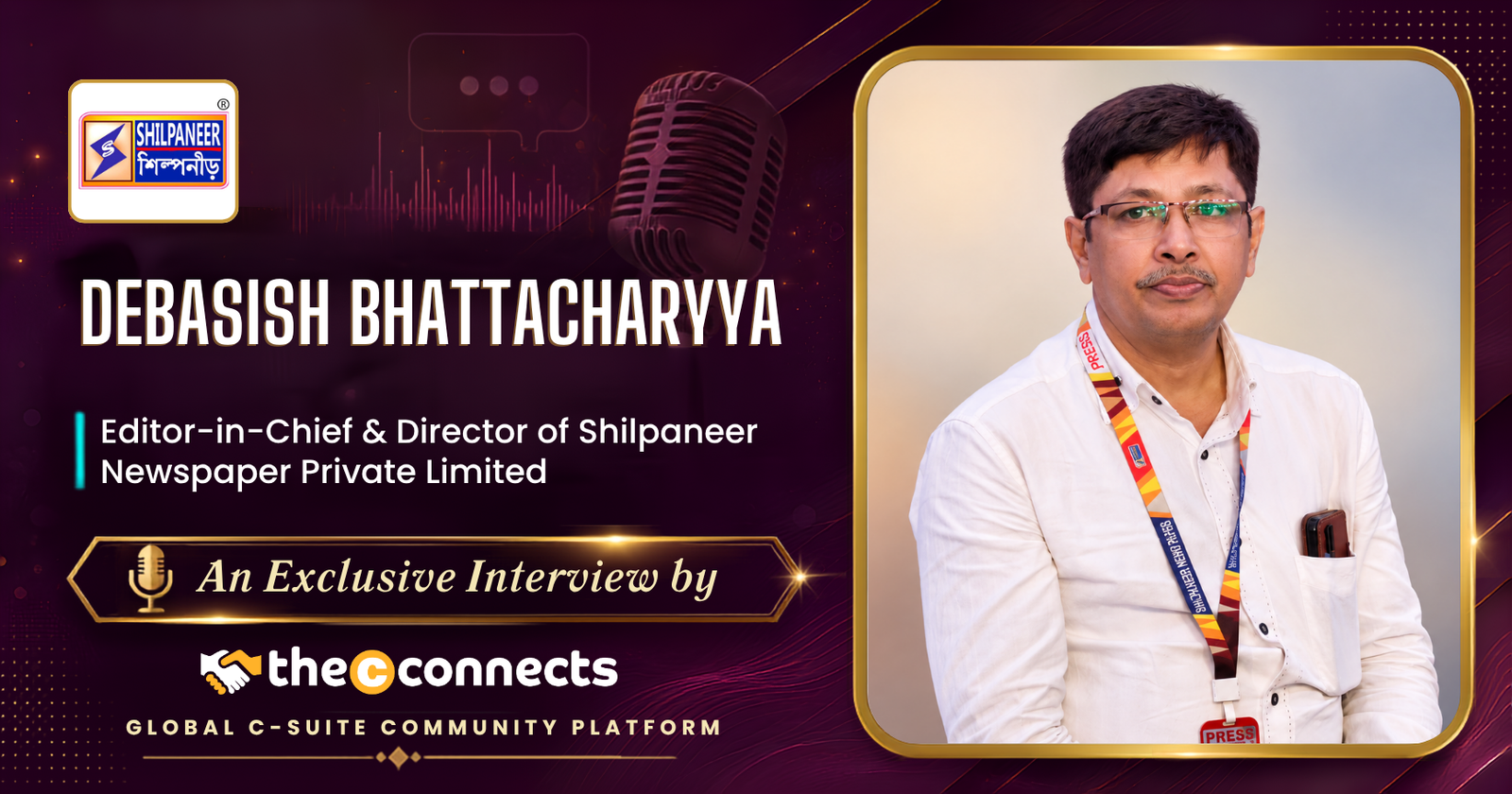

Welcome, Debasish Bhattacharyya! It is a distinct honor to host a cultural visionary of your caliber today. From the historic cultural hub of Shantipur-often called the “Cambridge of Bengal”-you have built an extraordinary legacy. Your journey spans decades as a revered theatre actor, television non fixing serial director, and acclaimed Bengali poem reciter, all of which naturally culminated in your leadership at Shilpaneer Newspaper. Today, as the Editor-in-Chief and Publisher of Shilpaneer Newspaper as well as the Director of Shilpaneer Newspaper Private Limited, you are championing emerging Bengali voices and regional journalism through both print and your digital e-magazine. We truly appreciate you taking the time for this conversation. How are you doing, and what is the current creative energy like at the Shilpaneer newsroom?
Debasish Bhattacharyya: Thank you so much for the incredibly warm welcome! It is a true pleasure to connect with TheCconnects and your readers. I am doing very well. The creative energy at Shilpaneer Newspaper is incredibly vibrant right now. We formalized our corporate structure into Shilpaneer Newspaper Private Limited recently, and we are heavily focused on expanding our digital footprint. We are actively curating content for our seasonal editions, including our special Durga Puja Sharod Sankhya, while continuously covering local events like the CIL Cup. Our newsroom is a dynamic mix of veteran cultural enthusiasts and young, emerging writers, making it a highly inspiring place to be every single day.
TheCconnects: Your professional journey is beautifully multifaceted, transitioning from traditional stage acting and national television into media leadership. Can you walk our readers through this evolution and how it led to your current role at Shilpaneer Newspaper?
Debasish Bhattacharyya: My professional journey has always been rooted in storytelling and cultural expression. Long before I became an editor, my life belonged to the stage and the microphone but not only editor but also an actor. My career began with open-air theatre in Shantipur, nadia in the early 1990s and expanded to national television and radio broadcasting since 1993. I had the privilege of working with Doordarshan, All India Radio, Zee Bangla, and Star Jalsha, and directing tele-magazines like Khonj and Kobitar Swapno Sarir.
Throughout those decades of directing and reciting, my core motivation was always to elevate Bengali culture. In 2008, I realized that while established artists had platforms, countless talented, lesser-known writers and musicians in rural and semi-urban Bengal were going unheard. That realization was the catalyst for Shilpaneer. What began as an independent publishing effort to support local literature and arts naturally evolved into Shilpaneer Newspaper. Today, managing the newspaper allows me to combine my media production experience with my lifelong dedication to giving emerging voices a global platform.
TheCconnects: It is a rare privilege to collaborate with legends across different eras of Bengali culture. Who has influenced you the most in your life and why?
Debasish Bhattacharyya: My greatest influences are the literary and cultural giants I have had the honor of working alongside. Directing figures like Nabaneeta Dev Sen, Chitra Lahiri, and Sarat Kumar Mukhopadhyay during the production of Kobitar Swapno Sarir profoundly shaped my understanding of literary depth. Furthermore, sharing the screen with legends like Soumitra Chatterjee during Sera Bangali was a masterclass in humility and artistic dedication. Also share the theatre platform with Legend Kumar Roy, Debes Chattopadhya, Writer Chandan Sen and so on.
On a deeper level, the heritage of Shantipur itself is my most constant influence. Growing up in a town steeped in classical music, handloom artistry, and deep literary traditions provided me with a cultural compass. The everyday struggles and triumphs of independent artists in Bengal constantly inspire me to ensure that Shilpaneer Newspaper remains a fearless, independent platform for their work.
TheCconnects: Running an independent cultural publication in today’s fast-paced digital era must be incredibly demanding. What are the biggest challenges you have faced with Shilpaneer Newspaper, and how did you overcome them?
Debasish Bhattacharyya: The biggest challenge was undoubtedly navigating the transition from a traditional print model to a unified digital and print ecosystem. When we started, print was the undisputed king of regional journalism. However, as reader habits shifted online, we had to digitize without losing our authentic cultural soul.
Another massive hurdle was financial sustainability. Independent publishing is rarely lucrative, and we wanted to keep subscription and advertising costs exceptionally low to support emerging writers. We overcame these challenges by embracing digital formats-launching the Shilpaneer e-magazine, building a strong presence on Facebook and YouTube, and officially incorporating Shilpaneer Newspaper Private Limited to streamline operations. By offering affordable subscriptions and relying on local community patronage, we built a self-sustaining model that protects our editorial independence.
TheCconnects: After decades traversing theatre, television, and journalism, what key lessons have you learned from your professional career?
Debasish Bhattacharyya: The most vital lesson I have learned is that authentic art and journalism do not need to be loud to be impactful. In television and media, there is often a rush for sensationalism. However, whether I was performing in the play Bhumidan at Gorky Sadan or editing a regional piece for Shilpaneer Newspaper, I realized that audiences deeply crave sincerity.
The second lesson is that talent is distributed equally, but opportunity is not. A brilliant poet in a remote village in Nadia deserves the same readership as an established author in Kolkata. As a media leader, my responsibility is to build the bridge between that raw talent and the global audience.
TheCconnects: Looking at the modern media landscape, what do you see as the biggest challenge for brands in the digital space today?
Debasish Bhattacharyya: The biggest challenge for brands in the digital space is maintaining their authentic identity amidst a sea of algorithm-driven content. The digital world forces publications to constantly fight for visibility, often pushing them to prioritize clickbait over quality.
For a cultural brand like Shilpaneer Newspaper, the challenge is proving that literature, poetry, and regional sports coverage still have immense value. The digital space is noisy. Cutting through that noise without compromising on the depth and integrity of Bengali literature requires immense discipline and a steadfast commitment to your core mission.
TheCconnects: How does Shilpaneer Newspaper address the specific pain points of your writers and your readers?
Debasish Bhattacharyya: We solve a very specific problem for emerging writers: the lack of accessible publishing platforms. Mainstream publications are often inaccessible to new authors due to high entry barriers. Shilpaneer Newspaper directly addresses this by maintaining a welcoming, open-door policy for independent writers. We provide an ISO-certified cultural magazine platform where they can publish original writing, poems, and news.
For our readers, the pain point is the loss of connection to grassroots cultural and regional news. We address this by providing hyper-local coverage that mainstream media ignores-whether it is local football tournaments like the CIL Cup, NGO activities, or deep-dive literary critiques. Furthermore, we make this highly accessible by keeping our e-magazine subscription costs very low.
TheCconnects: With your heavy involvement in directing the newspaper, corporate administration, and local cultural events, what does Debasish Bhattacharyya do in his free time?
Debasish Bhattacharyya: Art and culture are not just my profession; they are my lifeblood. In my free time, I return to my roots in recitation and voiceover work. I still find immense peace in performing poetry, much like I did when we released the Pronomi Tomare video CD featuring Rabindranath Tagore’s works. I also spend a lot of time mentoring young theatre actors and participating in cultural festivals across West Bengal. Listening to classical music and reading unpublished manuscripts keeps me deeply grounded and creatively refreshed.
TheCconnects: To conclude this highly insightful conversation, what advice do you have for aspiring media entrepreneurs and artists in your industry?
Debasish Bhattacharyya: My advice to aspiring entrepreneurs and media creators is to anchor your vision in a community. Do not start a publication or a brand merely for profit; start it because there is a voice that desperately needs to be heard.
Stay deeply connected to your roots. Whether you are building an app or a newspaper, your cultural identity is your greatest differentiator. Embrace digital transformation fearlessly, but never let the technology dictate your content. Finally, be patient. Building a trusted cultural platform takes years of consistency, empathy, and an unwavering commitment to quality.
TheCconnects: That is incredibly profound and grounded advice, Debasish Bhattacharyya. Your dedication to preserving Bengali literature and giving a voice to regional talent is truly inspiring. Thank you so much for sharing your journey, your cultural vision, and your expertise with us today. We wish you and Shilpaneer Newspaper Private Limited continued success in all your future endeavors!
Debasish Bhattacharyya: The pleasure was entirely mine. Thank you to TheCconnects for this wonderful platform and for highlighting the importance of independent cultural journalism.
TheCconnects: Have you received any awards or recognition for your work? That’s called an award!
Debasish Bhattacharyya: To answer this, first of all, when I started reciting Bengali poetry as a child, I did not get anything. But then, as I continued to participate as a contestant on the stage of the competition stage, I realized that it is not possible without learning a lot. The first competition of my life was the recitation competition of the ‘Oikya Sammelani Club’ of Santipur. I couldn’t find a place. However, I knew very little of the two people who were present as judges in that competition. One of them was Shri Debashis Bandyopadhyay, the worthy nephew of the famous radio and television newsreader Debdulal Bandyopadhyay and the great poet of Santipur, Swapan Roy (now deceased). At that point, I knew I had to learn how to write poetry. I started taking lessons from Debashish Da and Swapn da. I was a student of Class XI then. Yes, I forgot to say, the poem was Poet Nazrul Islam’s “BIDROHI”.
Although Swapan da was a clerk in the bank at that time, he used to take English lessons at home. I used to sit in one corner of the classroom and listen to him teach. In the end, I discussed the rhythm of the poem in a few words. I was very upset later. The relationship didn’t end. If I did, I wouldn’t say it today. He left this world two years ago.
I learned two things from him: one is English, and the other is poetry. It’s also a reward. I started a business year-round. He has also written books of poetry. I can’t remember exactly what day it was: January 23rd. It was around 8 at night. Suddenly, a dream came true. I found out that he had a small pamphlet out, with some poems. He wanted me to read two of his poems. I did. Then I realized how much I had learnt. He left without saying anything. It’s also a reward.
Maybe it will be 2010 / 11. At that time, I said, ‘I want to make a newspaper.’ ‘How can I do that? Let’s lay out and determine the size and how much more. At that time, I did not understand how many government permissions were needed to make a newspaper. I need to connect with people. In 2012, my edited magazine ‘SHILPANEER’ was published at the annual function of a newspaper in Ranaghat. Eminent poets and writers were present on the occasion. A lot of people picked up the paper that day. It was an emotional moment. A full-colour tabloid printed on four-page art paper. It was a fruitful gift of many struggles of today’s me and ‘SHILPANEER’. It was not time for society. The journey of ‘SHILPANEER’ magazine started. A great exhibition with the stalls of SHILPANEER Publications at the 35th Kolkata Book Fair. It was my dream and reality. Even today, there is SHILPANEER with its own form, fragrance, and richness. 12 years have passed today. At the same time and in the same manner. Today we have 20-25 field reporters. Core committee and many other government permissions. I don’t know if we are like that today.
In addition, I have received the ‘India-Bangladesh Friendship Award’, the ‘India Health Next Award 2026’, the ‘Rashtriya Gaurav Award’, and the biggest award, the ‘Honorary Doctorate Award’. For many years of tears, many hardships, and hard work and perseverance.