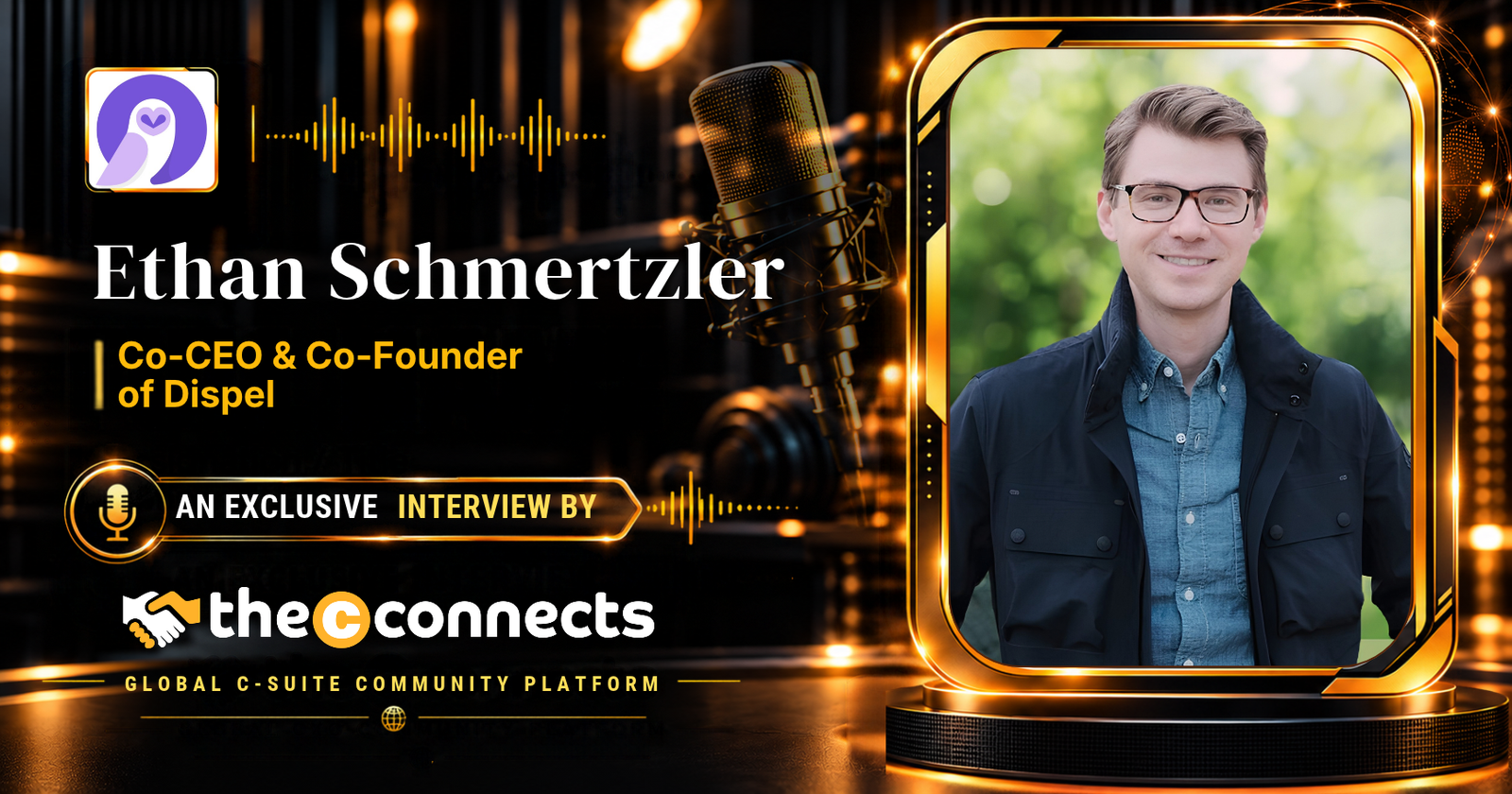

Welcome, Ethan Schmertzler! It is an absolute privilege to have you with us today. As the Co-CEO and Co-Founder of Dispel, you are at the helm of a company that protects over $500 billion in manufactured goods and serves more than 54 million utility users globally. Your extensive background-ranging from C4ISR capabilities to serving as an advisor for NATO and the U.S. Cybersecurity and Infrastructure Security Agency (CISA)-is incredibly impressive. The Dispel Zero Trust Engine is completely redefining Operational Technology (OT) secure remote access. Given your demanding schedule of steering global cybersecurity infrastructure, we truly appreciate you taking the time for this conversation. How have you been, and what is the energy like at Dispel these days?
Ethan Schmertzler: Thank you so much for the warm welcome! It is a pleasure to sit down with TheCconnects. I’m doing very well, thank you. The energy at Dispel is incredibly dynamic right now. We are seeing a massive shift in how the world’s largest utilities and manufacturers perceive industrial security. They are realizing that legacy tools are no longer sufficient. Our team is operating at full throttle-expanding our Dispel Zero Trust Engine capabilities and scaling across critical infrastructure. It is an intense, fast-paced environment, but the mission keeps everyone highly motivated.
TheCconnects: Your professional journey is fascinating. You hold a BA in Psychology, Japanese, and European History from Middlebury College, yet you transitioned into early-stage venture capital focused on defense, and ultimately founded a major cybersecurity firm. Can you walk our readers through this evolution?
Ethan Schmertzler: My background is definitely non-traditional for a cybersecurity founder, but it’s well suited to the dynamics of being a founding CEO. Psychology actually provided a brilliant foundation for human interface design and user interaction, which became crucial when we started building software. I spent some time in Silicon Valley during my college years, which sparked my interest in technology.
After graduating, I focused on emerging C4ISR (Command, Control, Communications, Computers, Intelligence, Surveillance, and Reconnaissance) technology. That experience immersed me in the broader defense and cyber sectors. I realized there was a glaring vulnerability in how critical infrastructure and industrial control systems were accessed remotely. In 2014, my co-founder and brother, Ian, and I started Dispel in my New York City apartment with the goal of creating a secure, anonymous internet transport system. We wanted to build something that didn’t just add security, but actually made operations run faster.
TheCconnects: Every founder draws inspiration and resilience from their personal experiences. Who or what has influenced you the most in your life and your approach to leadership?
Ethan Schmertzler: I draw a massive amount of influence from my experiences in the wilderness. I’ve been a National Outdoor Leadership School (NOLS) Wilderness EMT since 2007 and had the pleasure of other NOLS expedition courses, as well as NGO and non-profit work and engagement.
In those environments, you learn the concept of good expedition behavior (EB), one taught heavily by NOLS. Good EB means doing your share and then going beyond just a little more for others. It means thinking of the team before yourself. It means asking if anyone’s blocked and offering to take the gnarly customer call at 2 AM so someone else can sleep. It means getting in early to fix the flaky build and doing the unglamorous cleanup that needs doing. It means writing painstakingly clear docs and handoffs for the people who come after you, and giving the team the credit for the big win instead of taking it yourself. It means being kind and generous and big-hearted.
We’ve made EB a big part of our cultural pillars here at Dispel.
TheCconnects: Building a company that secures the world’s most critical infrastructure must come with immense pressure. What are the biggest challenges you have faced at Dispel, and how did you overcome them?
Ethan Schmertzler: The biggest challenge in the early days was simply convincing deeply entrenched, legacy-heavy industries-like utilities and manufacturing-to adopt a fundamentally new approach to security. These sectors historically relied on static VPNs and manual, IT-centric access models. They ended up facing a lot of operational friction.
We overcame this by proving that security and efficiency are not mutually exclusive. We didn’t just build a better lock; we built a faster door. We demonstrated that with Dispel, vendors could connect remotely in under 30 seconds, and we could deploy new sites in a single day. Once we proved that our Dispel Zero Trust Engine actually eliminated the operational friction they were accustomed to, the adoption barrier dissolved.
TheCconnects: You often serve on high-level advisory boards, including CISA and NATO. What key lessons have you learned from your professional career, particularly operating at the intersection of government defense and private enterprise?
Ethan Schmertzler: The most critical lesson is that security cannot be an afterthought; it must be built into the foundation of the operational workflow. In government and defense, the stakes are existential. You learn very quickly that adversaries are highly sophisticated and heavily resourced.
Another major lesson is the importance of collaboration. No single entity-government or private-can secure critical infrastructure alone. Serving on the CISA Sector Coordinating Council and advising NATO has reinforced my belief that public-private partnerships, transparent threat sharing, and joint strategic dialogue are essential for national and global security.
TheCconnects: Looking at the current landscape, what do you see as the biggest challenge for industrial and manufacturing brands in the digital space today?
Ethan Schmertzler: The biggest challenge is what we call the “session blind spot” and the persistent attack surface. As industrial environments digitize and connect to the cloud for AI and predictive maintenance, their attack surface explodes.
Most brands still rely on traditional authentication-once a user logs in, they are trusted. But most remote access platforms don’t know who is typing the passwords, and static infrastructure allows attackers to map networks and return later. The challenge is shifting from a perimeter-defense mindset to continuous, real-time evaluation. If you aren’t verifying the actual human behind the keyboard and constantly rotating your infrastructure, you are highly vulnerable.
TheCconnects: How does the Dispel Zero Trust Engine directly address these complex pain points for your customers?
Ethan Schmertzler: We eliminate the friction and the blind spots. Most secure remote access stops at the login. Dispel secures every session from login to disconnect.
First, our OT Secure Remote Access and Industrial Data Streaming deliver best-in-class experiences for administration, management, and maintenance of critical infrastructure. Second, Dispel Identity verifies the actual human behind the connection-using biometric facial matches and government ID validation-not just a phished password. Third, Dispel Intelligence continuously scores the session’s risk in real-time, integrating with the customer’s existing OT security stack. Finally, Dispel Compliance automatically builds audit evidence in the background. We make the secure path the fastest path, allowing operators and OEMs to connect safely in seconds.
TheCconnects: With such a demanding role protecting global infrastructure and serving on international councils, what do you do in your free time to disconnect and recharge?
Ethan Schmertzler: Disconnecting is crucial for maintaining clarity. As I mentioned, I love the outdoors. I’m an avid cyclist and skier. I practice Krav Maga, which is an excellent physical and mental reset. I also enjoy photography and love to cook.
TheCconnects: Finally, what advice do you have for aspiring entrepreneurs looking to enter the highly complex fields of cybersecurity or defense technology?
Ethan Schmertzler: My advice is to get relentlessly into the technical weeds of the market you are trying to serve. Do not build a product in a vacuum and assume the market will adapt to it. Understand the daily friction your end-users face. In our case, we had to understand the exact workflow of an industrial operator and build a security system that enhanced that workflow rather than hindering it. Also, cultivate a culture of “good expedition behavior” from day one. Your technology will only be as resilient as the team building it.
TheCconnects: That is brilliant, actionable advice. Thank you so much for joining us today, Ethan. It has been an absolute privilege exploring your journey, the incredible technology behind Dispel, and your vision for the future of critical infrastructure security. We wish you and the entire Dispel team continued success!
Ethan Schmertzler: Thank you for having me. It was a great conversation, and I appreciate the opportunity to share our mission with TheCconnects audience.