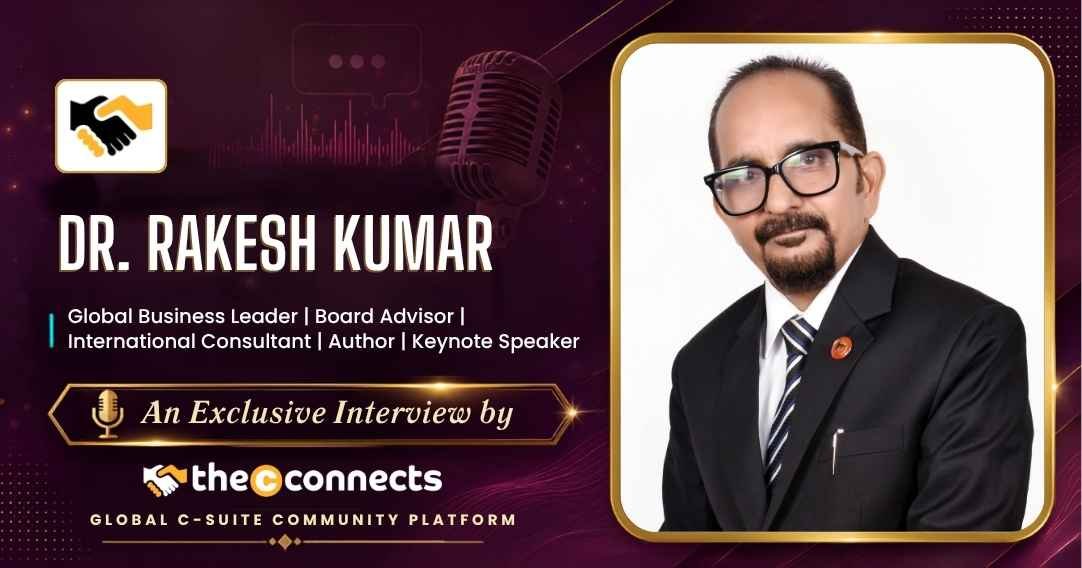

Welcome, Dr. Rakesh Kumar! It is an absolute privilege to have you with us today. First and foremost, congratulations on receiving the Lifetime Achievers Award earlier this year, a fitting addition to your extensive list of accolades, including the Indian Achievers Award. Looking at your 35-year trajectory-from a small village in the Himalayan foothills to the boardrooms of global giants like Nestlé, Amul, Parle Agro, Unikai Foods, and Almarai-your journey is a masterclass in resilience and operational excellence. Given your busy schedule advising multi-billion-dollar projects and mentoring the next generation of Dairy & Food tech leaders, we truly appreciate you taking the time for this conversation. How have you been, and what has been keeping you the most energized lately?
Dr. Rakesh Kumar: Thank you for the very warm welcome. It is a pleasure to be speaking with TheCconnects. I have been doing exceptionally well. What keeps me most energized these days is the sheer pace of transformation happening in the global Dairy and Food tech sectors. Transitioning from active corporate execution into a full-time Board Advisor and International Consultant has given me a fantastic vantage point. Lately, I have been deeply engaged in advising on a massive USD 3.6 billion integrated dairy project, alongside mentoring a few highly innovative food startups and advising academic universities. Helping organizations build future-ready, sustainable business models is incredibly fulfilling.
TheCconnects: Your career is a remarkable blueprint for executive leadership. For our readers, could you take us back to the beginning? How did you transition from your roots in the Himalayas to commanding multinational manufacturing and FMCG operations across the Middle East, Africa, and Oceania?
Dr. Rakesh Kumar: My journey began in the foothills of the Himalayas in Himachal Pradesh, where life taught me resilience, discipline and humility. In the early 1980s, information and career guidance were limited, and there was not even an engineering college in our state. I was passionate about becoming an engineer, although I was not sure which branch to pursue. Then, an unexpected opportunity came my way-I was selected to study Dairy Technology. That decision became a turning point, taking me from my Himalayan roots into a world of technology, dairy, food and business, and eventually onto a journey across industries, cultures and global leadership.
From there, my career was built on the factory floor and the supply chain trenches. I spent my formative years advancing through manufacturing and quality systems at organizations like Nestlé, GSK, and Almarai. Over time, I realized that operational excellence isn’t just about managing machines; it is about managing people and capital. To bridge that gap, I pursued advanced leadership and management programs at IIM Ahmedabad and IMT Ghaziabad. That academic backing, paired with hardcore ground experience, allowed me to step into P&L leadership roles, eventually leading operations exceeding USD 100 million for brands like Unikai Foods in Dubai, and managing INR 800 Crore operations at Amul.
TheCconnects: Climbing to that level of international leadership requires strong guiding forces. Who has influenced you the most in your life and shaped your value-based leadership philosophy?
Dr. Rakesh Kumar: My strongest influences have always been the environments I was placed in. The simplicity and hard work of my early village life taught me that there are no shortcuts to sustainable success. Professionally, I was profoundly influenced by the foundational ethos of the cooperative dairy movement in India-the idea that massive commercial success can, and should, directly uplift the primary producer at the grassroots level. Working alongside visionary leaders in the Middle East and New Zealand, representing India on various international platforms, and speaking at TEDx, Economic Times, and CII taught me the importance of scale and technological integration. My leadership philosophy today-which focuses on transparency, empowering cross-functional teams, and balancing aggressive growth with corporate governance-is a direct reflection of those combined experiences.
TheCconnects: You are well known for your ability to execute massive corporate turnarounds. At Unikai Foods PJSC in the UAE, you helped transform an AED 90 million loss into a break-even operation. What are the biggest challenges in executing a turnaround of that scale, and how did you overcome them?
Dr. Rakesh Kumar: Turning around a heavily bleeding enterprise is never just a financial exercise; it is fundamentally a cultural and operational challenge. When a business is losing that kind of capital, morale is typically shattered, and silos have formed across departments. The biggest challenge is stopping the operational hemorrhage without completely halting business momentum.
At Unikai, I reported directly to the CEO with a mandate to overhaul manufacturing, supply chain, and product innovation across the UAE and Oman. We overcame the crisis by going back to the absolute basics. We aggressively optimized the supply chain, which reduced annual operating costs by approximately USD 1 million. Simultaneously, we didn’t just cut costs; we chased strategic revenue. Of course, there were some tough decisions. We developed new product lines and secured high-value institutional clients like Emirates Airlines, Hilton, and Shangri-La. By aligning our 1,200+ employees behind a single, transparent recovery metric, we improved manufacturing efficiency and brought the business back from the brink.
TheCconnects: On the flip side of a turnaround is hyper-growth. During your tenure as Head of Operations at Amul, you delivered 35% business growth. What key lessons did you learn about scaling manufacturing and operations so rapidly?
Dr. Rakesh Kumar: The most critical lesson in scaling is that your infrastructure and your people must grow at the exact same pace. At Amul, we were managing a highly perishable commodity where supply chain bottlenecks are fatal. To achieve that 35% growth, we increased local milk procurement by 20% and commissioned new manufacturing facilities. But the real lesson was in value addition. We didn’t just push more volume; we expanded the value-added dairy product portfolio, which alone added INR 20 Crores in annual revenue. The takeaway is that sustainable scale requires a flawless marriage between rapid capacity expansion and continuous product innovation.
TheCconnects: Today, digital transformation is a boardroom priority everywhere. What do you see as the biggest challenge for global FMCG and manufacturing brands in the digital space?
Dr. Rakesh Kumar: The biggest challenge for legacy FMCG and manufacturing brands is the integration of Industry 4.0 and Smart Manufacturing into existing, traditional infrastructures. Everyone wants to talk about Artificial Intelligence and data analytics, but if your factory floor sensors aren’t communicating properly with your ERP system, that data is useless. The challenge is achieving true end-to-end digital visibility-from farm procurement to the retail shelf-without disrupting ongoing daily operations. Brands struggle with the “last mile” of digital transformation: training their legacy workforce to actually adapt to and trust these new digital tools.
TheCconnects: As an International Board Advisor, you now help companies navigate these exact hurdles. How do your advisory solutions address the current pain points of your corporate clients?
Dr. Rakesh Kumar: Right now, FMCG and dairy promoters face three major pain points: margin compression due to raw material inflation, inefficient capital deployment in new projects, and stagnant market expansion.
I address these by bringing 35 years of tested, cross-geography execution experience to the table. I don’t just provide theoretical reports. If a client is planning a greenfield project, I conduct rigorous investment evaluation and project feasibility studies to ensure capital efficiency-much like the USD 3.6 billion integrated dairy project I recently evaluated. I help them redesign their supply chains for resilience, implement smart manufacturing protocols to protect their margins, and build the organizational capability required to sustain that growth long after my advisory mandate concludes.
TheCconnects: Beyond the boardroom, you are also an accomplished author. Tell us about your book, From the Himalayas to the Helm, and what you do in your free time.
Dr. Rakesh Kumar: Writing From the Himalayas to the Helm-and its Hindi counterpart, हिमालय से नेतृत्व की कमान तक-was a deeply personal project. I wanted to document the leadership lessons, the operational strategies, and the personal resilience required to navigate from a rural upbringing to global executive leadership. It is my way of giving back and leaving a blueprint for the next generation of professionals.
As for my free time, my work and my passions are closely intertwined. I spend a significant amount of time mentoring emerging leaders and startups in the Dairy & Food tech spaces. I also enjoy reading extensively on macroeconomics and spending quiet time reflecting, which keeps me grounded.
TheCconnects: To wrap up this highly insightful session, what is your ultimate advice for aspiring entrepreneurs looking to disrupt the FMCG, dairy, or food-tech industries today?
Dr. Rakesh Kumar: My advice to emerging entrepreneurs is simple: fall in love with operational excellence, not just your product idea. A great product is only the beginning; sustainable success depends on disciplined execution across manufacturing, supply chain, quality, distribution and customer service.
Embrace data as a leadership tool-use it to understand your processes, identify problems early, improve decisions and continuously raise performance. As businesses move towards Smart Manufacturing, AI and automation, leaders must learn to connect technology with real operational challenges rather than adopting technology for its own sake.
Build strong unit economics from the beginning, protect uncompromising quality standards, keep your processes and supply chain lean, and build a resilient culture. Technology may give you an advantage, but operational excellence, data-driven decisions and strong people create lasting value.
TheCconnects: That is brilliant, actionable advice. Thank you so much for joining with us today, Dr. Rakesh Kumar. It has been an absolute honor to explore your incredible career, your insights into global manufacturing, and your vision for the future of the FMCG industry. We wish you continued success in all your advisory and literary endeavors!
Dr. Rakesh Kumar: Thank you very much for having me. It was a wonderful conversation, and I highly appreciate the platform TheCconnects provides for sharing these industry insights.