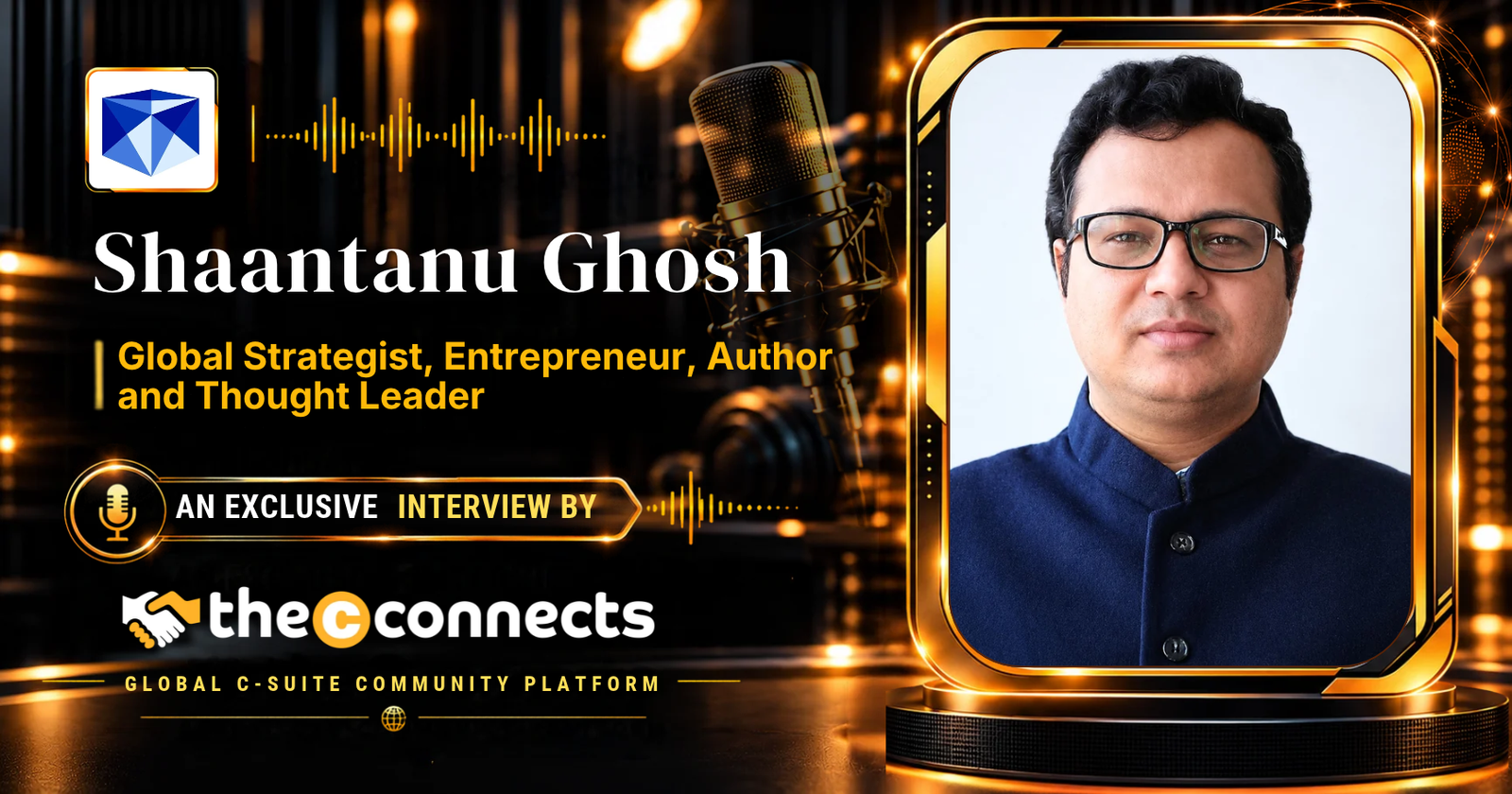

Welcome, Shaantanu Ghosh! It is an absolute privilege to host a strategic visionary of your caliber today. Over the past three decades, your career has been defined by a consistent pattern of industry disruption – from pioneering India’s BPO movement in the late 1990s, to introducing Knowledge Management frameworks in the early 2000s, to establishing some of the country’s first LPO ventures in the mid-2000s, and now to your current role at the intersection of global capital, government affairs, and economic statecraft. Today, as the Founder Chairman of Shriyai Consulting Group, an Economic Advisor for Multilateral Organizations, and the author of The Governance Arbitrage, you guide institutions and governments through profound transformations. We are thrilled to dive into your journey. [new para to start the Q&A] To begin, can you tell our readers a little about your professional evolution and how you transitioned into high-level economic statecraft and advisory?
Shaantanu Ghosh: Thank you for the incredibly warm welcome. It is a pleasure to connect with TheCconnects and your readers. My journey has fundamentally been about understanding how value is created at the intersection of different systems-technology, business, and governance. I started in the early 1990s as a programmer, which taught me the foundational logic of building things from the ground up. However, I quickly realized my true passion lay in applying technology to solve broader, complex business problems.
The late 1990s and early 2000s were a pivotal time in India. I was deeply involved in the early development of India’s Business Process Outsourcing (BPO) sector and subsequently worked on introducing Knowledge Management frameworks in India and thereafter establishing Legal Process Outsourcing (LPO) ventures at a time when these were still nascent business models in our country. We were essentially helping develop emerging industry segments and proving that high-value, complex knowledge work could be distributed globally. That experience of taking an abstract concept and scaling it into a disruptive business model shaped my strategic approach. In the 16 years since founding Shriyai Consulting Group, I have been able to synthesize that operational rigor with high-level strategic advisory. Today, the firm operates at the intersection of business and governance – facilitating cross-border investments & partnerships, while engaging institutional stakeholders, and helping businesses and projects navigate the complex operating and regulatory environments across Asia, Africa, and the Middle East.
TheCconnects: You have operated across highly diverse cultural and corporate landscapes. Who has influenced you the most in your life and shaped your unique leadership philosophy?
Shaantanu Ghosh: Professionally, I am continually inspired by leaders who balance bold, disruptive vision with the meticulous discipline required for execution. However, on a foundational level, my greatest influences stem from ancient scriptures and philosophical texts.
I spend a significant amount of my time studying these timeless wisdom traditions and correlating them with modern scientific, medical, and institutional discoveries. These texts reinforce the idea that while the tools we use-whether it’s Artificial Intelligence or new financial instruments-change rapidly, the core principles of human behavior, ethics, and effective governance remain remarkably consistent. This understanding is encapsulated in a belief that guides every aspect of my work: “Enduring progress is achieved when knowledge is balanced with character and purpose.” It serves as my North Star, reminding me that true value isn’t just financial; it’s about sustainable, positive impact.
TheCconnects: Operating across emerging markets in Asia, Africa, and the GCC undoubtedly comes with immense geopolitical and regulatory hurdles. What are the biggest challenges you have faced in this space, and how did you overcome them?
Shaantanu Ghosh: One of the most recurring challenges I face is navigating institutional inertia, particularly when advising governments or large, legacy corporations. When you operate in emerging markets, you frequently encounter entrenched systems resistant to change, often compounded by regulatory ambiguities and cultural nuances.
Overcoming this requires a delicate blend of deep operational rigor and high-level diplomacy-what I call “Economic Statecraft.” You cannot just present a brilliant strategy in a boardroom and expect it to be implemented seamlessly. I’ve learned that you must build consensus by demonstrating clear, measurable value at every step. It’s about bridging the gap between a leader’s visionary strategy and the institutional discipline required to execute it on the ground. This means understanding the local context intimately, aligning the interests of diverse stakeholders-from government policymakers to local operational heads-and ensuring the transformation is practically executable.
TheCconnects: You recently authored The Governance Arbitrage: Re-engineering the Indian State, which introduces a bold framework for unlocking economic value. What key lessons have you learned from your career that inspired this book?
Shaantanu Ghosh: A central lesson of my career and the core premise of my book is that immense economic value is often trapped within existing public and private systems due to sheer inefficiency. True transformation does not always require massive new investments, higher taxation, or increased public spending. Very often, it comes from re-engineering governance, improving capital deployment, and restructuring institutions.
While dealing with various Governments within our country or outside, one recurring lesson has stayed with me: a country’s or a state’s potential and its actual outcomes are not always the same. We often discuss economic growth in terms of capital, infrastructure, technology and policy. All of these are important. But there is another dimension that deserves equal attention: the quality of governance and the ability of institutions to translate intent into results.
Another vital lesson is the absolute necessity of a multidisciplinary approach. You cannot solve today’s complex global problems through a single lens. At Shriyai, our strength lies in our exceptionally diverse management team – we have Principal Consultants leading Artificial Intelligence, Renewable Energy, Hospitality, International Law, and Finance. This structure allows us to integrate macroeconomic strategy with precise, domain-specific operations. Finally, I’ve learned that resilience is non-negotiable. Whether you are building present day GCCs – Global Capability Centres- from scratch or facilitating complex business and government assignments globally, the ability to absorb setbacks, adapt, and keep moving forward is what ultimately drives success.
These key ideas prompted me to write this book so that we can have a deeper examination of how the State functions, how institutions create or constrain value, and how governance can be rethought to deliver better outcomes, instead of functioning merely as an administrative & compliance head in its operations – apart from policy making.
TheCconnects: Looking at the modern, hyper-connected landscape, what do you see as the biggest challenge for brands and massive institutions in the digital space today?
Shaantanu Ghosh: The digital space has democratized access, which is empowering, but it has also created an environment of intense noise, fleeting attention, and skepticism. The biggest challenge for brands and institutions today isn’t just visibility; it’s establishing and maintaining genuine trust and authority.
As digital transformation accelerates, maintaining institutional resilience is harder than ever. A brand’s digital presence must be a true, authentic reflection of its operational reality. If there’s a disconnect between the digital promise and the actual service delivery-especially in complex B2B, investment, or government advisory sectors-trust erodes instantaneously. The challenge is ensuring that digital strategies are anchored in real, tangible value creation, robust data governance, and uncompromising ethical standards.
TheCconnects: How does Shriyai Consulting Group specifically address the pain points of organizations trying to scale across these complex emerging markets?
Shaantanu Ghosh: Our clients – whether they are multinational corporations, investors, or sovereign entities – often face the pain point of navigating complexity. They struggle with regulatory hurdles, operational inefficiencies, and the sheer difficulty of executing a cross-border strategy.
At Shriyai, we address these challenges through an integrated approach combining strategic advisory, investment facilitation, corporate structuring, cross-border partnerships and institutional engagement. For instance, in Africa, we do so through our growing presence and network across the continent, which strengthens our understanding of local markets and cross-border business opportunities. Likewise, our international engagements also extend to the GCC, including advisory interactions with members of the Bahraini Royal Family and regional business stakeholders in UAE. With a partner base in the UK, we get direct access to the European market. Hence, a localised understanding coupled with a global approach, helps us address our clients’ expectations and pain areas.
TheCconnects: Balancing roles as a Group CEO, a board member, an author, and a government advisor must be incredibly demanding. What do you do in your free time to detach and recharge?
Shaantanu Ghosh: Beyond my professional commitments and my readings in ancient scriptures, my humanitarian work is a deeply significant part of my life. I serve as the Secretary General (pro bono) for the Tristar Global Humanitarian Trust based in the USA. We work in tandem with various governments to fund and strategize humanitarian projects across Asia and Africa – focusing on healthcare, skill development, education, and rural infrastructure. At present, I am also exploring options in Social Entrepreneurship.
Applying the strategic and financial acumen gained in the corporate world to create tangible, positive impacts in underserved communities is incredibly fulfilling. It keeps me grounded and reminds me of the broader purpose beyond business success. And, most importantly, I cherish the time I spend with my family; my wife and son, who are my greatest sources of joy and balance.
TheCconnects: Finally, drawing from your decades of experience disrupting industries and advising government stakeholders, what key advice would you offer to aspiring entrepreneurs and strategic advisors?
Shaantanu Ghosh: My advice is to focus relentlessly on value creation rather than just valuation. In the rush to scale or disrupt, it is easy to lose sight of the fundamental problem you are trying to solve. Ensure your business model is built on solid operational rigor and addresses a genuine need.
Embrace complexity, but strive for simplicity in execution. Understand the geopolitical and regulatory environments you operate in, respect cultural nuances, and build strong, multidisciplinary teams. Above all, ensure that your enterprise contributes to sustainable and inclusive growth. True leadership is not just about building profitable businesses; it is about building resilient institutions that endure and leave a legacy of positive impact on the world.
TheCconnects: That is exceptionally profound and actionable advice, Shaantanu. Your ability to seamlessly integrate deep operational strategy with diplomatic statecraft and humanitarian values is truly inspiring. Thank you so much for sharing your journey and wisdom with us today. We wish you and the team at Shriyai Consulting Group continued success in all your global endeavors!
Shaantanu Ghosh: The pleasure was entirely mine. Thank you to TheCconnects for this wonderful platform and for the insightful conversation.