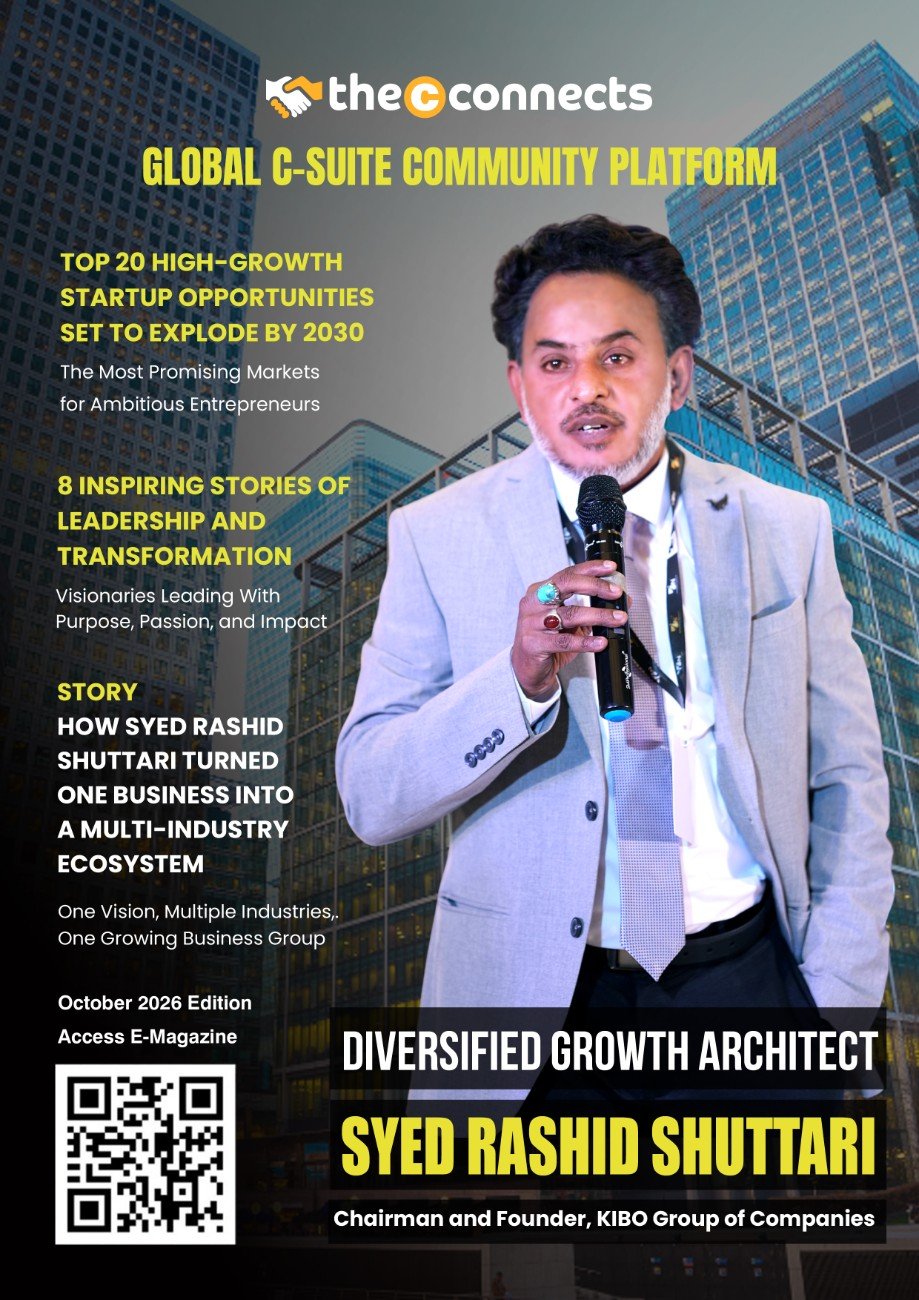

Cover Story: Syed Rashid Shuttari – The Diversified Growth Architect
This month’s cover feature belongs to Syed Rashid Shuttari, Chairman and Founder of KIBO Group of Companies, under the title “Building Across Boundaries.” His early career was spent inside the corporate sector – human resources, administration, business operations, and interior solutions – an education, as the feature puts it, in how organizations actually function: how people are managed, how operations are disciplined, how customers are retained. He built his first venture, an interior solutions business, more than fourteen years ago, and the lesson it taught him shaped everything that followed: diversification only works when each new venture rests on real operational knowledge, not just appetite. An MBA in Business Administration, combined with his grounding in time management and HR, gave him the formal framework to match that practical experience.
That philosophy produced KIBO Group, a conglomerate unified under one corporate identity in 2011 and now operating across distinct companies: KIBO Software and KIBOTech in technology solutions, KIBO Infra in infrastructure development, KIBO Mart in retail and supply chain, KIBO Fashions and KIBO Herbal Beauty in lifestyle and wellness, and separate ventures in events, entertainment, music, and regional film production. The structure is deliberate – each company stands on its own operational discipline, while the group as a whole benefits from shared, integrated capability that can carry a project from concept through to execution.
The recognition has followed at pace. In 2026, KIBO was named “Most Dynamic & Diversified Business Conglomerate of the Year” at the Global Icon Award convention in Goa, and Shuttari received the Telangana Global Elite Business Award for Emerging Conglomerate of the Year, followed by the Telangana & Andhra Achievers Award from the Global Pinnacle Foundation. He was also featured as the cover story of JJ Crowns Magazine’s July 2026 issue. But the feature makes a point of looking past the trophy case to where Shuttari actually invests the group’s visibility: KIBO served as the prime sponsorship partner for Glam Connect Edition 3, partnered on Face of India 2026 to scout new modeling talent, and acted as a prime financial sponsor of the Mumbai Growth & Success Awards – strategic investments in talent pipelines and brand ecosystems, not charitable gestures. KIBO has also acquired Ador Beauty Cosmetics, now the official beauty partner of designer Vishal Kapoor’s Timeless Fashion Show, and holds the only Hyderabad distributorship for Florencia Paris Perfumes.
The feature’s most forward-looking section covers KIBO’s move into Dubai, establishing a commercial presence in one of the world’s primary crossroads for trade, capital, and connectivity between India, the Gulf, and Africa. For an Indian diversified group, a Dubai base offers access to international partnerships and a credibility signal to global clients – and the expansion was recognized internationally when KIBO was invited as a VIP guest at the World Record of Excellence Awards in England.
What stands out most, though, is how the piece frames leadership itself. Shaped by his HR background, Shuttari’s approach gives equal weight to people and performance – nurturing talent, encouraging creativity, and treating employment generation and skill-building as core to the group’s purpose rather than peripheral CSR. The feature closes with a set of practical takeaways for other founders: operational credibility should precede diversification, governance should stay unified while execution decentralizes, sponsorships and talent platforms compound brand value across verticals, and international expansion works best as a discipline rather than a milestone to tick off. His own words sum up the philosophy best: at KIBO, the purpose is to build businesses that create meaning, deliver value, and shape a better tomorrow – not just revenue.
Ramesh Aiyyangar – Turning Technical Writing Into a Movement
Ramesh Aiyyangar founded Tech Write Pro on 4 June 2023 after nearly four decades in the field, including roles at 15-plus Fortune 100 and global technology organizations: IBM, Veritas, Symantec, Apigee, Capgemini, Persistent, HCL, and Reltio. More than 15 years in leadership positions and over 20 years of mentoring technical communicators shaped the philosophy behind the venture – one built not simply to produce better documentation, but to strengthen the professionals who write it.
Rather than building a conventional documentation agency, Aiyyangar structured Tech Write Pro around three pillars: mentoring, training, and community. Within roughly three years, that model has drawn a LinkedIn following exceeding 1,300 and more than 2,000 members across its broader social communities, organizing 30 to 40 online events with participants from Oracle, Cisco, Intel, HPE, Siemens, TCS, and Wipro.
His contribution to the profession runs deeper than his own company. He served as President of the Society for Technical Communication India Chapter in both 2013 and 2018, was elevated to Fellow of STC in 2019, and founded the Institute for Technical Communicators of India in 2018, which later became an initiative under Tech Write Pro itself. As AI reshapes how information gets researched and delivered, he’s made AI-enabled technical communication a core part of the curriculum, teaching professionals to treat it as a complement to human judgment, not a replacement. His contribution was recognized with the Glory of India Award in 2023 from the Indian Achievers’ Forum.
Debasish Bhattacharyya – Giving Regional Culture a Media Voice
As Editor-in-Chief and Director of Shilpaneer Newspaper Private Limited, Debasish Bhattacharyya brings an unusual background to journalism: years in theatre, television, radio, and recitation before ever running a publication. That experience, dating back to stage productions in the early 1990s and continuing through associations with Doordarshan Kolkata, Zee Bangla, Star Jalsha, ETV Bangla, and All India Radio, taught him something publishers often miss – that audiences don’t connect with information alone, they connect with voice, memory, and identity.
Founded in Shantipur, Nadia, in 2008, Shilpaneer grew from a cultural initiative into a print-and-digital media platform built to give space to regional stories, literature, emerging writers, and community voices that mainstream coverage typically overlooks. Its formal incorporation as Shilpaneer Newspaper Private Limited in 2025 marked its evolution into a structured media enterprise, though its real strength lies in holding onto the intimacy of a community platform while adopting the reach of a modern media business. Today its coverage spans local news, literature, sports, social initiatives, and cultural events, with its e-magazine and digital presence extending regional content beyond its original geography.
AjayKumar Rath – Making AI Accountable, Not Just Capable
AjayKumar Rath has built a career at the intersection of business intelligence, machine learning, data analytics, and AI research, moving through Wipro, Infosys BPM, Lendistry, LEALE.AI, and now Unilode Aviation Solutions. The through-line across all of it: analytics isn’t just a reporting function anymore – it’s becoming part of the decision engine itself.
The numbers behind his track record are concrete. At Lendistry, a cash-flow application he built improved loan decision-making speed by 25 percent, while machine-learning-based customer segmentation contributed to a 40 percent improvement in conversion, and reporting processes that once took 15 days were cut to one. Earlier, at Infosys BPM, his fraud analytics work helped identify approximately $156,000 in potential fraud value during FY2019-20, with predictive models achieving around 90 percent accuracy and cutting analysis time from five hours to two.
The more distinctive chapter of his story is what he’s building next. Through LEALE.AI, founded in 2025, he’s explored a self-evolving cognitive architecture combining large-language-model reasoning, dynamic memory, and ethical guardrails. His central concern: as AI becomes more autonomous, responsibility has to scale right alongside its capability. He describes Ethical AI as the direct integration of safety, fairness, privacy, transparency, consent, and accountability into an AI system’s decision-making process, reinforced through training data, safety policy, and runtime safeguards designed to catch harmful outputs before they cause damage. Today, at Unilode Aviation Solutions, he works on predictive analytics using SQL, Python, and Databricks, backed by a Master’s in Business Analytics and Data Science from California State University, East Bay. His take for other C-suite leaders: the next generation of AI leadership won’t be defined by who adopts the most technology, but by who builds intelligence that people actually trust.
Ravindra Rao “Haribakth” – From IT Officer to Bhagavad Gita Scholar
Some careers are remembered for their milestones. Ravindra Rao’s second act is remembered for what came after. He spent 34 years as an IT Officer with Bank of Maharashtra before taking voluntary retirement in 2015 – not to withdraw from professional life, but to pursue a far deeper project: studying and interpreting the Srimad Bhagavad Gita, writing under the pen name Haribakth.
What makes his approach distinctive is the lens he applies. Rather than treating the Gita purely as a devotional text, he examines it through Padartha Shastra, the classical Indian framework concerned with categories, substances, properties, and actions – studying the text’s 700 verses through the concepts of Rupa, Guna, and Karma, not merely through interpretation but through structure. His central argument: the many different philosophical readings of the Gita across centuries aren’t contradictions, but different levels of understanding – a principle he ties back to leadership, where mature decision-making starts with recognizing that disagreement comes from differing context, not simply right versus wrong.
His published work includes “19th Akshauhini: Algorithm of the Gita” and the nearly 600-page “Aksara Bhagavad Gita,” now available in seven languages and formats from e-book to audio and NFT editions. His work sits within the wider Vishwa Gita Paryaya movement running from 2024 to 2026. As he puts it himself: he’d far rather be a technically imperfect writer with unyielding devotion than a polished wordsmith without genuine spiritual realisation.
Dr. Ajay Pal Singh Dhanla – Bringing Yoga Into Academic Rigor
For Dr. Ajay Pal Singh Dhanla, yoga is a comprehensive discipline connecting body, mind, behaviour, self-awareness, and balanced living – not just physical postures. His academic background spans History, Education, Library Science, Psychology, Yoga, and the Science of Living, a multidisciplinary foundation that shapes how he examines yoga’s relationship with human behaviour and mental wellbeing rather than treating it as physical practice alone.
Between 2023 and 2026, he completed a Ph.D. in Yoga and Naturopathy, with doctoral research focused specifically on the role of Kriya Yoga in promoting mental health, building on a six-week Certificate Course in Yoga Sports Coaching completed in 2021 at the Netaji Subhas National Institute of Sports, Patiala. Since 2022, he has served as Assistant Professor of Yoga at Jai Narain Vyas University, Jodhpur, while also working as a Yoga Counsellor with Vardhman Mahaveer Open University since 2021. A major strand of his work focuses on UGC-NET/JRF exam preparation and career mentoring for yoga students.
As an author, he has contributed to yoga literature through books including “Yog Hansh,” “Yoga Parichay: Aadhyatmik Khoj,” “Kriyatmak Yog,” and “Yog Brahmastra,” covering yogic philosophy, practical application, and exam-oriented learning. In 2024, he founded the Aksharbrahm Holistic Yoga Training & Ayurveda Research Institute in Rajasthan, focused on yoga education, teacher training, research, and community awareness. His recognitions include the Veer Durgadas Rathore Award (2026), the Maru Ratna Award (2025), the Vidya Vachaspati honour from Kashi Hindi Vidyapeeth, Varanasi, and a District Collector’s Honour on Republic Day 2025 for his contribution to yoga and social awareness.
Samit B Misra – Technology That Proves Its Own Value
Samit B Misra has worked at the intersection of technology, economics, and organizational change since 1998, with experience spanning telecom, global product engineering, Microsoft, IBM, and Kyndryl environments. His core belief, laid out clearly in the feature: a transformation isn’t complete just because technology gets implemented – its success depends on whether an organization can actually understand, realize, and sustain measurable business value from it.
Central to his approach is a concept he calls Value Stream Intelligence (VSI), which extends beyond traditional value stream mapping by connecting value flows directly to business outcomes, financial information, technology, and organizational capability. His broader framework integrates Technology Business Management by Design, FinOps, and Agentic AI – TBM links technology economics to business priorities, FinOps strengthens accountability for cloud and technology spending, and Agentic AI supports analysis within governance controls. Crucially, he treats organizational change management – stakeholder alignment, communication, role clarity, capability development – as inseparable from the technical side of transformation.
Beyond his corporate work, Misra holds intellectual property including USPTO publication US20220138256A1, covering a cognitively rendered event timeline display, and is associated with AI inventions spanning 5G, autonomous vehicle networks, and cognitive automation. Writing under the pen name Bubu Mana, he’s published the Literary Titan Award-winning “Turning Vision to Reality,” along with “The Forgotten Room – An AI Mystery at Lukano Greyhound” and “Beyond Copenhagen – The Missing Link to Many Worlds.” He’s also Founder Director of GSPKM World Goodness Foundation, a nonprofit spanning ethical AI, education, and environmental restoration, and leads the HEP Transformation 2030 initiative connecting higher education with AI, research, and industry.
Dr. Gopi Krishna Durbhaka – Engineering Intelligence for Industry 5.0
A Principal Data Scientist and AI Solution Architect with more than two decades across industrial automation, SCADA, embedded systems, telemetry, Industrial IoT, predictive maintenance, and vibration analytics, Dr. Gopi Krishna Durbhaka’s feature lays out a case for what he calls Engineering Intelligence – connecting industrial data with physics, domain knowledge, and AI-driven analytics to produce better decisions, not just more data.
His framing positions this as the natural next step after Industry 4.0, which connected machines, sensors, and platforms through data. Industry 5.0, in his view, puts humans back at the center: machines provide precision and scale, AI processes volume and identifies patterns, and human professionals contribute domain expertise and ethical accountability. He’s explicit that industrial AI carries real responsibility, since its recommendations can influence production equipment and other critical physical environments – which is why he argues for trustworthy, explainable AI where engineers understand why a recommendation was generated and when human intervention is necessary. His closing line frames it plainly: the future of industry isn’t humans versus machines, but humans with AI combining the best of each to build a more productive, sustainable world.
Also in This Issue: A Deep Bench of Business Columns
Beyond the eight feature profiles, October’s issue runs one of TheCconnects’ largest collections of short-form business insight columns to date – nearly 30 in total, each built as a quick, scannable read. Taken together, they turn the back half of the magazine into a working reference section readers can return to long after they’ve finished the profiles.
Leadership and career development gets the heaviest coverage: 10 lessons from the world’s most resilient business leaders, 10 traits of future-ready CXOs, 7 ways great leaders build trust in 30 days, 5 CEO decision-making frameworks that actually work, 5 reasons emotional intelligence is becoming a career superpower, and 10 leadership lessons from companies that survived genuine crisis.
Artificial intelligence and technology forms its own recurring thread, separate from the AI-focused profiles earlier in the issue: 7 signs your career needs an AI upgrade, 5 things leaders should know about AI security, 7 ways to save 10 hours every week with AI, 7 game-changing AI agent strategies transforming enterprise growth, 5 deep work rules for the AI age, and 10 technologies that will shape the next five years.
Startups and funding make up a third cluster: 5 funding trends every startup should track, 10 reasons some startups scale faster than others, and the top 20 high-growth startup opportunities set to explode by 2030 – alongside financial literacy basics like 10 financial terms every founder should understand and 10 life skills every student should learn before 2026.
Wellness, performance, and daily habits form a fourth thread that’s a little less typical for a C-suite publication: 5 sleep rules every founder should follow, 7 stress management tools for high-pressure work, 10 micro-habits that improve daily performance, 10 daily health metrics professionals should track, and corporate wellness programs that actually reduce costs.
Finally, marketing and growth columns round out the issue: 10 marketing trends brands should use in October 2026, 10 proven cold outreach email scripts, a partnerships playbook on winning co-marketing deals, 10 lifestyle trends changing consumer behaviour, and the top 10 sustainability trends driving business growth.
A Few More Reasons This Issue Is Worth Your Time
A handful of specific points are worth pulling out before wrapping up, because they explain why this issue holds up better than most on a second read.
You get argument, not just achievement. Because each profile runs several pages instead of one, the magazine has room to show the reasoning behind a decision, not just the outcome. Shuttari’s feature doesn’t just list KIBO’s industries – it explains why operational credibility has to precede diversification. Rath’s feature doesn’t just list his AI projects – it explains his actual definition of what makes AI “responsible.”
The range forces you outside your usual reading lane. If you only ever read profiles in your own industry, you tend to absorb the same ideas over and over. Pairing a conglomerate CEO with a Bhagavad Gita scholar and a yoga researcher in the same issue is unusual, but it works – Haribakth’s argument about disagreement arising from differing context rather than right versus wrong is just as applicable in a boardroom as it is in scripture study.
The column section respects your time constraints. Not every reader has an hour for eight deep profiles in one sitting. The nearly 30 short columns at the back mean a five-minute break can still produce something useful, even on a day when the longer features have to wait.
It’s genuinely current. Several columns are dated directly to October 2026, signalling an editorial team actively updating content rather than recycling evergreen listicles month to month.
Why You Should Read This Issue
Before getting into who’s actually inside this issue, it’s worth explaining why the October 2026 edition of TheCconnects Magazine is worth your time – because it’s structured differently than most business magazines, and that structure is the point.
Most business publications chase breadth: a long list of names, a sentence or two on each, and a reader left with a highlight reel rather than an actual understanding of how anyone thinks. October does the opposite. Instead of a wide roster of thirty quick profiles, TheCconnects, the Global C-Suite Community Platform, slows down this month and goes deep on eight individuals, giving each one two to four full pages instead of a paragraph. That trade-off pays off for the reader: every feature has room to explain not just what someone built, but how they think and what they’d tell someone trying to follow a similar path.
The range of fields covered is also unusually wide for a single issue: a conglomerate builder running businesses across seven industries, a technical communication specialist turning a niche skill into a global community, a regional media editor keeping local culture visible in a digital-first world, two AI specialists working on almost opposite problems, a retired banker who spent a decade studying a 700-verse spiritual text through structural logic, a yoga educator bringing academic rigor to a field often dismissed as purely physical, and a transformation strategist who also happens to be a published novelist and patent holder. Reading them back to back is genuinely useful, because each one is solving a different version of the same underlying problem: how do you build real, lasting authority in a field that keeps changing underneath you?
Finally, this issue isn’t just long-form. The back half runs nearly 30 short business-insight columns covering leadership, AI, startups, wellness, and marketing – so whether you have five minutes or an hour, there’s something here worth reading.
Read the full October 2026 edition of TheCconnects Magazine for the complete interviews behind every profile in this issue, along with the full text of every column mentioned above.