
Buyers have changed. They research longer, trust less, and expect personalized experiences at every stage of their journey. Yet most businesses still rely on outdated or unstructured sales processes that leak qualified leads, burn marketing spend, and underdeliver on revenue potential.
The solution is not more traffic. It is a better funnel.
A well-designed sales funnel, one that is intentionally mapped to the way your buyer actually makes decisions, can double conversion rates without increasing ad spend. It reduces customer acquisition costs, improves lead quality, shortens sales cycles, and creates predictable revenue. For founders, sales teams, and marketers operating in competitive environments, funnel optimization is not a nice-to-have. It is a growth imperative.
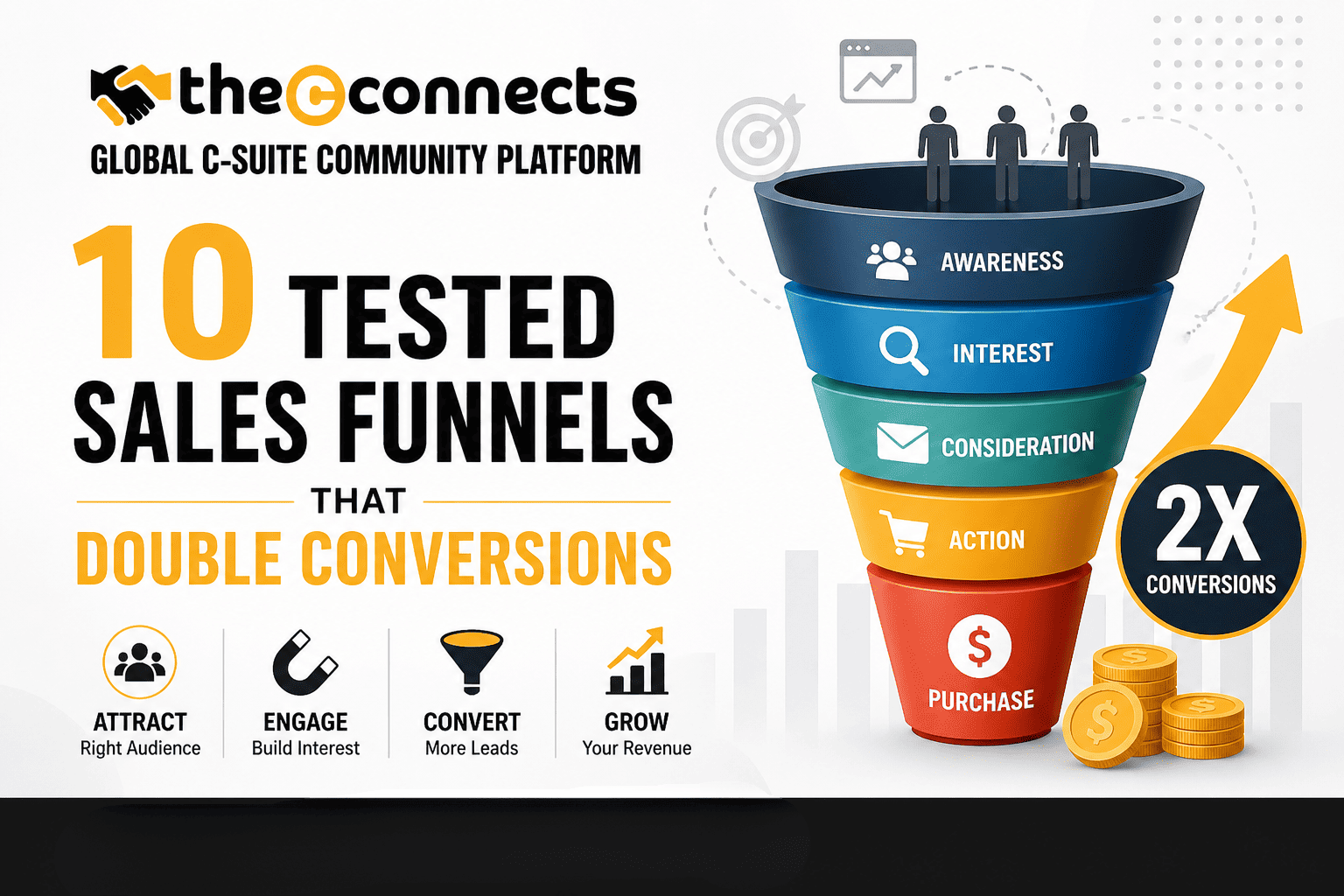
This feature covers the 10 tested sales funnels that double conversions, each one practical, proven, and directly applicable to real business contexts. Whether you are running a SaaS platform, a professional services firm, an e-commerce brand, or a B2B enterprise, there is a funnel architecture here that fits your model.
How the Sales Funnel Concept Has Evolved
The traditional AIDA model, Awareness, Interest, Desire, Action, served marketers well for decades. But modern buyers do not move in a straight line. They enter from multiple channels, loop back and reconsider, compare alternatives in parallel, and often need to be nurtured across weeks or months before they convert.
Today’s most effective sales funnels are not linear pipelines; they are orchestrated customer journeys. They combine content, automation, personalization, social proof, and timely offers to guide prospects toward a decision that genuinely serves them. When built on data and customer insight rather than assumption, these funnels do not just convert more leads, they convert better-fit customers who retain longer and spend more.
What Makes a Funnel “Tested” and Reliable
A tested funnel has real performance data behind it. It has been deployed across multiple campaigns or business cycles, refined based on measurable outcomes, and validated through metrics like conversion rate by stage, cost per acquisition, time to close, and revenue per lead.
The funnels in this guide are not theoretical constructs. They are architectures that growth teams, sales leaders, and marketing professionals have deployed, measured, and optimized in real-world conditions.
1. Lead Magnet to Email Nurture Funnel
What it is: A high-value content asset, a checklist, guide, template, or report, is offered in exchange for an email address. The prospect then enters a structured email nurture sequence designed to educate, build trust, and move them toward a purchase decision.
Why it works: This funnel converts cold traffic into a segmented, permission-based audience. The lead magnet signals intent and filters for genuine interest. The email sequence continues the conversation at scale, delivering value consistently without requiring ongoing ad spend.
How to structure it: Offer → Landing page → Thank-you page → 5 to 7-email nurture sequence → Soft conversion CTA → Sales conversation or product offer
Example: A B2B software firm offers a free ROI calculator. Leads who download it enter a 6-email sequence covering implementation stories, customer results, and a limited-time demo invitation. Conversion from download to demo booking runs at 18 to 22 percent in well-optimized versions.
2. Webinar to Demo Booking Funnel
What it is: A free, expert-led webinar addresses a specific business problem. At the end, attendees are invited to book a personalized demo or discovery call.
Why it works: Webinars build trust, demonstrate expertise, and create a low-friction environment for qualified prospects to self-identify. By the time the pitch is made, the audience has already received value and formed a positive association with the brand.
How to structure it: Paid or organic promotion → Registration page → Automated confirmation and reminder sequence → Live or recorded webinar → End-screen CTA → Follow-up booking sequence
Example: A fintech platform hosts a monthly webinar on cash flow management. Attendees who stay to the end convert to demo bookings at 25 to 30 percent, significantly above cold outreach benchmarks.
3. Free Trial to Paid Conversion Funnel
What it is: Prospects access a product for free for a defined period. A structured onboarding and conversion sequence runs parallel to the trial experience, guiding users toward activation and ultimately paid conversion.
Why it works: The product itself becomes the primary sales tool. Well-designed trial funnels focus on delivering an “aha moment”, the specific action or outcome that makes a user realize the product’s value. Once that moment is reached, conversion becomes significantly more likely.
How to structure it: Trial signup → Onboarding email sequence → In-product prompts → Human touchpoint for high-value accounts → Urgency messaging as trial end approaches → Paid plan offer
Example: A project management SaaS delivers its trial activation emails based on user behavior, not fixed timings. Users who complete a project template within 48 hours convert to paid at nearly double the rate of users who do not.
4. Quiz or Assessment Funnel
What it is: An interactive quiz or assessment delivers a personalized result, a score, a profile, a recommendation, in exchange for an email address. The result serves as the entry point to a tailored follow-up sequence.
Why it works: Quizzes are inherently engaging and feel personalized. They generate high opt-in rates because the value exchange feels immediate and relevant. The resulting segmentation data allows highly targeted follow-up messaging.
How to structure it: Quiz landing page → Question sequence → Results page (gated by email) → Segmented nurture sequence based on result → Tailored offer
Example: A HR software company builds a “What’s Your Hiring Blind Spot?” assessment. Completion rates exceed 70 percent among visitors, and the segmented follow-up sequences generate 3x the conversion rate of generic email campaigns.
5. Content Upgrade Funnel
What it is: A highly relevant bonus asset is offered within a piece of content, a blog post, article, or video, to readers who are already engaged with that topic. The upgrade is directly related to the content being consumed.
Why it works: Content upgrades convert at significantly higher rates than generic lead magnets because they are contextually matched to the reader’s current interest. A person reading a guide on pricing strategy is highly likely to download a pricing calculator.
How to structure it: SEO-driven or promoted content → Inline or exit-intent CTA for upgrade → Download page → Targeted nurture sequence
Example: A management consultancy embeds a downloadable M&A due diligence checklist within a blog post on acquisition strategy. The contextual relevance produces opt-in rates four to five times higher than the site’s standard newsletter popup.
6. Consultation Booking Funnel
What it is: Prospects are invited to book a free strategy session or discovery call directly from an ad, landing page, or email. The consultation itself qualifies the prospect and initiates the sales conversation.
Why it works: The offer of expert time and personalized insight carries high perceived value. For premium services, consulting, coaching, legal, financial, or high-ticket B2B, this funnel effectively filters for serious buyers and creates a direct path to proposal or close.
How to structure it: Ad or content → Landing page with value-anchored CTA → Calendar booking system → Confirmation and reminder sequence → Consultation → Follow-up proposal sequence
Example: A strategy consulting firm generates 40 percent of new client engagements from a targeted LinkedIn campaign driving directly to a “Book a complimentary strategy session” page.
7. Limited-Time Offer Funnel
What it is: A time-bound offer, a discount, a bonus, an exclusive package, creates urgency that accelerates purchase decisions from prospects who are already considering but not yet committed.
Why it works: Genuine urgency, when applied ethically and transparently, addresses one of the most common conversion killers: postponement. The limited-time structure provides a specific reason to act now rather than later.
How to structure it: Announcement campaign → Dedicated offer page → Countdown timer → Reminder sequence → Final-day message → post-offer follow-up for non-converters
Example: A SaaS company launches a quarterly “annual plan offer” campaign with a 20 percent discount available for 72 hours. This single campaign consistently generates 30 to 35 percent of annual subscription upgrades each quarter.
8. Retargeting Funnel
What it is: Prospects who have visited specific pages, viewed certain content, or abandoned checkout are retargeted with precisely matched ads that continue the conversation based on their demonstrated interest.
Why it works: Most visitors do not convert on first contact. Retargeting reconnects with warm audiences, people who already know the brand, with highly relevant messaging that addresses the specific point of abandonment or hesitation.
How to structure it: Pixel or tracking setup → Audience segmentation by behavior → Creative matched to stage → Sequenced retargeting ads → Landing page matched to message → Conversion
Example: An enterprise software company retargets pricing page visitors with a customer case study ad, followed by a demo offer. Conversion rates from this retargeting sequence are 4x higher than cold traffic to the same offer.
9. Referral or Advocacy Funnel
What it is: Satisfied customers are systematically invited to refer peers or colleagues in exchange for an incentive, account credits, discounts, exclusive access, or reciprocal benefits.
Why it works: Referred customers convert faster, retain longer, and typically generate higher lifetime value than customers acquired through paid channels. The cost of acquisition is dramatically lower, and the trust inherent in a peer recommendation shortens the sales cycle.
How to structure it: Post-purchase trigger → Referral invitation → Sharing mechanism → Tracking and attribution → Reward delivery → Follow-up nurture for referred leads
Example: A B2B platform introduces a tiered referral program offering account credits for successful referrals. Within six months, referred customers represent 22 percent of new business, at less than 20 percent of the average acquisition cost.
10. Post-Purchase Upsell and Cross-Sell Funnel
What it is: Immediately after a purchase, customers are presented with a complementary product, an upgrade, or a service enhancement that adds genuine value to what they have already bought.
Why it works: The moment immediately after purchase is the highest point of buyer commitment and trust. Customers who have just converted are in a positive decision state and significantly more likely to make an additional purchase than cold prospects.
How to structure it: Purchase confirmation → Immediate upsell page or email → Value-anchored offer → Acceptance or decline path → Follow-up cross-sell sequence → Customer success touchpoints
Example: An e-commerce brand adds a single one-click upsell after checkout, offering a complementary product at a 15 percent discount. The upsell offer is accepted by 28 percent of customers, generating a material increase in average order value at near-zero additional acquisition cost.
Common Mistakes Businesses Make With Sales Funnels
Even well-intentioned funnel strategies underperform when these errors are present:
Building one funnel for all audiences. Different buyer segments need different journeys. A single generic funnel rarely performs at the level of a segment-specific one.
Optimizing the top of the funnel while ignoring the middle. Most conversion leakage happens in the consideration and decision stages, not at the awareness stage.
Treating the funnel as a set-and-forget asset. High-performing funnels are continuously tested, analyzed, and refined. They are never finished.
Using mismatched messaging between ad and landing page. Message continuity from the first touchpoint to the conversion moment is one of the most significant single drivers of conversion rate.
How to Choose the Right Funnel for Your Business
The right funnel depends on three factors: your audience’s buying behavior, your offer type, and your sales cycle length.
For long-cycle B2B decisions, nurture-heavy funnels, lead magnet, webinar, consultation, build the trust required for high-value purchases. For transactional or impulse decisions, urgency funnels and retargeting perform strongly. For product-led growth businesses, trial conversion funnels are the primary revenue engine.
The most effective businesses do not choose one funnel, they run multiple simultaneously, each matched to a different segment or stage of the buyer journey.
Conclusion:
The difference between businesses that grow predictably and those that struggle with inconsistent revenue is rarely product quality. It is usually funnel discipline, the systematic, data-driven process of turning qualified interest into committed revenue.
The 10 tested sales funnels that double conversions covered in this guide are not silver bullets. They are strategic architectures that, when properly designed and continuously optimized, create the kind of compounding conversion improvement that changes a business’s growth trajectory.
Audit your current funnel performance. Identify your highest-value acquisition pathway. Choose the funnel architecture that most closely matches your buyer’s actual decision journey. Then test, measure, and refine relentlessly.
Connect With TheCconnects
If you specialize in building, optimizing, or scaling high-converting sales funnels, your insights can help businesses navigate today’s complex buyer journeys. We welcome founders, marketers, growth strategists, and sales leaders to share practical frameworks, real-world case studies, and data-driven perspectives with our audience.
If you want to publish your article on this platform or explore opportunities across other leading platforms, please feel free to reach out to us.
📧 Email: contact@thecconnects.com
📞 Phone: +91 91331 10730
💬 WhatsApp: https://wa.me/919133110730