
In the rapidly expanding Indian EdTech landscape, much of the focus has historically been placed on test prep for high school seniors or upskilling for college graduates. However, a critical gap exists at the foundation: developing raw analytical and reasoning skills in younger students before they ever face the pressure of a competitive exam.
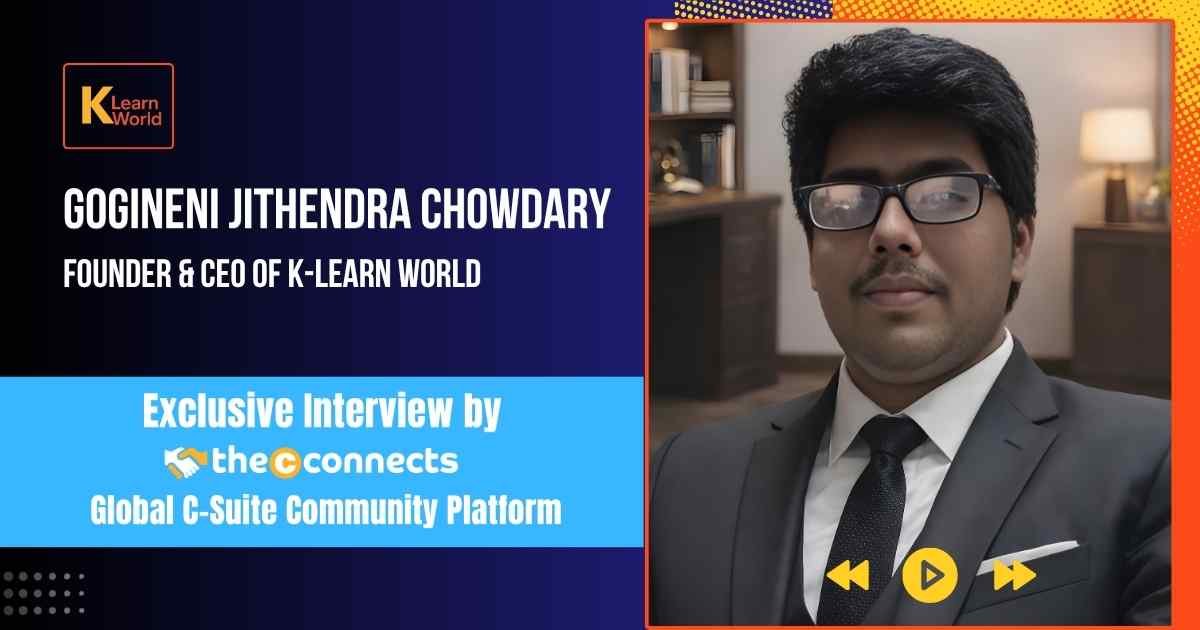
Enter Gogineni Jithendra Chowdary, an emerging education innovator from Tenali, Andhra Pradesh. As the Founder and CEO of K-Learn World, Jithendra is on a mission to dismantle rote learning and replace it with structured, engaging aptitude and reasoning training for school students. By blending traditional offline classes with scalable, AI-powered online solutions, K-Learn World is building the cognitive infrastructure for the next generation.
We sat down with Jithendra to discuss the inception of K-Learn World, the dangers of memorization-heavy curriculums, and his bold vision for integrating artificial intelligence into personalized student learning.
TheCconnects: Jithendra, it is a pleasure to have you with us. Let’s start at the beginning. Can you tell our readers a little about your professional journey? What was the catalyst that led you to found K-Learn World?
Gogineni Jithendra Chowdary: The pleasure is mine, thank you for having me. My journey into education wasn’t an accident; it was born out of a very clear, recurring observation. Throughout my academic and early professional life, I noticed a stark contrast between students who scored high marks and students who could actually solve complex, real-world problems.
We have an education system that heavily rewards memory. A student can score 95% by memorizing textbooks, but if you give them a basic logical puzzle or a situational reasoning question, they freeze. I realized that if we want to build a generation of innovators, we can’t wait until they are 18 to teach them how to think. We have to start at the school level. That was the catalyst for K-Learn World. I wanted to create an ecosystem where aptitude and reasoning aren’t just “extra-curriculars” but foundational skills taught with the same rigor as math or science.
TheCconnects: Focusing specifically on school students is an interesting pivot. How exactly does K-Learn World address the pain points of young learners and their parents?
Gogineni Jithendra Chowdary: The primary pain point for parents today is anxiety about the future. They know the world is getting fiercely competitive, and they see their children struggling with critical thinking despite heavy academic workloads. For the students, the pain point is boredom and intimidation. Traditional math and logic are often taught in a very dry, formulaic way.
At K-Learn World, we strip away the intimidation. We’ve built structured training programs that make aptitude learning highly accessible, engaging, and highly practical. Instead of forcing a child to memorize a formula for calculating train speeds, we teach them the logical foundation behind time, distance, and speed. We conduct offline classes to ensure hands-on, personalized interaction, but we are aggressively building scalable digital solutions so a student anywhere can benefit from our pedagogy. We address the pain point by making logic fun, which naturally translates into better academic and competitive performance down the line.
TheCconnects: Every entrepreneur faces hurdles, especially in the early days of building a startup. What have been the biggest challenges you’ve faced with K-Learn World, and how did you overcome them?
Gogineni Jithendra Chowdary: The biggest initial challenge was a mindset shift. When you approach a school or a parent with “aptitude training,” the immediate response is often, “My child isn’t writing the CAT or UPSC exams right now, why do they need this?” Overcoming that required intense grassroots education. I had to demonstrate that reasoning skills aren’t just for clearing exams; they are for navigating life. I started conducting free workshops and diagnostic tests in schools in and around Tenali. Once parents saw their children’s eyes light up when they finally “cracked” a logical sequence on their own, the resistance melted away. The second challenge has been balancing the hybrid model-maintaining the quality of our offline classes while developing a robust tech infrastructure for our online expansion. It requires relentless time management and a great team.
TheCconnects: Speaking of tech infrastructure, one of your key visions is integrating AI-powered personalized learning. How do you see AI transforming K-Learn World in the near future?
Gogineni Jithendra Chowdary: This is the area I am most excited about. In a traditional classroom of 40 students, one teacher has to teach at an “average” pace. But cognitive development isn’t average; it’s highly individual.
“AI is the great equalizer in education. It allows us to stop treating students as a monolith and start treating them as individuals with unique cognitive fingerprints.”
We are working toward an AI integration that analyzes a student’s micro-interactions with our platform. If an 8th grader is breezing through spatial reasoning but struggling with data interpretation, the AI will dynamically adjust their curriculum. It will slow down, provide different types of examples, and create a custom learning path that targets their specific weak points without causing frustration. AI won’t replace our teachers; it will give our teachers superpowers to understand exactly what each student needs.
TheCconnects: The digital space is incredibly crowded right now, especially in EdTech. What do you see as the biggest challenge for brands trying to establish themselves online?
Gogineni Jithendra Chowdary: The biggest challenge in the digital space today is authenticity. The barrier to entry for starting an online business is so low that the market is flooded with noise, aggressive marketing, and false promises.
For an EdTech brand, the challenge is proving tangible ROI (Return on Investment) to parents. Anyone can run a Facebook ad, but can you actually prove that your platform improved a child’s analytical baseline over six months? Brands that rely solely on flashy digital marketing without delivering real, measurable educational outcomes will burn out. Building digital trust is hard, and it requires transparency, consistent value delivery, and a genuine focus on student success over quick scale.
TheCconnects: Who has influenced you the most in your life and entrepreneurial journey?
Gogineni Jithendra Chowdary: I’ve drawn a lot of inspiration from the grassroots teachers I grew up around in Andhra Pradesh. These were people who didn’t have access to high-end technology or massive budgets, yet they had an uncanny ability to simplify complex concepts and inspire a love for learning. They taught me that at the core of all education is empathy.
From a business standpoint, I am deeply influenced by founders who build sustainable, profitable businesses that solve real-world problems, rather than just chasing the next round of venture funding.
TheCconnects: Building a startup is a 24/7 job. What do you do in your free time to unwind and keep yourself sharp?
Gogineni Jithendra Chowdary: Disconnecting is crucial, though it’s definitely a challenge! In my free time, I love reading extensively-mostly about behavioral psychology, technology trends, and biographies of leaders who have built lasting institutions. I also enjoy solving puzzles and strategy games myself. You can’t run a reasoning and aptitude company without practicing what you preach! Beyond that, spending quiet time with family and staying grounded in my local community keeps my perspective clear.
TheCconnects: Looking back at your journey so far, what key lessons have you learned that you carry with you every day?
Gogineni Jithendra Chowdary: Two things stand out. First, never fall in love with your solution; fall in love with the problem. We started with offline classes, but we realized the problem (lack of analytical skills) required a broader reach, which pushed us toward AI and digital scaling. If we had been stubborn about staying offline only, we would have limited our impact.
Second, listen to the end-user. In EdTech, the parent is the buyer, but the student is the user. If the student isn’t enjoying the process, no amount of marketing to the parent will save your business.
TheCconnects: Do you have any advice for aspiring entrepreneurs looking to enter the education or technology space?
Gogineni Jithendra Chowdary: Don’t build an EdTech company just because it’s a booming sector. Education is a sacred space; you are actively shaping the cognitive abilities of the next generation. Start by identifying a hyper-specific gap in the market. Validate it on a small scale. For us, it was aptitude for school kids. Go out, teach a few students yourself, understand their psychology, and then build the technology to scale that solution. Technology is an amplifier; make sure what you are amplifying is actually worth learning.