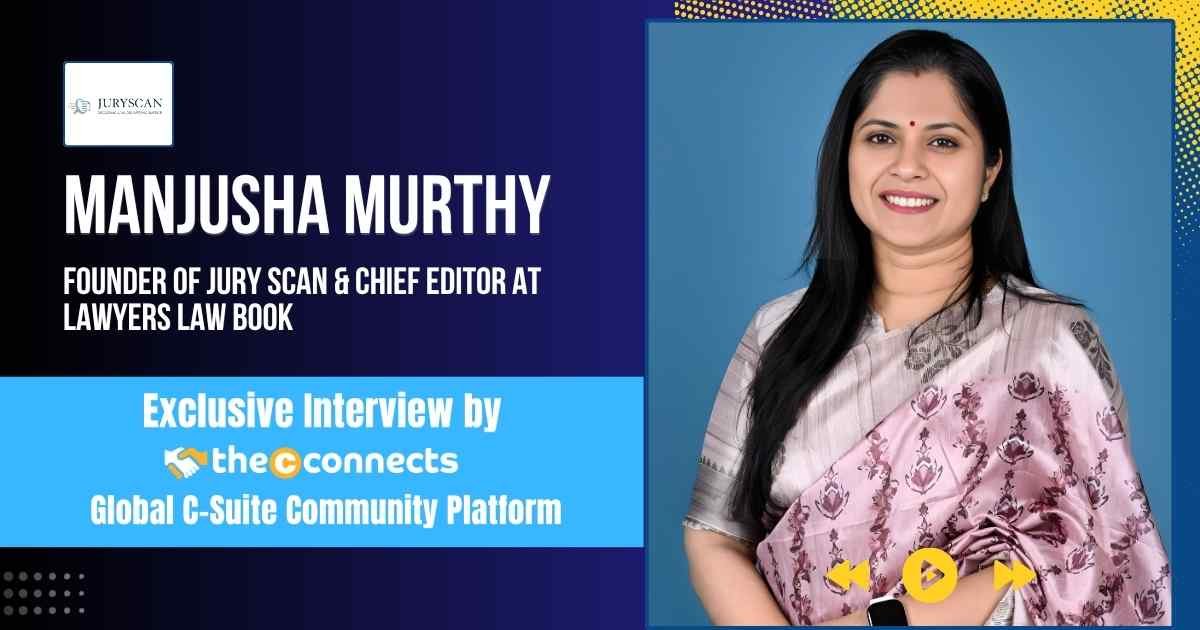

The legal profession has long been defined by dusty volumes and exhaustive manual research. However, a new wave of legal tech and editorial innovation is transforming how advocates navigate the complexities of the Indian judiciary. At the forefront of this shift is Manjusha Murthy, a legal professional who has spent over a decade balancing the rigor of the High Court with the precision of legal publishing.
As the Founder of Jury Scan and the Chief Editor at Lawyers Law Book Publishing House, Manjusha possesses a unique perspective on the law-one that is both a practitioner’s and a scholar’s. From managing a journal with over 5,000 subscribers to launching a platform that democratizes access to landmark judgments, her journey is a masterclass in professional evolution.
In this exclusive interview, Manjusha dives deep into the challenges of the legal ecosystem, the vision behind Jury Scan, and the future of legal information in India.
TheCconnects: Manjusha, it is an absolute pleasure to have you. You’ve spent over 13 years at the intersection of law and publishing. Could you take our readers through that journey? How did you arrive at this specific role where you are now leading both a tech-driven platform and a traditional publishing house?
Manjusha Murthy: Thank you for having me. My journey has been an organic evolution, really. I started with a pure focus on the courtroom. After my LL.B. from Bangalore University, I dove into litigation at the High Court of Karnataka, handling everything from complex civil disputes to sensitive matrimonial cases.
But I’ve always had an affinity for the “why” behind the law-the research, the structure, and how precedents are recorded. In 2012, I took on the role of Chief Editor at Lawyer’s Law Books. Managing the Karnataka Civil and Criminal Reporter allowed me to see the law through a different lens. I wasn’t just arguing cases; I was summarizing them for 5,000 other advocates. That dual life-practicing by morning and editing by evening-is what eventually sparked the idea for Jury Scan. I realized there was a massive gap between the vast body of court judgments and the actual ease of access for the average litigating lawyer.
TheCconnects: Litigation is notoriously high-pressure. Who has influenced your approach to law and leadership during these years?
Manjusha Murthy: Influence in the legal field often comes from the senior counsel you observe in the corridors of the High Court. Seeing how seasoned advocates maintain composure during intense cross-examinations taught me the value of clarity and structure.
On a more personal level, the litigants themselves have been my greatest influence. When you handle matrimonial or property disputes, you aren’t just dealing with sections of an Act; you’re dealing with human lives. That responsibility forced me to bring empathy into my drafting and consulting. Professionally, the mentors I had at various legal chambers taught me that a lawyer’s greatest weapon isn’t just their voice, but their ability to find the exact precedent that changes the narrative of a case.
TheCconnects: You’ve represented clients in everything from corporate breach of contract to domestic violence. What were some of the biggest professional challenges you’ve faced, and how did they shape Jury Scan?
Manjusha Murthy: One of the toughest challenges was the sheer volume of “information overload” during trial preparation. Finding a relevant, precedent-setting judgment in a sea of data is like finding a needle in a haystack.
Early in my career, the lack of streamlined access to recent case laws meant hours of manual searching. This challenge was the direct inspiration for Jury Scan. I wanted to build a tool that I wished I had when I was starting out-a platform that provides landmark judgments in a format that is easily consumable. Overcoming that personal struggle of “manual research fatigue” led to a solution that now empowers the wider legal community by providing equitable access to judicial decisions.
TheCconnects: You’ve been the Chief Editor of a major law journal for over a decade. What key lessons have you learned from the editorial side of the law?
Manjusha Murthy: Precision is everything. In a legal journal, a single misplaced word in a headnote can change the interpretation of a judgment for a practicing advocate.
I’ve learned that editorial integrity and legal accuracy are the bedrocks of the industry. Mentoring a team of writers and researchers taught me that you have to bridge the gap between “theory” and “practice.” A summary of a judgment is useless if a busy lawyer can’t read it in three minutes and understand how it applies to their case. Consistency, deadline discipline, and an eagle eye for detail are the three pillars that keep a fortnightly journal running for years.
TheCconnects: The legal industry is traditionally conservative. What do you see as the biggest challenge for legal brands in the digital space today?
Manjusha Murthy: The biggest challenge is Trust and Transparency. Law is a field where word-of-mouth has always reigned supreme. In the digital space, there is a lot of noise-unverified legal tips and cluttered databases.
The challenge for a brand like Jury Scan is to prove its reliability. Lawyers are naturally skeptical; they won’t use a platform unless the data is impeccable. Bridging the “trust gap” by ensuring that judicial decisions are accessible in a simple way is a hurdle every legal-tech founder faces. It’s not just about the technology; it’s about the authenticity of the legal insight.
TheCconnects: Let’s talk about Jury Scan. How does the platform specifically address the pain points of a litigating lawyer in India?
Manjusha Murthy: Litigating lawyers, especially those in independent offices, often lack the resources for expensive legal research assistants.
Jury Scan addresses this by providing easy access to recent case laws from the High Courts and the Supreme Court. We don’t just dump data; we provide analysis. We are also building a Case Management Tracker so advocates can manage hearing histories and timelines in one place. We want to remove the “administrative clutter” so the lawyer can focus on the “legal strategy.” My vision is to reach out beyond Karnataka to the lawyer communities of all southern states, providing news in a format that is consumable for the whole fraternity.
TheCconnects: Beyond Jury Scan and publishing, you’ve spent time remote consulting for rural and underserved regions. What did that experience teach you about legal access in India?
Manjusha Murthy: It was a reality check. We talk about “Digital India,” but in many rural areas, people don’t even know their basic property or matrimonial rights. Remote consulting taught me that Alternative Dispute Resolution (ADR) is the future. Helping a client resolve a conflict without them having to travel hundreds of miles to a formal court is incredibly fulfilling. It reinforced my vision-that legal information shouldn’t be a privilege for those in metro cities; it should be equitable for everyone, regardless of their resources.
TheCconnects: With such a heavy editorial and legal workload, what do you do in your free time to “recharge”?
Manjusha Murthy: After a day of summarizing judgments and drafting contracts, my brain needs a complete shift. I’m an advocate for “quiet time.” Reading something entirely non-legal helps me maintain perspective. I also enjoy the process of continuous learning-I recently completed a business management certification to help me run Jury Scan more effectively as a startup. Occasionally, I return to the courtroom just to observe; there’s something about the live energy of an argument that keeps me connected to why I chose this profession in the first place.
TheCconnects: Finally, what is your advice for aspiring entrepreneurs in the legal-tech or publishing space?
Manjusha Murthy: My advice is to prioritize the practitioner’s pain point over the technology. Don’t build a fancy app just because you can; build it because it solves a real problem a lawyer faces at 10 PM while preparing their brief for the next morning.
Also, remember that legal tech is 50% tech and 50% credibility. You cannot afford to be “mostly right” in law. Be meticulous, be patient, and always aim to make the judicial process more transparent. The goal is to empower the fraternity, not just to sell a subscription.
TheCconnects: Manjusha, thank you for such a thoughtful conversation. Your perspective makes it clear how much goes into building meaningful tech systems for the legal fraternity.
Manjusha Murthy: Thank you. It was a pleasure sharing the journey.