
Modern engineering organizations treat Continuous Integration and Continuous Delivery (CI/CD) pipelines as strategic infrastructure rather than mere operational helpers. High-performing engineering teams prioritize low-latency execution, multi-cloud flexibility, automated governance, and intelligent failure remediation.
As teams scale, build bottlenecks, software supply chain security vulnerabilities, and rising cloud compute expenses often become severe pain points. Selecting the right CI/CD vendor directly dictates developer productivity, system resilience, and organizational time-to-market.
Key Strategic Trends Shaping the Modern CI/CD Ecosystem
- AI-Driven Pipeline Intelligence & Automated Failure Remediation: Platforms are incorporating machine learning models directly into pipeline runtimes. Systems analyze historical build traces, test flakiness, and pull request diffs to predict failures before execution, run targeted test subsets (Predictive Test Selection), and generate automated root-cause summaries.
- Shift-Left Security & Supply Chain Attestation: Modern CI/CD systems serve as security enforcement boundaries. Standard expectations now include automated Software Bill of Materials (SBOM) generation, cryptographically signed build artifacts (SLSA framework compliance), inline container vulnerability scanning, and real-time secret detection.
- GitOps & Declarative Delivery Models: Driven by Kubernetes and cloud-native architectures, pull-based declarative GitOps workflows continue to displace traditional push-based deployment scripts. Infrastructure state continuously auto-heals to match the code declared in version control repositories.
- FinOps & Compute Cost Optimization: With runner compute costs representing a growing share of cloud infrastructure budgets, modern tools focus heavily on build artifact caching, intelligent auto-scaling runner groups, and dynamic resource allocation to minimize build waste.
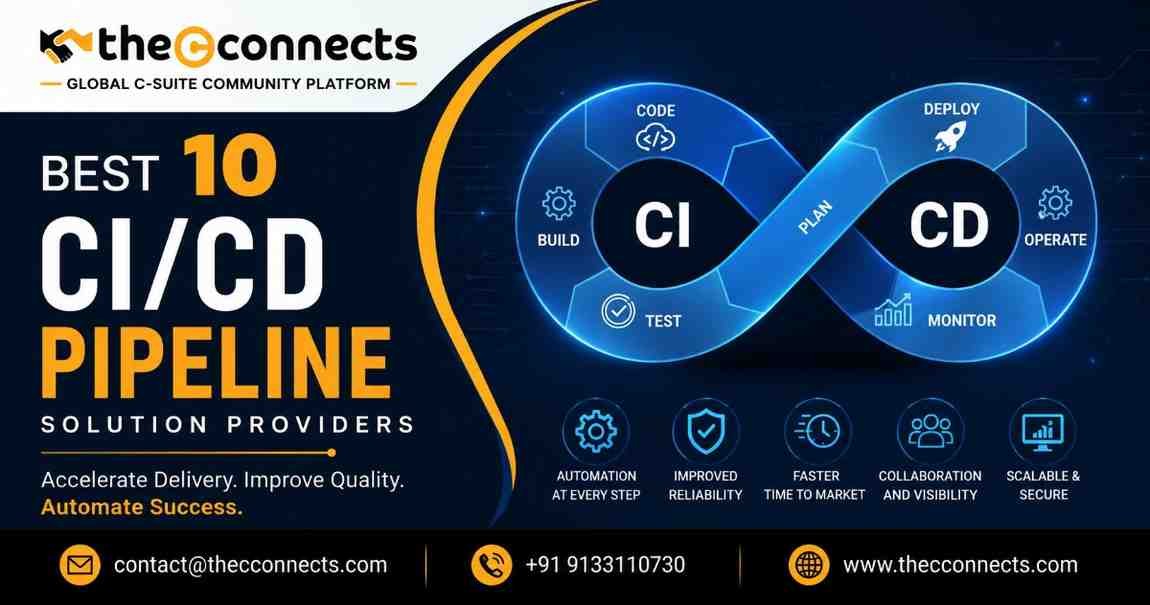
Top 10 CI/CD Pipeline Solution Providers
1. GitLab Inc.
- Founders: Sid Sijbrandij, Dmitriy Zaporozhets
- Founded Year: 2014 (Project initiated in 2011)
- Headquarters: San Francisco, California, United States
- Product Categories: DevSecOps Platform, Continuous Integration, Continuous Delivery, Code Governance, Value Stream Management
Company Description:
GitLab Inc. delivers a single, unified DevSecOps application that spans the entire software development lifecycle. By combining source code management, CI/CD pipelines, security auditing, container registries, and release orchestration into a single data architecture, GitLab eliminates the friction of managing complex multi-vendor toolchains. Built on an open-core foundation, it caters to organizations ranging from fast-scaling startups to global financial institutions. Its unified reporting engine gives leadership real-time visibility into value stream performance, security vulnerabilities, and cycle times across distributed engineering organizations.
Key Features:
- End-to-end platform covering code planning, repository management, CI testing, security, and cloud deployment.
- Integrated security scanning including SAST, DAST, secret detection, and dependency risk auditing on every commit.
- Auto DevOps features that automatically configure build, test, and deployment workflows based on code detection.
- Built-in AI assistants (GitLab Duo) for pipeline troubleshooting, code generation, and root-cause failure analysis.
- Comprehensive deployment capabilities targeting Kubernetes, serverless platforms, virtual machines, and hybrid environments.
- Policy enforcement frameworks and audit trail creation designed for strict regulatory compliance.
- Native Value Stream Analytics providing DORA4 productivity metrics and operational bottleneck identification.
2. GitHub (GitHub Actions)
- Founders: Tom Preston-Werner, Chris Wanstrath, PJ Hyett, Scott Chacon
- Founded Year: 2008 (GitHub Actions launched in 2019; acquired by Microsoft in 2018)
- Headquarters: San Francisco, California, United States
- Product Categories: Developer Platform, CI/CD Automation, Code Security, Package Management
Company Description:
GitHub, operating as an independent subsidiary of Microsoft, hosts the world’s largest developer network. Its native automation suite, GitHub Actions, allows developers to build, test, and deploy code directly alongside their repositories. Utilizing event-driven execution models, GitHub Actions enables automation triggered by pull requests, issue updates, or external webhooks. Combined with access to thousands of pre-built workflows in the GitHub Marketplace, engineering teams can build complex CI/CD workflows without writing bespoke integration glue code.
Key Features:
- Event-driven workflows that trigger execution on any GitHub event (pull requests, releases, issue comments).
- Deep integration with GitHub Marketplace, offering thousands of community and vendor-certified Actions.
- Parallel matrix build support across Linux, macOS, and Windows operating systems within a single configuration.
- Fully managed runner infrastructure, including GPU-accelerated instances and auto-scaling custom runner groups.
- Direct interoperability with GitHub Copilot for automated pipeline debugging and workflow creation.
- OpenID Connect (OIDC) support for secretless authentication with major cloud platforms (AWS, GCP, Azure).
- Flexible self-hosted runner controls for enterprise environments requiring private network connectivity.
3. Harness
- Founders: Jyoti Bansal, Rishi Singh
- Founded Year: 2017
- Headquarters: San Francisco, California, United States
- Product Categories: Software Delivery Platform, CI/CD Automation, Chaos Engineering, Cloud Cost Management, Internal Developer Portals
Company Description:
Harness is an AI-powered software delivery platform engineered to streamline release engineering for multi-cloud enterprise deployments. Founded by DevOps veterans, Harness applies machine learning models to build logs and production telemetry to verify deployment health and execute automatic rollbacks when anomalies appear. The platform features modular components for CI, CD, Feature Flags, Service Reliability, and Cloud Cost Management. Harness minimizes manual intervention while enforcing strict governance across complex enterprise delivery chains.
Key Features:
- Machine-learning-driven deployment verification that tracks production metrics and automates rollbacks on failures.
- Pipeline-as-Code capabilities backed by interactive visual drag-and-drop pipeline designers.
- Test Intelligence engine that runs only the specific tests affected by incoming code diffs to accelerate builds.
- Built-in Cloud Cost Management to identify idle build instances and optimize test runner compute costs.
- Centralized policy enforcement using Open Policy Agent (OPA) for fine-grained role-based access control.
- Unified security orchestrations that consolidate findings from multiple third-party scanning tools.
4. CloudBees
- Founders: Sacha Labourey, François Dechery
- Founded Year: 2010
- Headquarters: San Jose, California, United States
- Product Categories: Enterprise CI/CD, Release Management, DevSecOps Compliance, Continuous Integration Engine
Company Description:
CloudBees provides enterprise-grade continuous integration and delivery solutions built on top of open-source Jenkins. Designed for large-scale enterprise environments running heterogeneous applications, CloudBees adds high availability, enterprise security, centralized administration, and compliance management to Jenkins architectures. It allows engineering organizations to retain the flexibilities of the Jenkins plugin ecosystem while meeting modern compliance, stability, and corporate support requirements across mainframe, legacy, and cloud-native systems.
Key Features:
- High availability and auto-scaling management layers designed for enterprise Jenkins controller networks.
- Centralized dashboarding for cross-team pipeline management, security policies, and resource utilization.
- Enterprise pipeline template sharing to enforce standardized build practices across disparate business units.
- Automated compliance evidence generation tailored for SOC 2, HIPAA, and financial regulatory audits.
- Full compatibility with thousands of open-source Jenkins plugins and commercial extensions.
- Granular role-based access controls and enterprise identity provider integrations.
5. CircleCI
- Founders: Paul Biggar, Allen Rohner
- Founded Year: 2011
- Headquarters: San Francisco, California, United States
- Product Categories: Continuous Integration, Continuous Delivery, Build Automation, Test Analytics
Company Description:
CircleCI is a cloud-native platform focused on automated build execution speed and developer experience. Built to process millions of jobs daily, CircleCI emphasizes minimal build latency through dependency caching, parallel runner distribution, and configurable compute specs. Available as both a managed cloud service and a self-hosted installation, CircleCI utilizes declarative YAML configurations along with reusable packages known as “Orbs” to simplify complex build pipeline definitions.
Key Features:
- CircleCI “Orbs”-reusable configuration templates that simplify integration with cloud services and testing suites.
- Automated dependency caching and smart test-splitting logic across parallel execution threads.
- Dynamic execution support for Docker, macOS, Windows, Linux, and ARM system architectures.
- Granular resource class options, allowing teams to assign custom CPU/RAM power to specific job types.
- Built-in insights dashboards for monitoring pipeline health, mean time to recovery (MTTR), and flaky tests.
- OIDC-backed secret management and IP-restricted execution networks for enterprise security.
6. Atlassian (Bitbucket Pipelines)
- Founders: Mike Cannon-Brookes, Scott Farquhar (Atlassian)
- Founded Year: 2002 (Bitbucket Pipelines launched in 2016)
- Headquarters: Sydney, Australia
- Product Categories: Source Code Management, Integrated CI/CD, Agile Project Management, DevSecOps
Company Description:
Bitbucket Pipelines is a cloud-native CI/CD service integrated directly into Atlassian Bitbucket. Designed to minimize context switching, it allows development teams to manage, build, test, and deploy applications from within their code repositories. Natively linked with the Atlassian suite-including Jira Software, Confluence, and Opsgenie-Bitbucket Pipelines provides end-to-end traceability from early feature planning in Jira to final production deployment.
Key Features:
- Out-of-the-box integration with Jira Software, automatically linking deployment states to user stories and bug tickets.
- Container-native step execution where every pipeline stage executes inside isolated, user-defined Docker containers.
- Pre-configured Bitbucket “Pipes” that simplify deployment connections to major cloud providers like AWS, Azure, and GCP.
- Centralized environment management dashboards to monitor active releases across development, staging, and production.
- Self-hosted runner capabilities for executing tasks inside private clouds or behind corporate firewalls.
- Integrated code security scanning through Atlassian Guard and ecosystem security partners.
7. Octopus Deploy
- Founders: Paul Stovell, Sonia Stovell
- Founded Year: 2011
- Headquarters: Brisbane, Australia
- Product Categories: Continuous Delivery, Deployment Automation, Release Management, Operations Runbooks
Company Description:
Octopus Deploy focuses specifically on deployment automation and complex environment orchestration. While general-purpose CI engines focus on compiling code and running unit tests, Octopus Deploy takes compiled binaries and orchestrates their deployment across multi-tenant cloud platforms, Kubernetes clusters, and legacy on-premises servers. It complements upstream CI platforms (such as Jenkins, GitHub Actions, or TeamCity) by handling complex release promotion, manual approval gates, and operational runbook execution.
Key Features:
- Advanced release promotion logic with environment progression controls, freeze windows, and manual sign-offs.
- Automated Runbooks to manage routine operations, database maintenance, and emergency fixes as code.
- Built-in multi-tenant deployment engine to push updates to hundreds of isolated customer environments concurrently.
- Pre-built execution steps for Microsoft IIS, Windows Services, Kubernetes, AWS, and Azure targets.
- Centralized audit logging detailing exactly who deployed what version to which environment.
- Deep integration APIs for consuming compiled artifacts from almost any upstream continuous integration server.
8. JFrog (JFrog Pipelines)
- Founders: Shlomi Ben Haim, Yoav Landman, Frederic Simon
- Founded Year: 2008
- Headquarters: Sunnyvale, California, United States
- Product Categories: Software Supply Chain Platform, Binary Artifact Repository (Artifactory), Binary CI/CD, DevSecOps
Company Description:
JFrog provides an enterprise software supply chain platform centered around binary package management. JFrog Pipelines acts as the automation engine inside this ecosystem, specializing in binary-centric continuous delivery. Rather than focusing solely on source code scripts, JFrog Pipelines tracks immutable binary artifacts from creation through security scanning (via JFrog Xray) to final release distribution. This binary-first architecture guarantees high traceability, provenance, and security compliance for enterprise release pipelines.
Key Features:
- Binary-centric automation designed to promote validated software packages rather than rebuilding source code.
- Direct, native integration with JFrog Artifactory, Xray, and Distribution modules.
- Cross-pipeline dependency handling to automatically trigger downstream releases when upstream binaries change.
- Automated Software Bill of Materials (SBOM) generation and cryptographic signing for supply chain compliance.
- Declarative YAML workflow definitions featuring pre-built steps to reduce custom bash scripting.
- Scale-out node execution capable of running workloads across dynamic, hybrid-cloud environments.
9. Microsoft (Azure Pipelines)
- Founders: Bill Gates, Paul Allen (Microsoft)
- Founded Year: 1975 (Azure DevOps released as VSTS/TFS rebranding in 2018)
- Headquarters: Redmond, Washington, United States
- Product Categories: Cloud DevOps Suite, Continuous Integration Engine, Release Orchestration, Package Management
Company Description:
Azure Pipelines is the core build and release engine within Microsoft’s Azure DevOps cloud platform. It offers cloud-hosted and self-managed automation agents capable of building and deploying applications across any language, OS, or cloud environment. With support for Windows, Linux, and macOS platforms, Azure Pipelines integrates deeply with enterprise identity services, governance tools, and cloud infrastructure. It is widely adopted by enterprise engineering teams managing hybrid cloud workloads or migrating legacy enterprise infrastructure.
Key Features:
- Multi-cloud execution support covering AWS, GCP, Azure, and on-premises datacenters.
- Cloud-managed Microsoft runners offering scalable execution environments across Windows, Linux, and macOS.
- Advanced release gates that integrate monitoring signals, Azure Functions, and automated approval logic.
- Enterprise-grade identity management using Microsoft Entra ID (Azure AD) and OIDC integration.
- Self-hosted execution agent options for deployment inside restricted enterprise private networks.
- Native connectivity with Azure Boards, Azure Repos, and Azure Artifacts for end-to-end lifecycle tracking.
10. Amazon Web Services (AWS CodePipeline)
- Founders: Jeff Bezos (Amazon)
- Founded Year: 1994 (AWS founded in 2006; CodePipeline launched in 2015)
- Headquarters: Seattle, Washington, United States
- Product Categories: Cloud Infrastructure, Managed CI/CD, Serverless Automation, Cloud Developer Tools
Company Description:
AWS CodePipeline is a fully managed continuous delivery service provided by Amazon Web Services that automates release pipelines for cloud infrastructure and application code. Operating as a serverless service within AWS, CodePipeline coordinates the build, test, and deployment stages by orchestrating related services like AWS CodeBuild, AWS CodeDeploy, Amazon ECS, AWS Lambda, and AWS CloudFormation. It eliminates the overhead of managing underlying build servers, enabling teams to operate natively within the AWS ecosystem.
Key Features:
- Fully managed serverless execution model with zero runner infrastructure maintenance required.
- Direct integration with AWS IAM for fine-grained role-based security access controls.
- Native hooks into AWS EventBridge, S3, and CodeCommit for automated event-driven execution.
- Seamless deployment automation targeting Amazon ECS, Amazon EKS, AWS Lambda, and CloudFormation stacks.
- Parallel and multi-region deployment orchestration across global AWS cloud zones.
- Support for third-party source repos (GitHub, Bitbucket) and custom webhooks.
Strategic Recommendations for Engineering Leaders
When evaluating vendor options, decision-makers should align their choice with platform architecture, compliance overhead, and team workflows:
- For End-to-End Governance & Tool Consolidation: GitLab and GitHub Actions provide unified operational visibility, bringing source control, CI/CD execution, and DevSecOps security scanning into a single ecosystem.
- For Advanced Release Verification & FinOps: Harness delivers strong capabilities for organizations prioritizing machine-learning deployment validation and automated cloud compute cost management.
- For Multi-Tenant Deployments & Complex Infrastructure: Octopus Deploy and CloudBees excel at handling complex promotion paths across multi-tenant cloud setups, hybrid on-premises systems, or legacy Jenkins infrastructure.
- For Single-Cloud Native Operations: AWS CodePipeline and Azure DevOps offer low operational friction when building pipelines tightly tied to their respective cloud infrastructure networks.
📩 Contact Us for Feedback or Feature Enquiries
If you have feedback, updated company information, or believe your CI/CD solution is eligible to be featured in this ongoing market report, please reach out to our research team through any of the channels below:
📧 Email us: contact@thecconnects.com
📞 Call us: +91 9133110730
💬 WhatsApp us: https://wa.me/919133110730