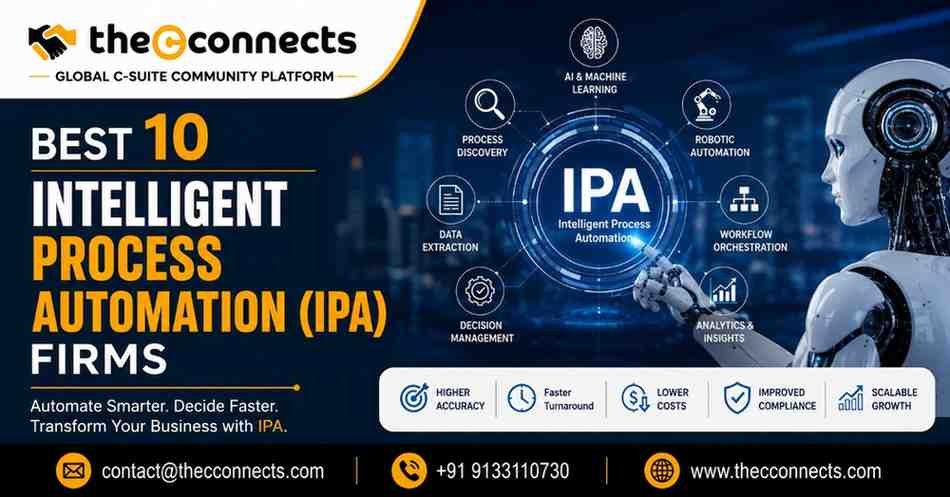

Intelligent Process Automation (IPA) represents the convergence of Robotic Process Automation (RPA), Artificial Intelligence (AI), Machine Learning (ML), Intelligent Document Processing (IDP), and Process Mining. Where traditional RPA executed rule-based, deterministic tasks across legacy applications, IPA introduces cognitive decision-making, adaptive workflow orchestration, and generative capability.
The enterprise IPA domain is undergoing structural shifts driven by several macro-technology trends:
- Shift to Agentic Automation & Dynamic Orchestration: Enterprise automation is moving beyond fixed, step-by-step scripts toward agentic AI workflows. AI agents now reason through unstructured data, evaluate contextual variables, and autonomously complete complex multi-step processes across heterogeneous systems.
- Convergence of Process Mining and Generative AI: Organizations no longer struggle with process discovery. Process mining tools continuously monitor system logs to pinpoint operational bottlenecks, while Generative AI models auto-generate automation scripts and workflow recipes to rectify inefficiencies in real time.
- Democratization via Low-Code/No-Code Canvas: Business users (citizen developers) are building end-to-end cognitive automations through drag-and-drop canvases, while central IT governance ensures enterprise-grade security, data privacy, and compliance.
- Unstructured Data Mastery via IDP: The vast majority of enterprise data resides in unstructured formats-PDFs, emails, scanned receipts, and media files. Modern IPA suites integrate specialized document processing engines that convert unstructured context into actionable system data with high accuracy.
Top 10 Intelligent Process Automation (IPA) firms
1. UiPath, Inc.
Founders: Daniel Dines, Marius Tirca
Founded Year: 2005
Headquarters: New York City, New York, USA
Product Categories: Robotic Process Automation (RPA), Agentic Automation, AI Center, Process Mining, Intelligent Document Understanding
Description:
UiPath is a market leader in the enterprise automation landscape, providing an end-to-end platform that combines traditional RPA with advanced AI and process intelligence. Originally founded in Bucharest, Romania, the company relocated its headquarters to New York City and expanded into a global provider of hyperautomation platforms. UiPath enables organizations to discover automation opportunities via AI-driven process mining, build automations using low-code tools, manage digital workforces centrally through Orchestrator, and execute complex workflows involving both structured and unstructured enterprise data.
Key Features:
- UiPath Studio: Drag-and-drop low-code/no-code canvas supporting both developer and citizen-led automation design.
- UiPath Orchestrator: Centralized control plane for deploying, monitoring, and scaling attended and unattended software robots.
- Document Understanding: Native AI-powered Intelligent Document Processing (IDP) capable of extracting data from unstructured documents.
- AI Center: Pre-built and custom Machine Learning model hosting environment integrated directly into operational workflows.
- Process & Task Mining: Deep analytics engines that observe user actions and system logs to identify process bottlenecks.
- Autopilot & Agentic AI: Generative AI assistant driving automated workflow generation and natural language interaction.
- Governance Frameworks: Enterprise-grade security, role-based access control (RBAC), and audit logging.
2. Automation Anywhere, Inc.
Founders: Mihir Shukla, Neeti Mehta Shukla, Ankur Kothari, Rushabh Parmani
Founded Year: 2003
Headquarters: San Jose, California, USA
Product Categories: Cloud-Native Automation, Generative AI Automations (Automation Co-Pilot), Document Automation, Process Discovery
Description:
Automation Anywhere is a pioneer in cloud-native Intelligent Process Automation, offering a platform designed to accelerate enterprise productivity. Headquartered in Silicon Valley, the company transitioned early from desktop-bound RPA to a web-based architecture. Its platform integrates cloud automation with Generative AI through features like Automation Co-Pilot, embedded document intelligence, and process discovery capabilities acquired via FortressIQ. Automation Anywhere serves thousands of global enterprises across financial services, healthcare, manufacturing, and supply chain logistics.
Key Features:
- Automation Success Platform: Microservices-based, cloud-native automation deployment architecture.
- Automation Co-Pilot: Generative AI assistant embedded inside web and desktop software applications.
- IQ Bot / Document Automation: Native cognitive capture engine utilizing deep learning for document classification and data extraction.
- Process Discovery: Automated recording and map-building of multi-application employee workflows.
- Enterprise Security Architecture: End-to-end data encryption in transit and at rest with SOC 1/2 compliance.
- API & Web Automation: Unified execution environment combining front-end UI automation with back-end API connections.
- Bot Store: Extensive ecosystem of pre-built automation components and integration connectors.
3. SS&C Blue Prism
Founders: Alastair Bathgate, David Moss
Founded Year: 2001
Headquarters: Warrington, United Kingdom
Product Categories: Enterprise Intelligent Automation, Intelligent Document Processing (IDP), Robotic Operating Model (ROM), Digital Workforce Management
Description:
SS&C Blue Prism is a foundational pioneer in the automation industry, credited with coining the term “Robotic Process Automation” (RPA). Acquired by financial software powerhouse SS&C Technologies in 2022, Blue Prism provides a highly secure, audited digital workforce platform engineered specifically for regulated industries like banking, insurance, and healthcare. Its platform combines server-based unattended bot management with cognitive capabilities, process intelligence, and a structured deployment strategy called the Robotic Operating Model (ROM).
Key Features:
- Centralized Digital Workforce: Server-centric architecture built for scalable, server-side unattended bot management.
- Robotic Operating Model (ROM2): Structured methodology for governance, delivery, and scaling of enterprise digital workforces.
- Decoupled Application Object Layer: Reusable abstraction layer separating business logic from underlying user interfaces.
- Decipher IDP: Native cognitive capture engine for automated processing of unstructured paper and digital documents.
- Process Intelligence (IPL): Integrated process discovery and task analytics built directly into the core suite.
- Strict Auditability & Security: Verifiable, immutable logs designed for compliance with stringent financial regulations.
- SS&C Ecosystem Integration: Deep integration with financial and enterprise software platforms across the SS&C portfolio.
4. Appian Corporation
Founders: Matthew Calkins, Michael Beckley, Robert Kramer, Marc Wilson
Founded Year: 1999
Headquarters: McLean, Virginia, USA
Product Categories: Low-Code Automation Platform, Business Process Management (BPM), Data Fabric, Process Mining, AI & RPA Integration
Description:
Appian Corporation is a leader in low-code process automation, empowering organizations to design, execute, and optimize complex end-to-end operational workflows. Headquartered in Northern Virginia, Appian’s platform unifies Business Process Management (BPM), low-code application development, process mining, and native AI automation. Its proprietary Data Fabric technology bridges disparate enterprise data sources without requiring complex data migrations, allowing organizations to deploy intelligent, automated applications rapidly while maintaining security and governance.
Key Features:
- Appian Data Fabric: Virtualized data abstraction layer unifying siloed backend databases into a single queryable layer.
- Low-Code Workflow Designer: Visual canvas for building complex business applications with low code.
- Native Process Mining: Built-in capability to analyze event logs, discover operational inefficiencies, and trigger workflows.
- AI Copilot & Generative AI: Integrated AI tools for automated interface generation, process design, and content analysis.
- End-to-End Orchestration: Seamless coordination across human workers, AI models, and automated bots.
- High-Impact Government & Enterprise Security: FedRAMP certified and trusted by defense, financial, and life science sectors.
- Cross-Platform Mobile Deployment: Write-once deployment running natively across web, iOS, and Android.
5. Celonis SE
Founders: Alex Rinke, Bastian Nominacher, Martin Klenk
Founded Year: 2011
Headquarters: Munich, Germany & New York City, USA
Product Categories: Process Mining, Execution Management System (EMS), Object-Centric Process Mining (OCPM), Business Process Optimization
Description:
Celonis is a leader in process intelligence and process mining technology, transforming how enterprises visualize and optimize operational flows. Founded as a spin-off from the Technical University of Munich, Celonis developed Object-Centric Process Mining (OCPM) to reconstruct exact digital twins of business processes using real-time system logs. Its Execution Management System (EMS) identifies operational friction, calculates financial impact, and automatically triggers remediation workflows across underlying ERP, CRM, and SCM platforms like SAP, Oracle, and Salesforce.
Key Features:
- Object-Centric Process Mining (OCPM): Technology mapping modern, interconnected enterprise processes across multiple objects.
- Process Sphere: Interactive 3D visualization model showing cross-departmental business processes.
- Action Flows: Automated execution engine connecting real-time process insights directly to operational action.
- Business Miner: Guided, intuitive interface allowing business users to ask natural language questions about workflow friction.
- Pre-built Process Connectors: Out-of-the-box integrations for major enterprise applications including SAP, Oracle, and ServiceNow.
- Value Analytics Engine: Real-time financial estimation calculating ROI and cost-savings generated by process fixes.
- Simulation & Scenario Modeling: Predictive testing tool for simulating process changes before live deployment.
6. Pegasystems Inc.
Founders: Alan Trefler
Founded Year: 1983
Headquarters: Waltham, Massachusetts, USA
Product Categories: Pega Infinity, Business Process Management (BPM), Customer Decision Hub, Low-Code Enterprise Automation, Attended & Unattended RPA
Description:
Pegasystems Inc. (Pega) is a global provider of enterprise low-code platform solutions for AI-powered decisioning and workflow automation. Driven by its flaghip Pega Infinity suite, the company blends Business Process Management (BPM) with real-time decisioning and robotic automation. Pega’s architecture utilizes a patented rule management engine (Center-Out) that abstracts business logic from channel delivery, ensuring consistent customer experiences and operational efficiency across massive global financial, telecom, and government institutions.
Key Features:
- Center-Out Architecture: Logic-first framework embedding business rules at the center rather than in siloed channels.
- Pega GenAI: Generative AI assistant auto-generating process models, low-code applications, and conversational agents.
- Customer Decision Hub: Real-time AI engine driving Next-Best-Action decisions for customer interactions.
- Process Fabric: Unified layer coordinating work across legacy applications, cloud microservices, and human teams.
- Attended & Unattended RPA: Embedded software bots executing repetitive desktop tasks alongside case management.
- Pega Workforce Intelligence: Desktop activity tracking identifying user bottlenecks and training opportunities.
- Enterprise Case Management: System orchestrating complex, multi-stage workflows from intake to resolution.
7. Tungsten Automation (formerly Kofax)
Founders: David Silver, Dean Hough
Founded Year: 1985
Headquarters: Irvine, California / Denver, Colorado, USA
Product Categories: Cognitive Capture, Intelligent Document Processing (IDP), Workflow Orchestration, e-Signature, Business Process Automation
Description:
Tungsten Automation, formerly known as Kofax, is an established provider of intelligent document processing and workflow automation solutions. Rebranded in 2024 to highlight its focus on enterprise workflow transformation, Tungsten specializes in ingesting, classifying, and extracting value from complex unstructured information assets. The platform connects cognitive document capture with robotic process automation and digital workflow orchestration, enabling seamless invoice processing, customer onboarding, and claims intake across financial services, logistics, and government organizations.
Key Features:
- Cognitive Capture & TotalAgility: Advanced document intake platform utilizing AI for classification and data extraction.
- Kofax RPA: Built-in web scraping and desktop automation engine converting data into structured database formats.
- Print & Document Management (ControlSuite): Integrated system managing print security, mobile capture, and document routing.
- SignDoc: Integrated electronic signature solution ensuring legal compliance and end-to-end digital approval flows.
- Process Director: Specialized automation layer tailored for SAP financial and procure-to-pay processes.
- Low-Code Case Management: Visual workflow builder for designing cross-departmental approval paths.
- Analytics & Insight Dashboards: Analytics delivering visibility into document processing accuracy and throughput.
8. ABBYY
Founders: David Yang, Ivan Smolnikov
Founded Year: 1989
Headquarters: Austin, Texas, USA
Product Categories: ABBYY Vantage (IDP), Timeline (Process Intelligence), Optical Character Recognition (OCR), Document AI & Data Extraction
Description:
ABBYY is a global leader in Intelligent Document Processing (IDP) and document intelligence solutions. Initially built on world-class Optical Character Recognition (OCR) technology, ABBYY transformed its platform into a low-code Document AI suite called ABBYY Vantage. The company empowers enterprises to transform unstructured documents-such as bills of lading, mortgage applications, and tax forms-into structured, actionable business data. Paired with its ABBYY Timeline platform, the company delivers end-to-end visibility into document-centric operational workflows.
Key Features:
- ABBYY Vantage: Microservices-based IDP platform delivering trainable document cognitive skills.
- NeoML & Machine Learning Framework: Proprietary deep learning engines optimizing text recognition accuracy.
- Vantage Marketplace: Pre-trained document processing models for invoices, passports, receipts, and insurance claims.
- ABBYY Timeline: Process intelligence platform analyzing document workflows across diverse business systems.
- Seamless API Integration: Connects with RPA vendors (UiPath, Blue Prism, Automation Anywhere) to fuel bots with structured document data.
- Multi-lingual Recognition: Context-aware text processing supporting over 200 languages.
- Human-in-the-Loop Validation: Intuitive user verification interface for continuous AI model training.
9. Workato, Inc.
Founders: Vijay Tella, Gautham Viswanathan, Harish Shetty, Dimitris Kogias
Founded Year: 2013
Headquarters: Mountain View, California, USA
Product Categories: Integration Platform as a Service (iPaaS), Enterprise Automation, Agentic Orchestration, Recipe-based Workflow Automation
Description:
Workato is a modern cloud-native integration and enterprise automation platform designed to bridge the gap between IT infrastructure and business teams. Built by integration veterans from TIBCO and Oracle, Workato replaces fragile custom code and complex legacy ESBs with a “Recipe”-based low-code canvas. The platform combines Enterprise Integration Platform as a Service (iPaaS) with event-driven process automation and AI orchestration, enabling enterprises to connect thousands of SaaS, on-premises, and custom applications effortlessly.
Key Features:
- Recipe-Based Workflow Canvas: Low-code/no-code interface enabling rapid creation of complex, multi-application automations.
- Pre-Built Connectors: Library of over 1,000 pre-built connectors for platforms like Salesforce, Workday, ServiceNow, and Snowflake.
- Workbot for Slack / Teams: Conversational automation bots executing backend enterprise workflows inside chat applications.
- Agentic Orchestration: AI-driven dynamic routing triggering workflows based on real-time event intent.
- Zero-Footprint Cloud Architecture: Serverless infrastructure eliminating physical server management and maintenance.
- Enterprise-Grade Security: Role-based security controls, custom key encryption, and SOC 2 Type II compliance.
- Embedded Analytics: Real-time job logs and performance monitoring tools across all automation recipes.
10. ServiceNow, Inc.
Founders: Fred Luddy
Founded Year: 2004
Headquarters: Santa Clara, California, USA
Product Categories: Now Platform, Intelligent Workflow Automation, Enterprise Service Management, Generative AI (Now Assist), Process Optimization
Description:
ServiceNow is an enterprise platform provider that digitizes and automates complex workflows across IT, HR, customer service, and creator operations. Centered on its unified “Now Platform,” ServiceNow provides a single digital architecture that sits on top of legacy enterprise systems. By integrating generative AI through Now Assist, low-code process automation, and robotic automation, ServiceNow simplifies service delivery, orchestrates end-to-end business requests, and optimizes cross-departmental operations at scale.
Key Features:
- Now Platform Single Data Model: Unified architecture delivering continuous data flow across cross-departmental workflows.
- Now Assist (Generative AI): Deep integration of GenAI for automated code generation, case summarization, and workflow creation.
- Process Optimization: In-platform process mining engine providing visibility into workflow efficiency and bottlenecks.
- Integration Hub & Automation Engine: API connectors and built-in RPA capabilities connecting legacy and modern systems.
- App Engine: Low-code development framework enabling rapid application design by both developers and business leads.
- Enterprise Service Management: Domain-specific suites tailored for IT Service Management (ITSM), HR Service Delivery, and CSM.
- Predictive Intelligence: Machine learning tools routing tickets and escalating requests automatically based on historical data.
If you have any feedback, updated information, or if your product or company is eligible to get featured in this article, please contact us using any of the following methods:
📧 Email us: contact@thecconnects.com
📞 Call us: +91 9133110730
💬 WhatsApp us: https://wa.me/919133110730