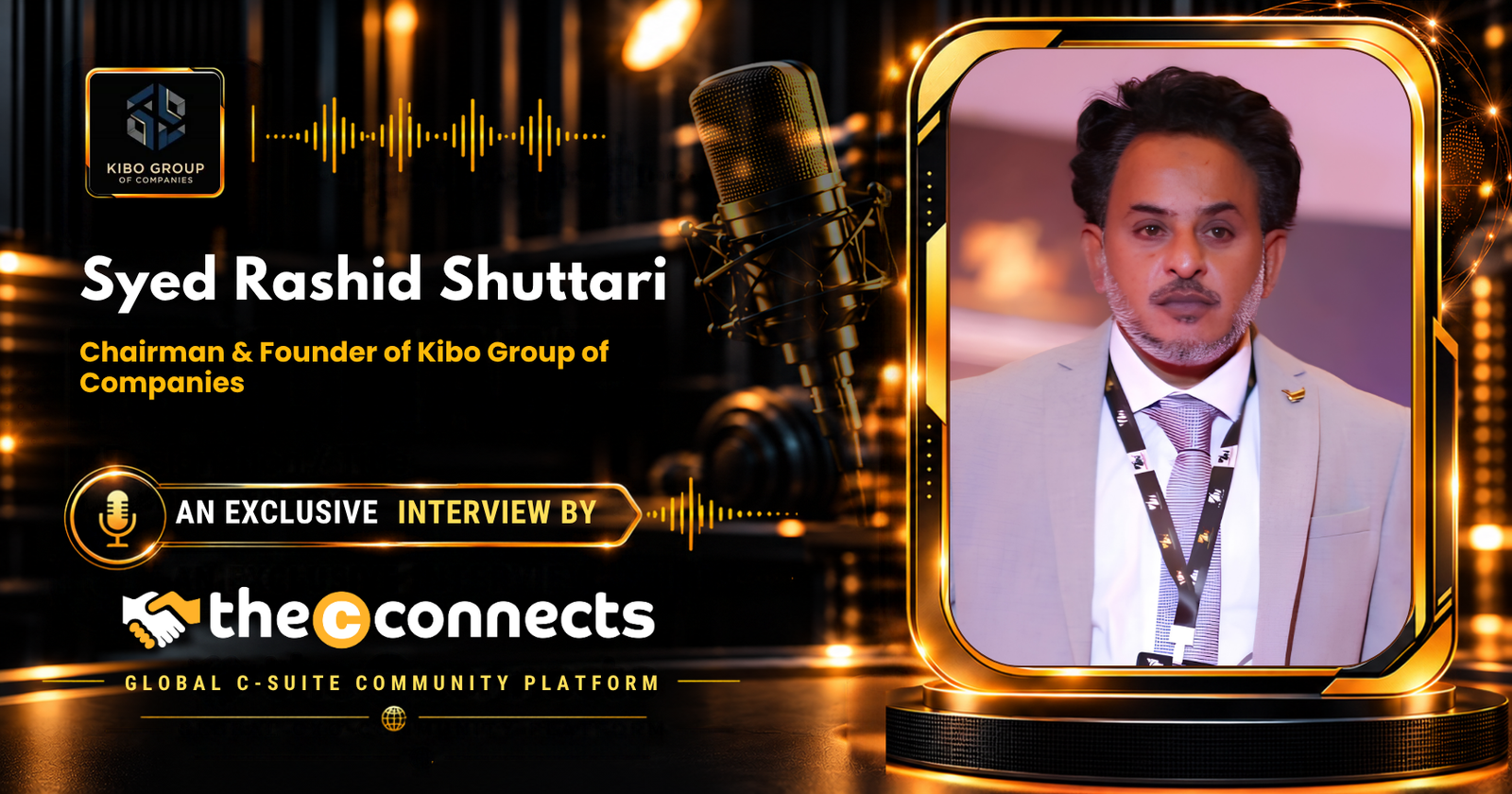

In an entrepreneurial ecosystem that frequently rewards narrow specialization, building a successful multi-sector conglomerate requires a rare combination of operational discipline, strategic agility, and macro-level vision. Over the past fourteen years, Syed Rashid Shuttari has silently executed one of the most compelling diversification blueprints in the regional market.
From its foundational roots as a specialized interior and infrastructure solutions firm, the Hyderabad-based Kibo Group of Companies has transformed into an eight-axis powerhouse. Today, the conglomerate spans Information Technology (KIBOTech), logistics and retail (KIBO Mart), lifestyle (Kibo Fashions and Kibo Herbal Beauty), and large-scale entertainment and film production. With recent major corporate distinctions-including the Global Icon Award for the Most Dynamic & Diversified Business Conglomerate of the Year-and a high-profile commercial expansion underway in Dubai, Shuttari has cemented his place as a premier architect of modern corporate scaling.
TheCconnects sat down with Syed Rashid Shuttari to dissect the mechanics of horizontal diversification, the critical role of human capital framework design, and how to build operational resilience across vastly different industry verticals.
TheCconnects: Rashid, looking at the current footprint of the Kibo Group of Companies, it is hard to believe this entire ecosystem originated from a focused interior solutions business fourteen years ago. Can you take our readers through the evolutionary milestone phases of your professional journey?
Syed Rashid Shuttari: It is a pleasure to connect with your audience. When I look back at my formative years at St. Patrick’s High School in Secunderabad and later pursuing my MBA at Sai Sudhir, the core lesson I absorbed wasn’t just about corporate management-it was about value architecture. My early years in the corporate sector were spent mastering the foundational realities of human resource management, business operations, and organizational administration.
When we laid the first brick of our interior solutions business over a decade ago, I deliberately resisted treating it as a static operation. I viewed it as a baseline for scaling workflows. As our execution models matured, we identified adjacent market friction points. The transition from physical interior infrastructure to digital infrastructure (KIBOTech) or supply chain management (KIBO Mart) wasn’t an erratic leap; it was a measured response to structural gaps in consumer delivery. In 2025, we formally consolidated these independent high-growth vectors under a single corporate identity. The growth you see today is the result of years of stabilizing internal operation loops before entering new verticals.
TheCconnects: Managing a single industry vertical is complex enough. You are simultaneously governing operations across eight distinct business divisions-ranging from raw software engineering and real estate construction to entertainment, wellness campaigns, and regional film production. What is the operational framework that keeps this machine cohesive?
Syed Rashid Shuttari: The key lies in separating capital allocation strategy from day-to-day execution semantics. If a Chairman tries to micro-manage the source code of a software platform while simultaneously reviewing fabric materials for a fashion line, the enterprise will collapse under its own weight.
My leadership model is anchored in a decentralized, framework-driven operational system. Each division operates with its own vertical specialists and operational leaders, but they are bound by the same centralized corporate governance models, time-management methodologies, and rigorous HR policies. We look for systemic common denominators. Whether you are distributing fresh lifestyle apparel through Kibo Fashions or managing logistical timelines for Kibo Events, the underlying engine relies on predictable talent performance, efficient resource allocation, and tight turnaround metrics. I don’t manage the products; I manage the structural systems that build them.
“If a leader tries to micro-manage the source code of a software platform while simultaneously reviewing fabric materials for a fashion line, the enterprise will collapse under its own weight. I don’t manage products; I manage the structural systems that build them.”
TheCconnects: You hold an MBA with deep domain specialization in Human Resources and Time Management. How do these two specific academic and professional disciplines manifest in the daily performance of the Kibo Group?
Syed Rashid Shuttari: In a conglomerate setup, time is your absolute currency, and human capital is your engine. Many organizations view HR merely as a compliance or payroll department. To us, HR is a strategic recruitment pipeline and talent optimization framework.
Because we operate in highly volatile markets like tech and media, our hiring parameters are geared toward cognitive adaptability. We train our teams extensively in time-blocking, workflow transparency, and metrics-driven milestones. We eliminate administrative friction through specialized automation tools developed by our own tech wing. When every team member knows exactly how their individual daily output metrics impact the broader quarterly P&L of their division, accountability ceases to be an enforced corporate rule and becomes an organic corporate culture.
TheCconnects: The Kibo Group has transitioned from a prominent regional player in Telangana and Andhra Pradesh to an international enterprise, with a strategic commercial rollout currently executed in Dubai. What drove the decision to establish a presence in the UAE market, and what unique challenges does it bring?
Syed Rashid Shuttari: The decision to scale into Dubai represents the maturity phase of our global market penetration strategy. Dubai is no longer just a Middle Eastern trade city; it is a global epicenter for venture building, technological integration, and international capital.
The primary driver was to leverage our tech and infrastructure portfolios in a hyper-scalable market. The challenge, of course, is navigating a sophisticated regulatory environment and competing against established global players. We are overcoming this by keeping our entry strategy highly localized. We aren’t trying to transplant Indian operational frameworks directly into the UAE. Instead, we are building cross-border alliances, establishing strategic regional distribution pipelines for our lifestyle lines, and positioning KIBOTech as an agile partner for local enterprise automation. International expansion forces an organization to strip away localized inefficiencies and upgrade its quality standards to a global benchmark.
TheCconnects: From your vantage point as a conglomerate leader supporting diverse business initiatives-including your prime partnerships with Glam Connect, Face of India, and urban tech awards-what do you see as the single greatest challenge for modern brands trying to scale in the digital space?
Syed Rashid Shuttari: The fundamental crisis for modern brands in the digital era is “Fragmented Consumer Attention vs. Over-Engineered Platforms.”
Right now, brands are spending astronomical sums on multi-channel marketing campaigns, fancy analytics dashboards, and hyped-up AI implementations without fixing the basic consumer experience. If a consumer visits an e-commerce platform or interacts with a digital solution and encounters high latency, non-intuitive navigation, or delayed customer fulfillment cycles, all the digital marketing spend is instantly invalidated.
Our solutions across our consumer-facing businesses-whether it is KIBO Mart or our lifestyle portals-focus heavily on extreme simplification. We streamline our user interfaces, eliminate checkout friction, and back our digital platforms with a ruthless, highly predictable physical supply chain. The digital space is incredibly loud; the only way to cut through the noise is by delivering flawless, quiet execution.
TheCconnects: Rashid, between managing global corporate rollouts, overseeing board meetings, and serving as a key financial sponsor for industrial excellence summits, how do you find time to recharge? What does your free time look like?
Syed Rashid Shuttari: (Smiles) Free time is a concept I define through the lens of continuous learning rather than passive rest. I am an absolute bibliophile. I spend a significant portion of my quiet hours studying international business models, trade history, and macro-economic shifts.
I also find immense clarity in creative media and film production. Engaging with the music and creative industries gives me a fresh, non-linear perspective on consumer psychology that I can loop back into our corporate strategies. Ultimately, my down time is spent recalibrating my mind so that when I step back into the boardroom, my decisions are sharp, analytical, and forward-looking.
TheCconnects: To close this highly insightful session, what concrete advice do you have for aspiring young entrepreneurs who are trying to scale businesses out of regional hubs into global markets?
Syed Rashid Shuttari: I will give you a simple three-step mental model that has guided my entire career:
- Master the Unit Economics First: Do not scale a broken business model. If your venture cannot generate a sustainable margin at a small, localized scale, adding more capital or moving to a bigger city will only accelerate your failure. Standardize your baseline operations before you chase growth.
- Build Systems, Not Just Products: A great product can make you a short-term profit, but a robust operational system builds a multi-generational legacy. Focus on your internal infrastructure, your HR framework, and your compliance protocols early.
- Invest in Long-Term Trust: In business, your reputation is your ultimate collateral. Whether you are dealing with a local vendor in Hyderabad or an international stakeholder in Dubai, protect your integrity at all costs.
Success is not a sprint determined by a single trendy tech launch; it is a marathon sustained by consistency, disciplined execution, and the courage to diversify when the data tells you the market is ready.
TheCconnects: Rashid, your strategic philosophy on conglomerate governance and your pragmatic approach to global growth are a masterclass for our audience. Thank you for joining us today.
Syed Rashid Shuttari: Thank you to the editorial team at TheCconnects. It was a thoroughly engaging conversation, and I hope our corporate blueprint inspires the next generation of global builders to execute their visions fearlessly.