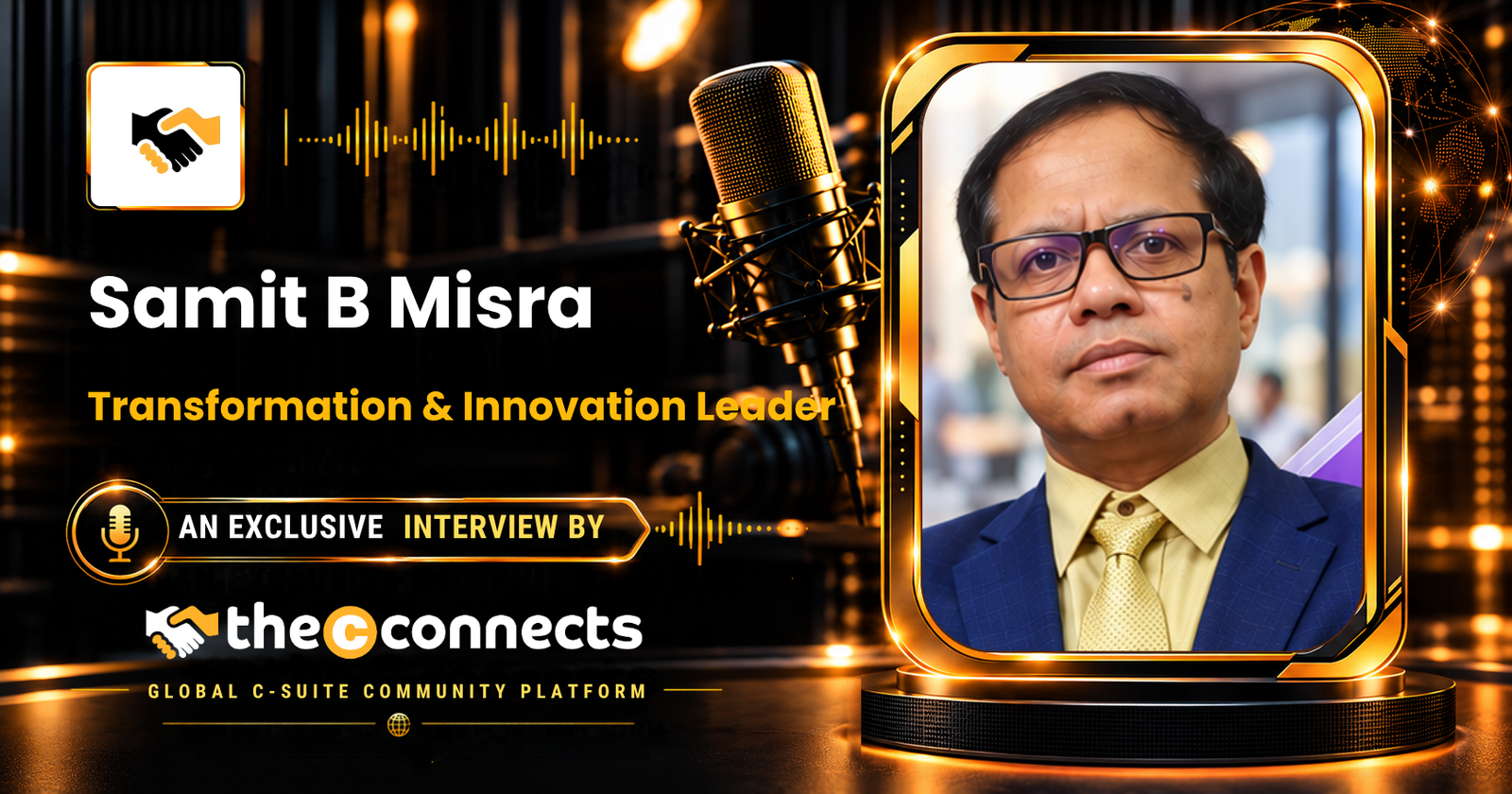

Welcome, Samit B Misra! It is an absolute privilege to host a Strategic Problem Solver and Transformation Leader of your caliber today. Your career trajectory is remarkably diverse-spanning leadership roles at global giants like IBM, Microsoft, and Kyndryl, to pioneering AI innovations, holding a USPTO AI Patent, and founding the GSPKM World Goodness Foundation. You operate at the intersection of business strategy, technology economics (FinOps), and Agentic AI, transforming tech from a cost center into a measurable driver of business value. Given your intense focus on “Value Stream Intelligence” and building future-ready innovation ecosystems, we are thrilled to dive into your journey. How are you doing, and what is keeping you most energized lately?
Samit B Misra: Thank you so much for the incredibly warm welcome! It is a true pleasure to connect with TheCconnects and your readers. I am doing very well. What keeps me most energized right now is the paradigm shift we are witnessing in enterprise transformation. We are moving from basic digital transformation to what I call “Intelligent Evolution.” The conversation is no longer just about applying AI to existing processes; it is about fundamentally rethinking how organizations operate, govern technology, and create value through Agentic AI and TBM (Technology Business Management) by Design. This is also where my thinking around Value Stream Intelligence comes in-moving beyond simply mapping value streams towards continuously understanding, sensing and improving the value an organisation creates. Bridging that gap between ambitious strategy and measurable execution is a fascinating space to operate in every day.
TheCconnects: Your professional journey is incredibly rich, moving from early roles in telecom billing and technology to senior global project and transformation leadership across IBM/Kyndryl, and now serving as a Director driving the GSPKM World Goodness Foundation. Can you walk our readers through this evolution?
Samit B Misra: My professional journey has always been guided by a singular focus: solving complex problems by connecting business strategy with technological execution. Early in my career, at organizations like Hutch-Vodafone and UshaComm, I learned the mechanics of system migrations and the critical importance of change management. Transitioning into leadership roles at Convergys and Microsoft taught me how to scale global operations and align diverse stakeholders across international boundaries.
During my journey through IBM and subsequently Kyndryl, I pivoted heavily into cognitive technology and AI. I realized that the biggest challenge organizations faced wasn’t a lack of technology, but a lack of alignment between technology spending and actual business value. This realization led me to explore how FinOps, TBM, Agentic AI and organisational change could work together to close that gap. Ultimately, this journey wasn’t just about corporate success; it was about human impact. That is why I took on the Directorship at the GSPKM World Goodness Foundation-to ensure that technological progress evolves alongside human consciousness and protects humanity.
TheCconnects: With such a multifaceted career bridging hardcore enterprise technology and profound spiritual/social initiatives, who or what has influenced you the most in your life?
Samit B Misra: My greatest influence is undeniably Gurudev Sri Sri Paresh Kumar Misra and the profound philosophy of the Dollymoni Sri Radharani sampradaya. The guiding principle-“Let all that you do be done in love”-has profoundly shaped not just my personal life, but my corporate leadership.
In the enterprise world, it is easy to become entirely consumed by metrics, cost-cutting, and aggressive competition. The spiritual foundation provided by Gurudev taught me that true leadership is about empathy, simplifying complexity, and fostering harmony. Whether I am developing an AI invention or building the Dollymoni School of Neuro Spiritual Recode, the underlying drive is to create value that uplifts people. Technology must serve humanity, not the other way around.
TheCconnects: Scaling global transformations and driving AI innovations across massive enterprises is notoriously difficult. What are the biggest challenges you have faced in your career, and how did you overcome them?
Samit B Misra: The most significant challenge I consistently face is the disconnect between the boardroom strategy and the operational frontline. Executives often view technology purely as a cost center, while engineers view it in isolation from business outcomes.
I overcame this by developing and championing what I call “Value Stream Intelligence (VSI)” together with “TBM by Design.” VSI is not simply an extension or rebranding of traditional Value Stream Mapping. VSM helps organisations understand how value flows; VSI seeks to create an intelligence layer around that value flow-connecting business outcomes, technology, economics, capabilities, people, AI and governance so that the organisation can continuously sense where value is being created, where it is leaking, and what action can improve it.
When you are trying to drive an AI-led transformation, you cannot just drop algorithms into legacy systems. You have to design the transformation with economics and organisational readiness in mind. By using FinOps to optimise consumption and linking technology investment to measurable business outcomes, I learned to speak the language of finance to the CFO, strategy to the CEO, and architecture to the engineers.
TheCconnects: After decades of navigating global system integrations, leading PMOs, and serving on the IBM TC&IS Whitepaper Review Board, what key lessons have you learned from your professional career?
Samit B Misra: The most critical lesson I have learned is that complexity is the enemy of execution. Organizations often fail to innovate because they are paralyzed by overly complicated structures and misaligned metrics.
I also learned that transformation is never just about technology; it is primarily about people and culture. You can implement the most advanced Agentic AI system, but if the organizational culture does not embrace continuous optimization and intelligent decision-making, the technology will fail. Finally, I learned that true innovation requires a willingness to challenge conventional thinking. Being an inventor and securing a USPTO patent taught me that you must have the courage to look at a traditional process and say, “There is a radically better way to do this.” That mindset is also what led me to conceptualise VSI-not to improve the old paradigm incrementally, but to ask whether the paradigm itself needed to evolve.
TheCconnects: Looking at the modern enterprise landscape, what do you see as the biggest challenge for brands and organizations in the digital and AI space today?
Samit B Misra: The biggest challenge is the illusion of transformation. Many organizations believe they are digitally transformed simply because they migrated to the cloud or implemented a basic generative AI tool. This is a massive trap.
The real challenge is moving from “doing digital” to “being intelligent.” Organizations struggle to govern AI responsibly, optimize their escalating cloud costs, and actually measure the business value their technology generates. The organization of the future cannot merely execute transformation; it must continuously sense, understand, and transform itself. Transformation should therefore become an organisational capability, not a project with a start date and an end date. Overcoming this requires integrating AI Governance, FinOps, and Agentic workflows so that technology becomes a continuously optimized driver of competitive advantage.
TheCconnects: How does your approach, specifically through concepts like Value Stream Intelligence (VSI), address these exact pain points for businesses?
Samit B Misra: VSI addresses a problem deeper than “blind spending”: blind value. Organisations may know what technology costs and may even know how efficiently it is being consumed, but they often lack a continuously connected view of whether those investments are actually creating the intended business value.
Instead of asking, “How much does this server cost?” we ask, “What business capability does this investment enable, what outcome is it expected to create, and how intelligently are we improving that outcome?” By combining FinOps cost optimization with Agentic AI insights, we turn technology spend into measurable value. It is not about spending less; it is about creating more value with every investment. This approach builds a smarter, more resilient, and sustainable organization.
TheCconnects: Your professional commitments range from corporate transformation consulting to directing the GSPKM World Goodness Foundation. What does Samit B Misra do in his free time to maintain balance?
Samit B Misra: For me, work and purpose are deeply intertwined, so my “free time” is often spent on initiatives that feed my soul. I am also a published author writing under the pen name Bubu Mana, and my books explore subjects ranging from personal transformation and spirituality to Artificial Intelligence, Quantum science, consciousness and the possible convergence of AI and Quantum technologies.
Writing gives me a different way to explore questions that may not fit neatly into a corporate transformation framework. Works such as Turning Vision to Reality, The Forgotten Room – An AI Mystery at Lukano Greyhound and Beyond Copenhagen – The Missing Link to Many Worlds reflect that curiosity.
I also dedicate significant time to the GSPKM World Goodness Foundation, working on spreading knowledge, kindness, and harmony. Exploring the frontiers of Neuro Spiritual Recode and how human consciousness can evolve alongside technological progress is a profound passion of mine. I also enjoy mentoring the next generation of leaders, having previously guest-lectured at institutions like IMT.
TheCconnects: To conclude this highly insightful conversation, what is your ultimate advice for aspiring entrepreneurs and transformation leaders in the tech industry today?
Samit B Misra: Do not become so infatuated with the technology that you forget the problem you are trying to solve. Aspiring leaders must learn to connect business strategy, technology, and economics. Understand FinOps along TBM and then track to measureble value.
Furthermore, as you build and innovate, remember your ethical responsibility. The opportunity lies in building technology that protects rather than threatens humanity. Aim to create ecosystems where technological progress and human consciousness evolve together. Be a strategic problem solver who simplifies complexity, creates measurable value, protects humanity, and ultimately leaves a legacy of goodness in the world.