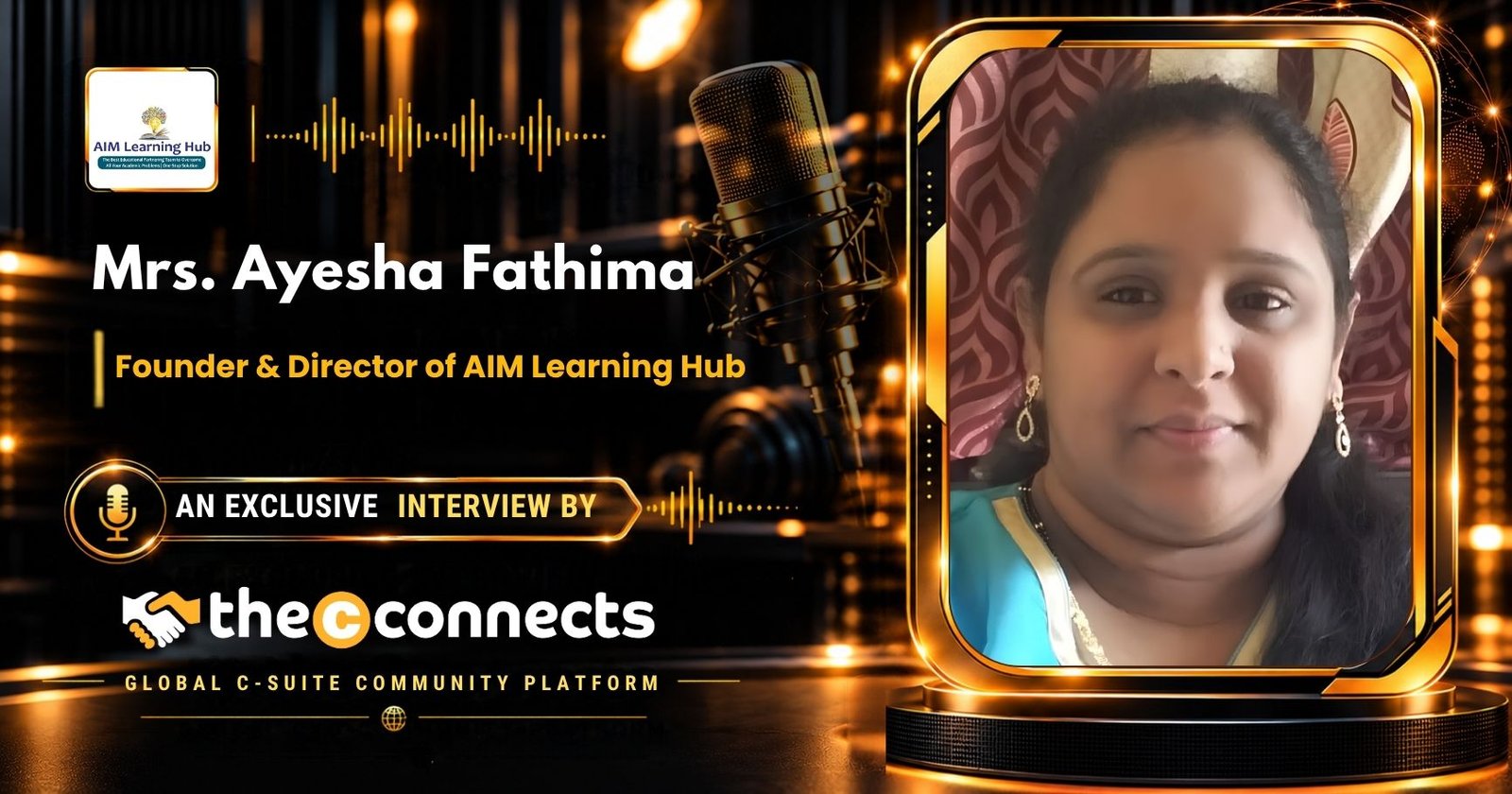

In the rapidly evolving landscape of Indian education, the spotlight is often placed on digital smartboards, tablet-based learning, and high-tech infrastructure. Yet, the true foundation of any successful educational institution remains profoundly human: the teacher. Few understand this better than Mrs. Ayesha Fathima.
With a distinguished career spanning over two decades, Mrs. Ayesha Fathima is a visionary education leader, a certified Early Childhood Education (ECE) author, and a curriculum architect. She spent 13 years at the heart of the classroom before dedicating the last seven years to academic leadership, teacher capacity building, and school administration. Today, as the Founder and Director of AIM Learning Hub in Hyderabad, she works with educational institutions across India, offering customized curriculums, academic audits, and intensive teacher training programs.
Armed with an M.A., an M.Ed., and multiple American TESOL Diplomas, she operates on a simple but powerful philosophy: “Quality education begins with empowered teachers.”
TheCconnects recently sat down with Mrs. Fathima to discuss her transition from the classroom to educational entrepreneurship, the harsh realities of modern school administration, and how she is reshaping the future of early childhood and primary education.
TheCconnects: Mrs. Ayesha Fathima, it is an absolute honor to have you with us today. Your career in the education sector spans over 20 years. You spent 13 of those years inside the classroom before moving into leadership and eventually founding AIM Learning Hub. How did that transition unfold?
Ayesha Fathima: Thank you for having me. The journey has been incredibly organic, born out of a deep love for the classroom. For the first 13 years of my career, my universe was my students. But as I grew in my profession, taking on roles as an Academic Program Manager and Curriculum Head, I began to see the broader ecosystem of a school.
I noticed a recurring pattern: even the most passionate teachers were often overwhelmed by poorly structured curriculums, immense administrative pressure, and a lack of practical training. I realized that while I could impact 40 students in my classroom, if I trained and mentored 40 teachers, I could indirectly impact thousands of students. That realization was the catalyst. I wanted to create a platform that supported schools holistically-not just by handing them a syllabus, but by hand-holding their educators. That is how AIM Learning Hub was born.
TheCconnects: Working in education means you are constantly shaping lives, but who has influenced your life and leadership style the most?
Ayesha Fathima: My greatest influencers have actually been the struggling teachers and the diverse learners I have encountered over the years. Early in my career, I worked under some phenomenal school principals who taught me that true leadership in education isn’t about sitting in an air-conditioned office reviewing reports; it’s about walking the corridors, observing the classroom dynamics, and mentoring with empathy.
Additionally, my continuous pursuit of learning-such as completing my American TESOL Diplomas in Business English and School Administration-exposed me to global educational standards. The intersection of local classroom realities and global best practices deeply shaped my approach to curriculum design and teacher mentoring.
TheCconnects: Transforming a school’s academic culture is a massive undertaking. What are the biggest challenges you have faced in school administration and teacher training, and how do you overcome them?
Ayesha Fathima: The biggest challenge in the education sector is resistance to change. Many schools are trapped in a cycle of rote learning and outdated teaching methodologies because “that is how it has always been done.” When we step in to conduct a School Quality Audit or introduce a learner-centered curriculum, there is often initial hesitation from both the management and the teaching staff.
I overcome this by shifting the narrative from evaluation to empowerment. I don’t walk into a school to tell teachers what they are doing wrong. Instead, through AIM Learning Hub, we provide highly practical Teacher’s Manuals, step-by-step lesson planning, and professional development workshops. Once a teacher sees that our customized curriculum (from Nursery to Grade 5) actually reduces their workload and increases student engagement, the resistance melts away. Transformation happens through collaboration, not dictation.
TheCconnects: How exactly does AIM Learning Hub address the pressing pain points of modern schools and educators?
Ayesha Fathima: Most schools face three massive pain points: inconsistent teaching quality, lack of structured academic documentation, and the disconnect between parents and the school’s vision.
At AIM Learning Hub, we provide an end-to-end ecosystem. We don’t just sell a curriculum. We conduct thorough academic audits to find the gaps. We design customized curriculums that suit the specific demographic of the school. We provide exhaustive Teacher’s Manuals so an educator knows exactly how to deliver a concept. Furthermore, we conduct Parent Orientation Programmes. Parents are crucial stakeholders, and if they don’t understand the school’s pedagogical approach, the child’s learning suffers. We bridge that gap, acting as a long-term academic partner for the institution.
TheCconnects: We live in an era where educational brands and EdTech companies are flooding the digital space. What do you see as the biggest challenge for educational brands in this digital age?
Ayesha Fathima: The biggest challenge is maintaining the human connection. The digital space is flooded with apps, smart-learning modules, and AI-driven assessment tools. While technology is a fantastic enabler, many educational brands market it as a replacement for the teacher.
The challenge for schools is not to get swept away by digital gimmicks. A digital smartboard is useless if the teacher operating it lacks foundational pedagogy. Brands in the digital education space struggle with retention because they focus on the software rather than the emotional and psychological development of the child. Technology must empower the teacher, not isolate the student.
TheCconnects: Looking back at your journey from a teacher to a recognized “Mastermind of Educational Growth,” what key lessons have you learned?
Ayesha Fathima:
- Never stop being a student. The moment an educator stops learning, they stop teaching effectively.
- Empowerment yields accountability. If you give a teacher the right training, the right resources, and a supportive environment, they will naturally take ownership of their students’ success.
- Curriculum is a living entity. A good curriculum isn’t just a printed book; it must evolve with the learners’ needs and societal changes.
TheCconnects: Between running AIM Learning Hub, designing curriculum architectures, and conducting training across India, do you have any free time? How do you unwind?
Ayesha Fathima: (Laughs) Free time is definitely a luxury! But when I do step away from work, I find solace in writing and reading. As a Certified ECE Author, I love researching early childhood psychology and cognitive development. I also enjoy spending quiet time reflecting on the educational trends happening globally. For me, creating educational content is not just a profession; it is a profound passion, so my downtime often naturally bleeds into creative brainstorming for new teaching modules.
TheCconnects: Finally, what advice do you have for aspiring “edupreneurs”-those looking to start their own educational ventures, schools, or consultancies?
Ayesha Fathima: My advice is to understand the ground reality of a classroom before you try to change it.
Many entrepreneurs enter the education sector viewing it purely as a profitable business. But education is a service of immense social responsibility. If you want to build a sustainable educational brand, you must spend time understanding the psychology of the child, the daily exhaustion of the teacher, and the anxiety of the parent. Build solutions that genuinely solve their problems. Anchor your business in empathy, prioritize quality over rapid expansion, and always remember: no matter how advanced your infrastructure is, your institution is only as good as the teachers inside it.
TheCconnects: Mrs. Ayesha Fathima, your dedication to empowering educators and transforming schools is truly inspiring. Thank you so much for sharing your profound insights with our readers today.
Ayesha Fathima: The pleasure was entirely mine. Thank you to TheCconnects for providing a platform to discuss the vital role of teacher empowerment in our education system!