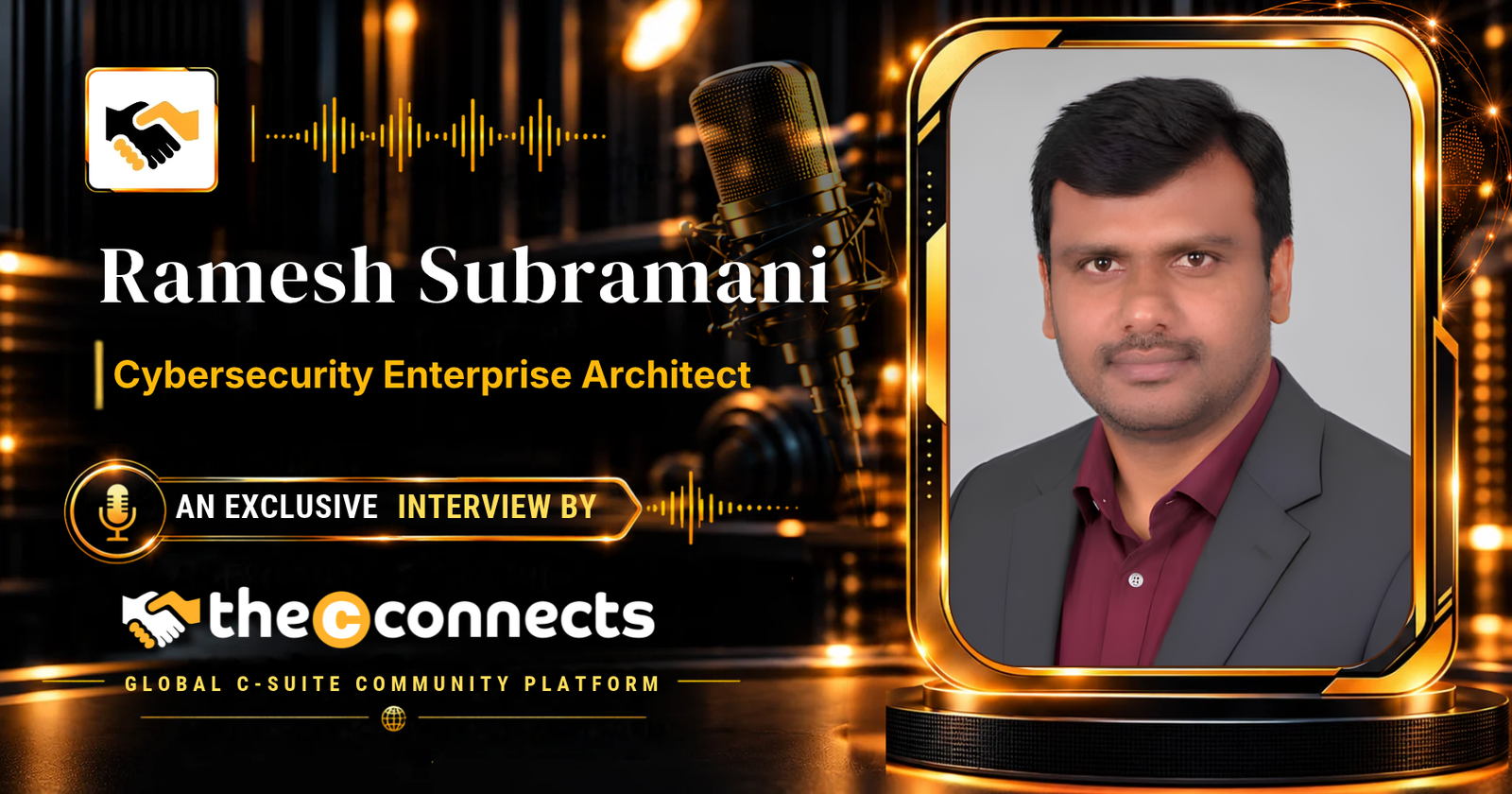

Welcome, Ramesh Subramani! It is a distinct privilege to feature a cybersecurity architect of your caliber with TheCconnects. With over 16 years of leadership experience spanning enterprise security architecture, cloud and hybrid cloud defense, and Zero Trust implementation, your work has fortified digital environments across North America, Europe, and the Asia-Pacific. From designing intricate boundaries between enterprise IT and operational technology (OT) to authoring IEEE conference papers on industrial system resilience, you operate at the absolute cutting edge of cyber defense. We are thrilled to delve into your insights on continuous security validation, AI-driven threat detection, and the future of enterprise resilience.
TheCconnects: Welcome, Ramesh! It is an absolute honor to host you today. Over the past 16 years, your career has evolved from a foundation in Electronics and Communication Engineering into deep enterprise cybersecurity architecture. To begin, can you tell our readers a little about your professional journey and how you transitioned into this highly specialized role?
Ramesh Subramani: Thank you for the warm welcome. It is a pleasure to connect with TheCconnects and your global audience. My journey has been a natural progression of following how data moves and understanding how to protect it. My academic foundation in Electronics and Communication gave me a granular understanding of how hardware, networks, and signals operate. As the digital landscape expanded, I quickly realized that building networks was only half the equation; securing them from sophisticated threats was the real challenge.
Over the last decade and a half, I transitioned from fundamental IT roles into designing complex enterprise security architectures. I became deeply focused on hybrid and multicloud environments and the integration of Zero Trust principles. Today, my role revolves around modernizing enterprise defenses, ensuring that as organizations scale globally, their security posture scales with them seamlessly across enterprise IT and manufacturing OT environments. What continues to interest me is turning security requirements into designs that teams can implement, operate, and improve across different regions
TheCconnects: Operating in a field that shifts daily requires strong foundational principles. Who or what has influenced you the most in your life and shaped your philosophy on cyber resilience?
Ramesh Subramani: My greatest influence has been the rapid, almost aggressive evolution of the threat landscape itself. Watching how cyber adversaries continuously adapt their tactics forces you to remain intellectually humble and highly vigilant.
On a more philosophical level, my approach has been shaped by the engineering principle of “resilience over perfection.” In the early days of cybersecurity, the goal was to build an impenetrable fortress. Today, we know that breaches are a matter of “when,” not “if.” The mentors and researchers I have collaborated with taught me to design systems that assume a state of continuous compromise. This mindset shifted my focus toward Zero Trust and continuous control validation-ensuring that even if a threat actor breaches the perimeter, they cannot move laterally or disrupt critical operations.
TheCconnects: You specialize in securing Operational Technology (OT), IIoT, and IoT environments. What are the biggest challenges you have faced in segmenting industrial environments from enterprise IT, and how do you overcome them?
Ramesh Subramani: The biggest challenge in segmenting IT and OT is the inherent conflict of operational priorities. Enterprise IT prioritizes data confidentiality, while industrial environments prioritize continuous availability and physical safety. If you apply a standard IT security policy to a manufacturing plant’s network, you risk causing massive operational disruptions.
I overcome this by focusing on least-privilege communication and risk-based network segmentation. We architect clear boundaries between the corporate network and the industrial floors without interrupting the necessary data flow for predictive maintenance and monitoring. It requires meticulous policy enforcement and secure connectivity design, ensuring we reduce the attack surface and eliminate lateral movement while keeping the industrial operations running smoothly.
TheCconnects: You are a strong advocate for Zero Trust. How does a Zero Trust architecture practically address the pain points of organizations transitioning to complex multicloud environments?
Ramesh Subramani: The main pain point for organizations moving to the cloud is the complete dissolution of the traditional network perimeter. You no longer have all your assets sitting safely in a local data center. Cloud adoption makes access decisions more complex because resources, identities, and services are distributed across different environments. Your data is distributed, your workforce is remote, and third-party vendors require access.
Zero Trust addresses this by shifting the security perimeter from the network to the identity and the endpoint. It operates on the principle of “never trust, always verify.” By enforcing microsegmentation and strict access policies, we ensure that every single access request is authenticated, authorized, and continuously validated for security posture before access is granted. The objective is to reduce the likelihood that compromised credentials can be used to reach critical resources or move laterally. It also requires consistent ownership of access policies across cloud and on-premises teams.
TheCconnects: Looking at the modern, hyper-connected landscape, what do you see as the biggest emerging cybersecurity challenge for global brands in the digital space today?
Ramesh Subramani: The biggest challenge today is the weaponization of Artificial Intelligence by threat actors. We are seeing AI-driven attacks that can automate vulnerability discovery, bypass traditional endpoint detection systems, and launch highly convincing, personalized phishing campaigns at scale.
For global brands, this means legacy, signature-based threat protection is no longer sufficient. Brands are struggling to keep pace with the sheer velocity of these automated attacks. The challenge is fighting AI with AI-brands must adopt AI-driven threat detection and automated incident response capabilities to identify anomalies and quarantine threats in real-time, long before human intervention is required.
TheCconnects: Having supported security modernization across North America, Europe, and the Asia-Pacific, what key lessons have you learned about global security governance?
Ramesh Subramani: The most critical lesson I have learned is that security architecture cannot be a one-size-fits-all template. A global security strategy must account for diverse regulatory environments, data sovereignty laws, and regional operational cultures. Those differences should be understood and documented rather than addressed through informal exceptions.
I’ve also learned that technology alone does not equal security. You can buy the most expensive endpoint detection and response (EDR) solutions, but if your security governance, policy integrity, and incident response procedures are poorly designed, you remain vulnerable. True modernization is the harmonious integration of people, precise policies, and resilient technology.
TheCconnects: You actively author IEEE conference papers on Zero Trust and industrial system resilience. How does this deep academic research influence your day-to-day practical security architecture?
Ramesh Subramani: Research gives me a structured way to question assumptions. Contributing to IEEE conferences forces me to look beyond the immediate operational fires of the day and analyze the fundamental science of cyber defense. It allows me to explore theoretical models of AI-driven threat detection and continuous security validation before they become mainstream enterprise requirements. I take these peer-reviewed, academic insights and translate them into practical, deployable security architectures for the organizations I advise. It bridges the gap between what is theoretically possible and what is operationally viable.
TheCconnects: Despite having 16 years of hands-on leadership experience, you are currently pursuing a Master’s in Cybersecurity. What drives this commitment to continuous academic learning?
Ramesh Subramani: In cybersecurity, the moment you stop learning is the moment your defenses become obsolete. While hands-on experience is invaluable for operational execution, a structured academic environment provides a rigorous framework for analyzing new cryptographic paradigms, advanced persistent threats, and global cyber policy. Pursuing my Master’s ensures that my foundational knowledge remains incredibly sharp and that the strategic guidance I provide is backed by the latest academic advancements in the field.
TheCconnects: You advocate heavily for “continuous security validation.” Why is it no longer enough for an enterprise to simply set up a firewall and conduct an annual penetration test?
Ramesh Subramani: A point-in-time assessment provides useful evidence, but infrastructure and access requirements continue to change afterward. Monitoring, penetration testing, architecture reviews, and control validation serve different purposes and should work together. For me, continuous validation means checking important security assumptions at a frequency appropriate to the risk, especially after material changes. Teams need to know what is being tested, what constitutes a failure, and who will act on the result. In OT environments, validation methods must also respect production constraints; passive checks and carefully planned testing may be more appropriate than intrusive techniques.
TheCconnects: The life of a Cybersecurity Manager handling global enterprise security is intensely demanding. What do you do in your free time to detach and recharge?
Ramesh Subramani: Mental detachment is critical to avoid burnout in this industry. In my free time, I make a conscious effort to step away from screens and digital interfaces. I enjoy spending quality time with my family, reading, and exploring topics completely outside of technology. When I do engage with the professional world off the clock, it is usually through writing or researching for my next paper, which I find to be a highly creative and fulfilling outlet that balances the high-pressure operational work.
TheCconnects: Finally, what advice do you have for aspiring cybersecurity professionals or tech entrepreneurs looking to build resilient security operations in today’s landscape?
Ramesh Subramani: My primary advice is to master the fundamentals of networking and systems architecture before diving into advanced security tools. You cannot secure what you do not understand.
For entrepreneurs and security leaders: do not build security architectures in a vacuum. Understand the business objectives and the operational realities of the end-users. Security should enable the business to move faster and safer, not act as a roadblock. Embrace Zero Trust, invest in continuous validation, and always design your systems with the assumption that a breach will eventually occur. Resilience is your ultimate goal.