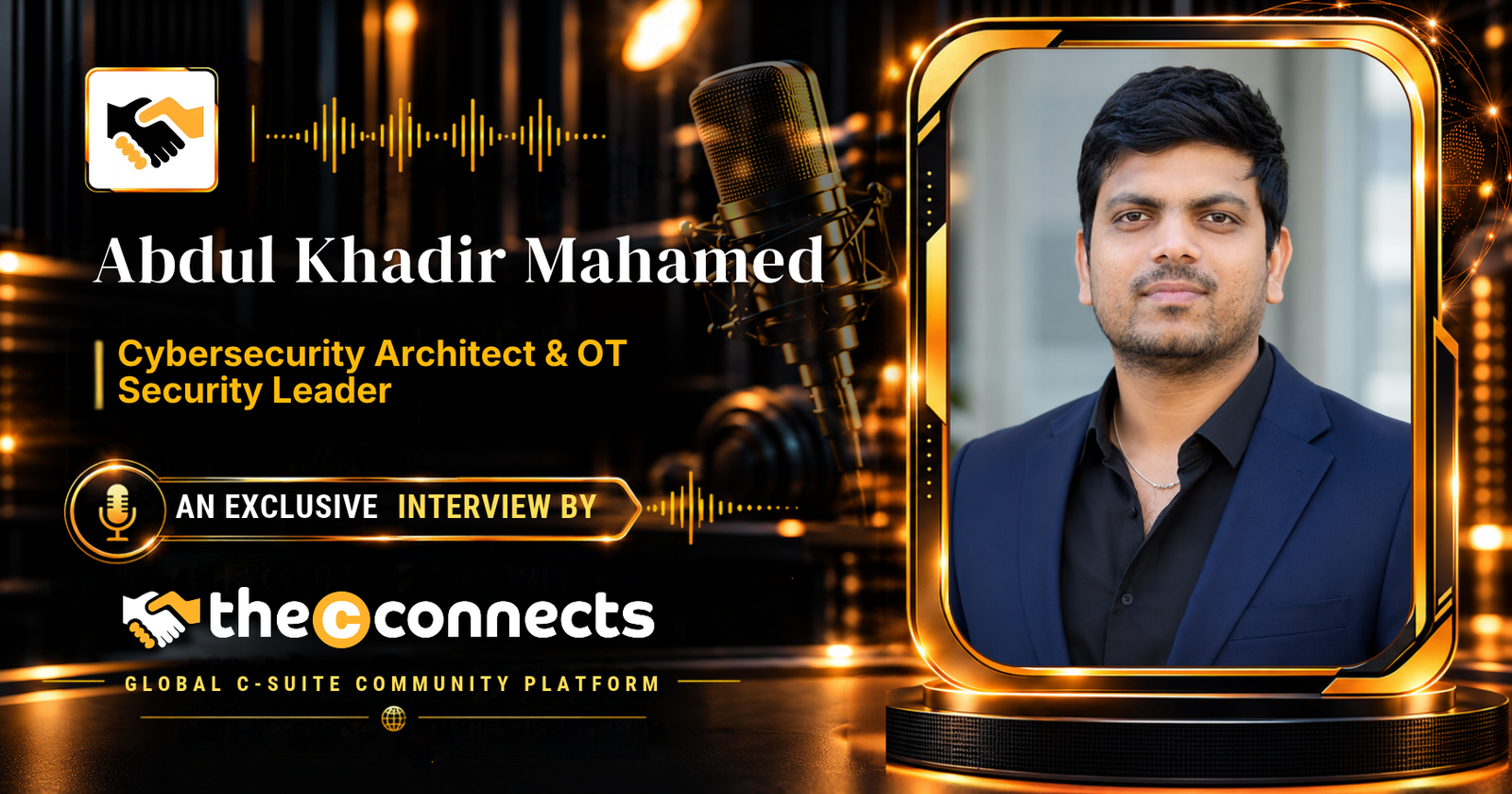

Welcome, Abdul Khadir Mahamed! It is an absolute privilege to feature a cybersecurity visionary of your caliber with TheCconnects. With over 13 years of leadership experience designing and managing security programs across Enterprise IT, Critical Infrastructure, Operational Technology (OT), and Industrial Control Systems (ICS), you operate at the highly complex intersection of digital defense and physical safety. Having secured global manufacturing value chains, R&D environments, and massive industrial ecosystems without disrupting critical processes, your expertise in IT/OT convergence is truly unparalleled. We are thrilled to dive into your insights on cyber resilience, threat monitoring, and the future of industrial security.
TheCconnects: Welcome, Abdul Khadir! It is a distinct honor to host you today. Over the past 13 years, your career has evolved through data analytics, enterprise security, and ultimately into the highly specialized realm of OT Security Architecture for global manufacturing and distribution brands. To begin, can you tell our readers a little about your professional evolution and how you transitioned into protecting critical infrastructure?
Abdul Khadir Mahamed: Thank you for the incredibly warm welcome! It is a pleasure to connect with TheCconnects and your readers. My journey has been a fascinating progression of bridging the physical and digital worlds. Academically, I started with a Bachelor’s in Electrical and Electronics Engineering. This gave me a foundational understanding of physical systems-how power grids, controllers, and heavy machinery operate on a molecular level.
Early in my career, I transitioned into data analytics and eventually enterprise IT security. However, as the world moved toward smart manufacturing and the Internet of Things (IoT), I noticed a massive, dangerous gap. Traditional IT security professionals didn’t understand the physical physics of the factory floor, and plant engineers didn’t understand advanced cyber threats. I realized that my background allowed me to speak both languages. That realization propelled me into specializing in OT/ICS and SCADA security, leading to my current role as a Security Architect Lead, where I design frameworks to protect global, cyber-physical manufacturing chains from sophisticated threat actors.
TheCconnects: Operating in a high-stakes environment where a cyber breach can result in physical damage or halt a global supply chain is immense pressure. Who or what has influenced you the most in your life and shaped your approach to cyber resilience?
Abdul Khadir Mahamed: My greatest influence has been the operational leaders and plant managers I have worked alongside on factory floors around the world. In the corporate IT world, if there is a malware outbreak, the standard protocol is to shut down the server and isolate the network. But plant managers taught me that in the OT world, availability and human safety are paramount. You cannot simply reboot a critical cooling system or a high-speed manufacturing line without risking catastrophic damage or endangering lives. Their perspective fundamentally shaped my philosophy: cybersecurity must act as a seamless enabler of business resilience, not a disruptor of physical operations.
TheCconnects: The cultural and technical clash between IT and OT is a well-known industry hurdle. What are the biggest challenges you have faced when integrating security controls across these two ecosystems, and how do you overcome them?
Abdul Khadir Mahamed: The biggest challenge is indeed that cultural clash-IT prioritizes data confidentiality, while OT prioritizes continuous availability and safety. When you try to apply traditional IT security tools, like active vulnerability scanners, to legacy industrial equipment, it can accidentally knock those machines offline.
I overcome this by focusing on “Security by Design” and passive monitoring. Instead of aggressively scanning the network, we architect secure industrial network segmentation and deploy passive threat detection tools that listen to the network traffic without interfering. We implement demilitarized zones (DMZs) between the IT and OT layers. It is all about building trust with the operational engineers by proving that we can drastically improve visibility and threat detection invisibly, running entirely in the background.
TheCconnects: You have extensive experience securing complex global value chains, especially concerning third-party vendors. How does your approach to secure remote access address the pain points of modern industrial enterprises?
Abdul Khadir Mahamed: The pandemic permanently changed how we operate; suddenly, OEMs and third-party vendors needed remote access to critical factory floors to perform maintenance. The massive pain point for enterprises is that if a vendor’s laptop is compromised, the attacker can use that connection to infiltrate the manufacturing plant.
To address this, I architect Zero Trust remote access pathways. We move away from traditional static VPNs. Instead, we implement Multi-Factor Authentication (MFA) and Just-In-Time (JIT) access, meaning the vendor is only granted access to a specific machine, for a specific window of time, and all activity is recorded. By tightly segmenting the network, we ensure that even if a credential is stolen, the blast radius is entirely contained, protecting the broader global value chain.
TheCconnects: You actively integrate AI-driven capabilities like XDR, SIEM, SOAR, and UEBA into your security programs. How is Artificial Intelligence changing the game for threat hunting and incident response in critical infrastructure?
Abdul Khadir Mahamed: AI is an absolute game-changer. The sheer volume of telemetry data generated across a global manufacturing and R&D network is impossible for human analysts to review manually. We leverage AI and Machine Learning to establish behavioral baselines for every device on the network.
If a Programmable Logic Controller (PLC) that usually only talks to a local server suddenly attempts to send a massive payload of data to an unknown external IP address at 2:00 AM, our AI-driven User and Entity Behavior Analytics (UEBA) instantly flags the anomaly. By automating these tier-one analytical tasks through SOAR (Security Orchestration, Automation, and Response), we free up our elite human analysts to focus on complex threat hunting, drastically reducing our mean time to detect (MTTD) and mean time to respond (MTTR).
TheCconnects: You are highly recognized for translating complex technical risks into actionable insights for executive leadership using tools like Power BI and Tableau. Why is data-driven storytelling so critical at the board level?
Abdul Khadir Mahamed: Executives and board members do not speak the language of packet drops, malware signatures, or firewall rules. They speak the language of financial risk, operational downtime, and brand reputation.
If you present a spreadsheet full of CVEs (Common Vulnerabilities and Exposures) to a C-suite, it creates fatigue and confusion. But if you use data visualization tools to say, “This unpatched system poses a 35% risk of halting our main distribution center, which equates to a potential loss of $X million per day,” you instantly gain their attention. Data-driven storytelling is the only way to secure the necessary budget, strengthen governance, and build a truly mature, scalable security program.
TheCconnects: Looking at the modern digital landscape, what do you see as the biggest emerging challenge for global brands over the next few years?
Abdul Khadir Mahamed: The biggest challenge is the weaponization of targeted ransomware against cyber-physical systems. Threat actors have realized that stealing credit card data is less lucrative than operational extortion. They know that if they can halt a major brand’s global manufacturing line, the company will bleed money every single minute, drastically increasing the likelihood of a ransom payout. Protecting highly interconnected supply chains against these sophisticated, state-sponsored or highly organized attacks is the defining challenge of our era.
TheCconnects: You have successfully built cybersecurity capabilities in both MSSP (Managed Security Service Provider) and in-house environments, including Build-Operate-Transfer models. What key lessons have you learned about scaling these programs?
Abdul Khadir Mahamed: The key lesson is that there is no one-size-fits-all approach. MSSPs are fantastic for rapid scalability and 24/7 “eyes on glass.” However, as an enterprise matures, it often needs the nuanced, deeply contextualized understanding that only an in-house team can provide. The Build-Operate-Transfer model is highly effective because it allows an organization to leverage external expertise to establish mature SOC operations, and then smoothly transition that capability internally once the corporate culture and operational maturity are ready to sustain it.
TheCconnects: Despite over 14 years of leadership experience, you are currently pursuing a Master’s degree in Cybersecurity in New York. What drives this commitment to continuous academic learning?
Abdul Khadir Mahamed: In the cybersecurity domain, complacency is your greatest enemy. The threat landscape shifts daily. Attackers are leveraging AI, exploring quantum computing, and discovering novel ways to exploit industrial protocols. Stepping back into academia allows me to engage with cutting-edge research, advanced cryptographic theories, and global cyber policy frameworks. It ensures that the architectures and governance models I build today will remain resilient against the threats we will face five or ten years from now.
TheCconnects: Securing critical infrastructure is a high-stress, 24/7 responsibility. What does Abdul Khadir Mahamed do in his free time to detach and recharge?
Abdul Khadir Mahamed: Intentional detachment is absolutely crucial in this field to avoid burnout. When I am off the clock, I make a conscious effort to step away from screens entirely. Living in the New York metropolitan area provides endless opportunities to explore history, art, and vibrant different cultures. I also prioritize quality time with my family. Taking that complete mental break is what allows me to maintain the sharp, analytical focus required when I return to the security operations center.
TheCconnects: Finally, what advice do you have for aspiring cybersecurity professionals or entrepreneurs who want to build a successful career or business in the OT/ICS security industry?
Abdul Khadir Mahamed: My biggest piece of advice is: learn the business, not just the technology. Do not just learn how to configure a firewall-learn how the factory actually manufactures its product. Understand the physical engineering behind the machines you are trying to protect.
For aspiring entrepreneurs building security tools, remember that industrial operators will bypass your product if it slows down their production. Build solutions that are frictionless, passive, and resilient. If you can successfully bridge the gap between digital security and physical safety, you will be an invaluable asset to any global enterprise.
TheCconnects: That is exceptionally profound and actionable advice, Abdul Khadir Mahamed. Your ability to seamlessly integrate advanced cyber defense with the operational realities of global manufacturing is truly inspiring. Thank you so much for sharing your journey, your architectural frameworks, and your wisdom with us today. We wish you continued success in all your global endeavors!
Abdul Khadir Mahamed: The pleasure was entirely mine. Thank you to TheCconnects for this fantastic platform and for highlighting the critical importance of industrial cybersecurity.