
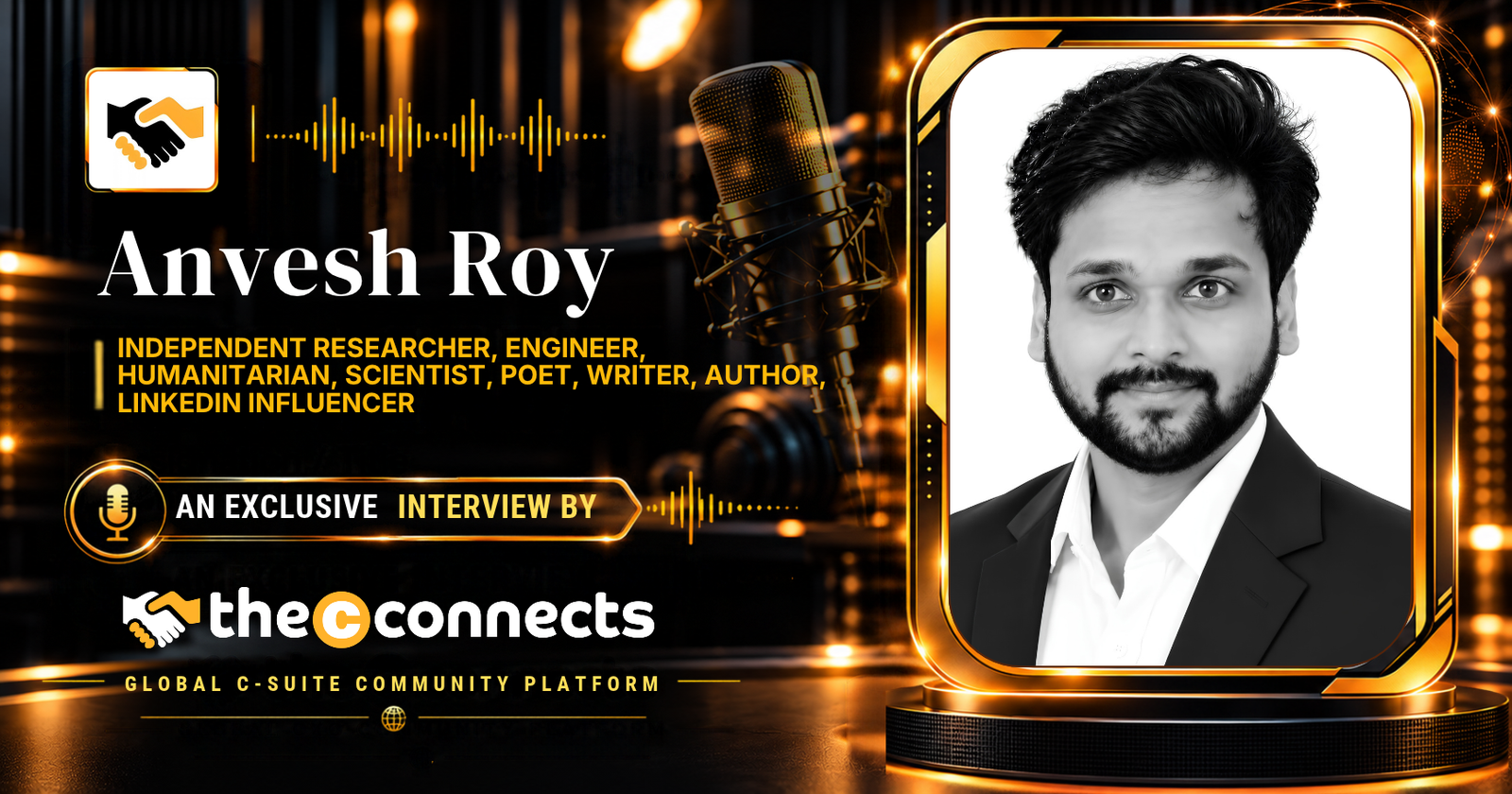

Anvesh Roy: At the Intersection of Science, Innovation and Humanity
A Multidisciplinary Journey Exploring the Power of Knowledge, the Responsibility of Innovation and the Pursuit of Human Progress
In an era defined by rapid technological transformation, complex global challenges and evolving ideas of leadership, the ability to connect knowledge across disciplines has become more important than ever. Progress today requires more than scientific advancement; it calls for a deeper understanding of people, society and the responsibilities that accompany innovation.
Anvesh Roy’s journey reflects this interdisciplinary perspective. With academic pursuits spanning engineering, scientific research, management, clinical psychology, journalism and mass communication, political science, economics, commerce and law, his intellectual interests extend across diverse fields. His work and research interests encompass emerging technologies, artificial intelligence, renewable energy, electric mobility and human-centred innovation, reflecting a continued interest in exploring how knowledge can address real-world challenges.
Beyond research and technology, Roy is engaged in humanitarian and community-oriented initiatives. As General Secretary (South India) of the Human Rights Council for India, he contributes to efforts centred on human rights, social awareness and community welfare. His identity as a writer and poet adds another dimension to his journey, with his LinkedIn newsletter, Relatable Realities, offering reflections on emotions, relationships, society, kindness and the human experience.
His professional journey has also been accompanied by research publications, patent contributions and recognitions across research, science, leadership and humanitarian engagement. Yet, the broader significance of his work lies in the questions that connect these different pursuits: How can scientific discoveries improve everyday lives? How can technology advance without losing its human values? And how can knowledge become a meaningful force for social progress?
These questions form the foundation of this conversation.
In this exclusive interview with TheCconnects, Anvesh Roy reflects on his multidisciplinary journey, research and contributions, the ethical dimensions of emerging technologies, the relationship between science and human psychology, and the importance of empathy in leadership. He also shares his perspectives on India’s role in global innovation, the future of education, and the kind of impact he hopes to create through his work.
Rather than viewing science, humanity and social responsibility as separate pursuits, his perspective invites a broader conversation about bringing them together in the service of a more thoughtful, inclusive and progressive future.
“The true measure of knowledge is not how much we discover, but how much we contribute. When science is guided by compassion, innovation grounded in integrity, and ambition directed towards humanity, progress becomes more than achievement-it becomes a legacy.”
– Anvesh Roy
TheCconnects: Your journey has crossed engineering, scientific research, psychology, management, writing, human rights, and social impact. Looking at the journey as a whole, what has been the central purpose connecting these seemingly different paths?
Anvesh Roy: When I look back at my journey, I do not see a collection of unrelated disciplines or a series of qualifications, positions, and achievements. I see a continuous search for understanding-and behind that search, one question has remained constant: How can what I learn become useful to people?
My journey has never been completely linear. It began with engineering, where I learned to think in terms of systems, logic, precision, and problem-solving. My B.Tech in Electrical & Electronics Engineering gave me a foundation for understanding how complex systems work. My M.Tech in Power Systems & Automation expanded that understanding toward energy, infrastructure, automation, and sustainability.
But the more I worked with technical systems, the more I realized that no system exists independently of people.
A technically perfect solution can still fail if it does not understand human behavior. An efficient organization can still become unhealthy if it ignores the people within it. A technological breakthrough can create new problems if questions of ethics, accessibility, dignity, and responsibility are left unanswered.
That realization gradually changed the direction of my learning.
My studies in Human Resource Management and Operations Management helped me understand organizations not simply as structures and processes, but as communities of people. Clinical Psychology took me deeper into the human mind-into emotions, behavior, resilience, vulnerability, and the psychological factors that influence the way people make decisions and experience the world.
Journalism and Mass Communication taught me another important lesson: knowledge has little social value if we cannot communicate it responsibly. Political Science and Economics helped me understand institutions, power, public systems, policy, and the broader forces that shape society. My current pursuit of Law represents another dimension of that journey, because justice, accountability, rights, and responsibility ultimately determine how knowledge and power should be used.
To someone looking from the outside, these disciplines may appear disconnected.
To me, they are different pieces of the same puzzle.
Engineering taught me how systems work.
Psychology taught me how people experience those systems.
Management taught me how people and organizations function together.
Journalism taught me how ideas influence society.
Political Science and Economics taught me how institutions and societies operate.
Law is teaching me how responsibility and justice must guide action.
And research, writing, and service have given me opportunities to bring those perspectives together.
This is why I have never been comfortable defining myself through only one professional label. I respect specialization deeply, but I also believe some of the world’s most difficult problems exist between disciplines. Climate and energy challenges are not only engineering problems. Artificial intelligence is not only a technology problem. Mental health is not only a psychological problem. Human rights are not only legal questions.
They are interconnected human questions.
That understanding has also influenced the way I approach research and innovation. I increasingly find myself asking questions beyond “Can this be done?” I ask, “Should it be done? Who will benefit? Who could be affected? What safeguards are necessary? What happens after the technology leaves the laboratory?”
My interdisciplinary background has become a kind of internal checkpoint. Engineering gives me technical discipline. Psychology reminds me of human vulnerability. Management and economics make me consider scale and sustainability. Journalism and political science make me conscious of communication, power, and public impact. Law brings accountability into the conversation.
Together, they encourage me to look at innovation not merely as an exercise in capability, but as an exercise in responsibility.
The same principle extends to my writing and poetry.
When I write, I am not thinking about technology or research alone. I am thinking about the experiences people carry silently-pressure, loneliness, relationships, self-doubt, resilience, kindness, purpose, and the need to feel understood. Through my writing and my LinkedIn newsletter, Relatable Realities, I have found another way of connecting with people across different backgrounds and cultures.
Research helps me ask questions.
Psychology helps me understand people.
Writing helps me give language to experiences that are sometimes difficult to express.
And service reminds me that knowledge must eventually return to the real world.
My community-service journey has reinforced that lesson. Whether it is supporting vulnerable people, feeding those experiencing homelessness, caring for stray animals, participating in rescue and relief efforts, or engaging with human-rights and social-impact initiatives, these experiences keep me connected to realities that cannot always be understood through books, laboratories, or professional titles.
They remind me that behind every statistic is a person, behind every policy is a life, and behind every technological system are human consequences.
That is also why I do not see patents, publications, awards, or recognition as the final destination of my journey. They are valuable, but to me they are instruments. A patent can become a solution. A research paper can contribute to understanding. A book can open a conversation. A leadership position can create an opportunity to serve. Recognition can provide a platform from which important ideas reach a wider audience.
But the real question is always what we do with those opportunities.
Over time, my understanding of achievement has therefore changed. Earlier, progress could easily be measured through visible milestones-education, projects, research, recognition, or professional growth. Today, I think more about the quality of impact.
Did the knowledge help someone?
Did the research address something meaningful?
Did the technology respect human dignity?
Did the leadership make someone feel heard?
Did the opportunity created for me create an opportunity for someone else?
Those questions matter more to me now.
I also believe this is increasingly important for the world we are entering. Artificial intelligence, automation, advanced computing, biotechnology, and other technologies are expanding what humanity can accomplish. But capability is growing faster than our collective ability to reflect on its consequences.
That is why I believe the future needs not only intelligent people, but wise people.
Intelligence can tell us what is possible.
Wisdom asks what is right.
And compassion reminds us who the progress is ultimately for.
If there is one central purpose connecting everything I have pursued, it would be this:
I want knowledge to become useful, innovation to become responsible, leadership to become compassionate, and achievement to become meaningful.
I do not believe we should have to choose between excellence and humanity. We can be ambitious without becoming insensitive. We can be scientific without becoming detached. We can be analytical without losing empathy. We can pursue global recognition without forgetting the people and experiences that shaped us.
For me, the journey has never really been about collecting different identities.
It has been about understanding different dimensions of the same world-and finding better ways to contribute to it.
“The more I learn about different fields, the more clearly I see the same truth: every discipline eventually leads us back to people, and every meaningful achievement carries a responsibility toward them.”
TheCconnects: Your academic journey spans engineering, power systems and automation, management, clinical psychology, journalism and mass communication, political science, economics, commerce, and law. What motivated you to pursue such a broad educational path, and how has each discipline shaped the way you think?
Anvesh Roy: My academic journey was never driven by the pursuit of credentials. It evolved organically as a response to questions I encountered while trying to understand systems, society, human behavior, and responsibility. Each stage of learning emerged because the previous one revealed another layer that I wanted to understand.
My foundation began with a B.Tech (Bachelor of Technology) in Electrical & Electronics Engineering, from a college affiliated with Jawaharlal Nehru Technological University, Kakinada. Engineering gave me a structured way of thinking. It taught me logic, systems thinking, problem-solving, precision, and accountability. I learned that even a seemingly small technical decision can have consequences that extend through an entire system.
That naturally led me to an M.Tech (Master of Technology) in Power Systems & Automation at GITAM University. This expanded my perspective from individual technical systems toward infrastructure, energy, automation, sustainability, and planning at scale. I began to understand that technical efficiency alone does not necessarily mean meaningful progress. A technically excellent system can still fail if it does not respond to human, economic, or social realities.
I then pursued an MBA in Human Resource Management and an MBA in Operations Management, both at GITAM University. These disciplines introduced another important dimension: organizations are ultimately built and sustained by people. I became interested in how people, processes, leadership, organizational culture, ethics, and decision-making interact to determine institutional outcomes.
My journey then moved deeper into the human dimension through an M.Sc. in Clinical Psychology at Jain (Deemed-to-be) University. Psychology changed the way I looked at problems. Engineering taught me to understand systems; psychology made me more attentive to what happens within the people living inside those systems. It gave me a deeper appreciation of mental health, emotional resilience, human vulnerability, behavior, and the psychological foundations of decision-making and leadership.
I subsequently pursued an MA in Journalism & Mass Communication, followed by an MA in Political Science and an MA in Economics, all from Andhra University. These disciplines helped me understand how ideas move through society, how public narratives are formed, how institutions function, how power operates, how policy affects people, and how socioeconomic realities influence opportunity and development.
My academic journey is still evolving. I have recently joined the M.Com (Master of Commerce) programme at Andhra University, which is giving me another perspective on commerce, business, financial systems, and the economic dimensions of organizations and society. I see this not simply as another qualification, but as an opportunity to understand how markets, resources, institutions, and human decisions interact.
Alongside this, I am currently pursuing an LLB (Bachelor of Laws) at Visakha Law College, Visakhapatnam. I value legal education because it connects many of the areas I have studied-technology, psychology, governance, economics, ethics, rights, and accountability. At the same time, my professional and research responsibilities continue to evolve, so I approach the LLB realistically. If I am able to dedicate the time and attention that the programme deserves, I intend to complete it; if my responsibilities eventually make that difficult, I may choose to discontinue it rather than pursue it without the commitment it requires. For me, education should be pursued with sincerity and purpose, not simply for the qualification itself.
Looking back, I don’t see these disciplines as separate qualifications. I see them as different lenses through which I have learned to examine the same complex world.
Engineering asks me how a system works.
Management asks how people and processes make it function.
Psychology asks how human beings experience it.
Journalism asks how its story reaches society.
Political science asks how institutions and power shape it.
Economics and commerce ask how resources, markets, incentives, and decisions influence it.
Law asks what rights, responsibilities, and accountability should govern it.
That combination has profoundly influenced the way I approach research and leadership.
When I encounter a problem today, I am less likely to ask only, “Can we solve this technically?” I am more likely to ask: Who will be affected? How will people respond? Is it economically sustainable? What are the ethical implications? What rights are involved? How should it be communicated? What happens when the system encounters real-world complexity?
That is why interdisciplinary learning has become so important to me. I don’t believe every person needs multiple degrees. What matters is developing the willingness to look beyond one’s own intellectual boundaries when the problem demands it.
My education has therefore been less about accumulating qualifications and more about developing better judgment.
The more I studied, the more I realized that knowledge becomes meaningful when it helps us understand not only how the world works, but also how our decisions affect the people living in it.
And I consider my education an ongoing journey. I do not want to reach a point where I believe I have learned enough. There will always be another question, another discipline, another perspective, or another human experience that can teach me something new.
“I do not pursue education simply to add another qualification to my name; I pursue it because every new field of knowledge gives me another way to understand the world and contribute to it responsibly.”
TheCconnects: You have deliberately resisted being defined by a single discipline. In a world that increasingly values specialization, do you believe the traditional definition of a scientist or researcher is becoming too narrow, and why does interdisciplinary thinking matter for solving the problems of the future?
Anvesh Roy: I have great respect for specialization. Deep expertise is essential, and every serious field requires people who are willing to spend years understanding its complexity. But I also believe that many of the most important problems facing humanity today do not belong to one discipline.
They exist at the intersections.
Climate change is an engineering challenge, but it is also an economic, political, behavioral, and social challenge. Artificial intelligence is a technological achievement, but its consequences involve psychology, ethics, law, employment, education, privacy, and human rights. Mental health cannot be understood only through clinical theory because family, society, economics, technology, work culture, and communication all influence how people experience their lives.
This is why interdisciplinary thinking has become so important to me.
My own academic journey developed through this realization. Engineering taught me systems thinking and technical precision. Power Systems and Automation exposed me to infrastructure, energy, and sustainability. Management helped me understand people, organizations, operations, and leadership. Clinical Psychology brought me closer to human behavior and emotional experience. Journalism and Mass Communication taught me about communication and public narratives. Political Science and Economics helped me understand institutions, policy, power, and socioeconomic realities. My ongoing study of Law is adding another dimension-accountability, rights, justice, and the responsibilities that accompany power.
I did not pursue these areas because I wanted to collect qualifications.
Each discipline answered one question and then revealed another.
That is what kept me learning.
The more I understood, the more I realized that a problem can look completely different depending on the lens through which we examine it.
An engineer may ask, “Can we build it?”
A psychologist may ask, “How will people respond to it?”
An economist may ask, “Can it be sustained and scaled?”
A political scientist may ask, “Who controls it and who is affected by the decision?”
A journalist may ask, “How will this information shape public understanding?”
A lawyer may ask, “Is it fair, lawful, and accountable?”
And a human-rights perspective may ask the most fundamental question of all:
“Does this protect human dignity?”
None of these questions is unnecessary.
In fact, the danger often comes when we ask only one of them.
I have seen how technically strong ideas can become incomplete when human behavior, communication, ethics, or institutional realities are ignored. A system can be efficient and still fail people. A technology can be innovative and still create unintended harm. An organization can achieve impressive results while damaging the wellbeing of the people who make those results possible.
That is why interdisciplinary thinking, in my view, is not about knowing a little about everything. It is about understanding when another discipline is necessary to make your own expertise more responsible and complete.
This distinction is very important.
I am not suggesting that every scientist should become an engineer, psychologist, economist, lawyer, and philosopher simultaneously. Rather, we should develop enough intellectual openness to recognize the boundaries of our own expertise and collaborate across them.
The future will require that kind of intellectual humility.
One of the greatest advantages of interdisciplinary thinking is that it changes the questions we ask.
Earlier in my journey, I might have looked at a technical problem primarily through the lens of feasibility and performance. Today, I naturally think further.
Who is this designed for?
Who might be excluded?
What psychological effects could it create?
What happens when it is used at scale?
What data does it require?
What happens to privacy?
Could it unintentionally reinforce inequality?
Who is accountable when something goes wrong?
These questions do not slow innovation unnecessarily. They can actually make innovation stronger.
I believe the future belongs to people who can connect knowledge rather than isolate it.
We will need scientists who understand ethics, engineers who understand people, entrepreneurs who understand responsibility, policymakers who understand technology, psychologists who understand digital environments, educators who understand emerging technologies, and leaders who can listen across disciplines rather than operating inside intellectual silos.
My own research reflects this approach. My interests have moved across areas including electric mobility, renewable energy systems, artificial intelligence, machine learning, IoT, healthcare, education, behavioral analysis, organizational studies, and human-centered innovation.
On the surface, these subjects may appear very different.
But the underlying question remains remarkably consistent:
How can knowledge be translated into something that improves human life responsibly?
That question also influences the way I look at patents and publications. I do not see research outputs merely as evidence that something new has been discovered. I see them as opportunities to explore problems, create possibilities, challenge assumptions, and contribute to conversations that may eventually influence society.
The world is changing too quickly for disciplines to remain completely isolated.
A technological decision made today can influence mental health tomorrow. An algorithm can influence employment. A healthcare system can involve questions of privacy and law. An educational technology platform can influence how an entire generation learns and interacts. An energy innovation can affect economics, environment, and communities simultaneously.
The complexity of the problem demands a corresponding breadth of thought.
At the same time, interdisciplinary thinking has taught me something personal: curiosity is not a distraction from purpose; sometimes curiosity is how purpose becomes clearer.
There were times when people may have wondered why I was moving from engineering toward management, then psychology, journalism, political science, economics, and law.
For me, each transition was a continuation.
I was not moving away from engineering.
I was expanding the context in which I understood engineering.
I was not moving away from science.
I was asking what science means when it enters human lives.
I was not moving away from technology.
I was trying to understand the people, institutions, emotions, and responsibilities surrounding technology.
That is perhaps the most important lesson interdisciplinary learning has given me: different fields do not necessarily compete for our attention. Sometimes they complete one another.
And as we move deeper into an era of artificial intelligence, automation, quantum technologies, advanced healthcare, climate innovation, and increasingly complex social systems, I believe this ability to connect perspectives will become even more important.
The future will not simply ask us what we know.
It will ask us whether we know how to connect what we know.
For me, interdisciplinary thinking is ultimately about building bridges-between science and society, technology and ethics, intelligence and empathy, ambition and responsibility.
Because the hardest problems of the future will not be solved by knowledge standing alone.
They will be solved when different kinds of knowledge learn to work together-and when all of them remain connected to the human beings they are ultimately meant to serve.
I also think the modern researcher has a responsibility to communicate beyond academic circles.
Research that remains inaccessible to society can have limited practical influence. Scientists increasingly need to communicate with policymakers, educators, industry, communities, journalists, and the public.
This is one reason writing has remained important to me.
My work as a writer and poet gives me another way of thinking about knowledge. Scientific research may tell us what is happening and why. Writing often forces me to ask what that knowledge means to people.
That connection is important to me because ultimately, research does not exist in isolation from human life.
A paper may contain equations, datasets, models, experiments, or theoretical frameworks.
But somewhere beyond those pages, there are people who may eventually experience the consequences of what we discover.
That is why I believe the future scientist cannot be defined only by laboratory boundaries.
We need scientists who understand society.
Engineers who understand human consequences.
Researchers who understand ethics.
Technology leaders who understand psychology.
Educators who understand technology.
Policymakers who understand science.
And, perhaps most importantly, professionals who remain curious enough to keep learning outside the boundaries of their original discipline.
My own journey has taught me that learning does not always move in a straight line. Sometimes one field gives you an answer that creates a more important question in another.
That is not confusion.
That is intellectual growth.
So, yes, I believe the traditional image of the scientist or researcher needs to expand.
Not to weaken expertise, but to make expertise more connected to reality.
The scientist of the future may still spend long hours studying one specialized problem. But they may also need to understand the psychological, social, ethical, economic, and human consequences surrounding that problem.
Because the greatest challenge before science is no longer simply discovering what is possible.
It is learning how to use what is possible wisely.
“The scientist of the future must not only discover what humanity can create; they must also develop the wisdom to understand what that creation means for humanity.”
TheCconnects: Your research and innovation work now span artificial intelligence, renewable energy, electric mobility, healthcare, education, behavioral analysis, IoT, and other emerging areas. What problems are you most interested in solving today, and why?
Anvesh Roy: At this stage of my journey, I am less interested in innovation simply because something is technologically possible. I am much more interested in problems where technology, human behavior, and real-world needs intersect.
The question that increasingly guides my research is not simply, “What can we invent?” It is, “What problem is important enough to deserve our knowledge, time, and responsibility?”
That distinction matters to me.
My research interests have developed across areas including artificial intelligence, electric mobility, renewable energy systems, healthcare, education, IoT, machine learning, behavioral analysis, organizational studies, and other emerging interdisciplinary fields. On the surface, these areas may appear very different, but there is a common thread connecting them: I am interested in using advanced knowledge to understand problems more deeply and develop solutions that can improve human life.
One of the areas I continue to be particularly interested in is artificial intelligence and human-centered technology.
AI is transforming almost every sector, but I believe the real challenge is no longer simply developing more capable algorithms. The larger challenge is ensuring that those capabilities are used responsibly.
I am interested in systems that can assist people in areas such as healthcare, education, behavioral understanding, decision support, and everyday problem-solving. My work involving AI, machine learning, image processing, intelligent monitoring, and behavioral analysis reflects this broader interest.
For example, when we work with technologies capable of identifying patterns related to stress, emotions, health conditions, or behavioral changes, the technical achievement is only one part of the problem. We must also think about privacy, consent, interpretation, bias, reliability, and how the information will ultimately affect a person’s life.
That is where my background in psychology becomes particularly important.
Technology can detect a pattern.
But understanding what that pattern means requires human context.
This is why I am increasingly interested in the space between artificial intelligence and human intelligence. I believe AI should enhance human understanding rather than reduce human beings to data points.
Another major area of interest for me is electric mobility and sustainable energy.
My engineering background naturally led me toward power systems, renewable energy, energy management, electric vehicles, and intelligent energy infrastructure. The transition toward electric mobility is not simply about replacing one type of vehicle with another. It involves batteries, charging infrastructure, renewable energy integration, energy storage, grid management, efficiency, affordability, reliability, and environmental sustainability.
I am particularly interested in how intelligent systems can make energy and mobility ecosystems more efficient and responsive.
The larger question is:
How can technology help us build cleaner, smarter, and more sustainable systems without making them inaccessible to the people who need them most?
That question brings engineering back into contact with economics, policy, human behavior, and social responsibility.
Healthcare is another area where I believe responsible innovation can make an enormous difference.
One of the earliest experiences that influenced my thinking about innovation was seeing someone close to me struggle after a medical condition whose warning signs had not been recognized early enough. That experience made technology personal for me. It made me understand that behind every dataset is a human being who may be frightened, vulnerable, or simply hoping for better information.
Since then, I have been interested in technologies that can support early detection, prediction, monitoring, and decision-making.
But healthcare technology requires extraordinary responsibility.
A prediction is not a diagnosis.
A model is not a doctor.
A dataset is not a human life.
Therefore, research in this area must be accompanied by humility, validation, ethical safeguards, and appropriate human oversight.
I am also increasingly interested in education and student wellbeing.
Education systems are becoming more technology-driven, but I believe we need to ask whether technology is actually helping students become healthier, more engaged, and better prepared for life-not merely more measurable.
My research interests involving academic stress, behavioral analysis, student engagement, intelligent educational systems, and faculty-related technologies come from this concern.
A student should not become merely another data point on a dashboard.
If technology can help educators understand when students are struggling, disengaged, overwhelmed, or in need of support, then it can become meaningful. But the purpose should always be to support the student-not to replace human understanding.
This connects closely with my interest in psychology and behavioral science.
Modern society has more technological capability than ever before, but we are also seeing increasing conversations around stress, emotional wellbeing, isolation, workplace pressure, and the psychological effects of rapidly changing environments.
I believe technology should not merely make people more productive. It should also help us understand how people are coping with the systems we create.
That is why I am interested in research that connects machine learning and behavioral understanding.
There is enormous potential in bringing these fields together, but there is also a responsibility to avoid reducing human complexity to algorithms.
People are not equations.
Human behavior is influenced by experience, relationships, culture, environment, memory, expectations, and countless factors that cannot always be captured by a model.
So, the role of technology should be to assist understanding, not pretend that it has completely understood the human being.
Another area that interests me is organizational behavior and the future of work.
Technology is changing workplaces rapidly. Automation and AI are transforming jobs, decision-making, recruitment, education, productivity, and organizational structures.
But organizations are still human systems.
I am interested in questions such as: How can organizations use AI without losing trust? How can automation improve work without unnecessarily diminishing human contribution? How should leaders respond when technology changes the nature of someone’s role? How can data-driven decision-making remain fair and accountable?
These are not purely technological questions.
They are questions about people.
That is why I believe my different research interests ultimately converge.
Whether I am thinking about an electric vehicle, an AI model, a healthcare system, a student experiencing academic stress, an organization adopting automation, or a renewable-energy system, I eventually return to the same consideration:
What does this mean for human beings?
That principle also shapes how I view patents and publications.
I have contributed to 70+ patent filings and have 40+ Scopus-indexed research publications, but I do not see these numbers as the purpose of research. They are outcomes of a larger process.
A patent should represent an attempt to address a meaningful problem.
A publication should contribute something useful to knowledge.
And both should remain open to scrutiny.
Research should not become a race for numbers where novelty matters more than usefulness or citations matter more than consequence.
For me, research is a form of responsibility.
The world already has enough technology that can make us faster.
The greater challenge is developing technology that helps us become safer, healthier, more sustainable, more informed, and more humane.
That is ultimately what I want my research to contribute to.
I do not expect one researcher or one field to solve these enormous challenges. But I believe every meaningful contribution begins with asking better questions.
And the questions I want to keep asking are simple:
Can technology reduce suffering?
Can research improve understanding?
Can innovation protect dignity?
Can intelligence be guided by ethics?
Can progress reach people who are usually left behind?
If the answer can increasingly become yes, then I believe the research is worth pursuing.
“I am not interested in creating technology merely to prove what is possible. I want to explore what becomes possible when intelligence is guided by empathy, responsibility, and a genuine understanding of human need.”
TheCconnects: Your journey includes more than 70 patent filings, 40+ Scopus-indexed research publications, and recognition across science, research, education, leadership, and literature. Looking beyond the numbers and awards, what do these achievements represent in terms of your contribution to knowledge, innovation, and society, and which contribution has been most meaningful to you?
Anvesh Roy: For me, the most important word in that question is contribution.
Patents, publications, awards, and other forms of recognition are visible outcomes of a journey, but they are not the reason I entered research. I have always believed that knowledge becomes meaningful when it contributes to understanding, problem-solving, innovation, or the long-term preparedness of society.
My contribution so far includes more than 70 patent filings and 40+ Scopus-indexed research publications, across areas reflecting my interdisciplinary interests, including artificial intelligence, machine learning, renewable energy, electric mobility, intelligent systems, healthcare, education, behavioral analysis, organizational studies, and other emerging fields.
But I don’t look at those numbers simply as measures of productivity.
A patent, for me, represents an attempt to move an idea toward a possible solution. A publication represents an opportunity to add something meaningful to an academic conversation. Neither is valuable merely because it exists.
I often ask myself: What does this work enable?
Can it contribute to a better understanding of a problem?
Can it encourage another researcher to explore a new direction?
Can it support responsible technological development?
Can it eventually improve a system, process, or human experience?
Can it help society prepare for challenges that are still emerging?
Those questions matter more to me than simply increasing the number of outputs.
My research journey has also taught me that innovation cannot be separated from responsibility. A patent should represent more than novelty; it should involve foresight. A research publication should be more than an addition to the literature; ideally, it should encourage critical thinking, further investigation, or responsible application.
This is particularly important in areas such as AI, healthcare, education, and behavioral analysis, where technology can directly influence human lives. In such fields, technical capability must be accompanied by questions of privacy, bias, interpretation, accountability, safety, and human dignity.
My recent recognitions have been meaningful because they reflect different dimensions of this broader journey. Among the most recent honors I have received are the Outstanding Scientist & Best Researcher Award 2026, the Grand Laureate for Educational Excellence 2026, and the Shakespeare Poetry Award 2026. These recognitions are particularly meaningful to me because they span scientific research, education, and literature-three areas that represent different parts of who I am and how I contribute.
They follow several important recognitions from 2025, including the Global Human Advancement Laureate of the Year 2025, the Global Multidisciplinary Humanitarian Polymath & Ethical Innovation Excellence Award 2025, and the Infinity Renaissance Catalyst Vanguard Award 2025. My earlier recognitions have also included the Best Emerging Scientist Award 2025, Best Emerging Scientist Award 2024, Best Researcher Award 2024, and ICONS OF INDIA 2024.
I am grateful for every one of these recognitions, but I don’t see them as destinations.
For me, an award acknowledges something that has already happened. Contribution asks what happens next.
Recognition can tell you that your work has been noticed. It cannot automatically tell you that the work has created lasting value. That responsibility remains with the person.
I therefore try to treat recognition as a reminder to become more accountable rather than more self-important. The greater the visibility, the greater the responsibility to remain ethical, consistent, accessible, and open to criticism.
I also believe recognition should never disconnect us from the quieter forms of contribution.
Some of the work that has mattered most to me has not happened on a stage or appeared on an award certificate. Supporting people experiencing homelessness, helping with animal rescue and care, contributing to disaster-relief efforts, engaging in mental-health awareness, writing about human experiences, and supporting people who may not have a strong voice have all shaped my understanding of contribution.
That is why I would find it difficult to name a single patent, publication, or award as the “most meaningful” achievement.
If a research idea helps another researcher think differently, that is a contribution.
If an innovation eventually helps solve a practical problem, that is a contribution.
If a publication creates a useful academic conversation, that is a contribution.
If a young person reads about my journey and believes that their circumstances do not have to determine their future, that is a contribution.
If something I write makes another person feel understood, that is also a contribution.
And if knowledge, visibility, or professional opportunity allows me to create opportunities for someone else, I consider that deeply meaningful.
So, while I am grateful for the numbers and recognition, I do not want them to become the definition of my journey.
70+ patents can show the scale of ideas explored.
40+ Scopus-indexed publications can show sustained academic contribution.
Awards can show that different communities have noticed aspects of that work.
But none of these alone can measure human impact.
Ultimately, I want my research to contribute to a culture in which innovation is ambitious but responsible, science is rigorous but human-centered, and knowledge is shared rather than simply possessed.
I don’t want to be remembered merely as someone who produced patents, publications, or awards. I would rather be remembered as someone who used knowledge across disciplines to ask meaningful questions, explore useful solutions, encourage responsible innovation, and contribute something of value to society.
Because, in the end, I believe the real measure of achievement is not how much we accumulate, but how much we contribute.
“Patents can demonstrate what we imagined, publications can record what we discovered, and awards can acknowledge what we achieved-but contribution is measured by what our knowledge ultimately makes possible for others.”
TheCconnects: You have contributed to more than 70 patent filings across different countries and published extensively in academic research. At this stage of your career, what does innovation mean to you beyond novelty, numbers, and intellectual recognition?
Anvesh Roy: At this stage of my journey, I have come to understand that innovation is much bigger than the creation of something new. Novelty is important. Technical excellence is important. Research publications, patents, citations, and recognition all have their place. But none of them, by themselves, answer the most important question:
What difference does the innovation make?
For me, that is where the meaning of innovation begins.
Earlier in my career, like many researchers and engineers, I was naturally fascinated by the possibility of creating something that had not existed before. There is a certain excitement in solving a difficult problem, developing a new model, designing a system, or exploring an idea that may have practical potential.
But as my work expanded across different disciplines and my understanding of society deepened, my definition of innovation also changed.
Today, I see a patent not simply as a claim of intellectual ownership. I see it as an expression of foresight.
I see a publication not simply as another addition to an academic record. I see it as an opportunity to contribute to a larger conversation.
And I see innovation not simply as the ability to create something new, but as the ability to create something meaningful, responsible, and useful.
My contribution to 70+ patent filings across different areas and my 40+ Scopus-indexed research publications are therefore not the destination for me. They are part of a much larger journey of learning and contribution.
The numbers can describe the scale of activity.
They cannot describe the purpose behind it.
That distinction has become increasingly important to me.
Research today exists in an environment where metrics are everywhere. We measure publications, citations, patents, rankings, funding, followers, awards, and visibility. These measurements can be useful, but they can also create a dangerous illusion-that more automatically means better.
I do not believe it does.
A large number of publications does not necessarily mean that we have asked important questions. A patent does not automatically mean that society has benefited. A technically successful system does not automatically mean that it has been ethically successful.
That is why I try to look beyond the output.
I ask what problem the work is addressing, who it is intended to serve, what consequences it could create, and whether it can remain responsible when used outside the environment in which it was originally designed.
This is particularly important in the areas I work in today.
Consider artificial intelligence.
We can build increasingly sophisticated systems capable of prediction, classification, automation, and decision support. But the existence of a technically impressive model does not automatically make it a good innovation.
We have to ask:
Is the data reliable?
Could the system reproduce bias?
Is privacy protected?
Can people understand or challenge its decisions?
What happens when the model is wrong?
Who is accountable?
Does it genuinely help the people it was designed for?
Those questions are not obstacles to innovation.
They are part of innovation.
The same principle applies to healthcare, education, energy, electric mobility, behavioral technologies, and organizational systems.
In healthcare, an intelligent prediction system may help identify risks earlier, but it must respect human dignity and the limits of prediction.
In education, technology may help identify patterns of academic stress or engagement, but students should never become merely data points.
In electric mobility and energy, innovation should not only improve efficiency; it should contribute to sustainability, accessibility, and long-term resilience.
In organizational technology, automation should not simply ask how many tasks can be eliminated. It should also ask how human capability can be strengthened.
That is why I increasingly think of innovation as a relationship between capability and responsibility.
Capability asks:
“What can we do?”
Responsibility asks:
“What should we do, and how should we do it?”
Both questions are necessary.
My interdisciplinary background has strengthened this way of thinking. Engineering taught me precision and feasibility. Psychology taught me about human vulnerability and behavioral complexity. Management taught me about people, systems, and organizational consequences. Journalism and political science made me more conscious of communication, power, and public impact. Economics introduced questions of scale and sustainability. Law is adding another layer of accountability and justice.
Because of this, I rarely look at innovation through only one lens anymore.
I want to understand the technology, but I also want to understand the environment in which that technology will operate.
This is also why I believe foresight is one of the most important qualities in innovation.
We often celebrate innovators for solving today’s problems. But responsible innovation should also ask what today’s solution could create tomorrow.
A technology may solve one problem while introducing another.
An automated system may increase efficiency while reducing human agency.
A powerful AI tool may increase productivity while creating new forms of misinformation or inequality.
A healthcare technology may provide valuable information while raising difficult questions about privacy.
A research breakthrough may be commercially successful while producing environmental or social consequences that were not anticipated.
Innovation therefore cannot end at invention.
It must continue through evaluation, monitoring, correction, and accountability.
This is why I believe researchers and innovators must be willing to admit that an idea can be improved. We should be willing to invite criticism, examine unintended consequences, and change direction when evidence tells us that something is not working as intended.
There is no weakness in saying, “We need to reconsider this.”
Sometimes that is the most responsible scientific decision we can make.
Another important shift in my thinking has been understanding that innovation should not be designed only for people; wherever possible, it should be informed by people.
The people affected by a technology often understand problems in ways that designers, researchers, or institutions may not initially see.
Listening to those experiences can reveal practical limitations, cultural realities, emotional consequences, and forms of exclusion that technical testing alone may miss.
That is where empathy becomes part of the research process.
For me, innovation has therefore become less about asking, “How impressive is this?” and more about asking, “How responsibly useful can this become?”
Recognition still matters. I receive awards and professional acknowledgements with gratitude. Publications and patents matter because they allow ideas to enter broader academic and professional conversations.
But recognition cannot become the reason for continuing.
The reason has to remain the problem.
The people.
The possibility of making something better.
I also believe innovation should ultimately expand human possibility rather than diminish human dignity.
Technology should help people make better decisions, not remove their ability to question decisions.
Automation should free people from unnecessary burdens, not make human contribution irrelevant by default.
AI should strengthen human intelligence, not become an excuse to abandon human judgment.
Research should expand understanding, not create false certainty.
That is the kind of innovation I want to contribute to.
My goal is not simply to be associated with many inventions or publications. I would rather be associated with a way of thinking-one in which scientific ambition is accompanied by ethical awareness, technological capability is accompanied by human understanding, and progress is evaluated not only by what it achieves, but by whom it serves and what it leaves behind.
Ultimately, I believe the greatest measure of innovation is not how new an idea is.
It is how meaningfully that idea enters the world.
“Innovation is not complete when something new is created; it becomes meaningful when what we create is responsible enough to serve people, resilient enough to endure scrutiny, and purposeful enough to leave the world better than we found it.”
TheCconnects: You often speak about human-centered innovation. As artificial intelligence becomes more capable, what aspects of human intelligence do you believe technology can never truly replace?
Anvesh Roy: I believe artificial intelligence will continue to become extraordinarily capable. It will process information faster, identify patterns that humans may overlook, automate increasingly complex tasks, and assist us in areas ranging from scientific research and healthcare to education, energy, business, and communication.
But capability and understanding are not the same thing.
A machine can process information. It does not automatically understand what that information means to a human life.
That distinction is central to how I think about the future of AI.
When I speak about human-centered innovation, I am not suggesting that humans should resist technology. Quite the opposite. I believe we should use technology boldly-but we must remain equally committed to developing the human qualities that give technology direction.
For me, the aspects of human intelligence that are most difficult to replace are empathy, moral judgment, self-awareness, conscience, lived understanding, and the ability to assign meaning to experience.
AI can recognize patterns in human behavior. But recognizing a pattern is not the same as understanding the person behind it.
A system may detect that someone is experiencing stress based on physiological or behavioral signals. It may identify correlations that a human observer could miss. But what happens next requires context.
Why is that person struggling?
What have they experienced?
What are they afraid to say?
What kind of support would actually help them?
What should be done with the information?
These are not merely computational questions. They are human questions.
My background in psychology has made me particularly conscious of this distinction. Human behavior is rarely a simple equation. The same outward behavior can emerge from completely different experiences. A person may be silent because they are calm, frightened, grieving, exhausted, reflective, or simply processing something internally.
Technology can assist us in identifying signals.
Human understanding must still interpret meaning.
That is why I believe one of the most important qualities we need in the age of AI is what I call awakened intelligence.
To me, awakened intelligence means intelligence guided by awareness, empathy, and ethical responsibility. It asks more than “What can we do?” It asks, “What should we do, why should we do it, and who may be affected?”
This becomes increasingly important as AI systems become more powerful.
We often worry about whether machines will become too intelligent. I think there is another question we should ask:
Will human beings remain wise enough to use that intelligence responsibly?
That concerns me more.
Technology itself does not possess our moral priorities simply because it is sophisticated. Systems reflect the data, assumptions, objectives, incentives, and decisions of the people and institutions that design and deploy them. If those human systems contain bias or indifference, technology can scale those problems very efficiently.
That is why I have said before that human indifference concerns me more than technological misuse.
Misuse can sometimes be identified, regulated, corrected, or challenged. Indifference is more subtle. When people stop asking questions, responsibility becomes diluted. Decisions become automated, biases become invisible, and convenience begins to replace conscience.
So, I do not see AI as the opposite of human intelligence.
I see it as something that should extend human intelligence while making human responsibility more important.
There are things AI can do better than us.
It can analyze enormous datasets.
It can operate continuously.
It can identify correlations across millions of variables.
It can assist with forecasting, optimization, pattern recognition, and automation.
We should not be afraid to acknowledge that.
But there are also dimensions of intelligence that are deeply connected to human existence.
Empathy allows us to feel concern for someone else’s experience.
Moral judgment helps us decide whether something should be done, not merely whether it can be done.
Self-awareness allows us to recognize our own limitations, biases, motives, and blind spots.
Conscience creates an internal sense of responsibility even when nobody is watching.
Compassion asks us to consider people who may never have a voice in the room.
Wisdom allows us to understand that the technically optimal decision may not always be the most humane decision.
And perhaps most importantly, human beings possess the ability to attach meaning to experience.
A machine can analyze a poem.
It can identify its structure, vocabulary, rhythm, emotional themes, and linguistic patterns.
But human beings write poems because they have lived something.
They have loved, lost, hoped, struggled, remembered, forgiven, or searched for meaning.
That lived experience matters.
As someone who works both in scientific research and writing, I experience this difference quite personally. Research helps me investigate what can be understood systematically. Psychology helps me explore human behavior and emotion. Writing and poetry allow me to express dimensions of experience that cannot always be reduced to data.
I don’t see these as competing forms of intelligence.
I see them as complementary.
The future, therefore, should not be about choosing humans over machines or machines over humans.
It should be about creating a healthier relationship between the two.
AI can help a doctor identify patterns, but the doctor must remain responsible for understanding the patient.
AI can help a teacher identify academic or behavioral patterns, but the teacher must understand the student as a person.
AI can help an organization identify risks, but leadership must decide how those risks should be addressed ethically.
AI can support scientific discovery, but researchers must determine what questions deserve to be pursued and what consequences must be considered.
In my own innovation philosophy, I therefore see AI as a decision-enabler, not a substitute for human accountability. Technology can inform decisions, but it cannot absolve the human being who ultimately makes them. Systems should remain explainable, reviewable, and correctable, particularly when their decisions affect people’s lives.
I also believe we need to protect certain human values as technology advances: empathy, dignity, integrity, and responsibility.
Empathy reminds us that behind every dataset is a person.
Dignity prevents us from reducing human beings to metrics.
Integrity protects truth and fairness.
Responsibility reminds us that possessing technological power does not give us permission to use that power without restraint.
Ultimately, I don’t fear a future where machines become more intelligent.
I fear a future where machines become more intelligent while humans become less attentive to one another.
If AI becomes more capable but society becomes less compassionate, we will have achieved technological progress without human progress.
But if we can combine computational power with human wisdom, we have an extraordinary opportunity.
We could build healthcare systems that are more preventive and humane.
We could create educational systems that understand students more personally.
We could make energy systems more sustainable.
We could support people experiencing psychological distress earlier.
We could reduce repetitive work and give humans more space for creativity, relationships, and meaningful contribution.
That is the future I would like to see.
I don’t want technology to make humanity unnecessary.
I want technology to give humanity more capacity to be human.
“The future of intelligence should not be measured by how closely machines resemble humans, but by how wisely humans choose to use the intelligence they create.”
TheCconnects: What would a genuinely human-centered technological future look like, and what mistakes should researchers and technology companies avoid?
Anvesh Roy: For me, a genuinely human-centered technological future is not one in which technology becomes invisible because it is everywhere. It is one in which technology becomes more responsible because human beings remain visible within the systems we create.
We are entering a period in which artificial intelligence, automation, advanced analytics, robotics, biotechnology, connected devices, and other emerging technologies will increasingly influence how we work, learn, communicate, travel, access healthcare, manage energy, and make decisions. The possibilities are extraordinary.
But capability alone cannot define the future.
The more powerful technology becomes, the more carefully we have to ask what that power is being used for, whom it serves, who might be excluded, and who remains accountable when something goes wrong.
That is the foundation of my understanding of human-centered innovation.
I believe every innovation effort should begin with three questions:
What problem are we solving?
Whom are we serving?
What responsibility are we accepting by solving it?
Only after those questions should we begin discussing the technology.
This is why I believe purpose should come before technology, governance before deployment, and human impact before scale. My innovation philosophy has developed around intentional design, responsible use of AI, strategic foresight, adaptive execution, and continuous governance. AI and automation should act as decision-enablers rather than replacing human judgment and accountability.
A human-centered future would therefore use technology to expand human capability rather than simply reduce the role of human beings.
For example, automation can remove repetitive work and give people more time for creativity, problem-solving, relationships, and higher-level decision-making.
AI can help researchers identify patterns that would otherwise take years to discover.
Intelligent healthcare systems can support earlier identification of potential risks.
Educational technologies can help teachers understand where students may need additional support.
Smart energy systems can improve efficiency and sustainability.
Assistive technologies can help people with disabilities participate more independently.
These are examples of technology doing something I believe it should do very well:
helping people do more without making people matter less.
That distinction is extremely important.
One of the mistakes I believe researchers and technology companies must avoid is treating technical success as complete success.
A system can be accurate and still be unfair.
It can be efficient and still be harmful.
It can be profitable and still be socially irresponsible.
It can be widely adopted and still damage trust.
We sometimes celebrate innovation because something works technically, without asking whether it works ethically.
That is where problems begin.
Another major mistake is designing technology for people without sufficiently understanding or involving the people who will actually live with it.
Researchers can spend months or years developing technically sophisticated solutions while overlooking how real people will experience them.
A community may have needs that are invisible in a dataset.
A student may behave differently because of circumstances that an algorithm cannot understand.
A patient may have concerns that cannot be represented by a clinical variable.
An employee may resist an automated system not because they oppose technology, but because they fear losing autonomy, dignity, or security.
Human-centered design requires listening before designing.
It requires researchers to step outside the laboratory, the boardroom, or the development environment and understand the reality in which the technology will operate.
The second mistake is assuming that technology is neutral.
Technology reflects the data, assumptions, priorities, incentives, and decisions of the people who create it.
If a dataset contains bias, an algorithm may reproduce it.
If an organization rewards only speed, its technology may optimize for speed even when caution is necessary.
If commercial incentives dominate every decision, social consequences can become secondary.
This is why transparency, continuous auditing, ethical oversight, and the ability to correct systems are essential.
The third mistake is allowing speed to become more important than responsibility.
There is enormous pressure today to launch first, scale first, publish first, or adopt the newest technology before competitors.
But not every technology that can be deployed immediately should be deployed immediately.
Sometimes the most intelligent decision is to pause.
Ask difficult questions.
Test assumptions.
Listen to criticism.
Examine unintended consequences.
Then proceed.
Strategic patience is not anti-innovation. In many situations, it is what makes innovation sustainable.
The fourth mistake is forgetting about human dignity.
Whenever technology interacts with people, we have to remember that we are not dealing with abstract data.
Behind a health record is a patient.
Behind an educational profile is a student.
Behind an employee dataset is a person with responsibilities, aspirations, fears, and a life outside the organization.
Behind a behavioral signal is a human story that may not be visible to the system.
That is particularly important in areas close to my own research interests, including stress detection, behavioral analysis, healthcare technologies, education, and intelligent systems.
A model may identify a pattern.
But a pattern should never become a reason to stop seeing the person.
The fifth mistake is creating systems that cannot be questioned.
I believe powerful technologies should remain explainable, reviewable, and correctable, particularly when they influence important decisions.
If an automated system makes a recommendation that affects someone’s education, employment, health, financial opportunity, or access to a service, there must be a meaningful way for human beings to examine that decision.
Accountability cannot disappear simply because an algorithm was involved.
Technology can distribute responsibility very easily if we allow it to.
Someone says, “The system decided.”
Another says, “The data showed it.”
Someone else says, “The model predicted it.”
But ultimately, people designed the system, selected the objectives, collected or approved the data, deployed the technology, and decided where it would be used.
Technology informs responsibility; it does not remove responsibility.
I also believe that companies need to think beyond the first successful version of a product.
Human-centered innovation is not finished when something launches.
It requires feedback.
It requires monitoring.
It requires the willingness to admit when something is not working.
It requires mechanisms for correction.
It requires listening to people who may be negatively affected, even when their concerns are inconvenient.
In other words, responsible innovation needs a self-correcting culture.
I strongly believe organizations should create environments where researchers, engineers, employees, and even customers can question technology without fear.
An organization that discourages dissent may move quickly, but it can also accelerate its own mistakes.
The most resilient organizations are not necessarily those that never make mistakes. They are the ones capable of recognizing mistakes early and correcting them honestly.
Trust is another major part of this future.
Technology can optimize many things, but trust cannot simply be optimized into existence.
It has to be earned.
People increasingly want to know not only what a technology does, but how it works, why it was created, what happens to their data, who benefits from it, and what protections exist when something goes wrong.
That means ethical responsibility is no longer something that belongs at the end of the innovation process.
It belongs at the beginning.
This is also why I believe human-centered innovation should not be confused with making technology merely convenient.
Convenience is valuable, but human well-being is broader than convenience.
Sometimes the right innovation is the one that protects privacy even when collecting more data would be easier.
Sometimes it is the one that gives users more control instead of maximizing engagement.
Sometimes it is the one that slows down a decision rather than automating it completely.
Sometimes it is the one that chooses accessibility over exclusivity.
And sometimes it is the decision not to build something simply because we can.
That, to me, is maturity in innovation.
The future I envision is therefore not a competition between human beings and machines.
It is a partnership in which machines handle what machines are good at, while human beings remain deeply involved in judgment, ethics, empathy, creativity, accountability, and meaning.
I want to see technology that makes healthcare more humane, education more inclusive, energy more sustainable, organizations more responsible, and everyday life more dignified.
Most importantly, I want future generations to inherit technologies they can trust.
Because ultimately, the question should not be:
“How advanced can technology become?”
It should be:
“How much good can advanced technology help humanity create?”
That is the standard by which I would like to measure innovation.
“The future of technology should not be built around replacing the human being; it should be built around giving the human being greater capacity to create, care, understand, and contribute.”
TheCconnects: Your research increasingly touches areas such as stress detection, emotional analysis, education, healthcare, and intelligent systems. How do you approach the ethical responsibility that comes with developing technologies capable of influencing human lives?
Anvesh Roy: When research moves from laboratories and academic papers into areas that directly affect human lives, the responsibility of the researcher changes significantly.
For me, the first principle is simple:
The more closely technology comes to a person’s life, the more carefully we must think about the consequences of using it.
Research involving stress detection, emotional analysis, healthcare, education, behavioral patterns, or intelligent decision-support systems is not simply about developing an accurate model. These technologies can influence how a person is understood, how an institution responds to them, and sometimes even how decisions are made about their future.
That means technical performance can never be the only measure of success.
An algorithm may have impressive accuracy, but I still want to ask: What happens when it is wrong?
That question is extremely important.
For example, if an AI system identifies signs of stress in a student, that output should not automatically become a diagnosis or a permanent label. A prediction is not a diagnosis. A behavioral pattern is not the complete story of a person. A dataset cannot capture everything happening inside an individual’s life.
Human beings are far more complex than the variables through which we attempt to understand them.
My interest in psychology has made me particularly conscious of this limitation. Technology can help us identify signals that deserve attention, but it should not pretend to possess a complete understanding of human experience.
That is why I believe technology should support human understanding rather than replace it.
In healthcare, for instance, intelligent systems can assist with early detection, prediction, monitoring, or decision support. But the technology must remain within its appropriate boundaries. The human professional must retain responsibility for interpreting the information within the patient’s actual context.
The same principle applies to education.
If technology identifies academic stress, disengagement, or behavioral changes among students, the purpose should be to understand and support them-not to punish, stigmatize, or permanently categories them.
A student should never become merely a data point.
Behind every behavioral signal is a person.
There may be family circumstances, financial pressure, loneliness, health concerns, relationship difficulties, academic expectations, or experiences that no algorithm can fully see.
This is where ethics becomes more than a theoretical discussion.
It becomes part of the design itself.
I think about ethical responsibility through several questions.
Was there meaningful consent?
Was the data collected and used appropriately?
Is privacy being protected?
Could the system reproduce bias?
Who could be disadvantaged by the technology?
Can the decision or recommendation be explained?
Can a person challenge it?
Who is accountable if the system causes harm?
And perhaps most importantly:
Are we solving a genuine human problem, or are we simply demonstrating what technology is capable of doing?
That last question is one I return to frequently.
There is a tendency in innovation to begin with capability: We can build this; therefore, we should build this.
I believe the sequence should often be reversed.
First understand the problem.
Then understand the people affected by it.
Then consider the risks.
Then design the technology.
And after deployment, continue evaluating its consequences.
My interdisciplinary background has reinforced this approach. Engineering taught me to think about whether a system can work. Psychology taught me to think about how human beings may experience that system. Management and economics taught me to consider scale and organizational consequences. Journalism and political science strengthened my awareness of communication, power, and public impact. Law is teaching me to think more carefully about accountability, rights, and justice.
Together, these perspectives changed the question from simply:
“Can this technology work?”
to:
“Should it be used, for whom, under what conditions, and with what safeguards?”
That distinction is fundamental to responsible research.
I also believe researchers have to be honest about uncertainty.
There is sometimes pressure to present technology as more capable than it actually is. But responsible science requires us to communicate limitations clearly.
If a model has limitations, say so.
If the dataset is incomplete, acknowledge it.
If the results cannot yet be generalized, explain that.
If there are ethical uncertainties, discuss them.
Scientific credibility is not strengthened by pretending that uncertainty does not exist. It is strengthened by being transparent about what we know, what we do not know, and what still needs to be studied.
This becomes especially important when working with sensitive human data.
Stress, emotions, health conditions, behavioral patterns, and personal experiences are not ordinary pieces of information. They are deeply connected to identity and dignity.
Therefore, privacy should not be treated as a technical checkbox added after the system has been developed.
It should be considered from the beginning.
Similarly, bias cannot be treated as something that belongs only to the algorithm. Bias can enter through the data, the research question, the way categories are defined, the assumptions made by designers, or the environment in which the technology is deployed.
That is why ethical review has to continue throughout the life of a system.
I believe responsible technology should be explainable, reviewable, and correctable.
If a system affects someone’s life, there should be a meaningful way to question its output.
If something goes wrong, there must be a mechanism for correction.
And if evidence shows that a system is causing unintended harm, researchers and organizations should have the courage to modify it-or, when necessary, stop using it.
That willingness to stop is also part of ethical maturity.
Innovation should never become so attached to its own creation that it loses the ability to question itself.
Another principle that matters deeply to me is human dignity.
Sometimes technological discussions become so focused on efficiency that we forget what efficiency is supposed to serve.
The fastest decision is not always the fairest decision.
The most automated process is not always the most humane process.
The largest dataset is not necessarily the most meaningful source of understanding.
And the most powerful system is not necessarily the most valuable one.
I believe the purpose of technology should ultimately be to improve human life while respecting human agency.
That is why, in my broader innovation philosophy, I see AI and intelligent systems as decision-enablers rather than decision-makers. They can identify patterns, support forecasting, assist with optimization, and help humans see possibilities that may otherwise remain hidden. But judgment, accountability, and moral responsibility must remain human-led.
There is also a social dimension to this responsibility.
Researchers should not work only within academic or technological circles. We need conversations with educators, healthcare professionals, policymakers, psychologists, legal experts, communities, and the people who will actually experience these systems.
Sometimes the most important ethical insight comes from someone who is not sitting inside the research team.
Listening is therefore part of research.
For me, ethical innovation is not about slowing technology down unnecessarily.
It is about making sure that when technology moves quickly, responsibility moves with it.
We should not fear ambitious research. We should encourage it.
But ambition needs boundaries, reflection, and accountability.
I want my research to contribute to technologies that can make people safer, healthier, better supported, and more informed. At the same time, I want those technologies to remain humble about what they can and cannot understand.
Because when we work with human lives, there is always something that cannot be captured completely by a model.
There is context.
There is emotion.
There is dignity.
There is choice.
There is uncertainty.
And there is the simple fact that every dataset represents real people.
That awareness is what I believe should remain at the heart of responsible research.
“When technology begins to influence human lives, accuracy is only the beginning of responsibility; the real test is whether we protect the dignity, freedom, and wellbeing of the people behind the data.”
TheCconnects: You have studied both technical systems and human psychology. What has psychology taught you that engineering alone could never have taught you?
Anvesh Roy: Engineering taught me how systems work. Psychology taught me why people sometimes struggle within those systems.
That distinction has changed the way I understand almost everything I do.
When I began my academic journey in Electrical & Electronics Engineering, I was naturally drawn to logic, structure, systems thinking, precision, and problem-solving. Engineering trains the mind to understand relationships between components, identify faults, optimize performance, and create solutions that function reliably.
There is something beautiful about that way of thinking.
But over time, I began noticing that many real-world problems could not be solved simply by designing a better system.
A system may be technically sound and still fail because people do not trust it.
An organization may have excellent processes and still experience conflict because people feel unheard.
A healthcare technology may be highly accurate and still fail to help someone if the person does not feel understood.
An educational platform may be sophisticated, but it cannot fully address a student’s difficulties if it does not recognize the emotional circumstances behind the behavior.
That is where psychology changed my perspective.
Psychology taught me that human beings are not systems that can always be optimized.
People carry memories, fears, relationships, expectations, disappointments, beliefs, insecurities, hopes, and experiences that influence the way they respond to the world.
Two people can experience the same situation and respond completely differently.
The same person can respond differently to the same situation at different points in life.
Engineering taught me to look for patterns.
Psychology taught me to ask what might exist behind the pattern.
That has been one of the most important lessons of my interdisciplinary journey.
My M.Sc. in Clinical Psychology deepened my understanding of mental health, emotional resilience, behavioral complexity, and the psychological foundations of decision-making and leadership. It also made me more aware of human vulnerability and the limits of purely technical thinking.
Perhaps the greatest lesson psychology gave me was the importance of context.
In engineering, if a component behaves unexpectedly, we investigate the conditions affecting that component and identify the cause.
Human behavior requires a much deeper level of patience.
Someone who appears unmotivated may actually be exhausted.
Someone who appears angry may be carrying pain.
Someone who withdraws may not be arrogant; they may be struggling internally.
Someone who makes a poor decision may not lack intelligence; they may be operating under fear, pressure, misinformation, or emotional distress.
Psychology taught me not to rush toward judgment when observation alone does not provide the whole story.
That lesson has influenced my leadership as much as my research.
I have become more conscious of the difference between reacting to behavior and understanding behavior.
That difference is enormous.
It also changed the way I think about technology.
When I work on areas involving artificial intelligence, behavioral analysis, stress detection, emotional analysis, healthcare, or education, I cannot look at the problem only as an engineering challenge.
A technical system may detect a behavioral signal, but the signal is not the entire person.
An algorithm may identify a pattern associated with stress, but it cannot automatically understand the individual’s life.
A model may predict something, but prediction is not diagnosis.
A dataset may contain information about a person, but it does not contain the full reality of that person.
Psychology has therefore given me a kind of intellectual humility.
It reminds me that complexity is not always a technical problem waiting to be simplified.
Sometimes complexity needs to be understood rather than eliminated.
That has also influenced my approach to research. My questions increasingly move beyond “Can this be done?” toward “Should this be done, for whom, under what circumstances, and with what safeguards?” Engineering gives me the ability to think about feasibility; psychology makes me think more carefully about vulnerability and human consequences.
Another important lesson has been the role of emotional intelligence.
Technical intelligence can help us solve problems.
But leadership requires us to understand how those solutions affect people.
A technically correct decision can still be poorly implemented if people feel ignored.
A leader may have the right strategy but lose trust through the wrong communication.
A manager may achieve short-term efficiency while creating long-term emotional exhaustion within a team.
Psychology taught me that people do not respond only to what we say or do. They also respond to whether they feel respected, heard, safe, and valued.
That understanding has strengthened my belief that leadership must involve listening.
Sometimes the most important information is not contained in a report.
It is contained in a person’s hesitation.
Their silence.
Their change in behavior.
The question they are afraid to ask.
The emotion behind their words.
Engineering trained me to diagnose systems.
Psychology taught me to listen to people before deciding what needs to be fixed.
There is another lesson that became particularly meaningful to me through my own experiences: vulnerability is not the opposite of strength.
We often admire people who appear consistently strong, productive, confident, and capable.
But psychology teaches us those human beings have limits.
We experience stress.
We experience uncertainty.
We experience loss.
We become overwhelmed.
We need support.
We sometimes need to stop.
My own period of slowing down and reflection reinforced this understanding. I learned that resilience is not simply the ability to continue pushing forward. Sometimes resilience means recognizing when you need to pause, understand what is happening internally, and return with greater awareness.
That experience made psychology feel less like a subject I studied and more like a lens through which I could understand life.
It also deepened my empathy toward people whose struggles are invisible.
This is important because society often evaluates people through visible performance.
We see the successful employee, but not always the anxiety behind the performance.
We see the high-achieving student, but not always the pressure behind the grades.
We see the confident leader, but not always the uncertainty they carry privately.
We see the finished achievement, but rarely the emotional journey that produced it.
Psychology teaches us to look beyond the visible outcome.
That perspective has also influenced my writing.
Through my articles, reflections, poetry, and my newsletter Relatable Realities, I often explore experiences such as self-doubt, pressure, loneliness, resilience, kindness, relationships, purpose, and emotional growth.
Writing gives me another way of understanding what psychology taught me: sometimes people do not need immediate solutions.
Sometimes they first need language for what they are experiencing.
When someone reads something and thinks, “I have felt this too,” a small connection has already been created.
That matters to me.
I have also realized that engineering and psychology are not opposites.
In fact, they complement each other.
Engineering asks:
How can we build a better system?
Psychology asks:
How will people experience that system?
Engineering asks:
How can we make something more efficient?
Psychology asks:
What does that efficiency mean for human wellbeing?
Engineering asks:
Can we automate this decision?
Psychology asks:
What happens to human agency when we do?
Those questions together produce better thinking.
This is why I resist the idea that interdisciplinary learning necessarily means knowing a little about everything. For me, it means understanding when another perspective is necessary to make your own expertise more responsible.
Engineering gave me structure.
Psychology gave me sensitivity to what exists within that structure.
Management helped me understand organizations and people at scale. Journalism taught me how communication shapes perception. Political science and economics helped me understand institutions and social realities. Law is giving me another perspective on accountability and justice.
Each discipline has added another layer to the same question:
How can knowledge be used responsibly in the real world?
Perhaps the deepest lesson psychology has given me is that people should never become secondary to the systems designed to serve them.
We can build faster systems.
Smarter systems.
More automated systems.
More predictive systems.
But if those systems make people feel less understood, less respected, less free, or less human, then we need to question whether we have actually progressed.
I still think like an engineer.
I still value precision, evidence, logic, structure, and measurable outcomes.
But psychology taught me to place those things within a larger human context.
And I think that is where my two worlds meet.
Engineering helps me understand how to build. Psychology reminds me why, for whom, and with what responsibility I should build.
“Engineering taught me to understand how systems function; psychology taught me to remember that every system eventually touches a human life.”
TheCconnects: Your writing and poetry explore emotions, relationships, society, kindness, and the human condition. How does the writer within you influence the scientist and engineer within you?
Anvesh Roy: For me, writing and science may appear to belong to two very different worlds, but internally, I have never experienced them as opposites.
Engineering taught me to observe systems. Science taught me to question what I observe. Psychology taught me to understand people. Writing taught me to listen to what cannot always be measured.
That combination has become an important part of who I am.
The scientist in me naturally looks for evidence, patterns, relationships, causes, and possibilities. The engineer wants structure, precision, functionality, and solutions. But the writer in me keeps asking another question:
What does all of this mean to a human being?
That question has become increasingly important as my work has expanded into areas involving artificial intelligence, healthcare, behavioral analysis, education, energy, and intelligent systems.
Technology can tell us what is happening.
Research can help us understand why something may be happening.
But writing often helps us explore what that experience feels like.
That is a different kind of understanding.
I write because writing creates space for honesty. In professional and scientific environments, we are often trained to communicate through structured language, data, results, conclusions, and recommendations. Those forms of communication are essential, but human experience does not always fit neatly into them.
Sometimes a person needs to describe loneliness without turning it into a statistic.
Sometimes grief needs a sentence before it can become a research question.
Sometimes kindness needs to be remembered simply as kindness.
Sometimes a difficult experience needs to be reflected upon rather than immediately solved.
Writing gives me that space.
My poetry and reflective writing have therefore become a form of internal observation. They allow me to slow down before I respond, reflect before I form an opinion, and understand emotions before trying to explain them.
That discipline of reflection has also influenced my scientific thinking.
A researcher has to be willing to pause and ask whether an assumption is correct.
A writer has to do something similar.
You write a sentence, read it again, and realize that perhaps the thought beneath it is not what you initially believed.
Research can work in the same way.
You begin with a hypothesis.
You investigate.
You encounter evidence.
You discover limitations.
And sometimes you have to change your understanding.
In that sense, both science and writing require intellectual honesty.
My presence on LinkedIn has given this relationship between writing and research another dimension.
I regularly share articles, reflections, and poems on LinkedIn around subjects such as life, leadership, mental health, ethics, kindness, relationships, resilience, and human values. What began as a personal habit gradually became a meaningful dialogue with people from different countries, professions, and cultures. The response has reminded me that although our backgrounds may differ, many of our inner experiences are surprisingly similar.
That global LinkedIn community has been especially meaningful to me.
People may live thousands of kilometers apart, work in completely different professions, speak different languages, or come from very different cultures-and yet they can connect with the same thought about loneliness, hope, kindness, self-doubt, purpose, or resilience.
That tells me something important:
Human emotions travel across borders more easily than we sometimes realize.
Alongside my regular LinkedIn writing, I also curate my newsletter “Relatable Realities.”
The idea behind Relatable Realities is intentionally simple. I wanted to create a space where we could talk about everyday human experiences that often remain hidden beneath professional identities-pressure, self-doubt, emotional exhaustion, relationships, personal growth, kindness, purpose, and the quiet struggles people may not openly discuss.
The newsletter is not about presenting myself as someone who has figured everything out.
It is about reflection.
Sometimes I write from something I have experienced.
Sometimes from something I have observed.
Sometimes from a conversation.
And sometimes from a simple question that stays with me.
The most meaningful part has been seeing people respond not merely by saying that they liked something, but by sharing their own experiences.
That transforms writing from expression into connection.
The global response to my writing has also reinforced something I deeply believe: people are not always looking for motivation. Sometimes they are looking for recognition-the feeling that someone else understands what they are going through.
That is one reason I value the word relatable so much.
I don’t want my writing to exist above people’s experiences.
I want it to meet them where they are.
This also influences the way I approach scientific and technological work.
When I work on an AI model, an intelligent system, or a research problem, the engineer in me asks whether the system works.
The researcher asks whether the evidence supports the conclusion.
The psychologist asks how people may experience it.
And the writer asks whether we have remembered the human story behind the system.
That last question can sometimes reveal things that technical analysis alone may miss.
For example, if we are developing technology for stress detection, we can focus on accuracy, data quality, model performance, and prediction.
But the writer in me asks:
What does stress actually mean to the person experiencing it?
If we are building educational technology, the scientist may analyze academic performance and behavioral patterns.
But the writer asks:
What if the student behind those numbers is carrying a problem nobody has noticed?
If we are designing workplace technology, engineering may focus on efficiency.
But writing reminds me to ask:
What does this change feel like to the people whose daily lives are being transformed by it?
That does not make the technology less scientific.
I believe it makes the thinking more complete.
Writing has also taught me to be careful with language.
Words have consequences.
This is particularly important in an era of misinformation, outrage, and instant judgment. I believe writers and thinkers have a responsibility to priorities truth over popularity, depth over virality, and clarity over unnecessary outrage. Every published sentence can influence how people understand an issue or another human being.
I therefore try not to write simply to win an argument.
I would rather write something that makes a person pause.
Something that encourages them to reconsider an assumption.
Something that makes someone feel less alone.
Something that creates a little more empathy.
That philosophy has also influenced my understanding of scientific communication.
Researchers sometimes communicate primarily with other researchers. But if knowledge is ultimately meant to serve society, it also needs to be communicated in ways that ordinary people can understand.
A discovery that remains locked behind complicated language may have enormous intellectual value, but its broader social value can be limited if people cannot understand why it matters.
This is where my interests in journalism, psychology, research, and writing intersect.
I want to understand knowledge, but I also want to communicate it responsibly.
I want to create technology, but I want to understand its human consequences.
I want to conduct research, but I want the questions to remain connected to real life.
And I want to write about human experiences without turning them into performances.
There is also something personally grounding about moving between these worlds.
Science gives me discipline.
Engineering gives me structure.
Psychology gives me empathy.
Writing gives me reflection.
Poetry gives me emotional space.
And LinkedIn gives me a global community with whom I can share these reflections and learn from their responses.
They strengthen one another.
I don’t think the writer within me makes me less scientific.
I think it reminds me why science matters.
And I don’t think science makes my writing less emotional.
I think it gives my curiosity another dimension.
Ultimately, I see both disciplines as different ways of paying attention.
A scientist pays attention to evidence.
An engineer pays attention to systems.
A psychologist pays attention to behavior and emotion.
A writer pays attention to meaning.
And when these forms of attention come together, I believe we can understand the world a little more completely.
“Science helps me understand what the world is made of; writing helps me remember what the world means to the people living in it.”
TheCconnects: You created and continue to develop “Relatable Realities.” What do you hope people take away from your writing that they may not find in academic research or professional discourse?
Anvesh Roy: I think academic research and professional discourse serve an important purpose. They give us evidence, frameworks, theories, methods, solutions, and ways of understanding complex problems. I value that world deeply because much of my own journey has been shaped by research and interdisciplinary learning.
But there is another dimension of human life that cannot always be captured through research papers, professional presentations, or technical language.
That is the dimension of lived experience.
This is where Relatable Realities comes from.
I created the newsletter because I wanted a space where we could talk about the things people experience every day but do not always have the opportunity-or the language-to express: pressure, self-doubt, loneliness, relationships, purpose, emotional exhaustion, resilience, kindness, personal growth, and the quiet battles that often remain invisible behind successful professional lives.
My hope is not that every reader will agree with everything I write.
My hope is that someone will pause and think, “I have felt this too.”
That moment of recognition is very powerful.
Academic research can tell us a great deal about stress, depression, resilience, human behavior, leadership, relationships, or social systems. Professional discourse can teach us how to become more productive, strategic, successful, or effective.
But sometimes a person does not need another framework.
Sometimes they simply need to know that their feelings are understandable.
That their uncertainty does not make them weak.
That asking for help does not make them incapable.
That success and vulnerability can exist in the same person.
That kindness is still valuable in a competitive world.
And that it is possible to continue moving forward without pretending that everything is always fine.
That is the space I try to create through my writing.
My presence on LinkedIn has made this particularly meaningful. I regularly share reflections, essays, and poetry, and over time, those writings have reached people from different countries, professions, cultures, and backgrounds. What began as personal reflection gradually became a conversation with a much wider community.
The response has taught me something I did not fully appreciate when I started:
People across cultures may live very different lives, but many of their deepest emotions are remarkably similar.
A scientist, entrepreneur, student, teacher, executive, artist, or someone quietly going through a difficult period may all connect with the same thought about hope, failure, kindness, loneliness, or starting again.
That is why I don’t write primarily for virality.
I write for resonance.
There is a difference.
Virality asks, how many people saw this?
Resonance asks, did it mean something to someone?
For me, the second question matters more.
Relatable Realities is intentionally built around that idea. It is not meant to compete with academic research, and it is not meant to replace professional knowledge. Instead, it creates a bridge between knowledge and everyday human experience.
For example, research may tell us that emotional wellbeing matters.
A professional discussion may explain how organizations should support employee wellbeing.
But a reflective piece can ask a simpler question:
When was the last time you genuinely asked someone how they were doing-and stayed long enough to hear the answer?
That question may not produce a dataset, but it can still change behavior.
Similarly, leadership literature can discuss emotional intelligence, psychological safety, servant leadership, or organizational culture.
But sometimes leadership begins with something much simpler:
Listening without preparing your response.
Allowing someone to disagree with you.
Admitting that you do not have the answer.
Recognizing when another person needs support rather than criticism.
These small human actions often determine whether knowledge actually becomes behavior.
Writing also allows me to explore ambiguity.
Academic work often requires clarity, structure, and conclusions. Writing-particularly poetry-can sometimes remain with a question.
Not every experience has an immediate explanation.
Not every loss has a lesson on the day it happens.
Not every relationship can be reduced to a definition.
Not every difficult season needs to be converted immediately into a success story.
Sometimes we simply need the freedom to acknowledge that something hurts, that something matters, or that we are still figuring it out.
I think there is value in that honesty.
My own experiences have also shaped this approach. Periods of uncertainty, personal challenges, professional responsibilities, research, leadership, and service have all taught me that people are rarely as simple as the roles they carry.
A person can be successful and still feel uncertain.
A leader can be strong and still need support.
A researcher can understand complex systems and still struggle to understand their own emotions.
Someone can appear completely fine and still be carrying something invisible.
Writing gives me a way to acknowledge those contradictions without judging them.
It also helps me remain grounded.
When professional life becomes focused on patents, publications, awards, positions, research outcomes, and visibility, it is easy to start measuring yourself through external achievements.
Writing brings me back to a more basic question:
Who am I becoming while I pursue all of this?
That question matters to me.
Because I believe achievement without self-awareness can become empty, and knowledge without humanity can become disconnected from the very people it is supposed to serve.
There is another responsibility that I associate with writing: how we speak about other people.
We live in an environment where outrage travels quickly, misinformation spreads easily, and complex issues are often reduced to simple labels. I believe writers have a responsibility to slow that process down-to choose truth over popularity, depth over virality, and empathy over unnecessary judgment.
Words can divide people, but they can also restore perspective.
They can make someone feel invisible, or they can make someone feel seen.
They can reinforce stereotypes, or they can introduce nuance.
They can create fear, or they can create understanding.
That is why I try to approach writing with restraint.
I don’t want Relatable Realities to tell people what they should feel.
I want it to give them enough space to reflect on what they already feel.
And perhaps that is the greatest difference between this kind of writing and much of professional discourse.
Professional discourse often asks:
What should we do?
Research often asks:
What does the evidence tell us?
Writing can sometimes ask:
What does this mean to us as human beings?
I believe we need all three.
We need evidence.
We need expertise.
But we also need reflection.
Because progress is not only about becoming more intelligent, more productive, or more technologically capable. It is also about becoming more aware of how our choices affect other people.
That is ultimately what I hope readers take away from Relatable Realities.
Not a formula.
Not a lecture.
Not a perfect answer.
Perhaps just a moment of honesty.
A little more patience with themselves.
A little more understanding toward someone else.
The courage to speak about something they have been carrying silently.
The willingness to choose kindness when indifference would be easier.
And the reminder that behind every professional identity is a human being trying to understand life.
I am deeply grateful to the LinkedIn community that has grown around my writing because their responses have shown me that even in a fast-moving digital world, people still want something genuine. They still seek meaning, connection, and conversations that go beyond performance.
That is what I want Relatable Realities to remain-a small space in a noisy world where people can pause, reflect, and remember what it means to be human.
“Research can expand what we know, but reflection helps us understand what that knowledge means for a human life.”
TheCconnects: Your professional life involves advanced technology and research, while your community work includes feeding people experiencing homelessness, caring for stray animals, disaster support, mental-health awareness, and grassroots service. Why have you remained committed to both worlds?
Anvesh Roy: For me, they were never really two separate worlds.
Technology and research represent one way of serving society: by using knowledge to understand problems, develop solutions, improve systems, and prepare for the future.
Community service represents another: by being present when someone is hungry, vulnerable, distressed, displaced, unheard, or simply in need of compassion.
Both come from the same question I have carried throughout my journey:
What can I do with what I have been given to make life a little better for someone else?
My professional work allows me to work with ideas, systems, technology, research, and innovation. My community work reminds me why those things matter in the first place.
I have always believed that knowledge becomes meaningful when it moves beyond the person who possesses it.
A patent can represent an idea.
A research publication can contribute to knowledge.
A technological system can solve a problem.
But ultimately, I ask myself: Who does this help? What does it change? And does it improve human life in a responsible way?
That perspective has shaped my approach to innovation.
My research interests have taken me into areas such as artificial intelligence, healthcare, education, electric mobility, renewable energy, behavioral analysis, IoT, and intelligent systems. These may appear highly technical, but each of these fields ultimately touches human lives.
Energy affects communities.
Healthcare affects families.
Education affects generations.
Artificial intelligence affects how people work and make decisions.
Mental-health technologies affect people at some of their most vulnerable moments.
So, I cannot look at technology only through the lens of technical performance.
There is always a human being somewhere on the other side of the system.
That awareness also comes from my community experiences.
Over the years, I have been involved in feeding people experiencing homelessness, caring for and feeding stray dogs, participating in animal rescue efforts, supporting disaster relief, and engaging in mental-health awareness initiatives. These activities have often happened quietly, without campaigns, publicity, or an expectation of recognition.
I do not see these things as separate from my professional identity.
I see them as part of the same responsibility.
My father, an Indian Army veteran, taught me the importance of service and responsibility. My mother taught me something equally important through her quiet sacrifices-the value of caring for others without expecting recognition.
Those lessons stayed with me.
When I see a person who is hungry, I do not think about whether helping them contributes to my career.
When I see an injured or abandoned animal, I do not think about whether anyone will know that I helped.
When a community is affected by a crisis, the first question should not be, “Will this be visible?”
It should be:
“What is needed right now?”
That is what service means to me.
I have also learned that compassion becomes more meaningful when it is consistent.
It is relatively easy to help once when emotions are high.
The greater challenge is continuing to care when there is no audience, no recognition, and no immediate reward.
That is why I have always been uncomfortable with the idea of making compassion performative.
I believe service is a matter of conscience rather than visibility. Human suffering does not require an audience before it deserves a response.
This philosophy also connects directly with my human-rights work.
As General Secretary (South India) of the Human Rights Council for India, I have remained connected to grassroots concerns involving dignity, equality, legal awareness, social justice, and the realities faced by people who may not always have the strongest voice within formal systems.
That experience has changed how I understand leadership.
Earlier, I might have thought leadership was primarily about responsibility, decision-making, and achieving outcomes.
Grassroots work taught me something deeper:
Leadership is also about proximity to human reality.
When you are close to people’s everyday struggles, leadership becomes less about authority and more about listening.
You begin to understand that policies and systems can look very different on paper compared with how they are experienced by ordinary people.
A right that exists legally but cannot be accessed meaningfully is still a human problem.
A technological solution that excludes vulnerable people is still a design problem.
A healthcare innovation that ignores dignity is still an ethical problem.
An educational system that measures students without understanding their emotional realities is still incomplete.
This is why my interdisciplinary education has mattered so much to me.
Engineering taught me systems and problem-solving.
Management taught me organizations, people, and operations.
Psychology taught me about behavior, vulnerability, and emotional experience.
Journalism taught me the importance of communication and public understanding.
Political science and economics helped me understand institutions, power, policy, and social structures.
Law continues to deepen my understanding of rights, accountability, and justice.
And community service continually reminds me that these subjects ultimately exist in relation to real people.
The balance between professional knowledge and lived experience is therefore very important to me.
Formal learning gives me frameworks.
Research gives me evidence.
But lived experience keeps both grounded.
I can study human behavior through psychology, but listening to someone speak about their struggle teaches me something that no textbook can completely capture.
I can research sustainable energy, but seeing how energy access affects ordinary communities gives the subject a different meaning.
I can develop intelligent systems, but interacting with people reminds me that human beings cannot be reduced to datasets.
That is why I resist the idea that scientific excellence and compassion are competing qualities.
I believe we need both.
In fact, I think the future requires more people who can move between these worlds.
We need engineers who understand human consequences.
Scientists who think about ethics.
Entrepreneurs who understand responsibility.
Leaders who listen.
Researchers who remain connected to society.
And professionals who remember that success should not create distance from ordinary human concerns.
My work in technology and research gives me opportunities to contribute through knowledge.
My service gives me opportunities to contribute through presence.
One asks me to think.
The other asks me to feel.
Together, they teach me to act responsibly.
I also believe this is important for the future of innovation. As artificial intelligence, automation, biotechnology, and other technologies become increasingly powerful, technical capability alone will not be enough.
We will need people who can ask difficult questions:
Who benefits?
Who might be left behind?
What are the unintended consequences?
How do we protect dignity?
Where should human judgment remain?
What happens when the system fails?
Those questions come naturally when you have spent time both studying systems and standing close to human realities.
That is why I don’t want my legacy to be measured only by patents, publications, awards, or professional positions.
Those achievements matter, and I am grateful for them.
But I would consider my work incomplete if it did not remain connected to people.
Whether I am working on a research problem, writing an article on LinkedIn, developing an idea, participating in human-rights work, feeding a stray dog, supporting someone during a difficult moment, or simply listening to another person, I see different expressions of the same principle.
Use what you have to serve what matters.
For me, technology without humanity becomes cold capability.
And service without knowledge can sometimes struggle to create lasting solutions.
The real opportunity lies in bringing them together.
That is the balance I want to continue carrying forward: science with compassion, innovation with responsibility, ambition with humility, and progress with humanity.
“I do not see science and service as two paths. One allows me to improve systems; the other reminds me whom those systems are meant to serve.”
TheCconnects: You currently serve as General Secretary (South India) of the Human Rights Council for India. What does human rights leadership mean to you in an era shaped by technological change, inequality, misinformation, and social division?
Anvesh Roy: For me, human rights leadership begins with a very simple principle: every person deserves dignity, regardless of their background, circumstances, social position, or ability to make themselves heard.
Serving as General Secretary (South India) of the Human Rights Council for India has strengthened my understanding that human rights are not merely concepts discussed in institutions, conferences, or legal documents. They are experienced in everyday life-in whether someone can access justice, whether a vulnerable person is heard, whether a family receives support during a crisis, whether a person is treated with dignity, and whether someone who has less power is still able to have a voice.
My understanding of leadership in this space has therefore become less about authority and more about trust, empathy, accountability, and responsibility.
Grassroots engagement taught me something particularly important: power is not only institutional; it is relational.
A person may technically have rights, but if they cannot access those rights, understand the system, or find someone willing to listen, the existence of those rights alone does not solve the problem.
That is why legal awareness and social awareness matter.
Human rights leadership should help bridge the distance between what systems promise and what people actually experience.
Technology has made this responsibility even more important.
We are entering an era in which artificial intelligence, automation, digital platforms, data analytics, biotechnology, and other technologies are changing how people work, communicate, access information, and make decisions.
These developments can create enormous opportunities.
But they can also create new forms of inequality.
Someone who has access to technology may have opportunities that another person does not.
Someone whose data is collected may not fully understand how it will be used.
An algorithm may appear neutral while reflecting biases present in its data or design.
A digital platform can connect millions of people, but it can also spread misinformation at extraordinary speed.
So human rights leadership today cannot remain disconnected from technological change.
We have to ask difficult questions about privacy, dignity, access, fairness, accountability, digital exclusion, misinformation, and the unequal distribution of technological benefits.
As someone who works in technology and research as well, I see this connection very clearly.
I do not believe technology itself is the enemy.
Technology can improve healthcare, education, accessibility, energy systems, communication, and many other areas of life.
The question is not simply:
“How powerful can technology become?”
The more important question is:
“How responsibly will we use that power?”
That is where human rights and innovation meet.
My interdisciplinary background has influenced the way I think about this.
Engineering taught me to understand systems.
Psychology taught me to understand vulnerability and human behavior.
Management and economics helped me think about organizations, resources, and scale.
Journalism taught me the importance of communication and public narratives.
Political science helped me understand institutions and power.
And my legal education is deepening my understanding of accountability, rights, and justice.
Together, these perspectives have made me cautious about looking at social problems from only one angle.
For example, if we discuss AI and employment, it is not only a technology question.
It is also an economic question.
It is a psychological question because people may experience uncertainty, fear, or loss of identity.
It is an educational question because workers need opportunities to adapt.
It is a policy question because institutions must respond responsibly.
And it is a human-rights question because technological progress should not simply create prosperity for some while making others invisible.
That is why I believe the future of human-rights leadership has to become increasingly interdisciplinary.
Another major challenge is misinformation.
We live in a world where information can travel faster than verification.
A false claim can reach thousands or millions of people before the truth has even had time to catch up.
This can affect reputations, communities, elections, social relationships, public trust, and even people’s sense of safety.
Human rights leadership therefore also requires a commitment to responsible communication.
Freedom of expression is important, but freedom must coexist with responsibility.
We should be able to disagree without dehumanizing one another.
We should be able to question institutions without spreading unverified claims.
We should be able to discuss difficult social issues without immediately reducing people to labels.
This is also one reason I value writing.
Through my articles and reflections on LinkedIn, I try to encourage thought rather than outrage. I believe thoughtful communication can create space for people to understand an issue before reacting to it.
Inequality is another area that concerns me deeply.
Technological progress can sometimes create the illusion that everyone is moving forward together.
But access to opportunity is not equal.
People differ in education, economic circumstances, social support, digital access, legal awareness, healthcare access, and many other forms of opportunity.
If innovation is designed without considering those differences, it can unintentionally widen existing gaps.
That is why I believe human-centered progress must ask:
Who benefits?
Who is excluded?
Who carries the risk?
Who gets to make the decision?
Who is accountable when something goes wrong?
These questions are not obstacles to progress.
They are safeguards that make progress more meaningful.
My grassroots experiences have also changed how I understand leadership.
When you work close to communities, you quickly realize that people do not always need someone to speak for them.
Sometimes they need someone willing to listen to them.
That distinction matters.
Leadership should not automatically assume that the person with the title has the best understanding of the problem.
Sometimes the person experiencing the problem understands it better than anyone sitting in a conference room.
So, I believe in listening before acting.
I believe in humility before authority.
And I believe accountability should increase as responsibility increases.
Grassroots human-rights work has taught me that leadership is tested not when everything is comfortable, but when people are vulnerable and systems are under pressure.
It also taught me that when institutions fail people, individuals still have a moral responsibility.
That does not mean replacing institutions or acting recklessly.
It means refusing to become indifferent.
It may mean speaking up when silence enables harm.
It may mean helping someone understand where to seek support.
It may mean using your knowledge, time, skills, or voice to help restore dignity.
Small actions can sometimes become the beginning of larger change.
I also believe human-rights leadership must resist becoming performative.
Service should not become a competition over who can demonstrate the most compassion publicly.
Some of the most meaningful work happens without cameras, announcements, or recognition.
I have experienced that through community service, animal welfare, disaster support, mental-health awareness, and other forms of grassroots engagement.
It has reinforced my belief that service is something to live, not something to display.
Looking ahead, I believe the greatest challenge will be ensuring that technological intelligence develops alongside human wisdom.
We may build systems capable of extraordinary computation.
We may automate more decisions.
We may connect billions of people.
But none of that automatically guarantees a more just or compassionate society.
Technology can amplify human values-but it can also amplify human biases, indifference, and inequality.
So, the responsibility belongs to all of us: researchers, governments, businesses, educators, civil-society organizations, professionals, and ordinary citizens.
Human rights cannot be left to one institution.
They have to become part of how we design technology, educate young people, build organizations, make policies, communicate online, and treat one another every day.
Ultimately, I see my role not as someone who has all the answers, but as someone who has a responsibility to keep asking better questions.
Are we becoming more advanced without becoming more humane?
Are we creating systems that protect people as well as serve them?
Are we giving the vulnerable a voice, or simply speaking about them?
And perhaps the most important question:
When future generations look back at our era, will they remember only how much technology we created-or how responsibly we used it?
For me, human rights leadership is about making sure that progress never becomes an excuse to forget the person standing behind the statistics, the system, the algorithm, or the policy.
“Human rights leadership begins where power becomes responsibility-when we stop asking how much influence we can hold and start asking how much dignity we can protect.”
TheCconnects: You have often described leadership through listening, stillness, empathy, and responsibility. What do you believe the next generation of global leaders must learn that traditional leadership models often overlook?
Anvesh Roy: I believe the next generation of leaders must learn something that traditional leadership models sometimes overlook: leadership is not primarily about being seen, being followed, or being in control. It is about being responsible for what happens because people trust you.
Traditional leadership has often been associated with authority, decisiveness, hierarchy, expertise, visibility, and the ability to produce measurable outcomes. Those qualities still have value. Organizations need people who can make decisions, take responsibility, build teams, and move ideas forward.
But the challenges facing the world today are becoming too interconnected for leadership to remain centered around one individual having all the answers.
We are dealing with artificial intelligence, climate change, inequality, public-health challenges, geopolitical uncertainty, misinformation, changing workplaces, mental-health pressures, technological disruption, and rapidly shifting social expectations. These problems do not belong to one discipline, one institution, or one generation.
They require leaders who can listen across boundaries.
That is one of the biggest lessons I believe young leaders need to develop.
Listening is an underrated form of leadership.
In a culture where everyone wants to speak, publish, comment, respond, and establish an opinion immediately, the ability to genuinely listen has become increasingly valuable.
Listening is not passivity.
It is an active form of intelligence.
When a leader listens carefully, they may discover that the problem being presented is not the real problem. They may hear concerns that people were afraid to express earlier. They may recognize that a decision that appears efficient from the top looks completely different to someone experiencing its consequences.
My grassroots human-rights experience reinforced this understanding for me. Working close to communities showed me that leadership becomes very different when you are no longer discussing people as statistics or categories, but actually listening to their concerns. Human rights work exposed me to the gap that can exist between policy and lived reality.
That is why I believe future leaders must learn to listen before they lead.
The second quality is stillness.
This may sound unusual in a world that rewards constant activity, but I increasingly believe that the ability to pause is a leadership strength.
My own experiences taught me that progress does not always come from moving faster. There are periods when stepping back, reflecting, and reassessing are more valuable than immediately taking the next step.
Stillness creates space between an event and our reaction to it.
That space matters.
A leader who reacts instantly to every criticism, crisis, disagreement, or opportunity can become controlled by circumstances. A leader who can pause can ask:
What is actually happening?
What am I assuming?
What information am I missing?
Who will be affected by this decision?
Am I responding from principle or from emotion?
Research has reinforced this for me as well. Scientific thinking teaches us that every model has limitations and every conclusion exists within certain assumptions. That intellectual humility is equally important in leadership. Leaders do not become weaker by admitting uncertainty; sometimes they become more trustworthy.
The third lesson is self-awareness.
I believe self-awareness may be more important to leadership than intelligence or talent.
Intelligence tells us what we may be capable of doing.
Talent gives us certain abilities.
But self-awareness asks:
How am I using those abilities?
A highly intelligent person without self-awareness can become dismissive.
A talented leader without humility can become self-serving.
A powerful person without accountability can become dangerous.
Self-awareness helps leaders recognize their limitations, biases, emotional reactions, blind spots, and influence over others. It creates the ability to question oneself before questioning everyone else.
It also creates resilience.
Success can distort judgment just as easily as failure can damage confidence. Self-awareness allows a person to remain grounded during both.
I also believe future leaders must become comfortable with uncertainty.
Traditional leadership often rewards certainty.
Leaders are expected to appear confident, decisive, and knowledgeable.
But today’s world is too complex for anyone to know everything.
The leader of the future should be able to say:
“I don’t know yet, but I am willing to learn.”
That sentence does not represent weakness.
It represents intellectual honesty.
A leader who acknowledges uncertainty creates space for others to contribute. A leader who pretends to have every answer can unintentionally silence the intelligence of the people around them.
This is particularly important in science and technology.
Artificial intelligence, biotechnology, quantum technologies, healthcare technologies, and other emerging fields are advancing faster than many traditional institutions can adapt.
We need leaders who can make decisions without pretending that every consequence can be predicted.
That requires judgment, humility, adaptability, and ethical reasoning.
Another lesson is that leadership must become more distributed.
I do not believe the future belongs to leaders who centralize every decision around themselves.
Complex problems require distributed intelligence.
A strong leader should be able to empower people to question decisions, contribute ideas, take ownership, and even disagree respectfully.
I have come to believe that disagreement, when handled constructively, can strengthen an organization.
A room where everyone agrees with the leader may look peaceful, but it may also be intellectually unhealthy.
Future leaders should create environments where people can say:
“I see the problem differently.”
And the leader should be capable of responding:
“Tell me why.”
That simple exchange can prevent enormous mistakes.
Empathy must also become a leadership competency, not merely a personal virtue.
Empathy does not mean agreeing with everyone.
It means making the effort to understand what another person may be experiencing before judging their behavior.
Psychology taught me this very clearly.
People bring their histories, fears, relationships, expectations, pressures, and vulnerabilities into every environment.
Two people can experience the same situation and respond completely differently.
A leader who understands this does not immediately ask, “Why is this person behaving like this?”
They may first ask:
“What might I not understand about what this person is experiencing?”
That shift can transform workplaces, institutions, education, and communities.
Future leaders also need to understand that technology does not remove responsibility.
In fact, it increases it.
As technology becomes more powerful, leadership decisions will increasingly involve questions of privacy, bias, employment, mental health, access, surveillance, misinformation, human dignity, and social inequality.
A leader cannot simply say, “The algorithm made the decision.”
Someone designed the system.
Someone selected the data.
Someone defined the objective.
Someone decided where and how it would be deployed.
Someone must ultimately accept responsibility for its consequences.
That is why I believe tomorrow’s leaders need technological awareness and ethical awareness.
The two cannot be separated.
Finally, I believe young leaders must redefine what success means.
The world already teaches young people how to compete.
It teaches them how to build a résumé, gain followers, collect credentials, increase visibility, and measure progress.
What it does not always teach sufficiently is how to remain human while doing all of that.
Leadership should not require someone to sacrifice kindness for ambition, integrity for influence, or wellbeing for productivity.
I want the next generation to understand that they can be ambitious without becoming ruthless.
They can be successful without becoming arrogant.
They can be powerful without becoming disconnected.
They can lead without needing to dominate.
And they can change their minds without feeling that changing their minds means they have failed.
For me, the strongest leaders will be those who combine competence with conscience, confidence with humility, ambition with balance, and authority with accountability.
The future does not need leaders who simply know how to command complex systems.
It needs leaders who understand the human beings living inside those systems.
Because ultimately, leadership is not measured by how many people stand behind you.
It is measured by whether the people around you become stronger, more capable, more confident, and more human because you were there.
“The next generation of leaders must learn that influence is not the ability to make people follow you; it is the responsibility to help people find the strength to move forward with you.”
TheCconnects: You have experienced periods that forced you to slow down and reassess your priorities. How did those experiences change your understanding of ambition, vulnerability, wellbeing, and resilience?
Anvesh Roy: There are certain experiences in life that teach us through achievement, and there are others that teach us through interruption. For me, one of the most significant periods of personal learning came when my health required me to slow down, step back from my usual pace, and give greater attention to recovery and wellbeing.
It was not a period I had planned for.
Like many ambitious people, I had become accustomed to measuring progress through movement-projects, research, learning, responsibilities, recognitions, and the constant feeling that there was always something more to accomplish. When that momentum was interrupted, I was forced to confront something I had not given enough attention to: we can become so focused on building our future that we forget to take care of the person who is supposed to live in it.
That realization changed me.
Earlier, I often associated resilience with continuing despite difficulty. I believed that being strong meant pushing through, finding another solution, and continuing toward the objective.
I still believe in perseverance.
But I understand resilience differently now.
Resilience is not always the ability to keep moving. Sometimes it is the wisdom to stop before you break.
That distinction has become extremely important to me.
It changed the way I understand ambition.
I have always been ambitious about learning and contribution. My academic journey, research, writing, innovation, and service have all emerged from that desire to keep exploring and creating.
But I learned that ambition without balance can quietly become self-pressure.
There is a difference between asking:
“What can I achieve next?”
and asking:
“What is genuinely required of me at this stage of my life?”
The first question focuses on output.
The second introduces responsibility.
During that period, I began to understand that not every opportunity has to be pursued, not every expectation has to be answered immediately, and not every pause needs to be justified as productivity.
Sometimes rest is simply rest.
Sometimes recovery is the work.
Sometimes saying no is necessary to protect the quality of the commitments to which we have already said yes.
That changed my relationship with time.
I became more selective about where I invest my energy and more conscious about the difference between being busy and being useful.
It also changed my understanding of vulnerability.
For a long time, vulnerability is something ambitious people can unconsciously treat as an inconvenience.
We want to appear capable.
We want to remain dependable.
We want to believe that if we understand enough, work hard enough, and prepare carefully enough, we can control most outcomes.
Life eventually reminds us that we cannot.
There are things beyond our control.
There are moments when the body asks us to listen.
There are moments when the mind needs space.
There are moments when even a highly capable person simply needs time.
I learned that acknowledging vulnerability does not reduce strength.
It makes strength more honest.
We often admire people who appear strong because they never stop. But sometimes the stronger person is the one who can say, “I need to pause. I need to recover. I need to reconsider.”
That is not surrender.
It is self-awareness.
And self-awareness has become one of the most important qualities I associate with leadership and personal growth. It allows us to recognize our limitations before those limitations become consequences for ourselves or others.
My understanding of wellbeing also became much broader.
Earlier, wellbeing could easily become something placed after achievement-as though we would take care of ourselves once everything else was finished.
But there is rarely a point at which everything is finished.
There will always be another research question, another responsibility, another deadline, another opportunity, another problem that needs attention.
If wellbeing is postponed until life becomes less demanding, it may never receive the attention it deserves.
I now see wellbeing as part of sustainable achievement, not an alternative to achievement.
A person cannot continually give without replenishing themselves.
A leader cannot sustainably support others while completely ignoring their own limits.
A researcher cannot maintain intellectual curiosity if exhaustion has removed the ability to think clearly.
A person cannot contribute meaningfully if they have forgotten how to listen to themselves.
This does not mean avoiding difficulty.
It means understanding that endurance without awareness can eventually become self-neglect.
The experience also changed how I think about other people’s struggles.
Before experiencing vulnerability more personally, it was easier to intellectually understand that people go through invisible difficulties.
After being forced to slow down myself, that understanding became more human.
You begin to realize that you rarely know the complete story behind another person’s behavior.
Someone may appear unproductive while privately trying to recover.
Someone may appear distant while carrying an emotional burden.
Someone may miss an opportunity because they are dealing with circumstances nobody else can see.
Someone may be performing exceptionally while quietly struggling.
That experience deepened my empathy.
It also influenced my writing, my research interests around human behavior and wellbeing, and the way I think about leadership.
I became less interested in judging the visible behavior of people and more interested in understanding the context behind it.
Perhaps the greatest lesson was learning that progress has different forms.
We often recognize progress only when it produces something visible.
A publication is visible.
A patent is visible.
An award is visible.
A promotion is visible.
But recovery can be invisible.
Reflection can be invisible.
Learning to set boundaries can be invisible.
Becoming emotionally healthier can be invisible.
Developing patience can be invisible.
Choosing not to react impulsively can be invisible.
Yet these may be some of the most important forms of personal development.
During that period, I realized that growth does not always announce itself through achievements. Sometimes it appears as a quieter change in the way we think, respond, priorities, and treat ourselves and others.
That is why I now value sustainable progress more than constant progress.
I want my work to continue growing, but I also want that growth to remain compatible with health, relationships, reflection, responsibility, and service.
It also changed my understanding of leadership.
Leadership is often associated with momentum-making decisions, solving problems, taking responsibility, and moving forward.
But leadership also requires knowing when momentum itself has become unhealthy.
A leader who cannot pause may eventually make decisions from exhaustion.
A leader who cannot acknowledge vulnerability may create an environment where everyone feels they must pretend to be invulnerable.
A leader who never reflects may repeat the same mistakes with greater confidence.
My experience taught me that sustainable leadership requires the ability to listen-to other people, to circumstances, and also to oneself.
That is particularly important because leadership affects more than the person holding the responsibility.
Our decisions influence teams, families, organizations, communities, and sometimes much larger systems.
Therefore, taking care of one’s own clarity and wellbeing is not merely a personal matter. It can also be a form of responsibility toward others.
Today, I try to approach ambition with greater patience.
I still want to learn.
I still want to research.
I still want to innovate.
I still want to write.
I still want to contribute to society.
But I no longer believe that every meaningful journey has to move at maximum speed.
There are seasons for building, seasons for learning, seasons for serving, seasons for recovering, and seasons for simply being present.
The wisdom is knowing which season you are in.
Perhaps that is the most important change this experience gave me: I no longer see slowing down as the opposite of progress. Sometimes slowing down is what allows progress to become sustainable.
And when I look back, I do not see that difficult period only as something that interrupted my journey.
I see it as something that refined the way I want to continue it-with greater awareness, patience, gratitude, empathy, and respect for the limits that make us human.
“Resilience is not measured by how long we can keep moving without stopping; it is measured by whether we can pause, heal, learn, and return with greater wisdom than we had before.”
TheCconnects: Your work has received recognition across science, research, education, leadership, literature, and social impact. How do you remain grounded when recognition and public visibility continue to grow?
Anvesh Roy: Recognition is meaningful, and I receive it with genuine gratitude. But I have learned that recognition can become either a source of responsibility or a source of distraction. The difference depends largely on how we choose to interpret it.
I have never wanted awards or public visibility to become the definition of who I am. I see them as acknowledgements of a particular phase of work, not conclusions about a person’s worth or journey.
When recognition begins to grow, there is a natural temptation to start looking at yourself through the eyes of the audience.
You begin thinking about how you are perceived.
What people expect from you.
Whether you are achieving enough.
Whether the next achievement will be bigger than the previous one.
Whether you are maintaining visibility.
That can become a dangerous cycle.
So, one of the most important things I have consciously tried to do is separate appreciation from identity.
An award is something I receive.
It is not who I am.
A publication represents work I have contributed.
It does not define my entire intellectual identity.
A media feature creates visibility.
It does not determine my value.
And a professional title represents responsibility.
It should never become an excuse for ego.
I treat recognition as a checkpoint, not a destination.
Whenever I receive an honor, I try to return to three questions:
Why did I begin this journey?
Who is the work ultimately meant to serve?
What responsibility comes with greater visibility?
Those questions help me maintain perspective.
My recognitions across research, science, leadership, innovation, education, and social impact are meaningful because they tell me that different aspects of my work are reaching people and institutions. But I do not want recognition to make me believe that the work is finished.
In fact, I believe the opposite happens.
The more visible your work becomes, the more carefully you should examine it.
Visibility increases accountability.
When fewer people are watching, a mistake may affect a small circle.
When more people are watching, the same mistake can influence perceptions, decisions, and even other people’s behavior.
So, recognition should make a person more careful, not more comfortable.
I also try to maintain spaces where recognition does not exist.
This has become increasingly important to me.
There are parts of my life where nobody is measuring me through awards, publications, followers, titles, or professional achievements.
Quiet study.
Reflection.
Writing.
Personal conversations.
Community service.
Listening.
Being present with people who may know nothing about my professional work.
Those spaces keep me connected to reality.
My community service has been particularly grounding because it operates outside the language of professional achievement. Feeding people experiencing homelessness, helping with animal welfare and rescue, supporting disaster-relief efforts, and participating in mental-health awareness are not activities I approach as extensions of a personal brand. They remind me that human need exists whether or not anyone is watching.
That perspective is important.
Because the moment every action becomes connected to visibility, even good intentions can become performance.
I would rather do meaningful work that nobody notices than become dependent on recognition to continue doing meaningful work.
I have also learned that awards are collective.
An individual may stand on a stage and receive an award, but no meaningful journey is built by one person alone.
Behind every achievement are teachers, mentors, colleagues, family members, institutions, communities, opportunities, difficult experiences, and people who believed in us at moments when we were still developing.
Remembering that keeps gratitude alive.
For me, recognition should never become a shield from criticism.
It should become a mirror.
If people recognize me for ethical innovation, am I actually remaining ethical?
If they recognize research, am I continuing to question my assumptions?
If they recognize leadership, am I listening to people?
If they recognize social impact, am I remaining connected to real human concerns?
If they recognize writing, am I still writing honestly rather than simply writing what people want to hear?
Those questions matter much more to me than the award itself.
Recognition also creates pressure.
I would not pretend otherwise.
When your work becomes more visible, expectations increase.
But I have gradually learned to interpret that pressure differently.
Earlier, pressure could feel like something I had to escape.
Today, I see some forms of pressure as a reminder that responsibility has increased.
The important thing is not to allow external expectations to become your internal identity.
External attention fluctuates.
One day people may praise your work; another day they may question it.
One project may receive recognition while another receives very little attention.
If your sense of worth depends entirely on those fluctuations, your inner stability becomes fragile.
That is why I increasingly rely on internal accountability rather than external validation.
I ask myself whether I am doing meaningful work, whether I am being honest about limitations, whether I am treating people fairly, and whether my actions remain consistent with my values.
Those measures are much more stable than applause.
My recent experiences also reinforced the importance of balance.
There was a period when I had to slow down because of health challenges. That experience changed my relationship with achievement and reminded me that constant momentum is not the same as sustainable growth. Recovery taught me patience, self-awareness, and the importance of listening to signals that ambition can sometimes make us ignore.
That lesson remains with me even when recognition increases.
I do not want a successful career at the cost of becoming disconnected from myself.
I do not want professional visibility at the cost of personal wellbeing.
I do not want achievements that make me less available to people.
And I certainly do not want recognition to make me forget the values that existed before recognition arrived.
I also believe public visibility carries an ethical dimension.
When someone becomes visible, their words travel further.
Their opinions may influence younger people.
Their professional claims may be taken more seriously.
Their mistakes may also be amplified.
Therefore, visibility should encourage greater restraint.
I try to be conscious about what I communicate, particularly when discussing science, technology, psychology, leadership, or social issues.
I believe public communication should contribute something constructive rather than simply generate attention.
That is also how I approach my writing and my LinkedIn newsletter, Relatable Realities. I want visibility to create conversations around human experiences, reflection, kindness, responsibility, and meaningful growth-not simply increase personal attention.
Ultimately, I remind myself that recognition is temporary.
An award ceremony ends.
A magazine edition eventually becomes an archive.
A social-media post disappears into a larger stream.
A title may change.
A professional role may change.
But character continues.
The people we helped remember how we treated them.
The people we mentored remember whether we listened.
The communities we serve remember whether we were present.
And, perhaps most importantly, we have to live with the person we become after all the applause has stopped.
That is why I try to keep my focus on the work itself.
I want my research to remain useful.
I want my writing to remain honest.
I want my innovation to remain responsible.
I want my leadership to remain accountable.
I want my service to remain sincere.
And I want my growth to remain human.
If recognition helps amplify those values, I welcome it.
If it begins to replace them, I need to step back and recalibrate.
Because ultimately, I don’t want to become successful at being recognized.
I want to become worthy of the responsibility that recognition creates.
“Recognition may tell the world that your work has been noticed; only your conduct can prove that the attention was deserved.”
TheCconnects: You were actively involved in cricket, football, kabaddi, and chess. What did sport teach you about pressure, teamwork, failure, and discipline that you still carry into your professional life?
Anvesh Roy: Sport entered my life much before formal leadership roles, professional responsibilities, or academic achievements. During my schooling, I was actively involved in cricket and football, and during college I continued with cricket, kabaddi, and chess. Looking back, I realize that sport was one of my earliest classrooms for understanding people, pressure, discipline, and character.
What sport taught me first was that talent alone is never enough.
You can have the best individual player, but a team can still fail if people do not trust one another. You can have a technically strong strategy, but circumstances can change within seconds. You can prepare thoroughly and still lose.
That understanding has stayed with me.
Cricket taught me the importance of teamwork, shared responsibility, and understanding individual strengths.
Some players need encouragement.
Some need clarity.
Some perform best when given freedom.
Some need someone to believe in them when their confidence is low.
Leadership therefore becomes less about giving instructions and more about understanding people well enough to bring out their strengths.
Those experiences reinforced that a team performs best when people communicate, trust one another, and take responsibility together.
If the leader panics, anxiety spreads.
Sport also taught me how to handle failure.
In professional life, we sometimes talk about failure as though it is an unusual event.
In sport, failure is unavoidable.
A batsman can score a century one day and get out for zero the next.
A bowler can have an exceptional spell and then have a difficult match.
A team can dominate one game and lose the next.
You learn very quickly that one result cannot become your entire identity.
That lesson has been extremely valuable in research.
A research idea may not work.
An experiment may produce an unexpected result.
A paper may face criticism.
A proposal may not move forward.
A project may take longer than expected.
An innovation may require several iterations before it becomes useful.
Sport taught me not to confuse a setback with a verdict on my ability.
You analyze what happened, accept what cannot be changed, learn from what can be improved, and prepare for the next opportunity.
That mindset is very different from either denial or self-criticism.
Pressure also taught me the importance of emotional discipline.
One of the most valuable things sport gives a person is the experience of making decisions while emotions are high.
When you are under pressure, you cannot always control the scoreboard.
You cannot control the opponent.
You cannot control every external circumstance.
But you can control your preparation, your concentration, your attitude, your communication, and your response.
I carry the same principle into professional life.
When criticism comes, I try not to react immediately.
First, I ask: Is there something valid here that I need to understand?
If there is, I learn from it.
If there is not, I do not allow it to determine my emotional state.
Sport taught me that losing composure can sometimes cause more damage than losing a point.
That lesson is particularly relevant to leadership because leaders are constantly being observed-not only when things succeed, but when things go wrong.
Different sports taught me different dimensions of thinking.
Cricket taught me patience, teamwork, adaptability, leadership, and decision-making over time.
Football taught me the importance of movement, coordination, awareness, and collective responsibility.
Kabaddi taught me courage, timing, physical and mental resilience, and the ability to make decisions under intense pressure.
Chess gave me something different: the discipline to think several steps ahead.
It taught me that every move creates consequences.
Sometimes the best decision is not the most aggressive one.
Sometimes you need to protect your position before you can advance.
That principle has relevance far beyond the chessboard.
In research, leadership, and innovation, we can become so focused on the next opportunity that we fail to consider the consequences several steps ahead.
Chess reminded me to think beyond the immediate move.
Sport also taught me humility.
Winning feels good, but sport teaches you very quickly that yesterday’s victory does not guarantee today’s success.
You have to earn the next result.
That is a useful lesson when recognition, awards, publications, or professional visibility increase.
Past achievements can give confidence, but they should never create entitlement.
You still have to prepare.
You still have to learn.
You still have to listen.
You still have to respect the people around you.
And you still have to accept that someone else may be better than you on a particular day.
I think that humility is essential for both leadership and research.
Perhaps the most important lesson was that leadership is about bringing people with you.
I have never believed that the strongest leader is necessarily the person who speaks the loudest or gives the most instructions.
The strongest leader may be the person who notices the teammate who has become quiet.
The person who gives confidence to someone who is struggling.
The person who accepts responsibility after a mistake.
The person who gives credit to others after success.
The person who understands that a team’s achievement should not become an individual’s ego.
That philosophy has followed me into my professional and social work.
Whether I am working with researchers, colleagues, communities, or people involved in service initiatives, I try to remember that every person wants to feel respected, heard, and valued.
Sport also changed my understanding of resilience.
Resilience is often described as the ability to keep going.
I think it is more than that.
Sometimes resilience means continuing.
Sometimes it means changing strategy.
Sometimes it means accepting defeat.
Sometimes it means stepping back, recovering, and returning stronger.
That understanding became particularly meaningful to me during later periods of life when I had to slow down and reassess priorities.
Sport had already taught me that recovery is part of performance.
You cannot remain at maximum intensity indefinitely.
The same principle applies to human beings.
We need effort, but we also need recovery.
We need ambition, but we also need perspective.
We need competition, but we also need compassion.
Ultimately, sport gave me a way of understanding leadership before I ever studied leadership academically.
It taught me that people perform better when they trust the environment around them.
It taught me that pressure reveals character.
It taught me that failure can be instructive rather than defining.
It taught me that preparation matters, but adaptability matters too.
It taught me that individual talent becomes powerful only when it contributes to something larger than itself.
And perhaps most importantly, it taught me that the scoreboard never tells the entire story.
Years later, I still carry those lessons into research, innovation, leadership, writing, and community service.
Because whether we are standing on a cricket field, leading a research project, building a technology, or trying to help a community, the fundamental question remains similar:
How do we perform under pressure without losing who we are?
That is what sport continues to mean to me.
“Sport taught me that victory is measured on the scoreboard, but character is revealed in everything we do before, during, and after the result.”
TheCconnects: You have spoken about your long-standing aspiration to contribute to the United States and to globally innovative environments. What attracts you to the international scientific and innovation ecosystem, and what contribution do you hope to make there?
Anvesh Roy: The United States has been a dream country for me since childhood. My interest has never been based simply on geography or the idea of living abroad. What has always attracted me is the environment of innovation-the way scientific research, technology, entrepreneurship, education, and new ideas can come together to create something that reaches far beyond an individual or an institution.
As I grew older and developed my own academic and research interests, that childhood aspiration became more meaningful. I began to see the United States as one of the places where interdisciplinary thinking, advanced research, entrepreneurship, and global collaboration can intersect at a very high level. Universities, research institutions, technology companies, entrepreneurs, investors, and independent researchers can contribute to the same ecosystem while approaching problems from very different perspectives. That culture of experimentation and collaboration is something I deeply value.
My own journey has also taught me that some of the most important problems cannot be solved within one discipline or one country. Artificial intelligence, renewable energy, electric mobility, healthcare, education, behavioral science, climate resilience, and responsible technology all require international cooperation. A research idea may begin in one place, but its potential impact can extend across borders.
That is the kind of international environment I hope to contribute to-not simply as someone seeking opportunities, but as a researcher bringing a multidisciplinary perspective shaped by engineering, science, psychology, management, social sciences, law, writing, and community experience.
I would particularly like to contribute to areas where technology and human needs intersect. My interests in AI, machine learning, intelligent systems, renewable energy, electric mobility, healthcare, education, behavioral analysis, and human-centered innovation have convinced me that the next generation of innovation must be both technically ambitious and socially responsible.
I would also like to contribute to stronger connections between research and real-world application. A paper should ideally open a conversation. A patent should represent more than an intellectual achievement. A technological system should ultimately answer a meaningful human need. I want to participate in research environments where these connections between discovery, innovation, entrepreneurship, and social impact are taken seriously.
At the same time, I believe international collaboration should be a two-way exchange. I would carry with me the experiences and perspectives I have developed in India, including an understanding of diverse social realities, resource constraints, community needs, and the importance of developing solutions that are practical as well as innovative. India and the United States have enormous potential to learn from one another in science, technology, education, entrepreneurship, and human development.
My aspiration is therefore not simply to reach an international platform. It is to contribute something valuable once I am there-through research, collaboration, innovation, mentoring, writing, and the exchange of ideas.
I hope to work with people who are willing to ask difficult questions, challenge established assumptions, and build responsibly. I want to be part of environments where a researcher can move from an idea to experimentation, from experimentation to innovation, and from innovation to meaningful impact.
And perhaps most importantly, I want to remain connected to the reason I entered research in the first place: curiosity. I still want to learn, explore unfamiliar fields, meet people who think differently from me, and work on problems whose solutions may not yet be obvious.
My childhood dream of the United States has therefore evolved into something much larger. It is no longer simply about visiting a country I admired while growing up. It is about contributing to a global ecosystem where knowledge crosses borders and where innovation can improve lives.
“I do not want to cross borders merely to build a career; I want to cross them to exchange knowledge, create meaningful solutions, and help turn global collaboration into human progress.”
TheCconnects: What does global impact mean to you, and how can your work-and India’s wider scientific and innovation ecosystem-contribute to the global conversation beyond geographical boundaries?
Anvesh Roy: To me, global impact does not simply mean having my name known in different countries. Global impact means creating knowledge, ideas, technologies, and conversations that remain useful even when they cross geographical, cultural, and institutional boundaries.
The world is more connected than ever, but connection alone does not create impact. A research paper can travel across countries. A technology can be deployed globally. An idea can reach millions through digital platforms. But the real question is whether that knowledge remains meaningful when it enters a different social, economic, cultural, or human context.
That is how I think about my own journey.
My work has developed across research, innovation, writing, education, psychology, technology, and social impact. My academic path has also crossed engineering, management, psychology, journalism and mass communication, political science, economics, and law. Each discipline has given me another way of understanding people and systems.
That interdisciplinary foundation has made me think beyond geographical boundaries because many of the problems we face today are already global.
Artificial intelligence does not belong to one country.
Climate change does not stop at a border.
Mental health challenges exist across cultures.
Digital privacy affects people everywhere.
Electric mobility, renewable energy, healthcare technology, educational innovation, and automation all have consequences that extend far beyond the place where a particular technology was developed.
So, I believe researchers have a responsibility to think about the wider consequences of their work.
For me, global impact begins with relevance.
I do not want research to exist simply because something is technically interesting.
I want to ask whether it addresses a meaningful problem.
Can it improve decision-making?
Can it make systems more sustainable?
Can it improve access?
Can it support healthcare or education?
Can it help people understand behavior?
Can it make technology safer or more responsible?
Can it contribute something that another researcher, institution, entrepreneur, policymaker, or community can build upon?
Those questions matter to me more than geography.
My research interests across AI, machine learning, renewable energy, electric mobility, IoT, healthcare, education, behavioral analysis, and human-centered innovation reflect this approach. These areas may look different technically, but they share a common concern: how can knowledge be translated into responsible solutions for real human needs?
That is also why I value both patents and academic publications.
A patent represents an attempt to translate an idea into something potentially useful.
A research publication places an idea into a wider intellectual conversation where it can be examined, questioned, improved, or challenged.
Neither should be treated as an endpoint.
Knowledge becomes more valuable when it becomes part of a larger ecosystem of learning.
I also believe global impact requires cultural humility.
One mistake we can make in international work is assuming that a solution that works in one environment will automatically work everywhere.
Human beings do not experience technology in identical ways.
Economic conditions differ.
Healthcare systems differ.
Educational structures differ.
Languages differ.
Cultural expectations differ.
Legal frameworks differ.
Even people’s understanding of privacy, authority, community, wellbeing, and technology can vary considerably.
Therefore, global research should not mean taking one solution and imposing it everywhere.
It should mean building solutions that can listen to context.
That is particularly important when working with technologies involving human behavior, healthcare, education, or personal data.
A model may perform well statistically and still behave differently across populations.
A system designed for efficiency may unintentionally exclude people who have fewer resources.
An AI tool may appear neutral while carrying assumptions from the data used to train it.
That is why I believe global innovation must combine scientific ambition with humility.
My writing has also given me another form of global connection.
Through LinkedIn, my articles, poems, and Relatable Realities newsletter, I have had the opportunity to communicate with people from different professional and cultural backgrounds.
What has interested me most is how often people from completely different environments respond to the same human themes.
Pressure.
Loneliness.
Purpose.
Self-doubt.
Relationships.
Kindness.
Resilience.
The need to be understood.
That experience has reminded me that while cultures may differ, many human experiences are remarkably shared.
This is one reason I believe communication is part of global impact.
Research can create knowledge, but communication determines how much of that knowledge reaches society.
A scientist who cannot communicate may have valuable discoveries that remain confined to a small circle.
A communicator without evidence may have reach without reliability.
I believe the future requires both.
I also want my work to contribute to conversations, not simply collections of achievements.
If someone in another country encounters my research, I would like them to see an idea they can question or develop.
If a young researcher reads something I have written, I would like them to feel that interdisciplinary learning is possible.
If a student from a modest background sees my journey, I would like them to understand that their starting point does not have to determine the boundaries of their curiosity.
If someone working in technology encounters my work, I would like them to think more carefully about the human consequences of innovation.
If someone involved in leadership sees my journey, I would like them to consider whether success can exist alongside empathy and responsibility.
That, to me, is a more meaningful form of international contribution.
I also see India as an important part of that global conversation.
I do not think global recognition should require disconnecting from one’s roots.
India has extraordinary intellectual, technological, entrepreneurial, cultural, and human potential. It also has complex challenges that can generate important research questions and innovative solutions.
There is enormous value in developing ideas here that can eventually contribute to global discussions.
At the same time, international collaboration allows Indian researchers to learn from other systems, institutions, cultures, and perspectives.
I would like my own work to exist within that exchange-not as a one-way movement of knowledge, but as a conversation.
Ultimately, global impact is about what remains after the immediate visibility disappears.
Awards can cross borders.
Publications can cross borders.
Patents can cross borders.
Digital platforms can cross borders.
But meaningful impact goes deeper.
It happens when an idea changes how someone thinks.
When research helps solve a problem.
When a technology improves someone’s quality of life.
When a young person finds confidence to pursue something they once thought was beyond them.
When different disciplines begin collaborating because someone was willing to connect them.
When innovation becomes more responsible because people started asking better questions.
That is the kind of global impact I hope to contribute to.
I do not want my work to be remembered simply because it travelled widely.
I want it to travel widely because it carried something worth sharing.
And if that contribution can emerge from India, connect with people across cultures, and become useful to communities and researchers elsewhere, then I believe geographical boundaries have done exactly what they should do-they have become points of connection rather than limits to human possibility.
India has a unique contribution to make to the global conversation because it brings together scientific ambition, technological capability, cultural diversity, entrepreneurial energy, and the lived experience of solving complex problems at enormous scale.
For me, India’s greatest strength is not simply the number of engineers, scientists, entrepreneurs, or technology professionals it produces. It is the ability to innovate while working within diverse social, economic, linguistic, and geographical realities. That experience can offer valuable lessons to the rest of the world.
India has demonstrated that advanced technology and large-scale human needs can exist within the same innovation ecosystem. Areas such as digital technology, renewable energy, electric mobility, healthcare, education, financial inclusion, agriculture, and public infrastructure show how innovation can be connected to everyday life.
I believe India can contribute particularly strongly in frugal and accessible innovation. Innovation should not always mean creating the most expensive or technologically complicated solution. Sometimes the greater achievement is developing something reliable, scalable, affordable, and useful to people who would otherwise be excluded.
My own interdisciplinary journey has reinforced this belief. Engineering taught me to think about systems and technical feasibility. Research taught me to question assumptions and validate ideas. Psychology taught me to consider human behavior and vulnerability. Management taught me about organizations and implementation. Economics and political science helped me understand resources, institutions, policy, and social impact. Journalism taught me the importance of communication, while law strengthened my understanding of rights, accountability, and responsibility.
These perspectives have made me believe that India’s contribution to global innovation should not be limited to technological output. We can contribute a broader philosophy of human-centered progress.
For example, as artificial intelligence develops, India can contribute not only software and technical talent but also important conversations about how AI can work within highly diverse populations. Questions around language, accessibility, education, employment, privacy, digital inclusion, and cultural context become extremely important when technology is intended to serve hundreds of millions of people.
The same applies to healthcare and education. A technology that works in a highly resourced environment may not automatically work in every community. India’s experience with diversity and resource variation can encourage researchers to think about scalability, affordability, accessibility, and practical implementation from the beginning.
I also believe India can contribute significantly to the global transition toward sustainable energy and electric mobility. The future of energy cannot be discussed only in terms of technological efficiency. It must also consider affordability, infrastructure, energy access, storage, transportation, environmental sustainability, and the realities of different communities. India’s scale makes these questions particularly important.
There is also a leadership lesson India can offer.
Leadership in the modern world should not be measured only by economic power, technological advancement, or institutional influence. It should also be measured by how effectively we convert knowledge into opportunity for others.
That means investing in education, encouraging young researchers, supporting entrepreneurship, creating space for interdisciplinary collaboration, strengthening scientific communication, and ensuring that technological progress does not leave vulnerable communities behind.
I also believe India should participate in global scientific conversations with confidence while remaining open to learning. Global leadership does not mean believing that one country has all the answers. It means contributing what we know, learning from others, building partnerships, and creating knowledge together.
My hope is that India will increasingly be seen not only as a large market or a source of technical talent, but as a source of ideas, research, innovation, leadership, and human-centered solutions.
And I would like my own work to be part of that larger journey. Whether I am working on AI, renewable energy, electric mobility, healthcare, education, behavioral research, or writing about human experiences, I want the work to demonstrate that Indian researchers can think globally without losing sight of human realities.
Ultimately, I believe India’s strongest contribution will come from combining scientific capability with social responsibility.
“India’s greatest contribution to the future may not be simply what we invent, but how we prove that innovation can remain ambitious, accessible, and deeply connected to human dignity.”
TheCconnects: The world is entering an era where artificial intelligence, automation, biotechnology, quantum technologies, and other emerging fields will transform society. What worries you most about this future-and what gives you the greatest hope?
Anvesh Roy: What concerns me most about the future is not technology itself. It is the possibility that our technological capabilities may develop faster than our wisdom to use them responsibly.
We are entering a period in which artificial intelligence, automation, biotechnology, quantum technologies, advanced robotics, and intelligent connected systems could transform almost every part of human life. These technologies can improve healthcare, accelerate scientific discovery, increase productivity, strengthen education, support sustainability, and help us solve problems that previously seemed extremely difficult.
But every major technological capability also creates new responsibilities.
One of my greatest concerns is the concentration of technological power without sufficient accountability. When systems become capable of influencing employment, education, healthcare, financial decisions, public information, or even personal behavior, we need to ask who designs them, who controls them, who benefits from them, who may be harmed by them, and what mechanisms exist when something goes wrong.
Artificial intelligence is a good example. We often discuss how intelligent machines can become, but we should also discuss how responsibly humans are using the intelligence they create.
There are genuine concerns around privacy, misinformation, algorithmic bias, surveillance, cybersecurity, employment disruption, unequal access, and the possibility of people becoming overly dependent on automated decisions. In areas such as healthcare or psychological assessment, the consequences can be particularly serious. A prediction may identify a pattern, but a prediction is not automatically a diagnosis. A dataset can contain information about people, but it can never completely represent a human being.
That distinction is important.
I also worry about human skills becoming undervalued. If technology can increasingly write, calculate, analyze, design, communicate, and make recommendations, education must not respond by simply teaching people how to operate increasingly sophisticated tools. We must continue developing judgment, creativity, empathy, critical thinking, ethical reasoning, communication, curiosity, and the ability to understand other human beings.
Another concern is inequality.
Technological progress can create enormous opportunity, but opportunity is not automatically distributed equally. If advanced healthcare technologies, education systems, AI tools, or clean-energy solutions are accessible only to those who can afford them, technological progress could unintentionally widen existing social divisions.
That is why I believe accessibility should be considered part of innovation itself, rather than something added later.
At the same time, I am genuinely hopeful.
What gives me hope is the extraordinary capacity of human beings to learn, collaborate, adapt, and create. I have seen this through research, education, community work, and through conversations with people from different professional and cultural backgrounds. There are countless researchers, engineers, doctors, educators, entrepreneurs, psychologists, policymakers, students, and social leaders who are trying to use emerging technologies to address real problems.
I am especially hopeful about the possibility of bringing different disciplines together.
The future should not belong exclusively to technologists. It should involve psychologists who understand human behavior, ethicists who examine consequences, lawyers who understand rights and accountability, economists who examine distribution and sustainability, educators who understand learning, healthcare professionals who understand human vulnerability, policymakers who understand institutions, and communities who experience the consequences of technological decisions directly.
That is where I see the greatest opportunity.
I believe we can build systems that are technologically advanced without becoming less human. We can use AI without abandoning human judgment. We can automate repetitive work while giving people more time for creativity and meaningful contribution. We can use biotechnology to improve lives while establishing strong ethical safeguards. We can develop quantum technologies while thinking carefully about their societal implications.
The central question should not be, “How powerful can our technology become?”
It should also be, “How wisely can humanity use that power?”
My optimism comes from believing that technology does not have a predetermined moral direction. The choices surrounding technology matter. The values of the people who design, regulate, deploy, and use it matter.
As researchers and innovators, we therefore have a responsibility to build not only more capable systems, but more trustworthy ones-systems that are explainable where necessary, reviewable by humans, open to correction, and designed with the people affected by them in mind.
I do not fear a future in which machines become extraordinarily intelligent. I worry more about a future in which humans become less thoughtful because machines are intelligent.
If we can avoid that, the possibilities are extraordinary.
“The greatest challenge of the technological age will not be teaching machines to become more intelligent; it will be teaching ourselves to become wise enough to use that intelligence well.”
TheCconnects: If technology can increasingly automate what humans do, what should education focus on teaching that machines cannot provide?
Anvesh Roy: I believe education must move beyond the question of what students can remember and focus much more on how they think, how they understand others, and what they choose to do with what they know.
Artificial intelligence can already process enormous amounts of information, identify patterns, generate text, analyze data, and perform many tasks that once required significant human effort. As these capabilities continue to develop, education cannot remain centered primarily on memorization or the reproduction of information.
That does not mean knowledge becomes less important. In fact, I believe the opposite is true. A person cannot think critically about something they do not understand. But knowledge should become the foundation for deeper capabilities rather than the final destination.
The first thing education should strengthen is critical thinking.
When information is abundant, the ability to question information becomes more important than simply accessing it. Students need to ask: Is this accurate? What evidence supports it? What assumptions are being made? What might be missing? Who could be affected by this decision?
The second is curiosity.
A machine can provide an answer extremely quickly, but education should continue teaching people to ask better questions. Some of the most important discoveries begin with someone being dissatisfied with the obvious answer and asking, “Why?” or “What if?”
I also believe creativity will become increasingly important.
If technology can automate many routine forms of production, humans will have greater responsibility for imagining possibilities, connecting seemingly unrelated ideas, developing new perspectives, and deciding which problems are worth solving. Creativity is not limited to art. A scientist needs creativity to develop a hypothesis. An engineer needs it to design a new system. An entrepreneur needs it to identify an opportunity. A teacher needs it to reach a student who learns differently.
Another essential area is emotional intelligence.
Education should teach young people how to communicate, listen, collaborate, manage disagreement, understand emotions, and recognize the experiences of others. These capabilities become particularly important when technology makes technical skills easier to access.
A highly intelligent person who cannot listen, cooperate, accept criticism, or understand another person’s perspective may still struggle to create meaningful impact.
I would also place ethical reasoning much higher on the educational agenda.
The future will give young people access to technologies with extraordinary capabilities. They will need to understand not only how something works, but whether it should be used, under what conditions, and with what safeguards.
For example, if an AI system can predict student performance, should that prediction determine a student’s opportunities? If technology can detect behavioral patterns, who should have access to that information? If automation can replace a particular task, what responsibility do organizations have toward the people affected?
These are not purely technical questions. They are human questions.
Education should therefore create people who can work across disciplines.
My own academic journey has reinforced this for me. Engineering taught me systems and problem-solving. Psychology helped me understand behavior and vulnerability. Management introduced me to organizations and people. Journalism taught me communication. Political science and economics provided perspectives on institutions, policy, and resources. Law brought questions of rights and accountability.
The future will increasingly require this ability to connect knowledge rather than keep it isolated.
I also believe education must teach resilience and the ability to learn continuously.
No degree can prepare someone for every technology, profession, or social change they will encounter throughout their lifetime. Students therefore need to become comfortable with uncertainty and capable of learning, unlearning, and relearning.
Perhaps most importantly, education should help people understand purpose.
Technology may increasingly tell us what can be done. Education must help humans decide what is worth doing.
A machine may optimize a process, but it cannot independently determine what a meaningful human life should look like. It can generate possibilities, but people must decide which possibilities are aligned with their values and responsibilities.
So, I would like to see education move toward a model where technical competence and human development grow together-where students learn mathematics and ethics, technology and communication, science and society, innovation and responsibility.
We should not educate young people merely to compete with machines.
We should educate them to become the kind of human beings who know how to work with powerful machines without surrendering their judgment, compassion, curiosity, or conscience.
“The purpose of education in the age of intelligent machines is not to make humans better at doing what machines can do; it is to help humans become better at being human.”
TheCconnects: In a world increasingly driven by speed, competition, comparison, and digital visibility, how can young professionals remain ambitious without losing kindness, integrity, and emotional balance?
Anvesh Roy: I believe ambition and kindness are not opposites. The real challenge is learning how to pursue one without sacrificing the other.
We live in a time when young professionals are constantly exposed to other people’s achievements. Social media can make someone else’s success visible within seconds-new degrees, promotions, publications, businesses, awards, international opportunities, financial milestones, and carefully presented moments of happiness.
That constant visibility can create an unhealthy question: “Am I doing enough?”
I think ambition becomes unhealthy when our definition of progress is determined entirely by comparison.
There will always be someone who is younger, faster, more accomplished, more visible, or further ahead in a particular area. If we make another person’s timeline the measurement of our own life, even genuine achievements can begin to feel inadequate.
I have learned that ambition needs an internal direction.
Instead of constantly asking, “Am I ahead of someone else?”, I believe young professionals should ask, “Am I becoming better than the person I was yesterday, and am I moving toward something that genuinely matters to me?”
That shift does not eliminate competition. It gives competition a healthier place.
I also believe young professionals should distinguish between visibility and value.
Digital platforms can increase visibility, but visibility is not the same as contribution. A person can have a large audience without creating meaningful change, while someone working quietly in a laboratory, classroom, hospital, community, or small organization may be making an extraordinary difference without public recognition.
This distinction is particularly important in research and professional life. Publications, patents, awards, titles, followers, and professional opportunities are meaningful, but they should remain measures of particular aspects of our work-not measurements of our entire worth as human beings.
Kindness is equally important.
In highly competitive environments, people sometimes assume that being kind means being weak or allowing others to take advantage of them. I disagree.
Kindness can coexist with boundaries. Integrity can coexist with ambition. Compassion can coexist with high standards.
We can be competitive without humiliating someone. We can disagree without disrespecting them. We can pursue leadership without making others feel insignificant. We can succeed without believing that someone else’s failure is necessary for our success.
For me, integrity means maintaining the same basic principles when nobody is watching.
It means giving credit where it is deserved. It means admitting when we are wrong. It means not using another person’s vulnerability for personal advantage. It means keeping commitments when circumstances become inconvenient. And it means remembering that how we achieve something matters almost as much as what we achieve.
Emotional balance is another area that young professionals need to take seriously.
We often celebrate productivity but rarely talk about recovery. We celebrate resilience but sometimes confuse resilience with continuously pushing ourselves beyond our limits.
I have come to believe that sustainable ambition requires knowing when to work, when to pause, when to learn, and when to recover.
Taking care of our mental and emotional wellbeing should not be viewed as a departure from ambition. It is part of protecting our ability to remain ambitious over the long term.
There will also be periods when progress looks different.
Sometimes progress is publishing a paper or achieving a professional milestone. Sometimes it is learning a difficult skill. Sometimes it is recovering from failure. Sometimes it is saying no to something that is not right for you. Sometimes it is having an honest conversation, helping someone, or simply giving yourself enough space to think clearly.
Not every productive season has to look impressive from the outside.
I would also encourage young professionals to build relationships that exist beyond professional utility.
If every relationship is evaluated by what someone can provide for our career, we gradually lose something important. Friends, family, mentors, colleagues, and communities should not become merely parts of a professional network.
Human beings need genuine connection.
And perhaps the most important thing is to remember that success is a journey, not an emergency.
There is no need to become everything at once.
A young professional can be ambitious while remaining patient. They can want international recognition while remaining grounded. They can dream of extraordinary achievement while still treating ordinary people with extraordinary respect.
The world needs ambitious people. But it needs ambitious people who understand that achievement without character can become empty, and success without balance can become unsustainable.
My advice would therefore be simple: work hard, remain curious, compete fairly, protect your wellbeing, celebrate others, keep your principles, and never allow the speed of the world to determine the value of your life.
“Do not let the race for success make you forget the person you wanted to become when you first began running.”
TheCconnects: Your earlier interviews explored success and legacy. Has your definition of success changed as your responsibilities, research, recognition, and life experiences have grown?
Anvesh Roy: Yes, my definition of success has changed significantly.
Earlier in my journey, I naturally associated success with achievement-education, professional progress, research, recognition, publications, patents, leadership opportunities, and the ability to accomplish things that once seemed difficult. Those milestones still matter to me, and I remain ambitious. But with experience, I have realized that achievement and success are not always the same thing.
Achievement can be measured externally. Success is much more personal.
As my responsibilities have grown, I have started asking different questions. Instead of only asking, “What have I achieved?”, I increasingly ask, “What have I contributed?”, “Who has benefited from my work?”, and “What kind of person am I becoming while pursuing these goals?”
That change has been gradual.
Research taught me that knowledge has value when it contributes something meaningful. My work across engineering, artificial intelligence, renewable energy, electric mobility, healthcare, education, behavioral analysis, and other areas has strengthened my belief that innovation should eventually connect with real human needs.
Recognition also changed my perspective.
Awards and professional recognition are meaningful because they acknowledge effort and contribution. I receive them with gratitude. But recognition can never become the definition of a person’s worth.
An award represents something I accomplished during a particular period. A publication represents a particular piece of research. A patent represents an idea or innovation. A professional position represents a responsibility. None of these, individually or collectively, can completely define a human being.
So, I have learned to appreciate recognition without becoming dependent on it.
I also understand success differently because of community service.
When you spend time around people who are dealing with circumstances very different from your own, your understanding of achievement becomes more grounded. Feeding someone who is hungry, helping someone who feels unheard, supporting an animal in distress, contributing during difficult circumstances, or simply being present for another person may never appear on a professional résumé-but those moments can carry enormous human value.
They remind me that impact does not always have an audience.
My experiences with writing have influenced this definition as well. Through poetry, articles, and Relatable Realities, I have explored subjects such as relationships, loneliness, emotional pressure, kindness, resilience, purpose, and the ordinary experiences people often keep private.
Writing has taught me that sometimes success is not about producing something impressive. Sometimes it is about making another person feel understood.
There has also been a personal change in how I view ambition.
I remain ambitious. I still want to conduct meaningful research, develop innovative ideas, contribute internationally, write, collaborate, and create opportunities for others. But I no longer believe that ambition requires constant acceleration.
There are seasons for building, seasons for learning, seasons for serving, and seasons for recovering.
My own experiences of having to slow down and reassess priorities taught me that protecting one’s wellbeing is not a retreat from success. If the pursuit of achievement destroys the person pursuing it, something important has been misunderstood.
Today, I would define success through several dimensions: meaningful work, continuous learning, responsible innovation, human relationships, service, integrity, wellbeing, and the ability to leave something useful behind.
I also believe success becomes more meaningful when it creates opportunities for other people.
If my research encourages another young researcher to think differently, if something I create helps solve a real problem, if my writing gives someone the courage to keep going, if my leadership helps another person find their voice, or if my journey convinces someone from an ordinary background that their starting point does not have to determine their destination-that is success to me.
Legacy has also become less about being remembered by name.
I would rather be remembered through ideas that helped, people who were encouraged, knowledge that was shared, systems that became better, and lives that were touched in some meaningful way.
Perhaps the greatest change is that I no longer see success as a final destination.
There will always be another question to investigate, another problem to understand, another person to learn from, and another way to contribute.
So today, success is not simply how far I have travelled.
It is whether the journey has made me wiser, kinder, more responsible, and more useful to the world around me.
“Success is not the height we reach, but the value we create, the people we uplift, and the person we become while climbing.”
TheCconnects: Looking ten or twenty years ahead, what kind of scientist, leader, writer, and human being do you hope to become-and what kind of change do you hope your work will have created by then?
Anvesh Roy: When I look ten or twenty years ahead, I do not primarily imagine a list of positions, awards, publications, or titles. I think more about the kind of person I want to become and the kind of value I want my work to leave behind.
As a scientist and researcher, I hope to become someone who remains curious even after gaining experience. I never want knowledge to make me feel that I have reached the final answer. I want it to make me more comfortable asking better questions.
I hope to contribute to research that sits at the intersection of technology and human need-particularly in areas such as artificial intelligence, renewable energy, electric mobility, healthcare, education, behavioral analysis, and other emerging fields. But I would like my future work to go beyond producing research outputs. I want to see ideas move responsibly from research into practical applications that can genuinely improve people’s lives.
I also hope to become a better interdisciplinary researcher.
The problems of the future will not respect the boundaries we have created between academic departments. A technological solution may require psychology. A healthcare innovation may require engineering and data science. An AI system may require law, ethics, economics, education, and human-rights perspectives.
I want to remain someone who can move across those boundaries while respecting the depth of each discipline.
As a leader, I hope I become less interested in being the person with the loudest voice and more interested in becoming the person who can create an environment where other people can do their best work.
Leadership, for me, should increasingly mean building trust, listening carefully, accepting responsibility, encouraging disagreement when it improves a decision, and helping younger people discover capabilities they may not yet recognize in themselves.
If I am fortunate enough to have greater influence in the future, I want that influence to create opportunities for others-not simply increase my own visibility.
I would particularly like to mentor young researchers and professionals who come from backgrounds where opportunities may not always be obvious or easily accessible. I know how meaningful it can be when someone believes in your potential before you have enough evidence to believe in it yourself.
As a writer, I hope I never lose the ability to notice ordinary human experiences.
Science may take me toward increasingly complex questions, but writing will continue bringing me back to the individual-the person experiencing loneliness, uncertainty, ambition, loss, hope, relationships, pressure, kindness, or change.
I want my writing to remain honest enough that people from different countries, professions, and backgrounds can recognize something of themselves in it.
Through Relatable Realities, poetry, articles, and future books or long-form work, I hope to continue exploring the space between achievement and emotion, technology and humanity, ambition and wellbeing, and knowledge and meaning.
But perhaps the most important part of my future vision is the kind of human being I want to remain.
I want success to make me more grateful, not more entitled.
I want knowledge to make me more humble, not more dismissive.
I want recognition to increase my sense of responsibility rather than my sense of importance.
I want leadership to make me more willing to listen.
And I want ambition to coexist with compassion.
I hope that, regardless of how far my professional journey takes me, I will continue to make time for people, community service, reflection, writing, and the simple human experiences that cannot be measured through professional metrics.
In terms of the change, I hope to create, I would like it to exist at several levels.
At the scientific level, I hope my research contributes useful knowledge and responsible innovations.
At the technological level, I hope some of the ideas I work on become practical solutions that improve safety, sustainability, healthcare, education, energy systems, or human wellbeing.
At the academic level, I hope to encourage interdisciplinary research and collaboration across geographical and institutional boundaries.
At the leadership level, I hope to help create environments where people are valued not merely for what they produce, but also for what they can become.
At the human level, I hope my writing and community work remind people that compassion is not separate from progress.
And at the personal level, I hope that when I look back, I can honestly say that I did not allow achievement to become more important than character.
Ten or twenty years from now, I do not need my name to be attached to everything I have contributed.
If a young researcher builds something better because an idea, I shared encouraged them; if a technology becomes useful to a community; if a student gains confidence because someone gave them an opportunity; if a reader finds courage in something I wrote; if a team becomes stronger because I listened when others did not-those outcomes would mean more to me than recognition alone.
Ultimately, I want my work to create a chain of contribution: knowledge leading to innovation, innovation leading to opportunity, opportunity leading to human progress, and progress creating opportunities for the next generation.
That is the kind of legacy I would be proud to leave.
“I do not want to spend my life simply building a name that can be remembered; I want to build knowledge, people, and possibilities that can continue creating value long after my name is no longer part of the conversation.”
TheCconnects: Finally, if a young person anywhere in the world-regardless of their background, country, financial circumstances, or starting point-came across your story and asked, “What should I remember from your journey?”, what would you tell them?
Anvesh Roy: I would tell them not to underestimate the beginning.
Your circumstances may influence where you start, but they do not have to determine where you finish.
You may come from a modest family. You may not have the strongest financial resources. You may not have the right connections. You may experience rejection, failure, criticism, uncertainty, or periods when your progress seems invisible. There may even be moments when you question whether your dreams are realistic.
I have learned that the journey rarely unfolds exactly as we imagine it.
There are chapters where everything seems to move forward and chapters where you are forced to slow down, rethink your priorities, recover, or begin again. Both kinds of chapters matter.
So, my first message would be: do not be ashamed of your starting point.
Your beginning is a circumstance, not a verdict.
The second thing I would say is: stay curious.
Do not allow yourself to believe that you have to fit into one definition of who you are. If you are interested in science, explore it. If you love writing, write. If psychology interests you, learn about people. If technology fascinates you, understand it. If society concerns you, engage with it.
You do not have to choose between being intellectually curious and being professionally focused.
At the same time, curiosity must be accompanied by discipline. Dreams are important, but they need sustained effort. There will be days when motivation disappears. That is when discipline becomes more important than inspiration.
I would also tell young people not to measure their lives entirely through comparison.
Someone else’s success does not reduce your potential.
The world may make it appear as though everyone is moving faster than you, particularly through social media. But you are seeing fragments of other people’s journeys, not their complete reality.
Build your own timeline.
Learn from others without turning their achievements into evidence against yourself.
I would also encourage them to embrace failure without allowing it to become an identity.
A failed experiment does not make you a failed researcher. A rejected paper does not make you incapable. A missed opportunity does not mean your opportunities are over. A difficult period does not define your entire life.
Sometimes failure is information.
Sometimes it tells you that your method needs to change. Sometimes it tells you that the timing was wrong. Sometimes it redirects you toward something you had not considered.
And sometimes, you simply have to accept that something did not work and continue.
I would also say: protect your character while building your career.
There will always be opportunities to move faster by compromising something-integrity, relationships, principles, another person’s trust, or your own wellbeing.
Not every shortcut is worth taking.
You can be ambitious without becoming ruthless. You can compete without becoming cruel. You can become successful without believing that success makes you more important than others.
Remember the people who helped you when you were still becoming who you wanted to be.
And when you eventually have opportunities, create some for others.
That is one of the most meaningful forms of success.
I would also tell them to take care of themselves.
There is no achievement large enough to justify completely losing yourself in the process of pursuing it.
Rest when you need to rest. Ask for help when you need help. Spend time with people who matter. Pay attention to your mental and emotional wellbeing. Allow yourself to be human.
You do not have to prove your strength by pretending that nothing hurts.
Sometimes the strongest decision is to pause, recover, and begin again with greater clarity.
And finally, I would tell them to make their knowledge useful.
Whatever field you choose, ask yourself:
Who can this knowledge help?
What problem can I solve?
What responsibility comes with what I create?
Whose voice might be missing?
And how can I leave something better than I found it?
For me, that is where science, writing, leadership, and service ultimately meet.
I have pursued different disciplines, research interests, professional responsibilities, writing, and community work, but the underlying question has remained remarkably simple:
What can I do with what I have learned that might make life a little better for someone else?
You do not need to change the entire world to make your life meaningful.
Sometimes you change one person’s direction.
Sometimes you give someone an opportunity.
Sometimes you solve a problem that affects a community.
Sometimes you write something that makes a stranger feel less alone.
Sometimes you simply choose kindness when you had every reason to become indifferent.
Those things matter.
So, if someone anywhere in the world remembers only one thing from my journey, I hope it is this:
You are not limited to the circumstances in which your story began. Learn relentlessly. Work honestly. Remain kind. Accept that some chapters will be difficult. Keep moving when you can, pause when you must, and never measure your worth only by what the world applauds.
Because ultimately, I believe our lives are not defined only by what we achieve for ourselves, but by what becomes possible for others because we chose to keep learning, growing, and contributing.
“Do not spend your life trying to prove that you are worthy of the world’s recognition; spend it becoming someone whose knowledge, kindness, and courage make the world more worthy of the people who come after you.”


