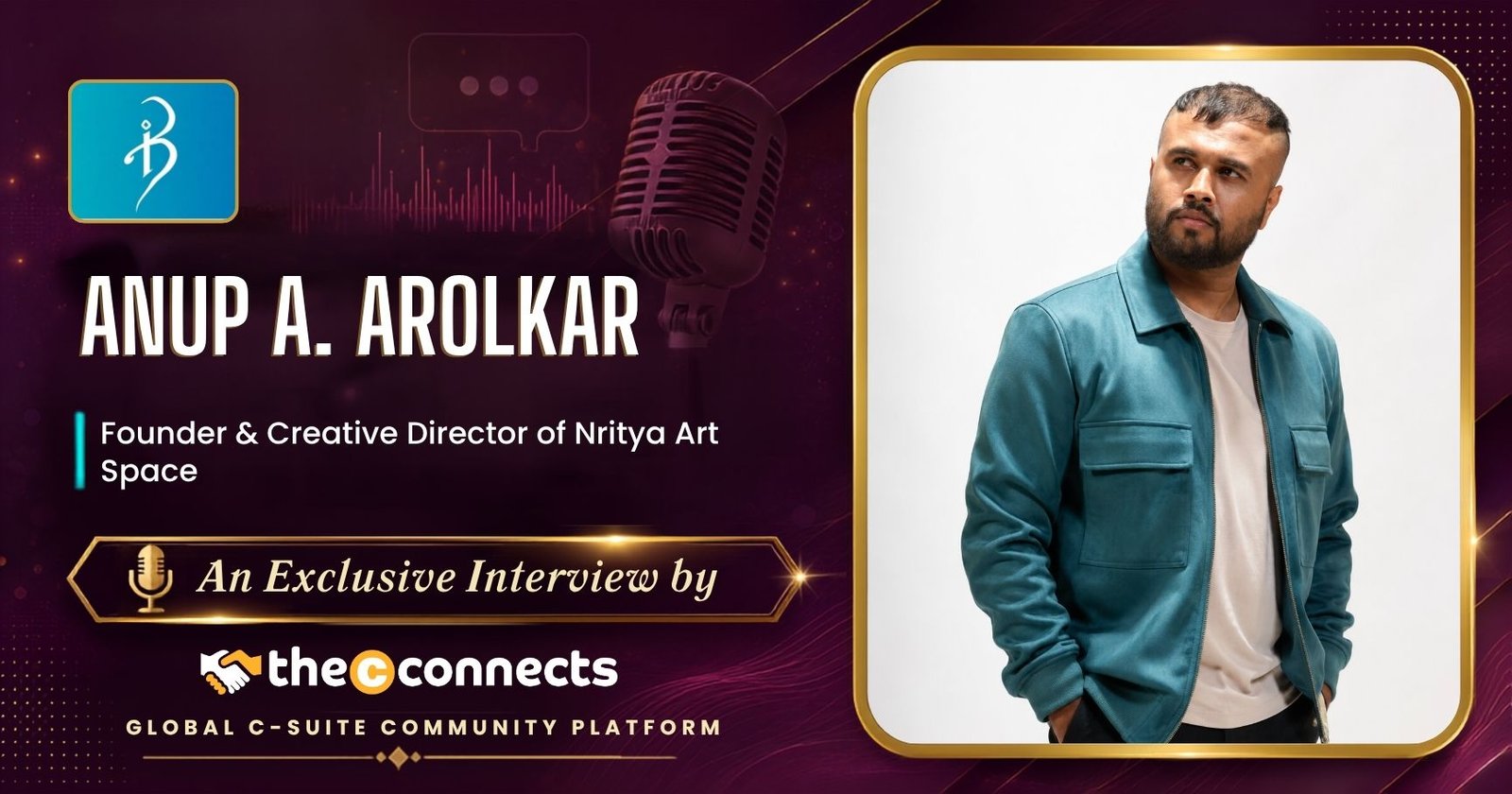

Welcome, Anup! It is an absolute privilege to have you with us today. With 15 years of experience spanning choreography, creative direction, production, and performing arts education, you have carved out a truly unique space in the industry. From representing India on international stages to founding Nritya Art Space and Arolkar Artique, your journey is deeply inspiring. We appreciate you taking the time to sit down with us. How have you been, and what is the creative energy like in Goa right now?
Anup A. Arolkar: Thank you so much for the warm welcome! It is a pleasure to connect with TheCconnects. I have been doing very well. The creative energy in Goa is incredibly vibrant at the moment. We are constantly working on new artistic productions, conducting workshops, and developing fresh talent at the studio. There is a beautiful shift happening where the performing arts are being taken more seriously as a sustainable profession here, and it is a very exciting time to be building this ecosystem.
TheCconnects: Let’s go back to the very beginning. Your connection to dance and movement comes from a deeply personal place. How did movement become your primary language, and how did it shape your career?
Anup A. Arolkar: My journey into the performing arts didn’t start with a desire for fame or applause; it started out of a desperate need to communicate. As a young boy, I struggled significantly with stammering. When you cannot string a sentence together without faltering, you lose confidence very quickly. You shrink into the background because speaking feels like a battle.
Dance became my sanctuary. It was the first space where I realized I didn’t need words to be heard, understood, or felt. Through years of training and performing, the physical movement unlocked something in my mind. It helped me overcome my inhibitions, build my self-esteem, and express my emotions freely. That personal transformation fundamentally shaped my philosophy. I realized that the performing arts are not just entertainment-they are powerful tools for building discipline, communication, teamwork, and raw confidence. I knew then that I wanted to spend my life helping others experience that exact same transformation.
TheCconnects: That is a profoundly moving transformation. Over the years, you evolved from a competitive dancer at the Indian Hip-Hop Championship and representing India at Lusofonia in Macau, to taking on heavy leadership roles like Managing Head of MesmeriZerZ India and General Manager of Encore Academy. How did you navigate the shift from being a performer to an arts manager and leader?
Anup A. Arolkar: Being a performer is a very internal process-it is about your body, your execution, and your connection with the audience. But as I spent more time in the industry, I started noticing the structural gaps. I saw incredibly talented artists struggling because they lacked professional guidance, platforms, and management.
I realized that if I wanted to create a larger impact, I had to step off the stage and learn how to build the stage itself. Taking on roles at MesmeriZerZ India and Encore Academy taught me the mechanics of the industry: how to organize large-scale productions, manage artist temperaments, design educational curriculums, and run the operational side of art. It was a challenging pivot, but it gave me the comprehensive blueprint I needed to eventually start my own ventures.
TheCconnects: Today, you are driving a larger vision through Nritya Art Space. One of your core philosophies is creating a pathway from “Learning to Earning.” Why is building this specific ecosystem so critical for artists today?
Anup A. Arolkar: For decades, society has romanticized the idea of the “starving artist.” There is this misconception that if you are passionate about art, you should be willing to struggle financially. I completely reject that notion.
At Nritya Art Space, we believe that talent deserves to be compensated. Our goal is to bridge the gap between raw passion and industry readiness. We don’t just teach choreography; we focus on professional skill development, work ethics, and artist management. I want a young dancer in Goa to know that they can train, discover their unique abilities, and eventually find meaningful, well-paying opportunities within the industry without having to abandon their craft. We are building an organization that combines storytelling with strong professional systems to create sustainable careers.
TheCconnects: You have also directed and choreographed cinematic dance productions and music videos like Mercedes, BATTLI, and Betting Loss. How does your creative approach change when blending movement with visual storytelling for a camera compared to a live stage audience?
Anup A. Arolkar: It is a completely different ballgame. On a live stage, you are choreographing for a wide, static perspective. The audience sees the entire picture at once, so the energy has to project all the way to the back row. The formations and the sheer physical power carry the narrative.
When you are directing for the camera, you are dictating exactly what the audience looks at. A slight tilt of the head, a subtle hand gesture, or a shift in the eyes can convey more emotion than a massive leap, simply because the camera is close. In projects like Mercedes or Betting Loss, the choreography has to seamlessly marry the cinematography, the lighting, and the editing cuts. It becomes less about executing a sequence of steps and more about capturing a very specific, intimate emotion within a framed narrative.
TheCconnects: The digital space has revolutionized how art is consumed today. What do you see as the biggest challenge for performing arts brands and individual creators in this era?
Anup A. Arolkar: The biggest challenge is the algorithmic pressure to prioritize virality over artistry. The digital space is currently dominated by 15-second trends and hyper-fast consumption. While social media is a fantastic tool for visibility, it forces many artists to constantly churn out bite-sized, formulaic content just to stay relevant, which can severely dilute their actual craft. The challenge for brands and creators is striking a balance-learning how to utilize digital platforms for marketing and audience building, while protecting the depth, authenticity, and integrity of their art.
TheCconnects: How do your solutions at Nritya Art Space address the pain points of young artists trying to break through this noise?
Anup A. Arolkar: Young artists today are overwhelmed. They have the talent, but they suffer from a lack of direction, poor industry networking, and a lack of understanding about how to market themselves professionally. We address these pain points through our artist management and mentorship programs. We act as an incubator. We provide them with high-quality enrichment programs to refine their craft, and then we plug them into real-world event productions and entertainment solutions. We handle the operational and management friction so that the artist can focus on what they do best: creating.
TheCconnects: Creative burnout is a real threat in your line of work. What do you do in your free time to disconnect and recharge your creative batteries?
Anup A. Arolkar: When your passion becomes your profession, the lines between work and life blur very quickly. To disconnect, I lean heavily into the natural beauty of Goa. Spending quiet time by the water or just being in nature is incredibly grounding. I also make it a point to listen to music strictly for pleasure-without analyzing the beats, the tempo, or thinking about how I would choreograph it. Sometimes, simply observing people and everyday life gives me the fresh perspective I need to conceptualize my next project.
TheCconnects: As we wrap up this insightful conversation, what advice do you have for aspiring performing arts entrepreneurs who want to build a sustainable organization in this industry?
Anup A. Arolkar: Master your craft, but do not ignore the business of your craft. You can be the greatest choreographer in the room, but if you don’t understand basic finance, people management, and marketing, your organization will struggle to survive. Be patient with your growth. Building a community and an ecosystem takes years of consistent, unglamorous hard work. Focus on creating genuine value for your artists and your audience, and the commercial success will naturally follow.
TheCconnects: That is brilliant and highly actionable advice. Thank you so much for joining us today, Anup. It has been an absolute honor to learn about your transformational journey, your vision for Nritya Art Space, and your commitment to uplifting the performing arts community. We wish you continued success!
Anup A. Arolkar: Thank you so much for having me. It was a wonderful conversation, and I deeply appreciate the platform TheCconnects provides to share our stories and connect with a wider audience.