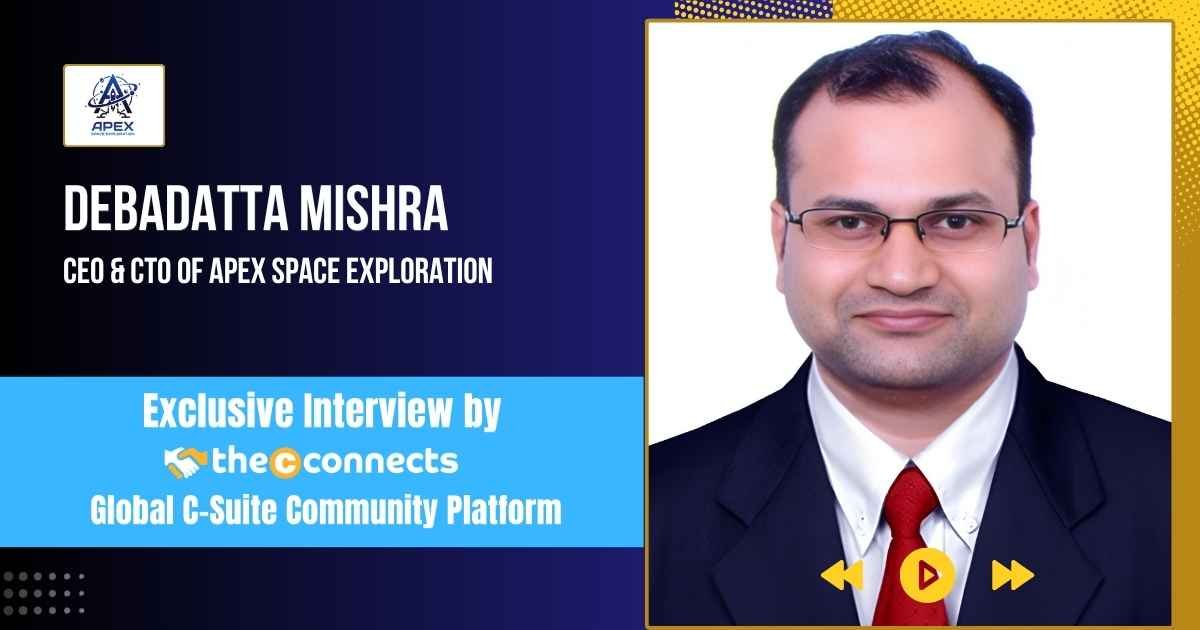

The aerospace and defence sectors in India are undergoing a massive transformation, shifting from purely government-driven endeavours to a vibrant, private-sector-led ecosystem. At the forefront of this monumental shift is Debadatta Mishra, the CEO and CTO of Apex Space Exploration (ApexSE).
With a distinguished career spanning over 22 years, including 15 pivotal years as a Senior Scientist at the Indian Space Research Organisation (ISRO), where he played a crucial role in the Gaganyaan Human Spaceflight Program, Mr. Mishra has seamlessly transitioned from a top-tier government scientist to a visionary tech entrepreneur. Beyond his technical prowess in cryogenic propulsion and satellite technologies, he has also spearheaded national workforce initiatives as the Officiating CEO of the Aerospace & Aviation Sector Skill Council (AASSC).
Today, under his leadership, ApexSE is building India’s first cost-efficient Micro Earth Observation Satellite Constellation, slated for launch in Q4 2027.
TheCconnects recently sat down with Mr. Debadatta Mishra to discuss his extraordinary journey from ISRO to entrepreneurship, the challenges of commercializing space technology, and his vision for the future of Earth observation.
TheCconnects: Debadatta Mishra, it is a privilege to have you with us. Your career trajectory is nothing short of phenomenal. Could you tell our readers a little about your professional journey and how you transitioned from a Senior Scientist at ISRO to founding Apex Space Exploration?
Debadatta Mishra: Thank you for having me. My journey has always been driven by an insatiable curiosity about how things work, which led me to pursue my B. Tech in Mechanical Engineering and later an M. Tech in Aerospace Engineering at IIT Kharagpur. The real turning point was joining ISRO. For over 15 years, I have had the privilege of working on some of the country’s most ambitious projects, including the Gaganyaan Human Spaceflight Program and advanced cryogenic propulsion systems.
However, as I observed the global space economy evolving, I realized that India’s private sector needed to step up to fully harness the potential of space technology for societal and commercial benefits. After a deeply fulfilling tenure at ISRO and DRDO, and a strategic stint leading skill development at AASSC, I felt it was time to leap. I founded Apex Space Exploration with a clear mission: to build reliable, indigenous space systems-specifically, a Micro Earth Observation Satellite Constellation, that can deliver actionable data for defence, maritime, and civilian applications.
TheCconnects: Stepping out of a highly structured environment like ISRO to build a startup is a massive leap. Who has influenced you the most in life and why?
Debadatta Mishra: I have been profoundly influenced by the pioneering founders of India’s space program, like Dr. Vikram Sarabhai and Dr. A.P.J. Abdul Kalam. They possessed a unique blend of scientific brilliance and nation-building vision. They didn’t just build rockets; they built institutions and ecosystems.
On a more contemporary note, I am constantly inspired by the young, driven innovators I meet while mentoring at the Atal Incubation Centre and various universities. I firmly believe that today’s entrepreneurs are the modern freedom fighters. They are the ones driving economic independence, technological self-reliance, and shaping solutions that uplift society. Their relentless energy keeps me motivated every single day.
TheCconnects: What are the biggest challenges you have faced in establishing Apex Space Exploration, and how did you overcome them?
Debadatta Mishra: The space sector is inherently capital-intensive and fraught with technical risks. One of our earliest challenges was striking the right balance between cutting-edge innovation and cost-efficiency. Building a satellite constellation that can operate 24/7, seeing through day and night, requires highly sophisticated payloads, such as Thermal Infrared(TIR) and Multispectral imaging.
Transitioning from a pure R&D mindset to a commercial mindset was another hurdle. In a startup, you have to be mindful of timelines, regulatory compliance, investor relations, and product-market fit all at once. We overcame this by building a multidisciplinary team. My time pursuing an MBA from Symbiosis and an MA in Space and Telecommunication Law from NALSAR gave me the strategic business and regulatory frameworks needed to navigate the commercial space sector effectively. Being incubated at IIT Bhubaneswar and securing recognition from INSPACe and DPIIT also gave us the critical institutional backing we needed.
TheCconnects: Looking back at your 22+ years in aerospace and defense, what key lessons have you learned?
Debadatta Mishra: The most vital lesson is the importance of “Systems Thinking.” In aerospace, no component works in isolation. A failure in a minor subsystem can compromise a multi-million-dollar mission. This applies to business as well. You cannot look at engineering, human resources, or finance in silos; they must operate as a cohesive unit.
Secondly, I’ve learned that continuous learning is non-negotiable. The technology landscape evolves rapidly. Even after two decades in the field, I am still pursuing my Ph.D. and expanding my knowledge in space law and business administration. You have to stay intellectually hungry to remain relevant.
TheCconnects: In today’s highly digital and data-driven world, what do you see as the biggest challenge for brands operating in the space and tech sectors?
Debadatta Mishra: The biggest challenge in the digital space today is translating massive volumes of complex data into simple, actionable, and user-friendly insights.
In the Earth Observation (EO) sector, satellites generate terabytes of raw data daily, including multispectral images, radar data, and environmental metrics. The challenge isn’t just acquiring the data; it’s making sense of it. For a brand in our space, if we hand a farmer or a city planner raw hyperspectral imagery, it’s virtually useless to them. The true test is leveraging AI, machine learning, and edge computing to turn that imagery into a clear directive-like “increase irrigation in sector 4” or “high risk of pipeline leak detected.” Bridging the gap between high-tech data collection and practical, ground-level application is the ultimate hurdle.
TheCconnects: How exactly do the services and solutions at Apex Space Exploration address the pain points of your customers?
Debadatta Mishra: Our approach at ApexSE is divided into upstream and downstream solutions. Upstream, we are building a Micro Earth Observation Satellite Constellation equipped with VNIR, SWIR, MWIR, and SAR technology. The pain point we solve here is the lack of persistent, cost-effective, all-weather monitoring. Our satellites will provide 24/7 visibility, unaffected by cloud cover or darkness.
Downstream, we solve the data-translation problem I just mentioned. For agriculture, we process data to calculate soil moisture and crop health (NDVI), allowing farmers to optimize irrigation and insurers to develop localized policies. For the oil and gas sector, we monitor infrastructure to detect leaks early. For defence and maritime, we provide real-time geospatial intelligence. We don’t just sell satellite images; we sell operational intelligence that saves money, protects the environment, and enhances security.
TheCconnects: With such an intense professional life-leading a startup, consulting, and studying-what do you do in your free time?
Debadatta Mishra: Free time is a luxury, but I firmly believe in giving back to the community. I spend a significant amount of my off-hours mentoring aspiring aerospace startups and delivering technical talks at schools and universities. Inspiring the next generation of space engineers is incredibly fulfilling for me. I also dedicate time to my ongoing academic pursuits-working on my Ph.D. thesis and my legal and business studies. For me, reading, researching, and mentoring are the best ways to unwind.
TheCconnects: Finally, what advice do you have for aspiring entrepreneurs looking to enter the aerospace or deep-tech industries?
Debadatta Mishra: My advice is to focus relentlessly on solving real-world problems. Don’t build a technology just because it sounds fascinating; build it because it addresses a critical societal or commercial need.
The deep-tech and space sectors require immense patience and resilience. You will face regulatory hurdles, funding crunches, and technical failures. Embrace them as part of the process. Furthermore, invest in indigenous capabilities. As India positions itself as a global space hub, there is a massive opportunity for startups to build reliable, home-grown technologies that strengthen our national security and economic resilience. Stay focused, build a great team, and never lose sight of the bigger picture.