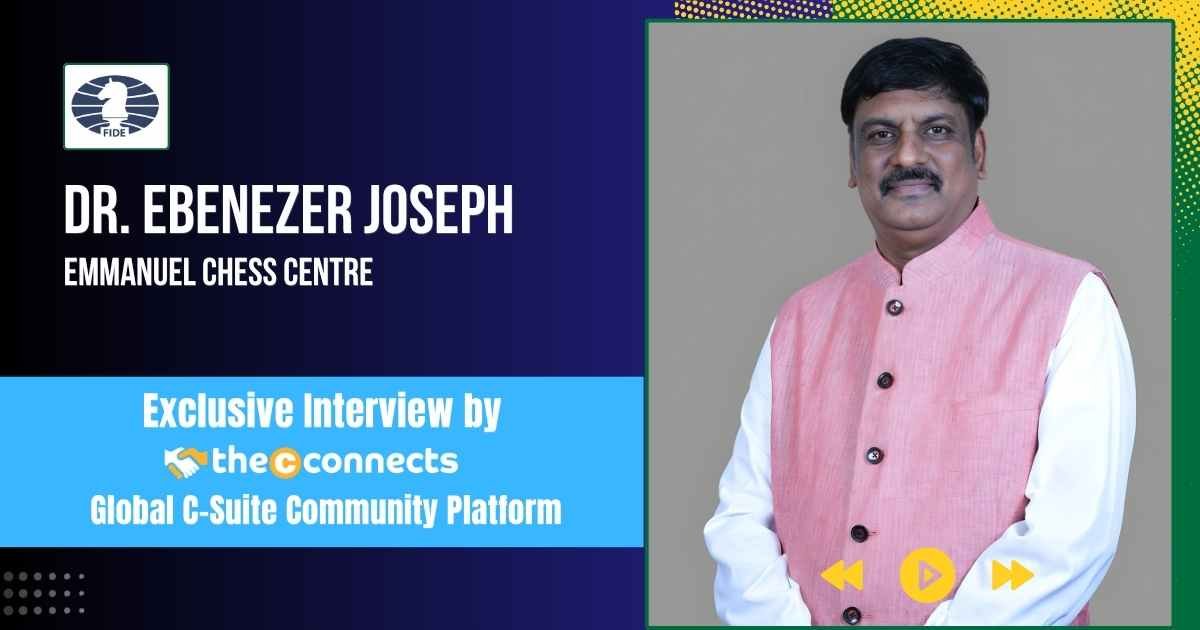

For centuries, chess has been revered as a battleground of intellect-a game of kings, grandmasters, and prodigies. But for Dr. Ebenezer Joseph, the 64 squares represent something far more profound: a laboratory for the human mind.
Dr. Ebenezer Joseph stands at an extraordinary crossroads of strategy, scholarship, and public service. He is not only India’s first certified FIDE Trainer and the only Indian designated as a Senior Lead Instructor by the World Chess Federation’s Chess in Education Commission, but he also holds the landmark distinction of earning India’s first Ph.D. in Chess from the University of Madras. As a cognitive psychologist, his pioneering research funded by the Government of India has empirically proven how chess transforms a child’s brain.
Beyond his academic brilliance, Dr. Joseph is a fierce competitor, currently ranked World Amateur No. 5 and Asia No. 5 Senior 50+. Furthermore, he balances these global achievements with his responsibilities as a Supervisor at the Finance and Communications Audit Office in Chennai.
TheCconnects recently had the privilege of sitting down with Dr. Ebenezer Joseph to discuss his three-decade legacy of mentoring over 15,000 children, the science behind chess, and his vision for the future of education in India.
TheCconnects: Dr. Ebenezer Joseph, it is a tremendous honor to speak with you. Your career is fascinating because it breaks the mold. You aren’t just a chess champion; you are a cognitive psychologist with India’s first Ph.D. in Chess. Can you tell us about the journey that led you from playing the game to studying its science?
Dr. Ebenezer Joseph: Thank you, the pleasure is mine. My journey really started with a pure, competitive love for the game. During my younger years, I captained the Madras University Team and won the All India University Chess Championship three times. I was fortunate enough to play in the World Youth Chess Championship in Brazil in 1991 and the Continental Championship in the USA in 1996.
However, as I spent thousands of hours at the board, I realized that the discipline of chess was subtly rewriting my cognitive habits. I was processing daily problems differently. I became deeply curious about the psychological mechanics behind this. That curiosity drove me to pursue a Ph.D. at the University of Madras. I wanted to move chess out of the sports pages and into the realm of scientific inquiry. I wanted to prove, empirically, that chess isn’t just about capturing a king-it is about building a highly efficient, analytical mind.
TheCconnects: That desire to prove the cognitive benefits led to your milestone research project funded by the Department of Science and Technology (DST). What exactly did your findings reveal about the impact of structured chess training on children?
Dr. Ebenezer Joseph: The DST-funded Cognitive Science Research Initiative was truly a watershed moment for us. We set out to measure what happens when children are exposed to systematic, structured chess instruction. The data we gathered was undeniable.
We recorded significant enhancements in core cognitive functions. Children who underwent structured chess training showed marked improvements in baseline intelligence, creative thinking, memory retention, and analytical reasoning. More importantly, we saw a dramatic increase in their concentration and decision-making competencies. When a child learns to evaluate multiple variations on a chessboard, weigh the risks, and make a move under time pressure, they are actively strengthening the neural pathways used for executive function. These cognitive upgrades resonate far beyond the chessboard-they translate directly to better academic performance and life skills.
TheCconnects: In 1996, you founded the Emmanuel Chess Centre in Chennai, and over the last 30 years, you’ve mentored over 15,000 children and 150 trainers. Who influenced your teaching philosophy the most, and what keeps you motivated after three decades?
Dr. Ebenezer Joseph: My teaching philosophy was heavily influenced by the rigorous, structured approaches of the classical chess schools, combined with my academic mentors in cognitive psychology who taught me the value of structured learning.
What keeps me motivated is the transformation I see in my students. Mentoring 15,000 children teaches you that true intelligence is not just raw talent; it is resilience. I have watched kids lose heartbreaking games, analyze their mistakes, and come back stronger. My pedagogical approach is anchored in intellectual discipline and ethical engagement. Watching a young mind grasp a complex positional concept and then apply that same critical thinking to their schoolwork-that is the ultimate reward.
TheCconnects: You lead a remarkably dual life. You serve as a Supervisor at the Finance and Communications Audit Office in Chennai, recruited under the sports quota, while also competing globally in places like Mongolia, Greece, and Iraq. What is the biggest challenge in balancing these roles, and how do you manage it?
Dr. Ebenezer Joseph: The biggest challenge is undoubtedly time management and maintaining mental stamina. Auditing requires an intense, meticulous eye for detail, and competitive chess requires immense psychological endurance.
I overcome this by applying the fundamental principles of chess to my daily life: strategic planning, prioritization, and maintaining absolute composure. I don’t see my government service and my chess career as competing forces; they complement one another. The analytical rigor required in finance and communications audit sharpens my mind for the chessboard, and the strategic foresight I learn in chess makes me more effective in my professional role.
TheCconnects: Today’s youth are growing up in an era of digital distraction and instant gratification. What do you see as the biggest challenge for educational brands and institutions in this digital space?
Dr. Ebenezer Joseph: The greatest challenge in the digital space is the erosion of deep focus. Educational brands and tech platforms are constantly fighting for a child’s fragmented attention, often reducing learning to bite-sized, gamified clips. While technology is a wonderful enabler, it often discourages sustained, deep analytical thought.
This is exactly the pain point our Chess in Education (CIE) framework addresses. Chess is the ultimate antidote to digital distraction. It demands delayed gratification, absolute presence, and deep calculation. Our challenge as educators is to use digital platforms to make chess accessible, without diluting the profound intellectual discipline the game requires.
TheCconnects: As an advocate for the Chess in Education (CIE) framework, what is your ultimate vision for chess in India?
Dr. Ebenezer Joseph: My central vision is the institutionalization of chess within mainstream education. I advocate for a systematic, research-driven integration of chess into school curricula across the country. It should not merely be an after-school club for a few talented kids. It must be scalable and inclusive. By aligning CIE programs with national educational priorities, we can use chess as a widespread tool for intellectual empowerment, nurturing a generation of thinkers, strategists, and resilient decision-makers.
TheCconnects: As an elite player, holding the US Master title and ranking Asia No. 5 Senior 50+, your game has surely evolved. How do you approach the board today compared to your early years, and what do you do in your free time when you aren’t calculating moves?
Dr. Ebenezer Joseph: My approach today is defined by composure and precision. When you are young, you often rely on sharp, aggressive tactics and rapid calculation. With experience, you develop a much more nuanced understanding of positional dynamics. I am comfortable maneuvering slowly and accumulating small, compounding advantages.
As for free time, because my professional life, research, and competitive play require such intense mental focus, I cherish moments of complete mental rest. I enjoy reading literature outside of my field, engaging in quiet reflection, and spending quality time with my family to recharge.
TheCconnects: What advice do you have for parents or aspiring educators who want to introduce chess to the next generation?
Dr. Ebenezer Joseph: Do not focus solely on creating grandmasters or winning trophies. Focus on the cognitive and character-building journey. Teach children that losing a game is not a failure; it is an opportunity to analyze and improve. Encourage intellectual discipline, patience, and ethical play. If you teach a child how to think strategically on the board, you give them a framework to navigate the complexities of life.