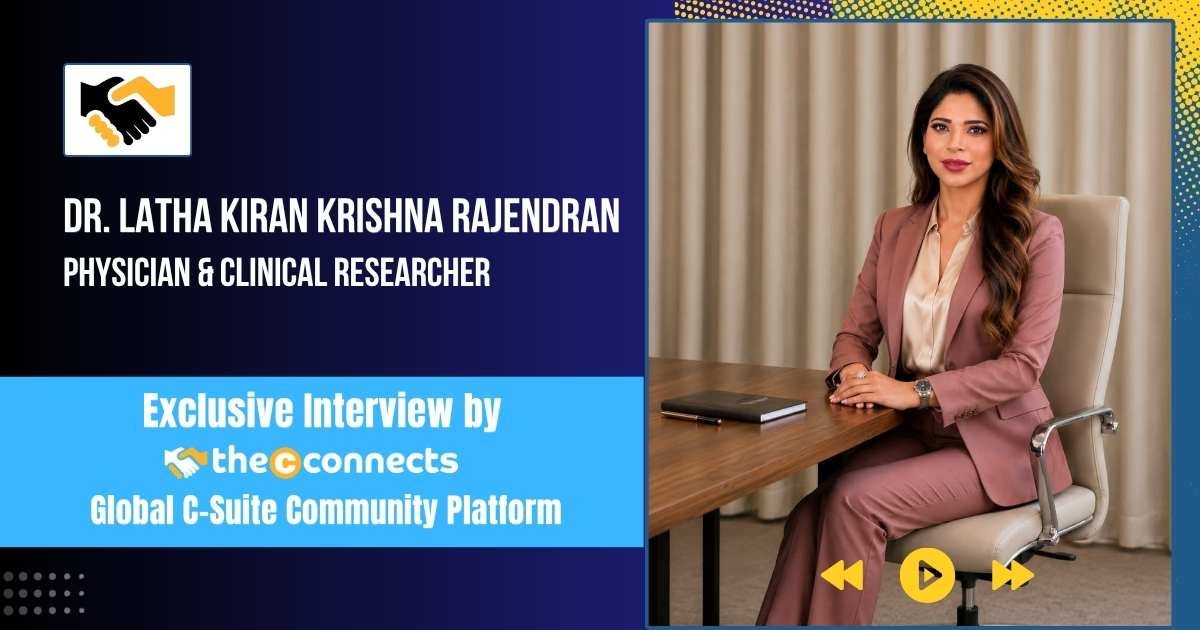

From Frontline Medicine to Precision Oncology:
How Dr. Latha Kiran Krishna Rajendran is Advancing Predictive Healthcare Through Clinical Excellence, Cancer Research, and Artificial Intelligence
As healthcare evolves from reactive treatment toward predictive and personalized medicine, a new generation of physician-scientists is helping shape the future of patient care. Among them is Dr. Latha Kiran Krishna Rajendran, MBBS, a Bengaluru-based physician, clinical researcher, author, inventor, and healthcare innovator whose work spans precision oncology, immunotherapy, cancer nanomedicine, pharmacogenomics, artificial intelligence, and predictive healthcare systems.
With more than seven years of clinical experience, extensive public health leadership during the COVID-19 pandemic, 13 Scopus-indexed publications, five scientific books, multiple patents, over 200 scholarly citations, and numerous international academic contributions, Dr. Rajendran represents a growing movement of clinicians working at the intersection of medicine, technology, and scientific innovation.
TheCconnects recently sat down with Dr. Rajendran to discuss her professional journey, her passion for oncology research, and her vision for the future of precision healthcare.
TheCconnects: Dr. Rajendran, thank you for joining us. Your career combines frontline medicine, public health leadership, oncology research, artificial intelligence, and healthcare innovation. Many professionals pursue only one of these paths. How would you describe the mission that connects your work?
Dr. Latha Kiran Krishna Rajendran: Thank you for having me.
At its core, my mission is simple: helping healthcare move from reaction to prediction.
Throughout my clinical career, I have cared for thousands of patients with chronic illnesses, infectious diseases, metabolic disorders, maternal health concerns, and complex medical conditions. One observation became increasingly clear to me-many diseases are diagnosed only after significant biological damage has already occurred.
That realization inspired my interest in precision medicine, predictive analytics, genomics, immunology, and artificial intelligence.
Whether I am caring for patients in clinic, publishing research, writing books, or developing new healthcare technologies, the underlying question remains the same:
Can we identify disease earlier, personalize treatment more effectively, and ultimately improve patient outcomes?
That question continues to guide everything I do.
TheCconnects: Tell us about your professional journey and how you arrived at your current role.
Dr. Latha Kiran Krishna Rajendran: My medical journey began at Vydehi Institute of Medical Sciences and Research Centre in Bengaluru, where I completed my MBBS training.
Following graduation, I served as a Medical Officer at Adugodi Urban Primary Health Centre. This experience exposed me to public health at an extraordinary scale and taught me the importance of healthcare accessibility, prevention, and community-based interventions.
During the COVID-19 pandemic, I worked on the frontlines of one of the most challenging public health crises in modern history. I participated in large-scale vaccination initiatives that ultimately contributed to administering more than 150,000 vaccinations. Those years reinforced the importance of resilience, teamwork, evidence-based decision-making, and public trust in healthcare systems.
Today, as a General Practitioner and Consultant, I manage a high-volume clinical practice caring for thousands of patients annually. Every patient encounter continues to teach me something new and frequently inspires the research questions I pursue.
Clinical practice remains the foundation of my scientific work.
TheCconnects: You maintain a busy clinical practice while also publishing extensively in oncology and precision medicine. What inspired your transition into research?
Dr. Latha Kiran Krishna Rajendran: Research was never a separate path from medicine-it was a natural extension of it.
As clinicians, we constantly encounter unanswered questions. Why does one patient respond exceptionally well to treatment while another does not? Why do certain cancers develop resistance? How can we detect disease before symptoms appear?
The more patients I treated, the more interested I became in understanding the biological mechanisms behind these differences.
Research provided an opportunity to explore those questions systematically and contribute to the broader advancement of medicine.
For me, research is simply another form of patient care-one that has the potential to impact thousands or even millions of lives beyond the clinic.
TheCconnects: Several of your publications focus on cancer immunotherapy, CAR-T cell therapy, and immune-based treatments. Why do you believe this field is so transformative?
Dr.Latha Kiran Krishna Rajendran: Immunotherapy represents one of the most significant breakthroughs in modern oncology.
Historically, cancer treatment focused primarily on surgery, chemotherapy, and radiation therapy. While these approaches remain essential, immunotherapy introduces an entirely different strategy-empowering the patient’s own immune system to recognize and eliminate cancer cells.
My work examining CAR-T cell therapies and other immune-based treatment approaches explores how we can further improve the precision, effectiveness, and safety of these therapies.
The future of cancer treatment will increasingly involve leveraging the immune system in highly personalized ways. I believe we are only beginning to understand the full potential of immunotherapy.
TheCconnects: Your research also explores immunotherapy resistance in colorectal cancer liver metastases. Why is this challenge so important?
Dr. Latha Kiran Krishna Rajendran: One of the greatest challenges in oncology is that many patients eventually develop resistance to treatment.
Even highly successful therapies may lose effectiveness as tumors evolve and adapt.
My research on immunotherapy resistance in colorectal cancer liver metastases investigates the complex biological mechanisms that enable tumors to evade immune surveillance and therapeutic intervention.
Understanding these resistance pathways is critical because overcoming resistance may ultimately be as important as developing new therapies themselves.
If we can identify why treatments stop working, we can design smarter and more durable therapeutic strategies for future patients.
TheCconnects: You have also written extensively about cancer nanomedicine and theranostics. Could you explain these concepts and their clinical significance?
Dr. Latha Kiran Krishna Rajendran: Cancer nanomedicine focuses on improving how therapies are delivered to tumors.
Traditional chemotherapy often affects healthy tissues alongside cancer cells, resulting in significant toxicity. Nanomedicine offers the possibility of delivering therapeutic agents more precisely to tumor sites through mechanisms such as the Enhanced Permeability and Retention (EPR) effect.
Theranostics takes this concept even further by combining diagnostic imaging and therapeutic intervention within a single platform.
Imagine being able to visualize a tumor, deliver treatment, and monitor therapeutic response simultaneously.
These technologies have the potential to improve treatment precision while reducing unnecessary side effects, which ultimately translates into better patient outcomes and quality of life.
TheCconnects: Genomic profiling and multi-omics integration are recurring themes throughout your research. How are these technologies changing oncology?
Dr. Latha Kiran Krishna Rajendran: Every cancer is biologically unique.
Genomic profiling enables us to examine the molecular characteristics that drive disease behavior. When combined with transcriptomics, proteomics, metabolomics, and other forms of biological data, we can develop a much deeper understanding of individual tumors.
My research explores how multi-omics integration can help identify therapeutic targets, predict treatment response, and uncover mechanisms of resistance.
The future of oncology will increasingly rely on molecular intelligence rather than broad treatment categories.
We are moving toward a world where therapies are selected based on the biology of an individual patient’s cancer rather than solely on where that cancer originated.
TheCconnects: Your more recent publications involve machine learning, predictive analytics, and clinical decision support systems. How do you see artificial intelligence influencing healthcare?
Dr. Latha Kiran Krishna Rajendran: Artificial intelligence has enormous potential in healthcare when implemented responsibly.
My research has examined machine-learning applications in cancer risk stratification, mortality prediction, treatment-response assessment, survival modeling, and clinical decision support.
However, I view AI as a tool that augments clinicians rather than replaces them.
The future physician will combine clinical expertise with computational intelligence. The most effective healthcare systems will integrate human judgment, scientific evidence, and predictive analytics to support more informed decisions.
Ultimately, AI should empower physicians and improve patient outcomes-not replace the human element that remains central to medicine.
TheCconnects: Beyond research papers, you have authored multiple scientific books. What motivated you to pursue scientific authorship?
Dr. Latha Kiran Krishna Rajendran: Scientific knowledge becomes most valuable when it is shared.
While journal articles communicate specific findings, books provide an opportunity to synthesize broader fields of knowledge and make complex topics more accessible.
My books explore subjects including immunotherapy, cancer nanomedicine, theranostics, genomic profiling, and mechanisms of treatment resistance.
Writing has allowed me to contribute not only to research advancement but also to education, which I believe is equally important for long-term scientific progress.
TheCconnects: You are also active as a peer reviewer, speaker, conference leader, and innovation judge. Why are these activities important to you?
Dr. Latha Kiran Krishna Rajendran: Science advances through collaboration.
Peer review helps maintain scientific rigor and research quality. Conference participation facilitates knowledge exchange and interdisciplinary collaboration. Judging innovation competitions allows us to encourage emerging talent and support the next generation of innovators.
These activities create opportunities to contribute beyond individual research projects and help strengthen the broader scientific ecosystem.
I consider them an important responsibility as both a physician and researcher.
TheCconnects: Looking ahead, what areas of healthcare innovation excite you most?
Dr. Latha Kiran Krishna Rajendran: I am particularly excited by the convergence of precision oncology, artificial intelligence, digital health, pharmacogenomics, and predictive medicine.
The integration of these disciplines has the potential to fundamentally transform healthcare.
I envision a future where diseases are detected earlier, treatments are individualized, therapeutic decisions are supported by predictive analytics, and healthcare becomes increasingly proactive rather than reactive.
The ultimate goal is not simply extending life-but improving the quality of life patients experience throughout their healthcare journey.
TheCconnects: Finally, what advice would you give aspiring physician-scientists and healthcare innovators?
Dr. Latha Kiran Krishna Rajendran: The future belongs to those who can bridge disciplines.
Do not limit yourself to traditional boundaries. Learn medicine, understand technology, appreciate data science, embrace innovation, and never stop asking questions.
Most importantly, remain patient-centered.
Technology will continue to evolve, but empathy, compassion, and a commitment to improving human lives will always remain at the heart of great medicine.
Stay curious.
Stay humble.
Keep learning.
And never underestimate how one idea, one discovery, or one innovation can improve the lives of millions.
TheCconnects: Dr. Rajendran, thank you for sharing your remarkable journey and insights with us.
Dr. Latha Kiran Krishna Rajendran: Thank you. It has been a pleasure. I am grateful for the opportunity to share my experiences and vision for the future of healthcare.