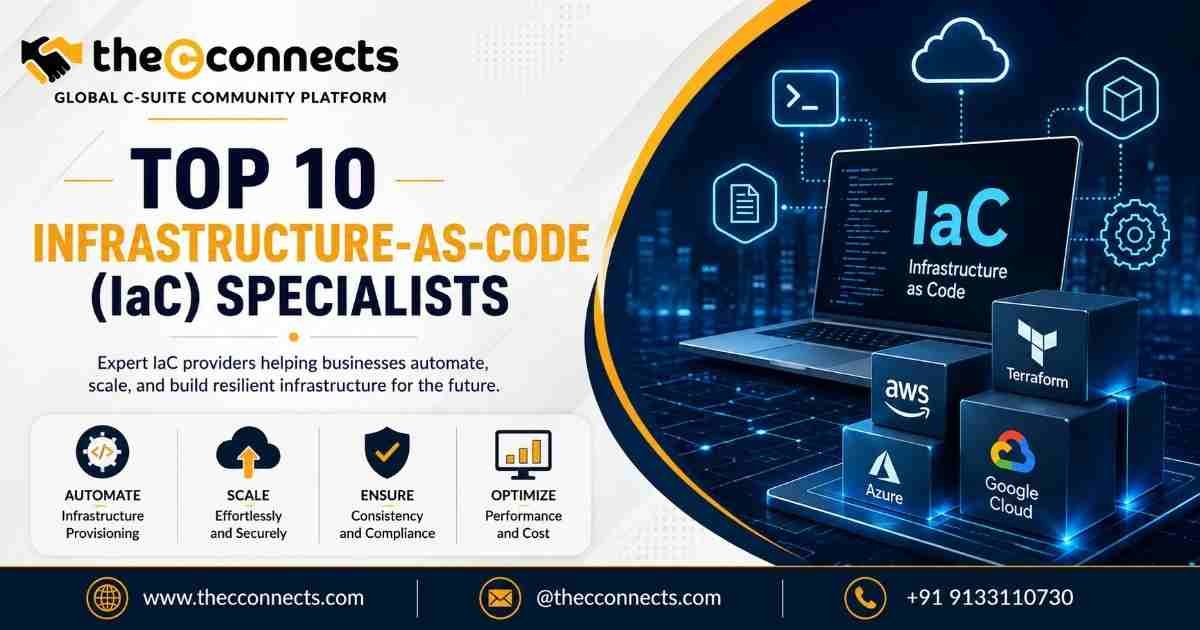

As enterprises accelerate cloud migration and scale complex multi-cloud ecosystems, manual infrastructure provisioning has become a liability. Static scripts, manual cloud console configurations, and fragmented operational pipelines create structural vulnerabilities: configuration drift, spiraling cloud spend, security non-compliance, and severe deployment bottlenecks.
To solve these systemic challenges, engineering organizations rely on Infrastructure-as-Code (IaC) Specialists. Modern IaC platforms do not simply automate cloud provisioning-they transform infrastructure into version-controlled, testable, and reusable software code. Today’s market leaders integrate policy-as-code guardrails, real-time drift detection, developer self-service portals, and cloud FinOps controls directly into Continuous Integration and Continuous Deployment (CI/CD) pipelines.
Market Dynamics: Key Trends Shaping the IaC Ecosystem
- The Shift to OpenTofu and Open-Source Governance: Following license changes by major vendors, the open-source community rallied behind Linux Foundation-backed projects like OpenTofu. IaC platforms now prioritize neutral, multi-framework support to give enterprises vendor choice.
- Programming Languages Over Declarative DSLs: Developers increasingly demand general-purpose programming languages (TypeScript, Python, Go) alongside traditional declarative formats (HCL, YAML). This enables software engineering best practices like loops, abstractions, and unit testing in infrastructure code.
- Policy-as-Code & Automated Governance: Security and compliance are moving left into provisioning workflows. Modern IaC platforms embed automated guardrails (using OPA or Sentinel) to prevent non-compliant infrastructure from ever being deployed to production.
- Continuous Drift Detection and Self-Healing: Static provisioning is insufficient. Leading IaC specialists now feature active, continuous monitoring that automatically detects state drift against real-world cloud resources and triggers automated reconciliation workflows.
Below is an in-depth evaluation of the Top 10 Infrastructure-as-Code (IaC) Specialists driving modern cloud platform engineering.
Top 10 Infrastructure-as-Code (IaC) Specialists
1. HashiCorp (IBM)
- Founders: Mitchell Hashimoto, Armon Dadgar
- Founded Year: 2012
- Headquarters: San Francisco, California, USA
- Product Categories: Infrastructure Provisioning, Secret Management, Service Networking, Cloud Security Automation
- Description: HashiCorp, now an IBM company, is the foundational pioneer of the Infrastructure-as-Code movement. Its flagship product, HashiCorp Terraform, established the industry standard for declarative infrastructure provisioning using HashiCorp Configuration Language (HCL). HashiCorp provides an integrated ecosystem-including Vault for secrets management and Consul for networking-enabling global enterprises to automate multi-cloud infrastructure lifecycle management, enforce security compliance, and govern state management at enterprise scale.
- Key Features:
- Industry-standard declarative infrastructure provisioning across public and private clouds
- Centralized state file management, remote execution, and concurrent run locking
- Policy-as-code enforcement utilizing HashiCorp Sentinel and Open Policy Agent (OPA)
- Seamless integration with HashiCorp Vault for dynamic secret injection during provisioning
- Private module registries supporting reusable, audited enterprise infrastructure components
- Enterprise role-based access control (RBAC), SSO, and audit logging frameworks
- Continuous drift detection and automated notification workflows for state deviations
2. Pulumi
- Founders: Joe Duffy, Eric Rudder
- Founded Year: 2017
- Headquarters: Seattle, Washington, USA
- Product Categories: Infrastructure-as-Code, Developer Portals, Policy-as-Code, Cloud Engineering Platforms
- Description: Pulumi revolutionized the IaC ecosystem by allowing developers and platform engineers to define cloud infrastructure using real, general-purpose programming languages such as TypeScript, Python, Go, C#, and Java. By bridging the gap between application software engineering and infrastructure management, Pulumi enables teams to utilize familiar IDEs, testing frameworks, and package managers. Its platform features Pulumi ESC (Environments, Secrets, and Configuration) and AI-driven infrastructure generation to simplify multi-cloud deployments.
- Key Features:
- Multi-language infrastructure authoring supporting TypeScript, Python, Go, C#, and Java
- Pulumi Automation API for embedding infrastructure provisioning directly into application code
- Native policy-as-code engine (CrossGuard) enforcing security and compliance rules
- Pulumi ESC for centralized environment configuration and short-lived secret management
- Testing capabilities including unit testing, integration testing, and property testing
- Pulumi AI integration for generating deployment-ready infrastructure code
- Comprehensive cloud state management with built-in audit trails and RBAC
3. Spacelift
- Founders: Pawel Hytry, Marcin Wyszynski
- Founded Year: 2019
- Headquarters: Redwood City, California, USA / Warsaw, Poland
- Product Categories: IaC Management & Orchestration, Cloud Governance, Policy Automation, Developer Platforms
- Description: Spacelift is a specialized management and orchestration platform designed to sit on top of underlying IaC frameworks like Terraform, OpenTofu, Pulumi, CloudFormation, and Ansible. Spacelift treats infrastructure orchestration as a collaborative, highly governed workflow. By delivering flexible policy enforcement via Open Policy Agent (OPA), advanced multi-stack dependencies, and drift management, Spacelift enables platform engineering teams to maintain total control over infrastructure delivery without creating developer bottlenecks.
- Key Features:
- Multi-framework orchestration supporting Terraform, OpenTofu, Pulumi, CloudFormation, and Ansible
- Deep Open Policy Agent (OPA) integration for granular policy control over runs, access, and stacks
- Multi-stack dependency management enabling complex, multi-stage infrastructure runs
- Continuous drift detection and automated remediation triggers
- Self-service infrastructure catalogs for developer empowerment with guardrails
- Contextual secret management and dynamic cloud provider credentials (OIDC)
- Comprehensive run audit logs, cost estimation, and detailed execution histories
4. env0
- Founders: Ohad Maislish, Omry Hay
- Founded Year: 2018
- Headquarters: Sunnyvale, California, USA
- Product Categories: IaC Automation, Cloud FinOps & Cost Governance, Self-Service Infrastructure, Environment Management
- Description: env0 is a cloud management platform specializing in automated Infrastructure-as-Code workflows with integrated FinOps and governance controls. Built to bridge the gap between DevOps engineers and business stakeholders, env0 enables developer self-service provisioning within safe operational boundaries. The platform automates environment lifecycles, tracks cloud costs down to specific deployment runs, and enforces strict TTL (Time-To-Live) policies to eliminate costly idle cloud resources.
- Key Features:
- Support for Terraform, OpenTofu, Terragrunt, Pulumi, Helm, and Kubernetes
- Granular cloud cost monitoring and run-level cost estimation prior to deployment
- Automated Time-To-Live (TTL) and scheduling settings for ephemeral developer environments
- Self-service environment catalogs allowing developers to safely provision pre-approved stacks
- Role-based access controls (RBAC) and OPA-based policy enforcement
- Continuous drift monitoring and real-time alert notifications
- Dynamic cloud credential management utilizing OpenID Connect (OIDC) authentication
5. Scalr
- Founders: Sebastian Stadil
- Founded Year: 2007
- Headquarters: San Francisco, California, USA
- Product Categories: Enterprise IaC Remote State & Management, Cloud Cost Governance, Policy Enforcement
- Description: Scalr is a dedicated Infrastructure-as-Code management platform engineered specifically for modern, multi-framework operations. Designed as a flexible, hierarchical alternative to traditional Terraform Cloud, Scalr provides a centralized management plane for Terraform and OpenTofu environments. It helps enterprises manage state files, enforce granular policy-as-code, and control module registries across complex organizational structures, offering a smooth path for companies migrating to open-source infrastructure tools.
- Key Features:
- Full native support for OpenTofu and Terraform workflows
- Organizational hierarchy model (Environments and Workspaces) for enterprise access isolation
- Native Open Policy Agent (OPA) integration for mandatory guardrails and compliance
- Centralized module and provider registries with automatic version control syncing
- Real-time cost estimation and budget thresholds embedded in provisioning pipelines
- Continuous background drift detection across managed infrastructure workspaces
- Dynamic access controls with single sign-on (SSO) and granular role mapping
6. Red Hat (Ansible Automation Platform)
- Founders: Michael DeHaan (Ansible lineage) / Marc Ewing, Bob Young (Red Hat lineage)
- Founded Year: 2013 (Ansible Inc.) / 1993 (Red Hat)
- Headquarters: Raleigh, North Carolina, USA
- Product Categories: IT Infrastructure Automation, Configuration Management, Event-Driven Orchestration, Hybrid Cloud Operations
- Description: Red Hat Ansible Automation Platform is an enterprise technology leader in IT automation and configuration management. Unlike purely declarative cloud provisioning tools, Ansible excels at imperative, agentless configuration, multi-tier application deployment, and continuous orchestration across cloud, bare-metal, network, and edge infrastructure. Using human-readable YAML “Playbooks,” Ansible enables cross-functional IT teams to define and manage end-to-end operational workflows through a unified IaC paradigm.
- Key Features:
- Agentless architecture utilizing standard SSH and WinRM protocols for rapid execution
- Human-readable YAML syntax simplifying cross-team operational playbook authoring
- Event-Driven Ansible for automated, real-time remediation based on network and system events
- Unified automation across hybrid cloud, legacy on-premise hardware, and edge devices
- Enterprise orchestration controller (formerly Automation Tower) providing central RBAC and auditing
- Automated credential management with secure external vault integration
- Vast ecosystem of pre-tested Ansible Content Collections for major hardware and cloud vendors
7. Progress Chef
- Founders: Adam Jacob, Jesse Robbins, Barry Steinglass, Nathan Haneys (Chef lineage)
- Founded Year: 2008 (Opscode / Chef)
- Headquarters: Burlington, Massachusetts, USA
- Product Categories: Infrastructure Configuration Management, Policy-as-Code, Application Delivery, Continuous Compliance
- Description: Progress Chef (acquired by Progress Software) is a long-standing pioneer in the infrastructure-as-code and continuous automation landscape. Chef approaches infrastructure by treating server configurations as pure Ruby-based code (“Recipes” and “Cookbooks”). Chef excels at deep enterprise node management, automated OS hardening, software configuration, and continuous compliance auditing across massive, highly regulated hybrid enterprise estates.
- Key Features:
- Ruby-based domain-specific language (DSL) for programmatic server configuration management
- Chef InSpec for auditing infrastructure state and enforcing continuous compliance-as-code
- Chef Automate dashboard providing global visibility into node health, drift, and compliance
- OS configuration management spanning enterprise Linux, Windows Server, and legacy platforms
- Enterprise cookbook management and repository controls for audited code reuse
- Continuous policy evaluation enforcing security benchmarks (CIS, HIPAA, PCI-DSS)
- Seamless integration with major enterprise CI/CD pipelines and ITSM tools
8. Puppet (Perforce)
- Founders: Luke Kanies
- Founded Year: 2005
- Headquarters: Minneapolis, Minnesota, USA (Perforce Software)
- Product Categories: Infrastructure Automation, Configuration Management, Compliance Automation, Hybrid Cloud Operations
- Description: Puppet, now a core technology under Perforce Software, is an established leader in automated infrastructure configuration management. Operating primarily on a declarative, model-driven architecture with a lightweight client-server agent model, Puppet automates the continuous provisioning, configuration, and security patch management of enterprise operating systems. It ensures that managed nodes continuously match their defined, desired state, actively preventing configuration drift across large-scale datacenter environments.
- Key Features:
- Declarative, model-driven infrastructure language specifying desired end-states
- Continuous agent-based enforcement actively correcting unauthorized system modifications (drift)
- Puppet Forge ecosystem offering thousands of pre-built modules for standard enterprise apps
- Enforceable security hardening profiles aligned with CIS Benchmarks and DISA STIGs
- Scalable, cross-platform support across Linux, Unix, and Microsoft Windows environments
- Comprehensive visual reporting, node classification, and operational RBAC
- Integration with hybrid cloud provisioning tools to manage post-provisioning software states
9. AWS CloudFormation
- Founders: Amazon.com Leadership
- Founded Year: 2011
- Headquarters: Seattle, Washington, USA
- Product Categories: Native Cloud Provisioning, Declarative Infrastructure, Application Stack Orchestration
- Description: AWS CloudFormation is the native, deeply integrated Infrastructure-as-Code service for Amazon Web Services (AWS). It provides a unified model for developers and systems administrators to create, manage, and update an entire stack of AWS resources using declarative JSON or YAML templates. By operating directly within the AWS control plane, CloudFormation offers immediate, zero-day support for new AWS features and services, providing automated dependency handling, rollback capabilities, and continuous state tracking natively inside AWS environments.
- Key Features:
- Native, zero-day support for AWS services and resource configurations
- Declarative template authoring utilizing standard YAML or JSON structures
- Automated resource dependency mapping and sequential provisioning orchestration
- StackSets functionality for deploying infrastructure across multiple AWS accounts and regions simultaneously
- Drift detection identifying manual changes made to AWS resources outside of CloudFormation
- Automated rollback-on-failure capabilities protecting production environments during updates
- Direct integration with AWS CloudTrail, IAM, and AWS Config for enterprise governance
10. System Initiative
- Founders: Adam Jacob, Mahir Lupo
- Founded Year: 2019
- Headquarters: San Francisco, California, USA
- Product Categories: Collaborative Infrastructure Automation, Visual IaC Platforms, Real-Time Cloud Simulation
- Description: System Initiative is an innovative, next-generation infrastructure automation platform designed to replace traditional static IaC run models. Co-founded by Adam Jacob (creator of Chef), System Initiative builds a dynamic, real-time visual model of infrastructure assets. Instead of slow “write code -> plan -> apply” feedback loops, System Initiative uses intelligent, reactive assets that dynamically update relationships, simulate change impacts instantly, and generate deployment code automatically in a collaborative, multi-user visual workspace.
- Key Features:
- Real-time, reactive visual canvas reflecting continuous infrastructure relationships
- Elimination of manual plan/apply execution phases through instant state simulation
- Automated code generation behind dynamic, user-configurable UI components
- Collaborative, multi-user environment (similar to modern design tools) for concurrent editing
- Real-time policy evaluation and configuration validation feedback loops
- Custom asset authoring leveraging TypeScript for deeply specialized resource models
- Built-in version control and change management via isolated workspace branches
📬 Get Featured or Share Your Feedback
Have updated market intelligence, feedback on this specialist evaluation, or believe your Infrastructure-as-Code product or company qualifies to be featured in upcoming iterations of this report? Reach out directly to our research and editorial team using any of the channels below:
📧 Email us: contact@thecconnects.com
📞 Call us: +91 9133110730
💬 WhatsApp us: https://wa.me/919133110730