
Ask any executive what drives team performance, and you will hear answers about talent, strategy, culture, and technology. Rarely will you hear “management style” mentioned first, and yet the research consistently identifies it as one of the most direct and controllable influences on the outcomes that every other input is designed to produce.
Gallup’s State of the Global Workplace research has documented for years that the quality of management is the primary driver of employee engagement, and that engaged employees produce measurably better business outcomes across every metric: productivity, customer satisfaction, retention, and profitability. McKinsey research on organizational health has consistently found that management practices explain a significant proportion of the performance variance between high- and low-performing organizations in the same sector.
What makes this particularly actionable for leaders is that management style is a choice, or more precisely, a set of choices that can be informed by evidence rather than inherited assumptions. The leaders who produce the most efficient, effective, and sustainable performance from their teams are not simply those with the most experience. They are those who have developed the repertoire and the judgment to deploy different management approaches in the conditions where each is most effective.
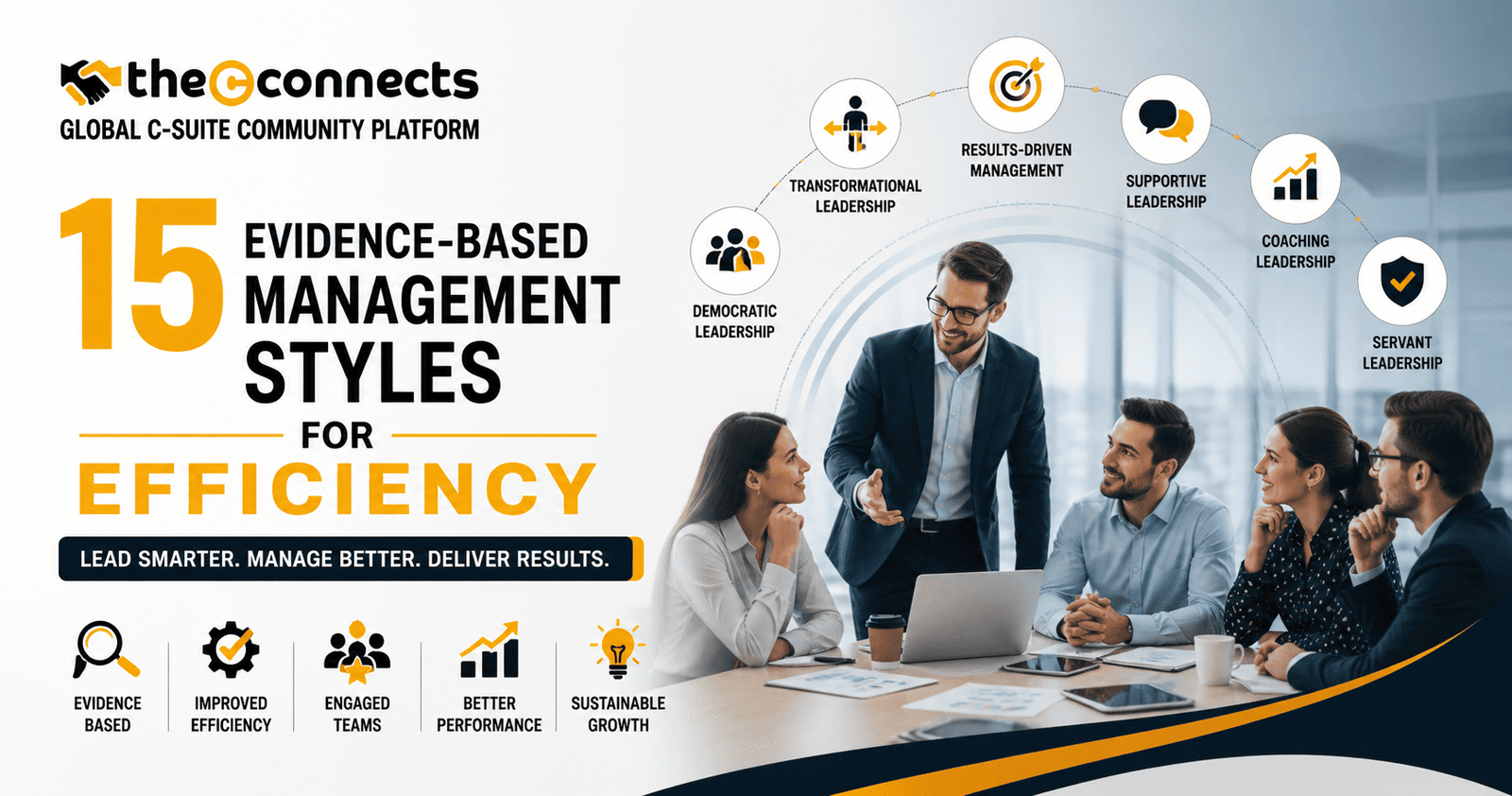
These 15 evidence-based management styles for efficiency are drawn from that body of research, practical, specific, and calibrated to the realities of modern organizations.
1. Democratic Leadership
What it is: A leadership approach that involves team members in decision-making processes, soliciting input, incorporating diverse perspectives, and building decisions on collective intelligence rather than unilateral authority.
Why it works: Research on participatory decision-making consistently finds that decisions made with appropriate team input are better informed, more effectively implemented, and more widely supported than those imposed without consultation. Gallup research on employee voice connects it directly to engagement outcomes.
How to apply it: Distinguish between decisions that genuinely benefit from team input and those that require speed or confidentiality. Use structured consultation for the former, dedicated discussion sessions, anonymous input mechanisms, or collaborative workshops, without creating the expectation that all decisions will be made collectively.
Example: A product strategy team that implemented structured quarterly planning sessions where all team members contributed input on priorities reported stronger alignment during execution and fewer mid-quarter priority disputes.
2. Coaching Leadership
What it is: A leadership style focused on developing team members’ capabilities, through regular one-on-one conversations, targeted feedback, skill-building assignments, and a management orientation toward long-term development alongside short-term performance.
Why it works: HBR research on coaching leadership has documented it as one of the most positively correlated management styles with team climate and performance outcomes. When managers invest in developing people, the compounding returns in capability, engagement, and retention consistently outperform the short-term efficiency of pure task-direction approaches.
How to apply it: Schedule regular one-on-one development conversations that are distinct from status meetings. Use coaching questions, “What would you do?” and “What support would help?”, rather than immediate directive responses to team challenges. Assign stretch assignments that develop specific capabilities.
3. Transformational Leadership
What it is: A leadership approach characterized by articulating and inspiring commitment to a compelling vision, connecting individual work to meaningful purpose, and motivating people to contribute beyond their minimum required performance.
Why it works: Transformational leadership is one of the most extensively researched styles in organizational psychology and consistently shows the strongest correlations with team performance, innovation, and organizational effectiveness. The motivational mechanism, intrinsic motivation through purpose and meaning, produces more durable performance than extrinsic reward alone.
How to apply it: Invest in clear vision articulation, not just organizational goals, but the meaningful purpose that connects work to outcomes that matter. Connect individual team member contributions explicitly to the broader vision in regular communication.
4. Situational Leadership
What it is: The adaptive approach, developed by Hersey and Blanchard, that adjusts leadership style based on the specific competence and commitment level of the individual in relation to the specific task at hand.
Why it works: No single leadership style is optimal for all individuals in all situations. A new employee in an unfamiliar role needs different management than a seasoned expert executing in their area of strength. Situational leadership provides a framework for making this adaptation deliberately rather than accidentally.
How to apply it: Assess each team member’s development level for each significant task area, not as a global rating, but as a task-specific evaluation. Provide higher direction for lower-competence situations, and higher delegation for higher-competence situations.
5. Servant Leadership
What it is: A leadership philosophy that prioritizes the needs, development, and wellbeing of team members, positioning the leader’s role as removing obstacles, providing resources, and enabling team members to perform at their best.
Why it works: Research on servant leadership consistently finds positive associations with team trust, team performance, and organizational citizenship behavior , the discretionary effort that exceeds formal job requirements and significantly affects organizational outcomes.
How to apply it: In every interaction with a team member, ask “What can I do to help you succeed?” and act on the answer. Prioritize removing the organizational obstacles, unclear priorities, inadequate tools, bureaucratic processes, that prevent your team from performing.
6. Results-Oriented Management
What it is: A management approach focused on defining clear, measurable outcomes and holding team members accountable for those outcomes, while providing significant autonomy over how those outcomes are achieved.
Why it works: Results orientation aligns management accountability with the actual business value that work is supposed to create, not activity or effort, but impact. When people are measured on outcomes rather than inputs, they naturally organize their work more efficiently around what actually produces results.
How to apply it: Define success for each role and each project in terms of specific, measurable outcomes. Review and discuss these outcomes regularly rather than reviewing activity. Resist the urge to prescribe how outcomes should be achieved, provide guidance when requested, but default to trusting people to find the most effective path.
7. Delegative Leadership
What it is: A management approach that assigns significant authority and responsibility to team members, trusting their judgment, expertise, and capability to manage significant work with limited oversight.
Why it works: Autonomy is one of the three foundational elements of intrinsic motivation in self-determination theory (Deci and Ryan). Delegation of genuine authority, as opposed to nominal authority, consistently produces higher engagement, stronger ownership, and often better decisions than centralized management.
How to apply it: Genuinely delegate, assigning not just tasks but decision authority and accountability. Avoid the common pattern of delegating task execution while retaining decision authority, which creates workload without empowerment.
8. Participative Management
What it is: A management style that actively involves team members in planning, problem-solving, and process improvement, creating organizational structures where insight flows upward as well as downward.
Why it works: The people doing the work typically have the most specific, current knowledge about what is working and what is not. Participative management taps this knowledge systematically, improving decision quality and creating the ownership commitment that supports effective implementation.
How to apply it: Create regular structured opportunities for team input, retrospectives, improvement workshops, open problem-solving sessions, and demonstrate that input actually influences decisions.
9. Data-Driven Management
What it is: A management approach that grounds decisions, performance assessments, and organizational choices in relevant, current data rather than intuition, tradition, or anecdote.
Why it works: Research on decision quality consistently demonstrates that data-grounded decisions outperform intuition-based decisions in complex organizational environments, particularly for decisions that involve identifying patterns, forecasting outcomes, or evaluating comparative performance.
How to apply it: Identify the three to five metrics that most directly reflect the outcomes your team’s work is supposed to produce. Review them regularly in team discussions. Use them to identify where to focus improvement effort rather than relying on subjective impressions.
10. Agile Management
What it is: A management approach that structures work in short iterative cycles, sprints or equivalent time-boxes, with defined deliverables, regular review, and continuous adaptation based on learning and changing requirements.
Why it works: Agile management reduces the risk of large, late failures by surfacing problems early in short cycles when they are still low-cost to correct. It also improves responsiveness to changing conditions and customer needs, a significant advantage in dynamic markets.
How to apply it: Implement short planning cycles, two to four weeks, with defined deliverables and a structured review at the end of each cycle. Use retrospectives to systematically improve team processes rather than just completing work.
11. Clear-Goals and OKR-Based Management
What it is: A management framework that creates explicit, measurable goals at organizational, team, and individual levels, typically through the Objectives and Key Results (OKR) methodology, and aligns all levels of the organization around shared priorities.
Why it works: Research on goal-setting theory has consistently demonstrated that specific, challenging, measurable goals produce higher performance than vague or easy goals. OKRs operationalize this research into a practical organizational management system.
How to apply it: Define ambitious objectives that inspire direction, paired with specific key results that measure whether the objective has been achieved. Keep the number of OKRs limited, three to five per quarter, and reference them consistently in team communication.
12. Strengths-Based Management
What it is: A management approach that deliberately identifies each team member’s distinctive strengths and organizes work assignments, team composition, and development efforts to maximize time spent working from strength rather than compensating for weakness.
Why it works: Gallup’s strengths research, drawing on data from millions of employees, has found that people working in their areas of strength are more engaged, more productive, and less likely to leave, and that strength-focused management consistently outperforms deficit-focused approaches.
How to apply it: Use structured strengths assessment tools to identify team member strengths. Actively design role assignments to align with strength profiles where operationally feasible. Have explicit conversations with team members about where they feel most capable and energized.
13. Feedback-Rich Management
What it is: A management approach characterized by frequent, specific, and timely feedback, both positive and developmental, delivered in a way that helps people improve continuously rather than only at annual review intervals.
Why it works: Research on learning and performance development consistently demonstrates that frequent, specific feedback accelerates capability development and improves performance quality more effectively than infrequent, general feedback. People who know how they are doing, and specifically what they can improve, improve faster.
How to apply it: Shift feedback from event-based (annual review) to continuous (part of every significant interaction). Develop the skill of specific, behavior-focused feedback, describing what was done and its impact, rather than offering general evaluations.
14. Autonomy-Focused Management
What it is: A deliberate management approach that resists micromanagement, defining outcomes clearly and then trusting people with significant autonomy over how those outcomes are achieved.
Why it works: The research evidence against micromanagement is extensive and consistent. Teams managed through excessive oversight consistently demonstrate lower engagement, lower innovation, and higher attrition than those given appropriate autonomy. The psychological mechanism is straightforward: micromanagement signals distrust, and distrust undermines the intrinsic motivation that produces excellent work.
How to apply it: Make explicit agreements about what outcomes are required and when, then actively practice restraint about how. Reserve direction for genuine situations where capability gaps require it, and transition to autonomy as capability develops.
15. Change-Adaptive Management
What it is: A management style that builds organizational resilience and learning capacity alongside task execution, developing teams’ ability to adapt to changing conditions, adopt new ways of working, and navigate uncertainty without losing operational effectiveness.
Why it works: McKinsey research on organizational agility has found that organizations with high change-adaptive capacity consistently outperform their less adaptive peers during periods of market disruption and organizational transformation. The management behaviors that build adaptive capacity, psychological safety, learning orientation, explicit change communication, are learnable and teachable.
How to apply it: Normalize learning and adaptation in team culture. Explicitly debrief on lessons from both successes and failures. Communicate organizational changes clearly, early, and with honest acknowledgment of uncertainty where it exists.
Conclusion:
The 15 evidence-based management styles for efficiency covered in this guide collectively represent the current research base for what effective management actually looks like in modern organizations. The most important takeaway is not that anyone style is superior, it is that the best leaders develop a full repertoire and the judgment to deploy each approach where it creates the most value.
Contact TheCconnects
If you have insights on leadership, management practices, or team performance that go beyond theory and into real-world impact, this is the platform to share them.
Whether you are a business leader, HR professional, or management expert with practical experience in building high-performing teams, your perspective can add value to a growing audience of decision-makers.
If you would like to contribute your expertise, and publish your article on this platform or any other platform please feel free to reach out to us.
📧 Email: contact@thecconnects.com
📞 Phone: +91 91331 10730
💬 WhatsApp: https://wa.me/919133110730