
Every week, the collective inbox of the business world receives millions of cold outreach emails. A small fraction of them starts conversations. The rest are deleted in under three seconds, not because cold email doesn’t work, but because most cold emails are written with the sender’s agenda in mind rather than the recipient’s genuine interests.
The fundamental reality of B2B cold outreach in 2026 has not changed: relevance converts, and irrelevance is ignored. What has changed is the bar for relevance. Decision-makers are more overwhelmed, more sceptical, and better trained at pattern-recognizing template emails than at any previous point in sales history. The teams that consistently book meetings through cold outreach are those that have invested in understanding who they are writing to, what genuinely matters to that person, and how to communicate value with precision and respect.
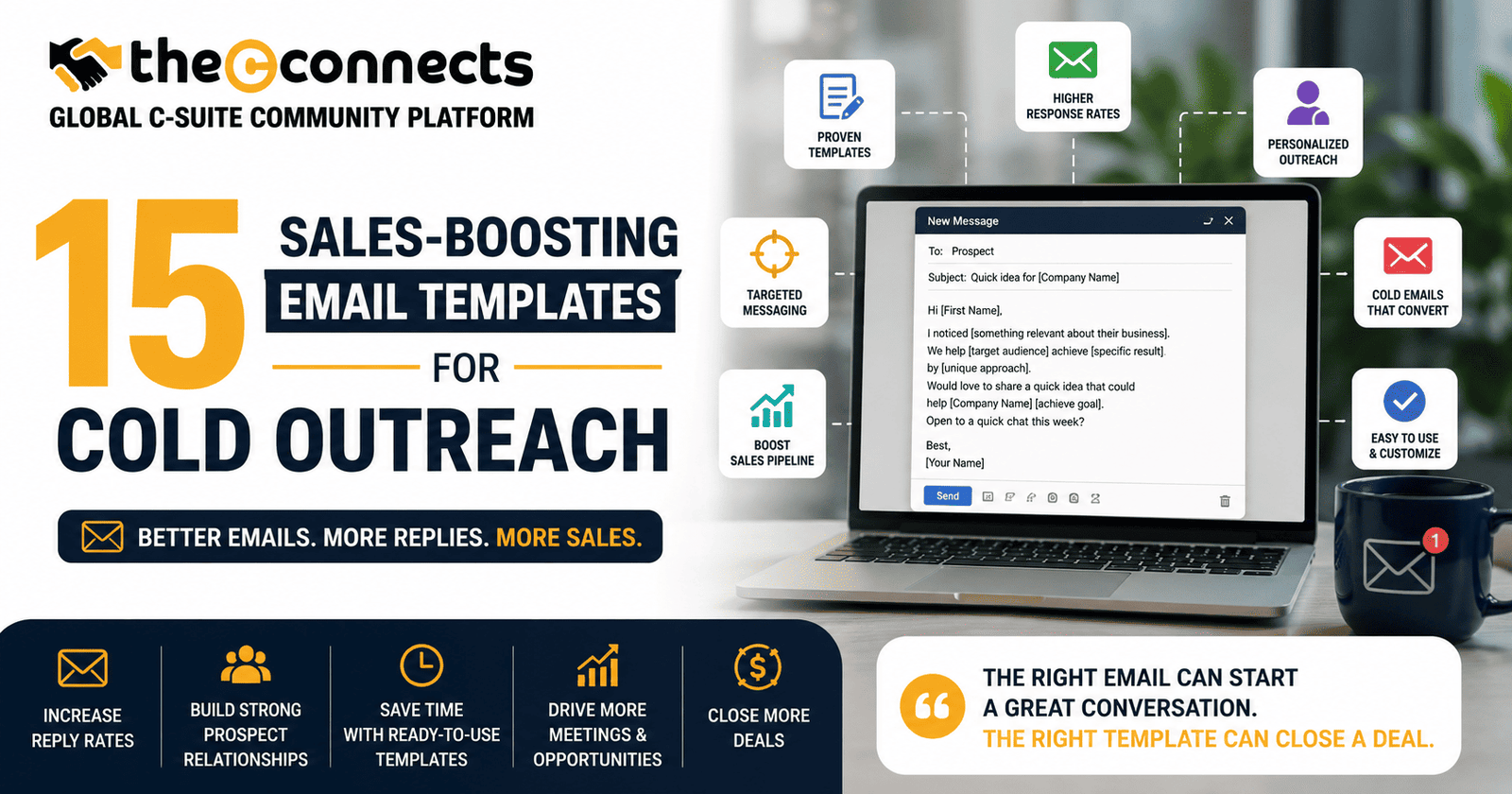
The 15 sales-boosting email templates for cold outreach in this guide are designed with that principle as the foundation, not copy-paste scripts, but frameworks that require genuine personalization to reach their potential.
Template 1: The First-Touch Introduction Email
When to use it: Your very first contact with a prospect who has no prior relationship with you or your company.
Subject line: Quick question about [specific challenge or initiative]
Body:
Hi [First Name],
I came across [specific reference, their content, a recent announcement, or their company’s work] and wanted to reach out.
We help [similar companies / job titles] to [specific outcome, reduce X, improve Y, achieve Z]. Given [specific observation about their situation], I thought this might be relevant timing.
Would it make sense to have a brief 15-minute conversation this week to explore whether there’s a fit?
[Name]
Why it works: It demonstrates research, anchors to a specific outcome, and asks for a small, low-commitment next step.
Personalization tip: Replace every bracket with genuine, researched specifics. “I came across your recent LinkedIn post on X” is infinitely more effective than “I’ve been following your company.”
Mistake to avoid: Starting with a paragraph about your company. The recipient does not care yet. Lead with relevance to them.
Template 2: The Pain-Point Email
When to use it: When you have identified a specific, verifiable challenge that your target prospect is likely experiencing.
Subject line: [Company name], a question about [specific pain]
Body:
Hi [First Name],
[Companies in your space / role] typically run into [specific challenge] when they’re [growth stage / initiative]. It tends to [consequence, cost time, slow revenue, create risk].
We’ve worked with [type of company] to [specific resolution]. In most cases, they see [credible, conservative outcome] within [timeframe].
If this resonates, I’d be happy to share how we approached it. Would 20 minutes make sense this week?
Why it works: Pain-first framing creates immediate relevance. The prospect recognizes their own situation before you have said anything about yourself.
Personalization tip: Verify that the pain is genuinely relevant to this specific prospect’s industry, role, and company stage. Generic pain points reduce credibility.
Template 3: The Value-First Email
When to use it: When you want to lead with something useful rather than a direct sales proposition.
Subject line: [Resource name], might be useful for your work on [X]
Body:
Hi [First Name],
I’ve been researching [their industry/challenge] and put together [brief description of resource, a framework, analysis, or insight] that seems relevant to where [company name] is heading.
Happy to share it, no strings attached. Would that be useful?
Why it works: Value-first outreach builds goodwill and establishes credibility before making any commercial ask. It also naturally identifies interested prospects.
Template 4: The Referral or Mutual Connection Email
When to use it: When you have a genuine mutual connection or can reference a credible source of introduction.
Subject line: [Mutual contact] suggested I reach out
Body:
Hi [First Name],
[Mutual contact’s name] mentioned you as someone worth speaking with regarding [relevant topic]. They thought there might be an interesting connection between what you’re working on and what we do for [similar companies].
I’ll keep this brief, [one sentence on what you do and who you help]. Would a short call make sense?
Why it works: The referral dramatically lowers skepticism. A recipient who trusts the referring contact extends a portion of that trust to you.
Mistake to avoid: Never fabricate or exaggerate the referral relationship. This approach only works, and only works ethically, with a genuine connection.
Template 5: The Follow-Up After No Response
When to use it: Three to five business days after an unreplied first-touch email.
Subject line: RE: [Original subject line]
Body:
Hi [First Name],
Following up on my note from last week, wanted to make sure it hadn’t fallen through the cracks.
[One new piece of value or insight, a relevant article, data point, or case study.] Thought it might add useful context.
Happy to connect if the timing works.
Why it works: The follow-up adds new value rather than simply repeating the ask. Most responses to cold outreach sequences come from follow-ups, not first contacts.
Template 6: The Short Bump Email
When to use it: As a final brief touchpoint before pausing a sequence.
Subject line: Still relevant?
Body:
Hi [First Name],
Just wanted to check, is [specific challenge we discussed] still something on your radar? If not, no worries at all. I’ll stop following up.
Either way, happy to reconnect if timing changes.
Why it works: The explicit offer to stop following up paradoxically generates more replies than another sales-forward email. It signals respect for the prospect’s time and decisions.
Template 7: The Case Study or Social Proof Email
When to use it: When you have a relevant, verifiable success story from a similar company or use case.
Subject line: How [similar company] solved [specific challenge]
Body:
Hi [First Name],
[Similar company name] was dealing with [specific challenge] that I suspect looks familiar in your industry.
They [what they did, in one sentence], and the result was [specific, credible outcome]. I’ve written up the full story if you’d find it useful.
Would it be worth 15 minutes to explore whether something similar could work at [their company]?
Why it works: Proof beats promise. A specific, verifiable result from a similar company is far more persuasive than any benefit claim.
Template 8: The Problem-Solution Email
When to use it: When you can diagnose a specific, observable problem in the prospect’s current approach.
Subject line: Noticed something about [specific area]
Body:
Hi [First Name],
I was looking at [specific observable aspect of their business, website, content, public data] and noticed [specific, genuine observation].
Most [companies in their position] address this by [your approach]. The typical result is [credible outcome].
Worth a conversation?
Personalization tip: The observation must be genuine and specific. Vague observations signal template use and undermine credibility.
Template 9: The Event or Webinar Invitation Email
When to use it: When you are hosting or participating in a relevant industry event, webinar, or round table.
Subject line: [Event name], thought you’d find this relevant
Body:
Hi [First Name],
We’re hosting a [brief description of event] on [date] focused on [specific topic relevant to their role and challenges].
Given your work on [specific relevance], I thought you might find the session on [specific topic] particularly useful.
Happy to reserve a spot for you, registration takes two minutes.
Why it works: Events lower the barrier to engagement compared to a direct sales conversation. They provide genuine value while building a relationship and qualifying interest.
Template 10: The Consultation or Discovery Call Email
When to use it: When you are specifically prospecting for discovery calls with decision-makers.
Subject line: 20 minutes on [specific topic]
Body:
Hi [First Name],
I work with [type of company] leaders on [specific challenge or area]. Most conversations start with a 20-minute call where I share what I’m seeing across the industry and listen to where you’re focused.
There’s no pitch, just a structured conversation that most people find worth the time.
Would Thursday or Friday this week work?
Why it works: Framing the conversation as a peer exchange rather than a sales call reduces the prospect’s resistance to engaging.
Template 11: The Re-Engagement Email
When to use it: When reconnecting with a prospect who engaged previously but went quiet.
Subject line: Checking back in, [relevant trigger or news]
Body:
Hi [First Name],
We connected [timeframe] ago about [original topic]. Since then, [relevant development, industry change, your new capability, their company news].
Thought it might be worth revisiting the conversation given the new context. Would it make sense to reconnect?
Why it works: A genuine trigger for re-engagement demonstrates that you have been paying attention, not just running a sequence.
Template 12: The Competitor Comparison Email
When to use it: When a prospect is known to use a competing solution and there is a credible reason to explore switching.
Subject line: Alternative to [competitor name]?
Body:
Hi [First Name],
I noticed you’re using [competitor] for [function]. Many of our current clients came from similar setups, they moved to us primarily because of [one to two specific differentiators].
If [specific differentiator] matters to your team, a 15-minute comparison might be worth your time. Happy to keep it factual.
Mistake to avoid: Never disparage competitors. The framing should be differentiation, not criticism.
Template 13: The Free Resource or Lead Magnet Email
When to use it: When you have a genuinely useful resource, guide, template, tool, benchmark data, that provides standalone value.
Subject line: Free [resource type] for [their role/challenge]
Body:
Hi [First Name],
We built [resource description] specifically for [their job title/function]. It covers [specific topics] and has been useful for teams working on [specific challenges].
Happy to send it over, no form to fill out. Just reply and I’ll share it directly.
Why it works: The informal, friction-free delivery mechanism signals respect for the prospect’s time and builds goodwill before any commercial conversation.
Template 14: The Trial or Demo Request Email
When to use it: When the prospect has demonstrated some level of prior interest or research.
Subject line: Seeing in the context of [their situation]
Body:
Hi [First Name],
Based on what I know about [their industry/challenge], I think seeing

I’d configure the demo specifically around [relevant use case] so you can evaluate it against your actual needs. Would 30 minutes this week work?
Why it works: Personalized demos consistently outperform generic product walkthroughs. Promising a contextually configured demo communicates both preparation and relevance.
Template 15: The Closing-the-Loop Email
When to use it: After a conversation or previous touchpoint to advance or close a stalled opportunity.
Subject line: Closing the loop on [topic]
Body:
Hi [First Name],
Wanted to close the loop on our conversation about [topic]. If the timing isn’t right, completely understood, I’d rather know than assume.
Is this something that makes sense to revisit in [specific timeframe], or should I check back in [Q3/next quarter]?
Why it works: Direct, respectful, and time-specific. It provides a clear path forward and demonstrates professionalism regardless of outcome.
Conclusion:
The 15 sales-boosting email templates for cold outreach covered in this guide are frameworks for quality outreach, not copy-paste scripts. Their effectiveness depends entirely on the research, personalization, and genuine relevance that you bring to them.
The sales teams that consistently generate pipeline from cold outreach are not those with the best templates, they are those that combine good frameworks with genuine research, clear value propositions, and the discipline to follow up consistently without becoming noise.
Focus on relevance. Invest in research. Respect your prospects’ time. The results compound.
Contact TheCconnects
If you specialize in B2B sales, email marketing, lead generation, SDR strategy, or outbound growth, and want to share actionable insights with a wider business audience, we’d love to hear from you.
Whether you have proven cold email frameworks, sales automation strategies, outreach case studies, or practical lessons from real-world prospecting campaigns, TheCconnects welcomes expert contributions from sales professionals, founders, marketers, and business leaders.
Looking to publish your article, share your expertise, or collaborate with our platform? Reach out to us and become part of the conversation shaping modern sales and business growth.
📧 Email: contact@thecconnects.com
📞 Phone: +91 91331 10730
💬 WhatsApp: https://wa.me/919133110730