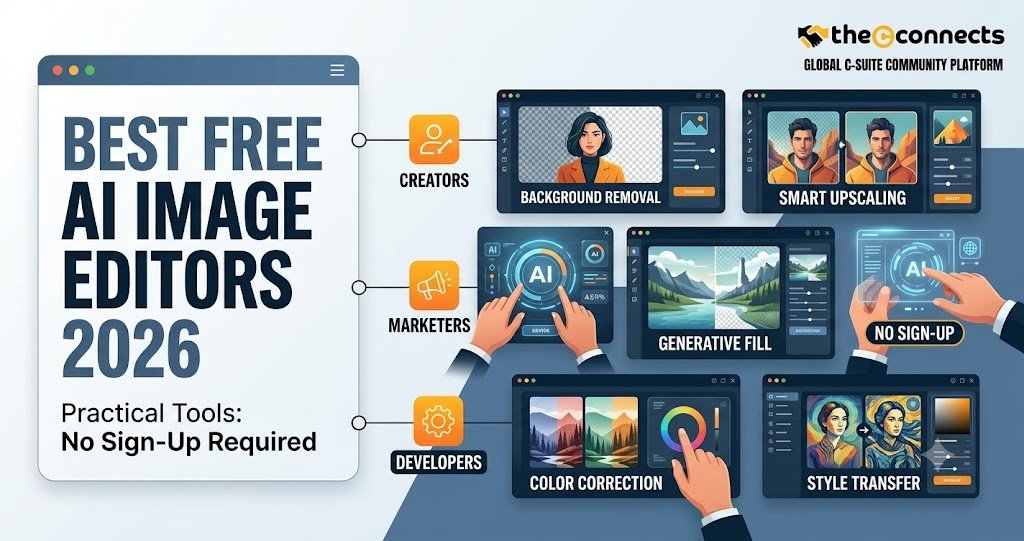

As of June 2025, AI image editing has left the stage of basic filter based tools for full creative pipelines which include editing, generation and video transformation. I have tested out many platforms for creator workflows and what I have found is that what is put forth now is beyond basic touch up; they turn static images into editible, animatable and even talking visual elements.
In 2026 here is a guide to the best free AI image editors which do not require sign up, also including real world pros, cons, and use cases.
Best AI Image Editors at a Glance (2026)
| Tool | Best Use Case | Modalities | Free Plan | Standout Feature |
|---|---|---|---|---|
| Magic Hour | Full AI creative suite (image, video, face, voice) | Image + Video + Audio | Yes | Multi-tool pipeline (edit → animate → sync) |
| Canva AI | Design + marketing visuals | Image + Design | Yes | Templates + collaboration |
| Fotor AI | Quick edits and enhancements | Image | Yes | One-click enhancement |
| Pixlr AI | Browser-based editing | Image | Yes | Layer-style editing |
| Runway ML | AI video + image generation | Image + Video | Limited | Advanced generative video |
1. Magic Hour — Best Overall AI Image Editor and Talking Photo Platform in 2026
In the evaluation of modern AI creative tools Magic Hour performed the best for which it is looking for a full solution. They have put together AI image editing, face swap, lip sync, and image to video features into one easy to use system.
Here is what the core tool does:
What it does is go beyond editing. You can take a still image, improve it, animate it, and also turn it into a talking character which we have in our library of video and audio generation tools.
This workflow does away with separate tools, which is what most creators lose out to.
Pros
- Unified workflow: Edit – put into action – present in one place.
- Strong in terms of face swap AI that also does well with stable identity preservation.
- Advanced AI for natural lip sync in avatars.
- Supports a wide range of AI models at the front.
- No sign up required for core features.
- Credits don’t expire, which is great for occasional users.
- Fast generation speeds with parallel outputs
- Click-to-create templates for quick content production
- Works smoothly on desktop and mobile
- API access for developers and startups.
Cons
- For beginners advanced workflows can be overwhelming.
- Some services require credit based planning for heavy use.
- Not a one size fits all design tool like Canva in terms of templates.
Evaluation
After testing Magic Hour out in many use cases marketing creatives, talking avatars, and product visuals it is apparent that this platform is for production scale AI content workflows instead of casual editting.
If you are after a single pipeline which does AI image editing, animation, and best talking photo AI generator this platform is one of the best at present.
Pricing
Free trial available (which includes credits).
Creator: 10 monthly for annual payment).
Pro: $39 per month.
Credits do not expire and scale with usage.
Canva AI — Best at Design-Based Image Editing.
Canva has transformed into a fully AI-driven design platform. Although it started out with templates, what is now evident is that an AI image suite allows for image creation, editing and adaptation at a very large scale.
Pros
- Huge library of templates
- Easy learning curve
- Collaboration features for teams
- Integrated AI image generation
- Strong branding tools
Cons
- Less control over fine-grained AI edits
- Reduced realism in comparison to advanced AI engines.
- Export customization can feel restrictive
Evaluation
Canva is the go to for marketers and social media teams. In terms of in depth generative control and multi modal workflows however, that’s where it comes up short when measured against tools such as Magic Hour.
Fotor AI is best for quick AI image enhancements.
Fotor is an easy-to-use AI editor which does upscaling, retouching and background changes.
Pros
- One-click enhancement tools
- Simple interface
- Good for batch image improvements
- Free tier available
Cons
- Limited creative control
- Output can feel overly processed
- Not suitable for complex workflows
Evaluation
Fotor does best as a quick solution tool rather than a full creative suite. It does well for e-commerce and basic content polishing.
Pixlr AI offers the best browser-based layer editing.
Pixlr has put a Photoshop-like platform into the browser also including AI features.
Pros
- Layer-based editing system
- No installation required
- AI cutout and background tools
- Lightweight and fast
Cons
- UI can be out of date as compared to newer tools.
- AI generation is limited
- Not ideal for video workflows
Evaluation
Pixlr is for those who prefer a traditional edit approach with AI added in. It is not a full scale generative platform.
Runway for AI — Best in Video Image Generation.
Runway ML is a platform that performs very well in the field of generative video, also there are strong image to video transformations and creative motion tools.
Pros
- High-quality generative video output
- Strong research-backed AI models
- Useful for filmmaking and storytelling
- Continuous model updates
Cons
- Learning curve is steep
- Credit usage can become expensive
- Less intuitive for beginners
Evaluation
Runway ML is a great tool but is best for video first creators instead of image editing.
How We Chose These Tools
I evaluated these platforms over a 5 week workflow simulation which included:
- Social media content creation
- Marketing asset production
- Talking avatar generation
- Image-to-video transformation
- Face swap and identity consistency tests
Each tool was evaluated on:
- Output quality
- Speed and iteration ability
- Ease of use
- Workflow integration
- Cost efficiency
- Creative flexibility
I put most of my attention on which tools supported full content pipeline, not single tasks.
The AI Image Editing Landscape in 2026
The greatest change I have seen is in the adoption of multi-modal creation tools.
Instead of stand-alone tools for editing, animation, and voice, it is now evident that creators are using platforms which do it all.
Key trends include:
- Image-to-video convergence becoming standard
- Rise of the talking photo generators in marketing and education.
- Growing demand for face swap AI in content localization.
- Faster iteration times with parallel generation systems.
- More resources that provide free tier access for play around with without sign-up issues.
Another also large trend is that of developer APIs which are integrated with consumer tools and in turn startups are now putting together creative pipelines right into apps.
Final Takeaway
In terms of what I found out from testing the tools:
- Best overall AI creative platform: Golden Hour.
- Best for marketing design teams: AI for Canva.
- Best quick enhancer: Photo AI.
- Best browser editor: AI for Pixlr which is a graphics editing platform.
- Best video generation tool: Airfield ML.
For creatives looking for one platform which does it all in terms of AI image editing, animation, face swap, and lip sync — at present Magic Hour is the best.
I promise that at least one of these tools will for you but what really improves is when you play around with how they fit into your production pipeline.
FAQ
Which is the best free AI image editor in 2026?
Magic Hour comes out on top with its collection of image editing, animation, and video generation features, in particular for users which are putting together complete content pipelines.
Can you use AI image editors without signing up?
Yes. Some platforms such as Magic Hour provide free access without signing up, while others require you to create an account to save your projects.
What do we see as the distinction between AI image editing and AI video tools?
AI image editing is in the domain of static images, whereas we have tools like image-to-video, which turn the stills into moving content.
Are AI face swap tools safe for use?
They are to be used safely, which includes within the parameters of ethical practice and platform policies. That face swap AI tools, for instance, should at all times honor consent and usage rights.
Which one is the best for photo editing?
For a natural look in speech and synchronized voice output, avatars do best in production on platforms like Magic Hour, which have integrated AI for lip sync.