
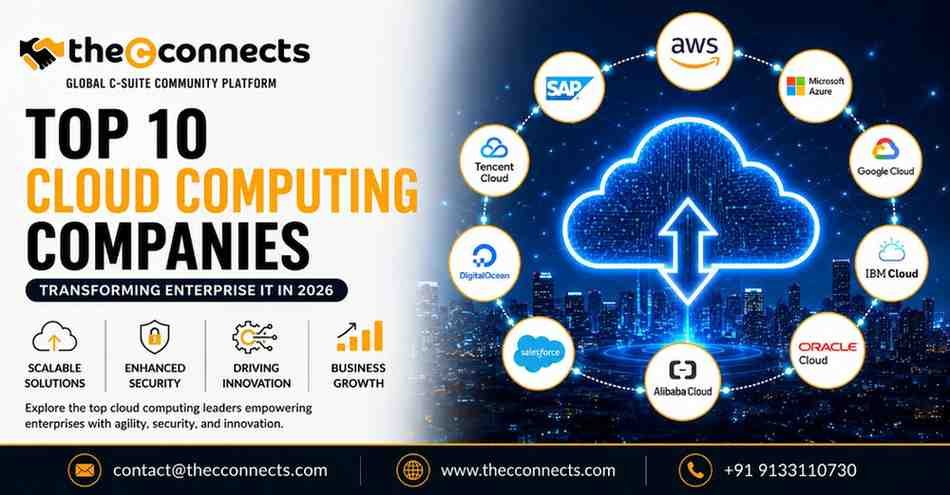

The cloud computing landscape of 2026 has moved beyond the simple “migration” era. Today, the focus has shifted from merely moving workloads to the cloud to architecting resilient, AI-native ecosystems that prioritize data gravity, operational sustainability, and hybrid flexibility. As enterprises integrate Generative AI into their core business logic, the cloud is no longer just a hosting location-it is the indispensable operating infrastructure of the modern digital economy.
In this market analysis, we explore the top 10 players driving this transformation, each offering distinct advantages in AI infrastructure, hybrid cloud management, and data intelligence.
1. Amazon Web Services (AWS)
- Founders: Jeff Bezos
- Founded Year: 2006
- Headquarters: Seattle, Washington, U.S.
- Product Categories: IaaS, PaaS, AI/ML, Serverless Computing, IoT.
- Description: As the pioneer of the modern cloud, AWS remains the global market leader. In 2026, its strategy focuses heavily on democratizing Generative AI through Amazon Bedrock and custom silicon like Trainium. AWS provides the most expansive global footprint, making it the default choice for enterprises requiring unmatched scale and a vast ecosystem of third-party integrations. It is the backbone for companies that need a “full-stack” cloud experience, ranging from raw infrastructure to high-level managed AI services.
- Key Features:
- Largest global network of data centers.
- Advanced AI/ML toolsets via Amazon Q and Bedrock.
- Comprehensive serverless computing options.
- Mature ecosystem with 200+ fully-featured services.
- Robust pay-as-you-go economic model.
2. Microsoft Azure
- Founders: Bill Gates, Paul Allen
- Founded Year: 2010 (Launch of Windows Azure)
- Headquarters: Redmond, Washington, U.S.
- Product Categories: Hybrid Cloud, Enterprise SaaS, AI/ML, Identity & Security.
- Description: Azure’s 2026 dominance is anchored in its seamless integration with the Microsoft ecosystem-Teams, Office 365, and Dynamics 365. Its partnership with OpenAI has positioned Azure as the premier destination for enterprises deploying Large Language Models (LLMs) at scale. With a focus on “enterprise-ready AI,” Azure provides the compliance frameworks and hybrid capabilities that legacy firms require to transition securely to AI-native workflows.
- Key Features:
- Deep integration with enterprise Microsoft software.
- Leading-edge OpenAI Service for private LLM deployment.
- Best-in-class hybrid and multi-cloud management.
- Enterprise-grade identity and access governance.
- Global availability with stringent compliance controls.
3. Google Cloud Platform (GCP)
- Founders: Google (Alphabet Inc.)
- Founded Year: 2008
- Headquarters: Mountain View, California, U.S.
- Product Categories: Data Analytics, AI/ML, Cloud-native Infrastructure.
- Description: Google Cloud has carved out a unique position as the “data-first” cloud. Its strength lies in its ability to pipeline massive datasets into production AI. With Gemini fully woven into the GCP fabric, it offers unmatched performance for developers building data-intensive applications. Enterprises migrating from on-premise data warehouses to modern, AI-driven environments find Google Cloud’s high-performance networking and analytics suite to be the most innovative in the market.
- Key Features:
- Industry-leading BigQuery and data analytics tools.
- Seamless Gemini AI integration across services.
- High-performance global fiber network.
- Advanced Kubernetes and containerization expertise.
- Focus on sustainable, carbon-efficient computing.
4. IBM Cloud
- Founders: Charles Ranlett Flint (as Computing-Tabulating-Recording Company)
- Founded Year: 1911 (IBM), Cloud division evolved later
- Headquarters: Armonk, New York, U.S.
- Product Categories: Hybrid Cloud, Quantum Computing, AI (Watsonx), Mainframe Modernization.
- Description: IBM Cloud is the trusted steward for highly regulated industries like finance, healthcare, and government. By focusing on hybrid cloud and the Watsonx AI platform, IBM allows organizations to keep sensitive data in private, highly secure environments while utilizing the agility of the public cloud. It is the go-to for companies that cannot afford the risks associated with public-only infrastructure and need expert-level support for legacy system modernization.
- Key Features:
- Strong focus on hybrid and multi-cloud security.
- Watsonx platform for enterprise-ready, ethical AI.
- Industry-specific compliance clouds (Finance/Health).
- Integration of mainframe reliability with cloud agility.
- Leadership in emerging quantum computing cloud services.
5. Oracle Cloud Infrastructure (OCI)
- Founders: Larry Ellison, Bob Miner, Ed Oates
- Founded Year: 2016 (Current OCI generation)
- Headquarters: Austin, Texas, U.S.
- Product Categories: Database Cloud, Enterprise Apps, HPC.
- Description: OCI has emerged as the high-performance powerhouse for database-centric workloads. By re-architecting for low-latency, high-bandwidth needs, Oracle provides a cloud environment that is exceptionally cost-effective for large-scale enterprise databases. Organizations that rely on Oracle’s deep stack of enterprise applications find OCI to be the most “frictionless” migration path, often offering superior price-to-performance ratios compared to the larger hyperscalers.
- Key Features:
- Autonomous database management and self-patching.
- High-performance computing (HPC) capabilities.
- Consistent, low-latency performance across regions.
- Excellent cost-performance for mission-critical apps.
- Multi-cloud database services (interoperability with Azure).
6. Salesforce
- Founders: Marc Benioff, Parker Harris
- Founded Year: 1999
- Headquarters: San Francisco, California, U.S.
- Product Categories: SaaS, CRM, Customer Data Platforms (CDP).
- Description: Salesforce redefined enterprise software by proving that SaaS could be the foundation for an entire business. In 2026, its Einstein AI layer acts as the “brain” of the customer experience, automating sales cycles, marketing personalization, and service resolution. It remains the most widely adopted platform for B2B enterprises looking to unify their customer data into a single, actionable source of truth.
- Key Features:
- World-leading CRM platform integration.
- Einstein AI for automated sales and service insights.
- Robust AppExchange ecosystem (7,000+ apps).
- Unified customer data platform (CDP).
- Scalable low-code development environment.
7. HPE GreenLake
- Founders: Bill Hewlett, David Packard
- Founded Year: 2017 (Launch of GreenLake as-a-service)
- Headquarters: Spring, Texas, U.S.
- Product Categories: Edge-to-Cloud, Private Cloud, Infrastructure-as-a-Service (IaaS).
- Description: HPE GreenLake is the standard-bearer for organizations that want the “cloud experience” without the latency or data sovereignty issues of public cloud providers. It brings the cloud to the data center, allowing enterprises to manage on-premise hardware with a pay-per-use, cloud-like consumption model. It is perfect for organizations that need rigorous control over their hardware while demanding the agility of software-defined infrastructure.
- Key Features:
- True cloud-like consumption of on-prem resources.
- Superior data governance and sovereignty.
- Excellent for edge computing workloads.
- Unified dashboard for hybrid-cloud visibility.
- Predictable, usage-based cost modeling.
8. ServiceNow
- Founders: Fred Luddy
- Founded Year: 2004
- Headquarters: Santa Clara, California, U.S.
- Product Categories: Enterprise Automation, Workflow Management.
- Description: ServiceNow functions as the “platform of platforms” for the enterprise. It automates fragmented workflows across IT, HR, and customer service. In 2026, it is the primary engine enterprises use to connect their various cloud silos, ensuring that tasks move efficiently between legacy systems and modern cloud environments. It provides the automation intelligence needed to keep complex, multi-cloud enterprises from descending into operational chaos.
- Key Features:
- Unified cross-departmental workflow automation.
- Extensive IT Service Management (ITSM) capabilities.
- Generative AI for incident response and self-service.
- Low-code development tools for internal apps.
- Deep integration with major hyperscalers.
9. Dell Technologies
- Founders: Michael Dell
- Founded Year: 1984
- Headquarters: Round Rock, Texas, U.S.
- Product Categories: Hybrid Cloud, Data Storage, Private Cloud Infrastructure.
- Description: Dell has transformed its hardware dominance into a software-defined cloud offering. Focused on the “multi-cloud-by-design” movement, Dell provides the hardware agility that allows companies to remain vendor-agnostic. Their private cloud solutions are specifically optimized for everyday operations, allowing enterprises to easily decommission and replace infrastructure without getting locked into a single proprietary cloud provider.
- Key Features:
- Vendor-agnostic private cloud ecosystems.
- Intelligent lifecycle management for hardware.
- Zero-touch automated deployment processes.
- Optimized for everyday enterprise operations.
- Excellent support for multi-cloud data portability.
10. Red Hat (IBM Subsidiary)
- Founders: Bob Young, Marc Ewing
- Founded Year: 1993
- Headquarters: Raleigh, North Carolina, U.S.
- Product Categories: Hybrid Cloud, OpenShift (Kubernetes), Linux/Infrastructure.
- Description: Red Hat is the foundation of the open-source cloud. Through its OpenShift platform, it provides the common abstraction layer that allows workloads to run consistently across any environment-be it AWS, Azure, GCP, or on-premise. In 2026, Red Hat is the essential partner for any enterprise seeking to avoid cloud lock-in and maintain complete control over their deployment and security stack through open standards.
- Key Features:
- Industry-standard OpenShift/Kubernetes management.
- Complete vendor-neutral portability.
- Enterprise-grade open-source security.
- Granular control over hybrid-cloud environments.
- Extensive support for developer-friendly tools.
Reach Out to Us
If you have feedback, updated information, or believe your company is eligible to be featured in our upcoming industry insights, we would love to hear from you!
📧 Email us: contact@thecconnects.com
📞 Call us: +91 9133110730
💬 WhatsApp us: https://wa.me/919133110730


