

The enterprise perimeter has completely dissolved. As we cross the midpoint of 2026, the global threat landscape is no longer dominated by isolated malware or predictable software vulnerabilities. Instead, organizations face highly sophisticated, interconnected risks: autonomous Agentic AI systems acting as malicious swarm attackers, deepfake-driven identity deception, and cascading supply-chain exploits.
According to recent market intelligence, machine identities now drastically outnumber human users, transforming Identity Threat Detection and Response (ITDR) and Web Application and API Protection (WAAP) into the primary battlegrounds for Chief Information Security Officers (CISOs). Security operations are shifting away from rigid, manual rules toward continuous threat exposure management (CTEM) and autonomous defense mechanisms.
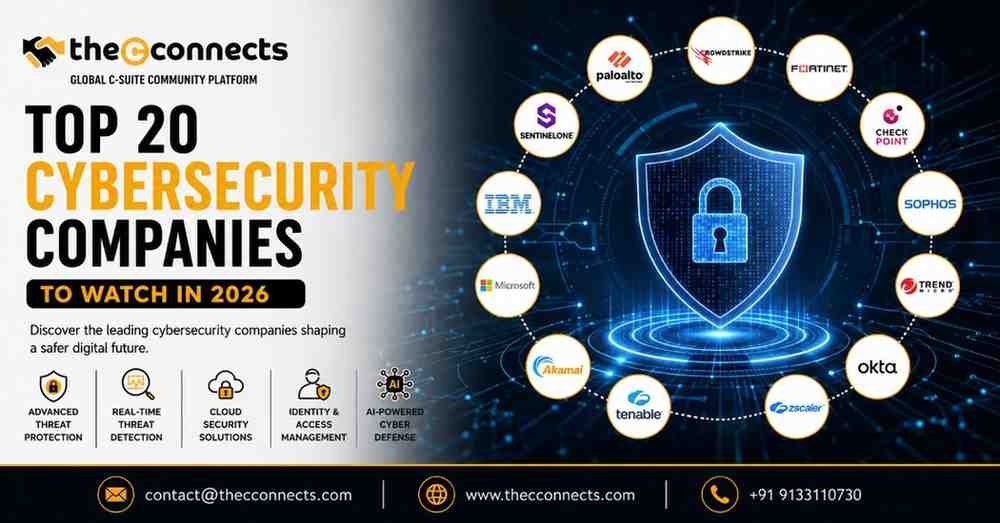
To help enterprise leaders navigate this hyper-dynamic market, we have conducted an extensive analysis of the industry’s most critical innovators. Here are the Top 20 Cybersecurity Companies to Watch in 2026, capturing the market leaders and pioneering startups defining the next era of digital resilience.
1. Palo Alto Networks
- Founders: Nir Zuk
- Founded Year: 2005
- Headquarters: Santa Clara, California, USA
- Product Categories: Network Security, Cloud Security (Prisma), SASE, AI-Driven Security Operations (Cortex), AI Security Posture Management (Prisma AIRS)
- Company Description: Palo Alto Networks remains an undisputed titan of the cybersecurity industry by aggressively modernizing its portfolio for the AI age. Its groundbreaking Prisma AIRS 3.0 platform leads the industry in discovering, auditing, and governing autonomous AI agent actions within enterprise infrastructure. By consolidating network protection, advanced firewalls, and cloud security into unified platforms, they allow large enterprises to replace disparate legacy tools with a cohesive, automated defense layer.
- Key Features:
- Prisma AIRS 3.0: Provides real-time visibility and governance over complex AI and agentic software workflows.
- AI Agent Gateway: Monitors and secures inline, automated agent-to-agent communications.
- Precision AI Technology: Embeds advanced machine learning across all endpoint and network infrastructure to stop zero-day exploits.
- Comprehensive SASE: Fuses software-defined wide area networking (SD-WAN) with cloud-delivered security.
- Cortex XSIAM: Accelerates modern Security Operations Centers (SOCs) through autonomous data stitching and alert triage.
2. CrowdStrike
- Founders: George Kurtz, Dmitri Alperovitch
- Founded Year: 2011
- Headquarters: Austin, Texas, USA
- Product Categories: Endpoint Security, Threat Intelligence, Managed Detection & Response (MDR), AI Detection & Response (AIDR)
- Company Description: Famous for its cloud-native architecture, CrowdStrike continues to set the benchmark for modern endpoint defense via its ubiquitous Falcon platform. Recognizing the unique threat landscape of 2026, the company recently rolled out Falcon AIDR (AI Detection and Response) to secure AI prompt interactions and mitigate model poisoning risks. CrowdStrike’s heavy reliance on real-time threat intelligence allows organizations to counter “malware-light” identity-heavy intrusions rapidly before attackers can pivot laterally through cloud infrastructure.
- Key Features:
- Falcon AIDR Platform: Protects large language models and enterprise AI agents from prompt injection attacks.
- Single-Agent Architecture: Delivers light, cloud-native endpoint protection without disrupting system performance.
- Identity Threat Detection (ITDR): Blocks stolen credential abuse and lateral movement across local and cloud directories.
- Falcon Horizon: Maps real-time cloud security posture management (CSPM) to eliminate infrastructure gaps.
- Automated Threat Hunting: Continuously scours endpoints using predictive AI algorithms to uncover living-off-the-land techniques.
3. Armadin
- Founders: Kevin Mandia
- Founded Year: 2025
- Headquarters: Reston, Virginia, USA
- Product Categories: Autonomous Breach & Attack Simulation (BAS), Offensive AI Security, Security Validation
- Company Description: Led by Mandiant founder Kevin Mandia, Armadin is one of the most heavily backed and closely watched startups of 2026. The firm solves a critical enterprise pain point: determining what assets are actually vulnerable before a real attack occurs. Armadin’s unique platform deploys an autonomous agentic attacker swarm that models how advanced persistent threats (APTs) plan, reason, and exploit modern defenses. This gives boardrooms and tech leaders decision-grade proof of their actual security exposures.
- Key Features:
- Agentic Attacker Swarm: Simulates real-time, evolving AI attacks against corporate infrastructure.
- Continuous Exposure Validation: Replaces periodic penetration testing with continuous, non-disruptive validation.
- Board-Level Risk Metrics: Translates deep technical exploit vectors into quantifiable business risk data.
- Dynamic Playbook Generation: Automatically builds defensive blueprints based on successful simulation paths.
- Multi-Cloud Vector Analysis: Tests complex, interconnected environments for identity and configuration flaws.
4. Okta
- Founders: Todd McKinnon, Frederic Kerrest
- Founded Year: 2009
- Headquarters: San Francisco, California, USA
- Product Categories: Identity & Access Management (IAM), Customer Identity (CIAM), Identity Governance, Non-Human Identity Security
- Company Description: In 2026, identity has officially become the new security perimeter. Okta has successfully adapted from basic single sign-on (SSO) workflows to securing a mixed workforce of humans and AI agents. By integrating advanced machine identity governance into its core platform, Okta prevents malicious actors from spoofing automated user behaviors or hijacking API access tokens, keeping modern enterprises secure amidst unprecedented workforce decentralization.
- Key Features:
- Agentic-AI Identity Management: Governs and assigns verifiable identities to automated internal AI agents.
- Phishing-Resistant MFA: Deploys universal FIDO2 and passkey authentication across complex systems.
- Identity Threat Detection & Response (ITDR): Catches out-of-pattern credential usage in real time.
- Automated Lifecycle Management: Instantly provisions or revokes administrative rights based on user context.
- Universal Directory: Unifies workforce and API service credentials into a single pane of glass.
5. 7AI
- Founders: Lior Div
- Founded Year: 2024
- Headquarters: Boston, Massachusetts, USA
- Product Categories: Agentic AI SOC Platforms, Autonomous Threat Hunting, Next-Gen SIEM/SOAR
- Company Description: Co-founded by Cybereason alumnus Lior Div, 7AI has shaken up the market with its substantial Series A backing and ambitious product vision. The company provides a complete agentic AI platform for the Security Operations Center, acting as a comprehensive operating system for overworked analyst teams. Instead of merely aggregating data like legacy SIEM tools, 7AI’s platform leverages autonomous AI agents to run investigations, map complex attack root causes, and execute remediation actions at machine speeds.
- Key Features:
- Agentic SOC Operating System: Unifies event logs, automation playbooks, and threat context under an AI architecture.
- Autonomous Incident Investigation: Reconstructs full attack timelines without requiring manual query creation.
- Predictive Threat Hunting: Proactively queries internal environments for signs of active compromise.
- Natural Language Remediation: Allows analysts to isolate systems and revoke access tokens via conversational commands.
- Zero-Overload Alert Triage: Filters out false positives autonomously so analysts focus only on valid risks.
6. Zscaler
- Founders: Jay Chaudhry, K. Kailash
- Founded Year: 2007
- Headquarters: San Jose, California, USA
- Product Categories: Secure Access Service Edge (SASE), Zero Trust Network Access (ZTNA), Data Loss Prevention (DLP)
- Company Description: Zscaler remains an industry bellwether for zero-trust architectures, driving the wholesale retirement of legacy corporate VPNs. Its proprietary Zero Trust Exchange platform acts as an intelligent switchboard, securely linking users, devices, and workloads over any network. In 2026, Zscaler is heavily focused on data protection, safeguarding business-critical data from leaking into public AI tools while maintaining high-speed connections for a globally distributed workforce.
- Key Features:
- Zero Trust Exchange: Connects users directly to applications rather than networks, eliminating lateral threat movement.
- AI-Powered DLP: Automatically detects and halts sensitive corporate data transfers to unauthorized SaaS tools.
- Secure Access Service Edge (SASE): Combines comprehensive web gateways with cloud-native access control.
- Sandboxing Tech: Isolates and executes suspicious payloads safely away from the network infrastructure.
- Workload Segmentation: Prevents server-to-server compromises across public and private cloud fabrics.
7. Arctic Wolf
- Founders: Brian NeSmith, Kim Cameron
- Founded Year: 2012
- Headquarters: Eden Prairie, Minnesota, USA
- Product Categories: Managed Detection & Response (MDR), Managed Risk, Cloud Detection, Agentic SOC Services
- Company Description: Arctic Wolf has disrupted the managed services ecosystem with the launch of its Aurora Agentic SOC. Built on top of their Superintelligence Platform, it blends an advanced security knowledge graph with interactive AI agents to handle high-volume alert validation. By combining cutting-edge technology with dedicated human expertise, Arctic Wolf delivers enterprise-grade security monitoring to mid-market organizations lacking large internal cybersecurity teams.
- Key Features:
- Aurora Agentic SOC: Drastically cuts down event noise and false alarms via automated AI verification.
- Managed Detection and Response: Delivers continuous, around-the-clock infrastructure monitoring and triage.
- Arctic Wolf Risk Dashboard: Constantly maps internal exposures and unpatched vulnerabilities.
- Incident Response Guarantee: Pairs technology with proactive support during active breach remediation.
- Cloud Infrastructure Monitoring: Collects and interprets data logs across AWS, Azure, and Google Cloud environments.
8. Cloudflare
- Founders: Matthew Prince, Michelle Zatlyn, Lee Holloway
- Founded Year: 2009
- Headquarters: San Francisco, California, USA
- Product Categories: Web Application & API Protection (WAAP), DDoS Mitigation, Edge Security, Cloudflare Mesh
- Company Description: Operating one of the world’s largest global edge networks, Cloudflare has expanded far beyond simple content delivery into a strategic security pillar. Its 2026 debut of Cloudflare Mesh offers organizations a highly secure, private networking framework specifically engineered to protect AI agent traffic. By blocking malicious bot traffic and neutralizing DDoS attacks at the edge, Cloudflare ensures that enterprise websites and modern APIs stay available and resilient.
- Key Features:
- Cloudflare Mesh Architecture: Delivers granular, private network access policies tailored for AI models.
- Advanced WAAP Platform: Combines bot mitigation, API protection, and web application firewalls into a single platform.
- Global DDoS Protection: Uses automated edge intelligence to drop multi-gigabit attacks instantly.
- Zero Trust Browsing: Safely isolates browser sessions to protect endpoints from web-borne exploits.
- API Discovery Engine: Maps hidden or unmanaged APIs to stop unauthorized data leakage.
9. Dropzone AI
- Founders: Edward Wu
- Founded Year: 2023
- Headquarters: Seattle, Washington, USA
- Product Categories: Autonomous AI Analysts, SOC Automation, Alert Investigation
- Company Description: Dropzone AI tackles tier-one analyst burnout by offering a software-only, fully automated AI SOC analyst platform. Unlike traditional orchestration tools that rely on manual script configuration, Dropzone leverages purpose-built AI agents to mimic the reasoning of expert tier-1 and tier-2 human security analysts. It connects directly with existing security stacks, autonomously investigating every alert to provide security teams with fully documented, high-fidelity findings.
- Key Features:
- Autonomous SOC Analyst: Investigates, cross-references, and closes out standard security alerts without human intervention.
- Software-Only Model: Scales infinitely during major security incidents without requiring extra personnel.
- Cross-Tool Signal Correlation: Connects data points across endpoints, emails, and networks to unearth threats.
- End-to-End Audit Logs: Explains the reasoning behind every automated investigation step for complete transparency.
- Fast Integration: Plugs smoothly into existing SIEM, EDR, and email security environments via standard APIs.
10. Fortinet
- Founders: Ken Xie, Michael Xie
- Founded Year: 2000
- Headquarters: Sunnyvale, California, USA
- Product Categories: Network Security, Next-Generation Firewalls (NGFW), Secure SD-WAN, OT/ICS Security
- Company Description: Fortinet remains a fundamental building block of enterprise IT security through its unified Security Fabric. While renowned for its high-performance FortiGate firewalls, the company has successfully expanded its footprint into operational technology (OT) and industrial control systems (ICS). Fortinet uses purpose-built security processing units (ASICs) to process immense data volumes, making it the preferred vendor for hybrid networks, manufacturing firms, and critical national infrastructure.
- Key Features:
- Fortinet Security Fabric: Delivers holistic visibility across endpoints, clouds, and local networks.
- Next-Gen Firewalls (NGFW): Provides fast, hardware-accelerated deep packet inspection.
- Secure SD-WAN: Integrates enterprise routing capabilities with native network security.
- Operational Technology Protection: Safeguards specialized industrial equipment and IoT devices.
- FortiGuard Labs: Delivers automated, real-time threat intelligence feeds to every connected system.
11. Netskope
- Founders: Sanjay Beri, Lebin Cheng, Ravi Ithal, Krishna Narayanaswamy
- Founded Year: 2012
- Headquarters: Santa Clara, California, USA
- Product Categories: Security Service Edge (SSE), Cloud Access Security Broker (CASB), Netskope One AI Security
- Company Description: Netskope is a market leader in cloud and data security, steering companies toward secure cloud adoption. Its unified Netskope One platform houses their new AI Security suite, featuring the Netskope One Agentic Broker. This tool allows security leaders to monitor, log, and control user and system transactions with both approved and unapproved generative AI models, ensuring that data privacy boundaries remain intact.
- Key Features:
- Netskope One Agentic Broker: Offers total visibility over corporate transactions with external machine-learning applications.
- Cloud Access Security Broker (CASB): Secures data across thousands of external SaaS applications.
- Zero Trust Engine: Checks device health, user context, and data risk levels before granting system access.
- High-Speed Global Edge: Routes internet traffic through a private network to avoid security latency.
- Private Application Access (ZTNA): Replaces legacy inbound corporate gateways to prevent server exposure.
12. Microsoft Security
- Founders: Bill Gates, Paul Allen
- Founded Year: 1975
- Headquarters: Redmond, Washington, USA
- Product Categories: Cloud Security, XDR (Defender), SIEM (Sentinel), Identity Security (Entra), Security Copilot
- Company Description: Leveraging its dominant footprint in the enterprise software ecosystem, Microsoft Security delivers one of the most comprehensive cloud security frameworks available today. Combining Microsoft Defender, Sentinel, and Entra, the company uses global signals from trillions of daily data points to feed its generative AI defense layers. It is highly valued by enterprises looking for out-of-the-box integration across hybrid cloud and traditional Windows environments.
- Key Features:
- Microsoft Copilot for Security: Uses natural language to assist security teams with fast incident triage and report generation.
- Microsoft Entra Suite: Combines conditional access, identity governance, and machine identity verification.
- Microsoft Defender XDR: Unifies security signals across email, endpoints, and cloud infrastructures.
- Microsoft Sentinel: Offers a cloud-native SIEM built for massive data collection and analysis.
- Azure Cloud Defensive Tools: Automates configuration compliance and workload protection within Azure.
13. Noma Security
- Founders: Niv Braun
- Founded Year: 2023
- Headquarters: Tel Aviv, Israel
- Product Categories: AI Security Posture Management (AI-SPM), AI Lifecycle Security, Application Security
- Company Description: Noma Security has emerged as an essential player in securing the modern software development lifecycle. As developers rapidly integrate AI models and external data pipelines into their production apps, Noma provides a unified AI agent security platform. It continuously maps where AI models and autonomous data agents live, analyzes what files and source code repositories they can touch, and surfaces runtime vulnerabilities before code is deployed.
- Key Features:
- Continuous AI Asset Discovery: Builds an automated inventory of all internal corporate AI models and data agents.
- AI-SPM Risk Prioritization: Ranks AI vulnerabilities based on potential enterprise data impact.
- Runtime Attack Mitigation: Halts active adversarial attacks targeting active AI applications.
- Data Lineage Tracking: Monitors sensitive information to verify it isn’t used in unauthorized model training.
- DevSecOps Pipeline Checks: Prevents vulnerable or poisoned open-source models from entering production.
14. Guardz
- Founders: Dor Eisner
- Founded Year: 2022
- Headquarters: Tel Aviv, Israel
- Product Categories: Unified SMB Security, Managed Service Provider (MSP) Security Hubs, Multi-Tenant Cybersecurity
- Company Description: While many vendors target large enterprises, Guardz has built a business model around Managed Service Providers (MSPs) catering to Small and Medium-Sized Businesses (SMBs). Guardz simplifies security by combining point solutions-like email filtering, endpoint monitoring, identity protection, and cloud backups-into a single multi-tenant dashboard. This allows small IT teams to offer robust, automated protection to small businesses facing enterprise-grade threats.
- Key Features:
- Unified Multi-Tenant Platform: Built for MSPs to oversee dozens of small business networks simultaneously.
- Integrated Correlation Engine: Combines anomalies across emails, devices, and clouds to discover breaches faster.
- Automated Email Phishing Defense: Catches malicious links and deepfake scams before they hit the inbox.
- Simplified Device Management: Pushes security updates and monitors posture across Windows and macOS endpoints.
- SMB Compliance Maps: Generates automated reports to satisfy local cyber insurance and compliance demands.
15. Cisco Security
- Founders: Leonard Bosack, Sandy Lerner
- Founded Year: 1984
- Headquarters: San Jose, California, USA
- Product Categories: Network Security, Secure Access, Extended Detection & Response (XDR), Threat Intelligence (Talos)
- Company Description: Cisco Security uses its deep roots in global networking hardware to bake zero-trust access control directly into corporate network fabric. Backed by Cisco Talos, one of the world’s largest commercial threat intelligence groups, Cisco analyzes massive volumes of telemetry data to identify and block exploits before they scale. Their current portfolio focuses heavily on zero-trust architectures and simplified XDR setups for large, complex multinational networks.
- Key Features:
- Cisco Talos Intelligence: Feeds predictive security and global threat data to all active Cisco deployments.
- Unified Cisco XDR Platform: Correlates disparate network and endpoint alerts to focus on high-priority threats.
- Zero Trust Architecture: Verifies user device posture and identity at every network connection point.
- Secure Access Suite: Simplifies hybrid employee logins while enforcing strict security rules.
- Cloud Application Security: Secures cloud-native microservices and internal API communication paths.
16. CybExer Technologies
- Founders: Lauri Almann
- Founded Year: 2016
- Headquarters: Tallinn, Estonia
- Product Categories: Cyber Range Platforms, AI Defense Testing, Situational Awareness Simulations
- Company Description: CybExer Technologies has earned international recognition, including the NATO Defence Innovation Award, for its advanced Cyber Range platforms. Working alongside global governments, military branches, and large critical enterprises, CybExer creates highly realistic digital twins of enterprise networks. These simulated environments are used to stress-test defensive setups, run real-time red-versus-blue team exercises, and evaluate how security personnel respond to complex AI-driven attacks.
- Key Features:
- Advanced Cyber Range Platform: Simulates complex, hyper-realistic network topologies for incident rehearsals.
- Space Cyber Range Solutions: Developed alongside the European Space Agency to test satellite and orbital asset security.
- AI-Warfare Simulations: Tests how human operators interact with and respond to autonomous network attack chains.
- Real-Time Visualization: Generates visual graphs charting the speed and spread of an active digital exploit.
- Automated Skills Assessment: Tracks and scores security analyst incident response times and mitigation choices.
17. Check Point Software Technologies
- Founders: Gil Shwed, Marius Nacht, Shlomo Kramer
- Founded Year: 1993
- Headquarters: Tel Aviv, Israel
- Product Categories: Network Security, Cloud Security, Threat Prevention (Infinity Platform), Mobile Security
- Company Description: Check Point has long championed a prevention-first model, arguing that resolving a breach after the fact is always costlier than blocking it at the doorstep. Its Infinity Platform delivers collaborative AI threat prevention across corporate networks, mobile devices, IoT equipment, and hybrid cloud setups. Check Point’s centralized dashboard makes it popular among security administrators who need to manage global firewall rules and data compliance policies from a single screen.
- Key Features:
- Infinity AI Threat Prevention: Uses shared intelligence engines to stop zero-day attacks before they can execute.
- Unified Management Console: Controls network, cloud, endpoint, and remote user security via a single interface.
- CloudGuard Platform: Automates security posture management and cloud workload defense across multi-cloud infrastructure.
- Harmony Mobile Security: Shields distributed remote employee phones and tablets from malicious app downloads.
- Quantum Security Gateways: Delivers high-speed firewall throughput designed to handle heavy enterprise traffic.
18. IBM Security
- Founders: Charles Ranlett Flint (IBM Corp.)
- Founded Year: 1911 (Security Division expanded via key acquisitions like Resilient)
- Headquarters: Cambridge, Massachusetts, USA
- Product Categories: Enterprise Risk Management, AI-Driven Security, X-Force Threat Intelligence, Cyber Range Facilities
- Company Description: IBM Security pairs enterprise-grade technology with a deep bench of risk advisory and consulting services. Backed by their X-Force Threat Intelligence team, IBM helps highly regulated sectors-like banking, healthcare, and energy-reconstruct their security perimeters for modern compliance needs. The company operates full-scale interactive Cyber Range facilities worldwide, allowing executive teams to rehearse responses to major supply-chain crises or large-scale ransomware events.
- Key Features:
- X-Force Threat Intelligence: Provides deep advisory services and early identification of global exploit patterns.
- Immersive Cyber Ranges: Offers full-scale physical and virtual environments for executive incident response training.
- AI Risk Assessment Engines: Uses advanced analytics to automate data protection and compliance checks.
- Resilient Incident Response: Orchestrates human workflows and automated actions during an active crisis.
- Data Security & Encryption: Safeguards high-value databases across traditional mainframe and hybrid cloud structures.
19. Sophos
- Founders: Jan Hruska, Peter Lammer
- Founded Year: 1985
- Headquarters: Abingdon, United Kingdom
- Product Categories: Endpoint Protection, Managed Detection & Response (MDR), Firewall Security, SMB Security Ecosystems
- Company Description: Sophos specializes in delivering advanced, synchronized protection to mid-market enterprises and companies relying on managed service providers. Through its cloud-based management hub, Sophos Intercept X endpoint security interacts natively with Sophos Firewalls, creating a defensive loop where endpoints can notify firewalls to isolate infected systems automatically. Their massive MDR operations provide continuous threat monitoring for thousands of businesses globally.
- Key Features:
- Synchronized Security Ecosystem: Automates direct communications between endpoints and firewalls for faster threat containment.
- Intercept X Endpoint Protection: Uses deep learning models to identify and block ransomware execution styles.
- 24/7 Managed Detection and Response: Delivers human-led threat hunting and full root-cause investigation services.
- Sophos Central Console: Handles the entire vendor product stack through a single browser window.
- Secure Wi-Fi and Email Modules: Extends corporate protection rules out to home office networks and cloud mail services.
20. In Time Tec
- Founders: Jeet Kumar
- Founded Year: 2009
- Headquarters: Meridian, Idaho, USA
- Product Categories: Security Consulting, Risk Avoidance Frameworks, Enterprise Compliance Architecture
- Company Description: In Time Tec has carved out a unique space in the market by moving away from purely product-led approaches, choosing instead to blend tailored consulting with data-informed security models. The firm concentrates heavily on practical business outcomes, aligning an enterprise’s risk posture with its growth objectives. By analyzing custom business workflows, In Time Tec helps mid-market companies design and implement zero-trust and cloud security architectures that pass strict regulatory audits without slowing down operations.
- Key Features:
- Consulting-Led Security Blueprints: Tailors protection strategies directly to core business objectives.
- Risk Analysis Frameworks: Identifies and quantifies internal security vulnerabilities and technical debt.
- Governance & Compliance Audits: Aligns internal data storage systems with strict international regulations.
- Cloud Architecture Optimization: Evaluates and configures public cloud setups to eliminate access gaps.
- Data-Informed Threat Response: Uses security analytics to optimize software deployment workflows.
📢 Get Featured or Share Your Feedback!
We constantly update our market reviews to highlight the most innovative vendors and shifting industry trends. If you have any feedback on this article, possess updated company information, or believe your cybersecurity company is a strong candidate to be featured in our upcoming editions, we want to hear from you!
Please reach out to our research team using any of the convenient options below:
- 📧 Email Us: contact@thecconnects.com
- 📞 Call Us: +91 9133110730
- 💬 WhatsApp Us: https://wa.me/919133110730


