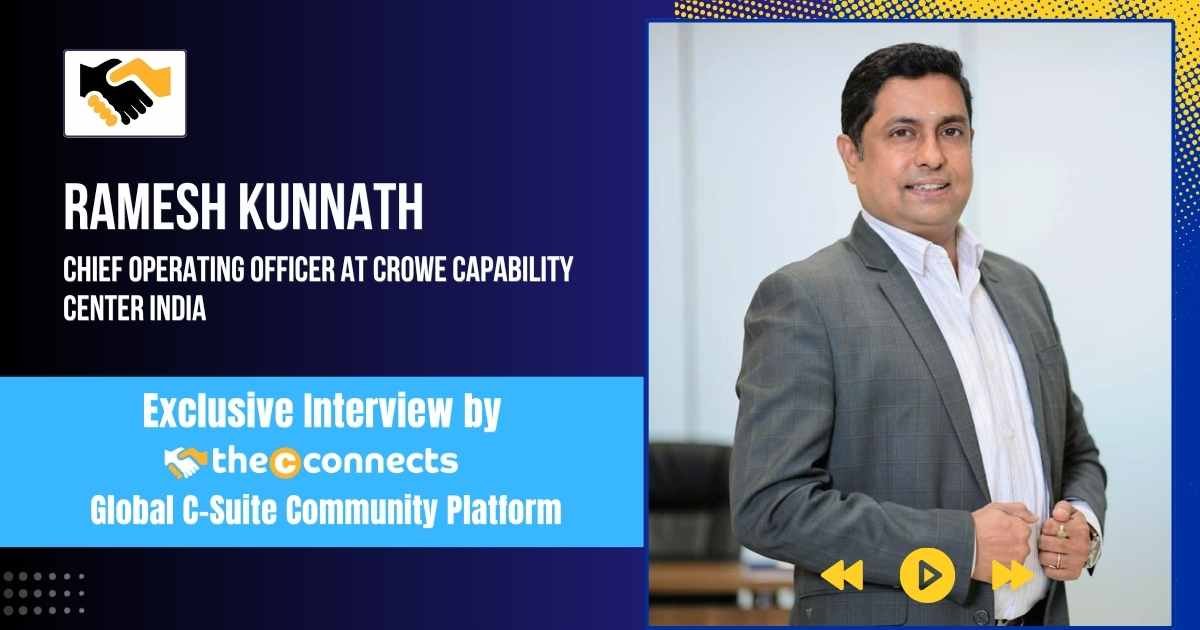

In the vast and complex landscape of Global Capability Centers (GCCs), few leaders possess the operational depth and strategic foresight of Dr. Ramesh Kunnath. With over 28 years of experience, Dr. Kunnath has built, scaled, and transformed enterprise operations across some of the world’s most formidable public accounting and consulting firms, including PwC, Deloitte, RSM, and Crowe.
His career is a masterclass in progressive leadership. He began in the trenches of finance and audit, evolving into a transformative force managing global delivery models for over 42,000 professionals. Today, as the Chief Operating Officer at Crowe Capability Center India, he operates at the intersection of business strategy, governance, and technological innovation. Armed with a PMP® certification, a Six Sigma Black Belt, and executive education from Columbia Business School and ISB, Dr. Kunnath has consistently delivered enterprise-wide digital transformations that leverage AI, RPA, and structured operational excellence.
Recently honored with the “Transformational Leader Award 2026,” Dr. Ramesh Kunnath sat down with TheCconnects to discuss his incredible 28-year journey, the realities of building scalable global delivery models, and his vision for the future of GCCs in India.
TheCconnects: Dr. Kunnath, it is an absolute honor to have you with us today. Your career trajectory-spanning 28+ years across GE Capital, Deloitte, RSM, PwC, and into your current role as a Chief Operating Officer-is incredibly inspiring. Can you walk our readers through this evolution and how you built the foundation for your current executive role?
Dr. Ramesh Kunnath: Thank you for having me. It is a pleasure to connect with your readers. My journey is truly a reflection of steady growth across the global public accounting and consulting ecosystem. It did not start in the C-suite; it started with a very strong foundation in finance, audit, and account reconciliations during my early days at Vedanta and GE Capital.
The turning point was my 17-year tenure at Deloitte. I transitioned from handling day-to-day tax operations to leading massive global digital transformation projects and establishing enterprise governance frameworks. I realized early on that managing a few hundred people requires management, but managing offshore operations for thousands of professionals across the US, UK, and Canada requires systems thinking. I invested heavily in upskilling-earning my Six Sigma Black Belt, PMP®, and RPA certifications. By the time I took on enterprise leadership roles at RSM and PwC Acceleration Centers, my focus had shifted entirely to building resilient, scalable GCCs. Today, my core mandate is to weave those threads together: aligning enterprise strategy with flawless operational execution.
TheCconnects: Managing global delivery operations for tens of thousands of professionals is a monumental responsibility. How do you approach people development, and what is your strategy for grooming the next generation of future leaders in the GCC space?
Dr. Ramesh Kunnath: I firmly believe that “enduring global institutions are built when leaders grow with the complexity they are trusted to manage.” When you are leading a workforce of 40,000+, true operational stability does not come from software or policy manuals; it comes from an empowered, high-performance culture.
My approach to people development is anchored in building robust succession pipelines and fostering cross-functional expertise. We are moving away from traditional, siloed skill sets. The future leaders of the GCC ecosystem must understand how technology, finance, risk, and human resources intersect. I actively mentor middle management to think like enterprise leaders rather than just process owners. By championing continuous learning and creating environments where teams are encouraged to challenge the status quo, we don’t just fill managerial seats-we groom visionaries who can sustain the organization’s growth for the next decade.
TheCconnects: Building and scaling US-India offshore centers across multiple cities involves immense logistical and cultural hurdles. What were the biggest challenges you faced in these large-scale transitions, and how did you overcome them?
Dr. Ramesh Kunnath: The biggest challenge in setting up or scaling a GCC is what I call the “Integration Gap.” You can easily build a beautiful facility and hire talented people, but integrating them seamlessly into the global parent company’s culture, technology stack, and compliance frameworks is incredibly difficult. Historically, offshore teams were often viewed merely as cost-saving back-offices, which led to a disconnect in quality and engagement.
I overcame this by treating GCCs as strategic extensions of the global business. I implemented robust governance models and insisted on cross-functional collaboration across Talent, L&D, IT, and Finance. By applying Six Sigma methodologies and structured Project Management, we didn’t just transition processes; we optimized them. For instance, in one of my major transformations, we improved client profitability from 9% to 41% simply by standardizing procedures and eliminating operational waste.
TheCconnects: With the GCC landscape evolving at breakneck speed, how do you design a “Future-Ready Operational Framework” that remains agile, scalable, and resilient against global disruptions?
Dr. Ramesh Kunnath: A Future-Ready Operational Framework rests on three critical pillars: Agile Governance, Scalable Technology, and Business Continuity.
You cannot predict every global disruption, but you can build systems that absorb the shock. I design frameworks by first establishing absolute process standardization-you must eliminate the noise before you scale. From there, we layer in strict governance and risk management protocols. Finally, we integrate technology intelligently. A future-ready framework does not chase every new tech trend; instead, it utilizes targeted automation, AI, and predictive analytics to create transparency. When your operational framework provides real-time visibility into your productivity, risk, and financial metrics, you can pivot your strategy overnight without fracturing the business.
TheCconnects: When dealing with C-suite executives and global stakeholders across different geographies, what are their most pressing pain points today, and how do your enterprise strategies resolve them?
Dr. Ramesh Kunnath: Global stakeholders universally face two main pain points: unpredictable service delivery quality and escalating operational costs.
As a COO, my mandate is to solve both simultaneously without compromising one for the other. We address this by building a highly scalable delivery model anchored in strict enterprise governance. We do not just execute tasks; we drive transformation. By conducting deep “As-Is / To-Be” gap analyses and integrating RPA into our daily workflows, we drastically reduce manual errors and turnaround times. This ensures that our global partners experience consistent, top-tier service delivery while simultaneously optimizing their cost structures.
TheCconnects: As a leader who holds certifications in RPA and has spearheaded AI-enabled process optimization, what do you see as the biggest hurdle for global brands attempting digital transformation?
Dr. Ramesh Kunnath: The biggest hurdle today is “Digital Execution without Operational Foundation.”
Many global brands rush to implement AI, cognitive technologies, and Robotic Process Automation (RPA) because they feel pressured by market trends. However, if you automate a broken or inefficient process, you simply generate errors faster. The challenge is ensuring that before a company invests millions in a globally integrated platform, their foundational processes are optimized, and their risk frameworks are airtight. Technology must enable scale, but operational discipline must dictate the strategy.
TheCconnects: Earning the “Transformational Leader Award 2026” is a testament to your relentless schedule. What does a Global Operations Leader do in his free time to maintain balance?
Dr. Ramesh Kunnath: Free time is scarce, but it is essential for clarity. I dedicate a significant amount of time to continuous learning. Executive education, like my stints at Columbia Business School and ISB, acts as a mental reset for me. Beyond academics, I am deeply passionate about community impact. During my time at Deloitte, I spearheaded a rural education initiative called Vidya Vahini, which grew from 20 to over 14,000 volunteers. Engaging in large-scale social impact projects keeps me grounded and reminds me that leadership is ultimately about serving others.
TheCconnects: Drawing from 28 years of building GCCs and driving global transformations, what advice do you have for aspiring operations leaders and entrepreneurs in the corporate space?
Dr. Ramesh Kunnath: My advice is to master the intersection of Process, Technology, and People.
Do not rely solely on technical brilliance. You must understand how to navigate complex organizational matrices, how to manage enterprise risk, and how to drive consensus among C-suite stakeholders. Invest in frameworks like Six Sigma, PMP, and Agile, because they teach you how to execute strategy predictably. Finally, always remember that at the core of any digital transformation or offshore expansion are your people. Build an inclusive culture where your team feels empowered to innovate, and operational excellence will follow naturally.