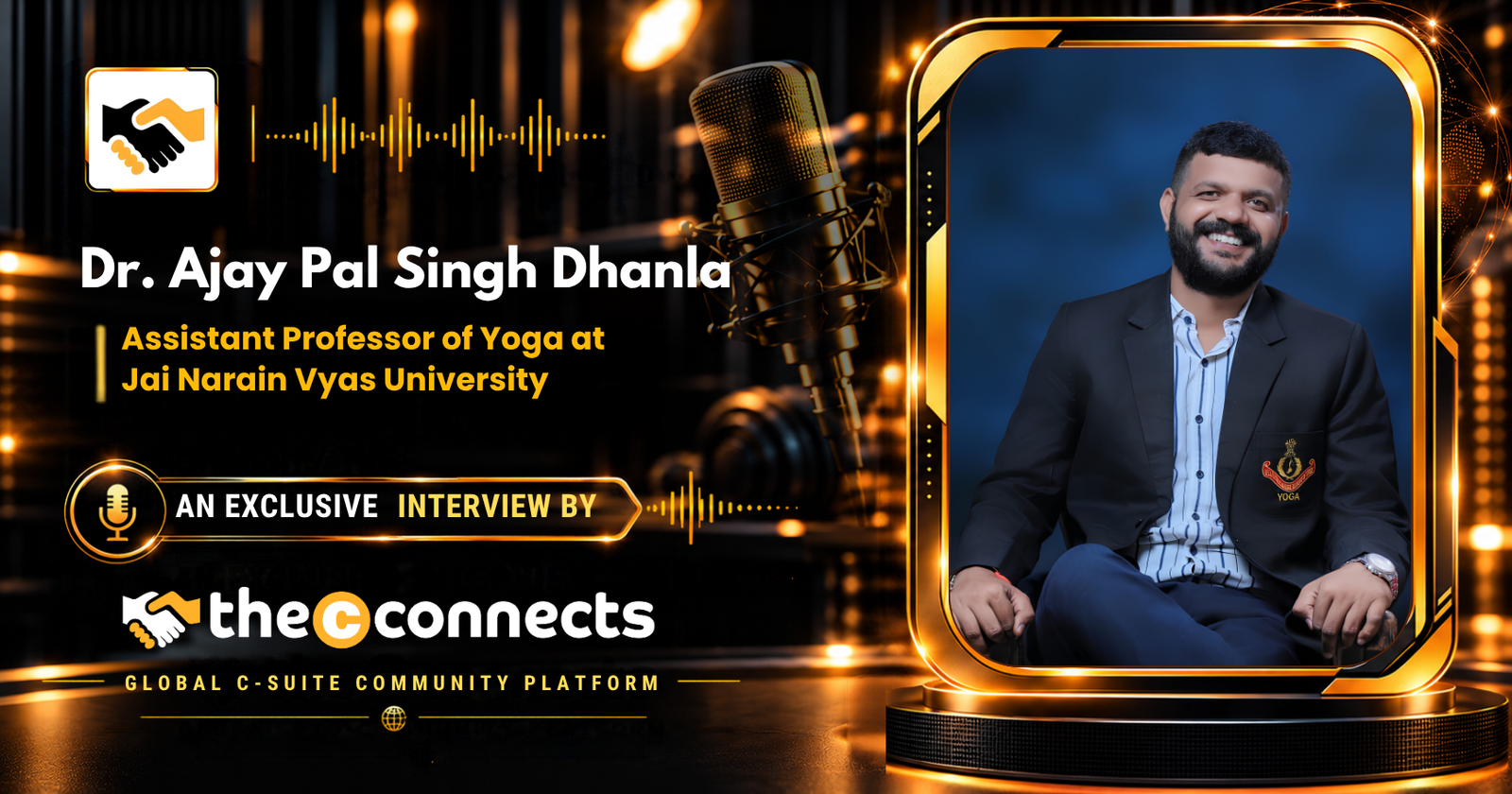

Welcome, Dr. Ajay Pal Singh Dhanla. It is a profound privilege to speak with an educator, researcher, and practitioner who is so deeply embedded in the authentic traditions of Yoga and Naturopathy. You wear many hats-Assistant Professor at Jai Narain Vyas University (JNVU), Founder of the Aksharbrahm Holistic Yoga Training & Ayurveda Research Institute, a UGC NET/JRF mentor, and a Yoga Sports Coach. Your academic background is incredibly diverse, spanning Psychology, History, and Library Science before culminating in a Ph.D. in Yoga and Naturopathy. How did this multidisciplinary journey shape your current approach to holistic health and education?
Dr. Ajay Pal Singh Dhanla: Thank you for having me. My journey was not a linear path, but rather a gradual gathering of perspectives that ultimately converged on Yoga. Studying History gave me a deep reverence for the Indian Knowledge System (IKS) and the cultural roots of our ancient practices. Psychology allowed me to understand the complexities of the human mind, human behavior, and the modern mental health crises we face today.
When I immersed myself in Yoga and Naturopathy, I realized it was the perfect bridge. Yoga is not just a physical practice; it is an applied psychology and a historical science of living. My diverse background allows me to teach Yoga not in isolation, but as a comprehensive educational and therapeutic tool. Whether I am teaching university students at JNVU or guiding aspirants at Aksharbrahm, I approach Yoga as a complete science that heals the body through Naturopathy, conditions the mind through Psychology, and grounds the spirit in our traditional wisdom.
TheCconnects: That intersection of mind and body is a focal point of your current Ph.D. research, which examines the role of Kriya Yoga in promoting mental health. In today’s fast-paced, high-stress world, what makes Kriya Yoga such a vital intervention?
Dr. Ajay Pal Singh Dhanla: We are currently facing a global epidemic of stress, anxiety, and depression. Modern medicine often treats the symptoms, but traditional yogic concepts address the root cause-the disconnect between the breath, the mind, and the inner self. Kriya Yoga is highly systematic. It utilizes specific breath control (Pranayama), cleansing techniques (Shatkarmas), and meditation (Dhyana) to directly influence the nervous system.
In my research, I critically review these traditional practices to demonstrate their contemporary, evidence-based relevance. Kriya Yoga acts as an internal recalibration. It shifts the practitioner from a state of constant sympathetic nervous system arousal-the “fight or flight” mode modern society traps us in-into a parasympathetic state of rest and repair. It is a highly practical, drugless intervention that empowers individuals to take control of their own mental well-being.
TheCconnects: Your commitment to academic rigor in this field is evident in your work as a UGC NET/JRF mentor and as the author of the widely cited guidebook Yog Hansh. What drove you to focus so heavily on the academic and competitive examination side of Yoga?
Dr. Ajay Pal Singh Dhanla: As Yoga gained global popularity, I noticed a growing gap between the commercialized, fitness-oriented Yoga seen in studios and the authentic, philosophical Yoga documented in our ancient texts. To preserve the true essence of this science, we need highly qualified, knowledgeable educators in our universities and research institutions.
I wrote Yog Hansh and established our mentoring programs to help dedicated students clear national benchmarks like the UGC NET, JRF, and Yoga Certification Board (YCB) exams. I want to equip the next generation of Yoga scholars with a profound understanding of texts like the Patanjali Yoga Sutras and the Hatha Yoga Pradipika. By supporting their academic preparation, we are building a robust foundation of educators who will carry forward authentic Yoga education rather than diluted, trend-based practices.
TheCconnects: Interestingly, alongside your deep academic roots, you are also a certified Yoga Sports Coach from the Netaji Subhas National Institute of Sports (NSNIS), Patiala. How do you reconcile the internal, spiritual focus of traditional Yoga with the competitive, external nature of sports?
Dr. Ajay Pal Singh Dhanla: That is a brilliant question. People often assume Yoga and competitive sports are inherently opposed, but they actually complement each other perfectly. My training at NSNIS focused on the application of Yoga in athletic performance. A high-performing athlete requires immense physical flexibility, injury prevention, and rapid recovery-all of which therapeutic yogic postures and Naturopathy provide.
However, the real game-changer is mental conditioning. In competitive sports, the difference between a gold medal and a loss is often entirely mental. Through specific Pranayama and concentration techniques, we train athletes to maintain unwavering focus under extreme pressure. Furthermore, Yoga itself has emerged as a competitive sport, which encourages youth to master incredible physical discipline. The physical competition is merely a gateway; once they master the body, we guide them toward mastering the mind.
TheCconnects: You founded the Aksharbrahm Holistic Yoga Training & Ayurveda Research Institute. What is your core vision for this institution, and how does it address the pain points of the modern wellness seeker?
Dr. Ajay Pal Singh Dhanla: Aksharbrahm was born out of a need for a truly integrated ecosystem. Today, a wellness seeker often has to go to one place for a physical workout, a clinic for stress management, and another platform entirely for academic learning.
At Aksharbrahm, we bring the Indian Knowledge System under one roof. We address the pain point of fragmented health by integrating Ayurveda, Naturopathy, and Yoga Therapy. For students, we provide career guidance and rigorous academic coaching. For the community, we conduct health camps and awareness programs. We even instituted the “Abhyas Ayushya Ratna” recognition to honor unsung heroes contributing to Ayurveda and Yoga. Our vision is to make authentic, holistic wellbeing accessible to everyone, from the competitive exam aspirant to the individual seeking relief from lifestyle diseases.
TheCconnects: Given your active involvement in education and public awareness, including your talks on Akashvani, what do you see as the biggest challenge for Yoga and wellness brands in the digital space today?
Dr. Ajay Pal Singh Dhanla: The biggest challenge in the digital space is the commodification and misrepresentation of Yoga. Social media prioritizes visual aesthetics-who can perform the most acrobatic, complex posture. This creates a massive misconception that Yoga is only for the young, the hyper-flexible, or the physically elite.
This digital trend alienates people who actually need Yoga the most-the elderly, those dealing with severe mental health issues, or individuals with physical limitations. The challenge for authentic wellness platforms is cutting through this superficial noise. We must use digital platforms to educate the public that a simple, mindful breathing practice holds as much, if not more, therapeutic power than an advanced handstand. We have to market the internal transformation, not just the external performance.
TheCconnects: With such a demanding schedule-teaching at JNVU, running an institute, mentoring students, and conducting Ph.D. research-how do you find balance? What do you do in your free time?
Dr. Ajay Pal Singh Dhanla: Balance is the very essence of Yoga, so I must practice what I teach. My own Sadhana (daily spiritual practice) is non-negotiable. It is where I draw my energy. In my free time, I immerse myself in reading ancient texts and exploring Indian history and philosophy. I also find immense joy in writing; synthesizing complex traditional concepts into accessible books and research papers is deeply therapeutic for me. Beyond academics, spending quiet time in nature, which aligns with my background in Naturopathy, keeps me grounded and recharged.
TheCconnects: To conclude our conversation, what advice do you have for aspiring educators, researchers, and entrepreneurs who want to build a career in the Yoga and holistic health industry?
Dr. Ajay Pal Singh Dhanla: First, ensure that your personal practice is deeply rooted. You cannot pour from an empty cup, and you cannot authentically teach or build a wellness brand if you are not experiencing the discipline of Yoga yourself.
Second, do not chase trends. The wellness industry is full of fleeting fads. Anchor your work in authentic, traditional texts and evidence-based research. If you are a student, aim for academic excellence-clear your UGC NET, pursue research, and understand the science behind the practice. If you are an entrepreneur, focus on solving real problems, like stress management and lifestyle disorders, rather than just selling an aesthetic. When your work is grounded in genuine compassion and authentic knowledge, success and societal impact will naturally follow.
TheCconnects: That is incredibly profound and actionable advice, Dr. Ajay Pal Singh Dhanla. Your dedication to preserving the authenticity of Yoga while advancing it academically is truly inspiring. Thank you for sharing your journey and insights with us today.
Dr. Ajay Pal Singh Dhanla: The pleasure was entirely mine. Thank you to TheCconnects for this wonderful platform and for highlighting the importance of authentic holistic education.