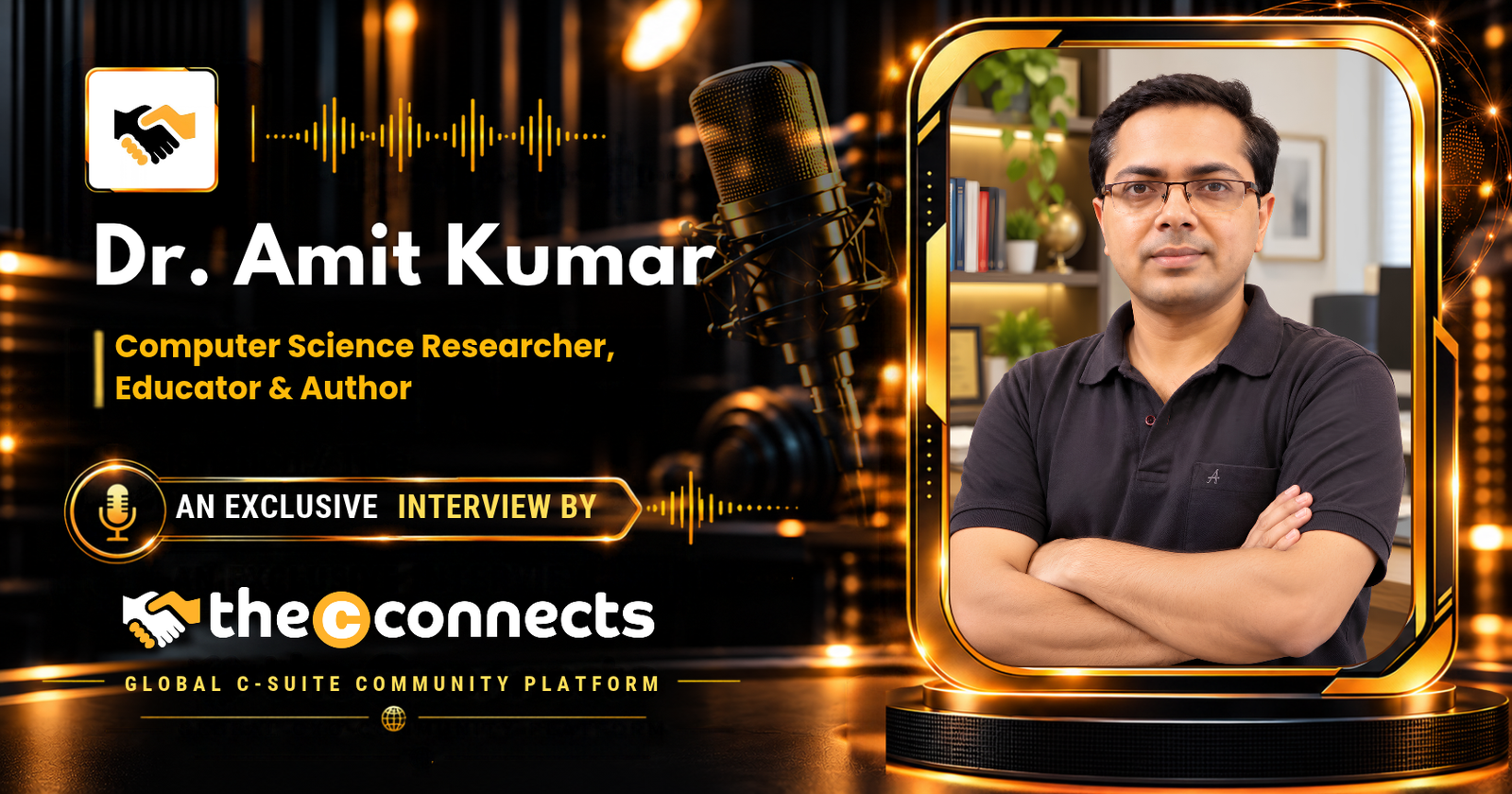

Welcome, Dr. Amit Kumar! It is an absolute privilege to host a technology professional and academic of your caliber today. As a highly respected computer science researcher, educator, and author, your work sits at the fascinating intersection of Machine Learning, Artificial Intelligence, and Software Engineering. With a Ph.D. from Tilka Manjhi Bhagalpur University and a highly anticipated new book, Machine Learning with Python, hitting the shelves, your insights are incredibly valuable to our readers. How are you doing today, and what is the current energy like as you transition between your research and your writing endeavors?
Dr. Amit Kumar: Thank you so much for the warm welcome and the kind words! It is a true pleasure to connect with TheCconnects and your global audience. I am doing exceptionally well. The energy right now is incredibly dynamic. Balancing rigorous academic research with writing educational content requires shifting gears between deep, highly technical problem-solving and finding the most accessible, simplified ways to explain those exact same concepts to students and professionals. It is a demanding but deeply fulfilling process, especially with the release of my new book.
TheCconnects: Your professional journey is beautifully layered, blending hardcore academic research with a passion for teaching. Can you walk our readers through your journey and how you arrived at your current multifaceted role?
Dr. Amit Kumar: My journey has always been driven by an insatiable curiosity about how intelligent systems can solve complex, real-world problems. I began with a strong foundational interest in computer science, which eventually led me to pursue my Ph.D. at Tilka Manjhi Bhagalpur University in Bihar.
My doctoral research specifically focused on “Software Defect Prediction using Novel Ensemble-Based Machine Learning Approaches.” During this time, I realized that while the tech industry was rapidly producing software, ensuring the reliability and quality of that software was becoming a massive bottleneck. I wanted to use Machine Learning to predict and mitigate software defects before they caused system failures. As I delved deeper into research areas like feature selection and cost-sensitive learning, I simultaneously discovered a profound passion for teaching and academic writing. I realized that researching solutions wasn’t enough; I needed to share this knowledge in a structured, learner-friendly way. That dual passion brought me to where I am today-a researcher, a technology professional, and an author.
TheCconnects: Your Ph.D. focused on “Ensemble-Based Machine Learning Approaches” for software defect prediction. For our readers who might not be deeply technical, what does this mean, and how does it solve industry pain points?
Dr. Amit Kumar: That is a great question. In simple terms, software defect prediction is like preventive healthcare for computer programs. Instead of waiting for a software application to crash or be hacked, we use historical data to predict which parts of the code are most likely to contain bugs.
“Ensemble-based learning” simply means that instead of relying on just one machine learning model to make these predictions, we combine the intelligence of multiple models. Think of it like seeking advice from a panel of expert doctors rather than just one; the collective decision is always more accurate and reliable. By integrating this with “cost-sensitive learning”-which trains the AI to understand that missing a critical bug is far more costly than raising a false alarm-we help software companies save millions of dollars, reduce testing time, and deploy highly reliable digital products to their customers.
TheCconnects: Every dedicated educator and researcher draws inspiration from somewhere. Who or what has influenced you the most in your life and shaped your philosophy?
Dr. Amit Kumar: I have been profoundly influenced by my academic mentors and the open-source technology community. My professors instilled in me the rigor of scientific research-the idea that you must deeply validate your hypotheses before presenting them to the world.
On a broader scale, I am inspired by the democratization of technology. Seeing self-taught developers use Python and Machine Learning to build solutions for agriculture, healthcare, and education in rural areas deeply influences me. It reinforces my core philosophy: complex concepts in computer science should not be locked in academic ivory towers. They must be made easy to understand through practical examples and clear explanations so that anyone with the drive to learn can create a meaningful impact.
TheCconnects: Speaking of making complex concepts accessible, congratulations on your book, Machine Learning with Python, published by OrangeBooks Publication. With so many programming books on the market, what makes yours stand out?
Dr. Amit Kumar: Thank you! When I set out to write this 216-page book, my primary objective was to bridge the gap between heavy mathematical theory and hands-on application. Many books on the market either overwhelm the reader with complex calculus or swing too far the other way, just providing code snippets without explaining the “why” behind them.
My book provides a structured, application-oriented study. It takes the reader on a logical journey-from basic AI concepts and Python programming to mathematical foundations, data preprocessing, and feature engineering. Crucially, I have included dedicated sections on Generative AI, Responsible AI, and model deployment. It is designed to support both classroom teaching and independent learning, complete with review questions, case studies, and reproducible workflows. I want the reader to not just run a machine learning model, but to formulate the problem soundly and evaluate it appropriately.
TheCconnects: You dedicated a section of your book to “Responsible AI.” As AI continues to dominate the digital space, what do you see as the biggest challenge for brands and developers regarding AI integration?
Dr. Amit Kumar: The biggest challenge in the digital space today is the ethical and responsible deployment of data-driven systems. Brands are in a rush to integrate AI to stay competitive, but speed often compromises safety.
The challenge lies in data bias, lack of transparency, and poor problem formulation. If you train a machine learning model on biased historical data, it will automate and scale that bias, leading to unfair outcomes for customers. Furthermore, as Generative AI becomes mainstream, distinguishing between authentic and AI-generated content is a massive hurdle for brand trust. Brands must prioritize “Responsible AI”-ensuring their models are transparent, their workflows are reproducible, and their data privacy standards are uncompromising. AI should augment human capabilities, not exploit user trust.
TheCconnects: After years of rigorous academic research, teaching, and writing, what key lessons have you learned from your professional career?
Dr. Amit Kumar: The most important lesson I’ve learned is that continuous learning is non-negotiable. Technology, especially Artificial Intelligence, evolves at an unprecedented pace. The algorithms I studied a decade ago have been entirely revolutionized today. You have to remain a student for life.
Secondly, I have learned the power of simplicity. Whether you are writing a complex algorithm for software testing or writing a chapter for a book, if you cannot explain your solution simply, you haven’t understood it well enough yourself. Simplicity is the ultimate sophistication in software engineering and education.
TheCconnects: With such a demanding schedule-conducting research, writing books on Performance Marketing, PHP, and ML, and teaching-what does Dr. Amit Kumar do in his free time?
Dr. Amit Kumar: Free time is a bit of a luxury, but I genuinely enjoy what I do, so the lines often blur! In my downtime, I love exploring emerging digital technologies outside of my immediate research scope. I enjoy reading about performance marketing, digital trends, and how technology intersects with behavioral economics. I also spend time developing technical content and blogs, finding new, creative ways to share knowledge. When I completely step away from the screen, I enjoy quiet moments of reflection, spending time with my family, and staying grounded in the simple joys of life.
TheCconnects: Finally, what advice do you have for aspiring researchers, tech professionals, and ed-tech entrepreneurs entering the industry today?
Dr. Amit Kumar: For aspiring tech professionals and researchers, my advice is to focus relentlessly on the fundamentals. Don’t just chase the latest programming language or AI framework; understand the mathematical foundations and the core logic of problem-solving. Frameworks will change, but fundamental logic remains eternal.
For entrepreneurs in the ed-tech and digital space, focus on creating genuine value. Build resources that are practical, original, and learner-friendly. Education, research, and technology are not isolated fields; when they work together harmoniously, they possess the power to solve real-world problems. Keep your focus on creating that meaningful impact, and success will naturally follow.
TheCconnects: That is incredibly profound and actionable advice, Dr. Amit Kumar. Your dedication to elevating software reliability and democratizing machine learning education is truly inspiring. Thank you so much for sharing your journey, your research, and your wisdom with us today. We highly recommend our readers pick up a copy of Machine Learning with Python. We wish you massive success in all your future endeavors!
Dr. Amit Kumar: The pleasure was entirely mine. Thank you to TheCconnects for this fantastic platform and for highlighting the importance of structured, responsible technology education.