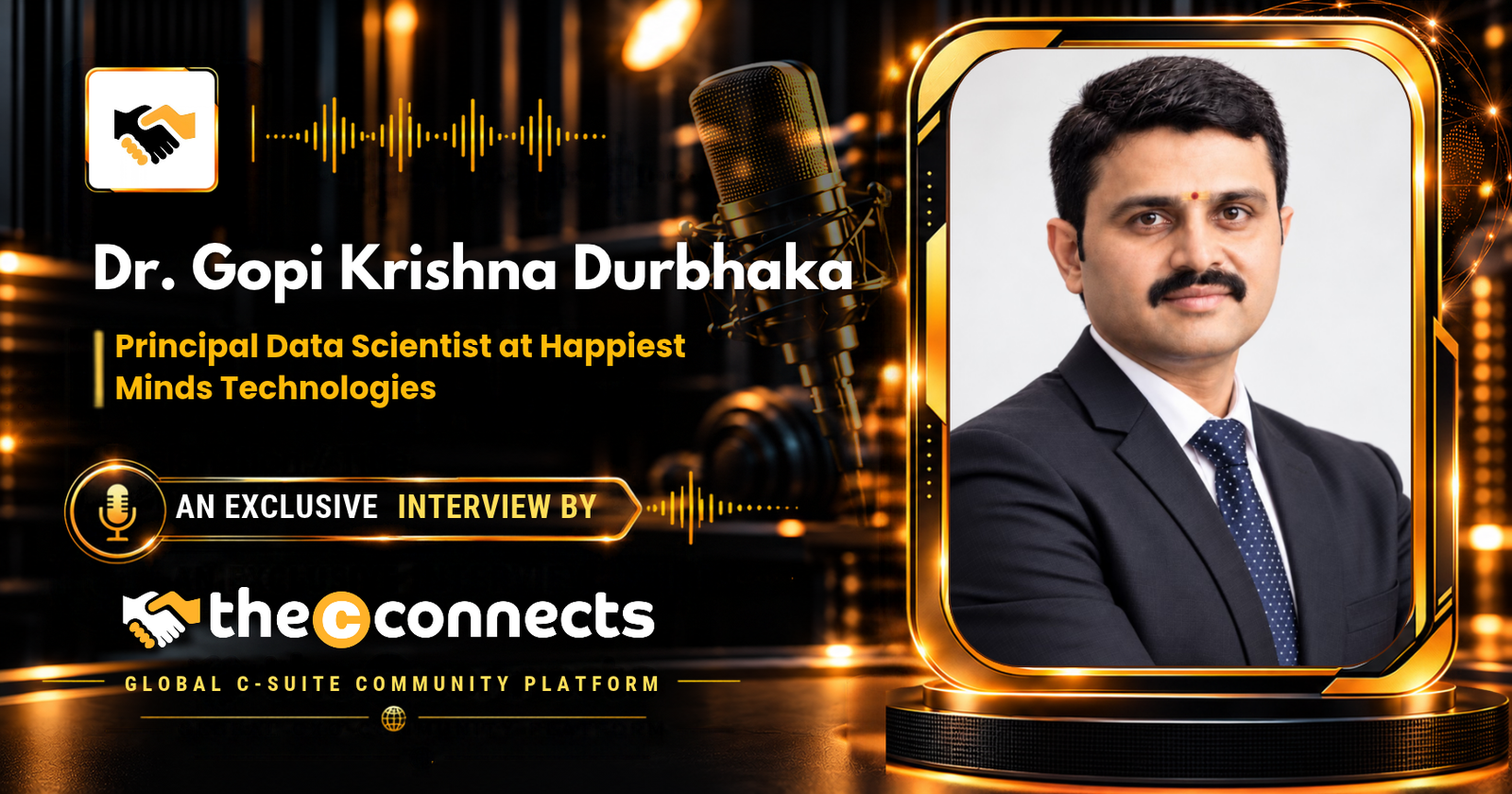

Welcome, Dr. Gopi Krishna Durbhaka! It is a distinct honor to host a technology strategist and scientist of your caliber today. With over two decades of experience spanning Artificial Intelligence, Industrial IoT, and Predictive Analytics, your trajectory is truly remarkable. From serving as a Research Scientist for the Government of India to your current role as Principal Data Scientist at Happiest Minds Technologies, you have consistently pushed the boundaries of innovation. You hold six patents, are a Senior Member of IEEE, a Fellow of the ISECE, and a 5x LinkedIn Top Voice. Given your demanding schedule leading R&D and deploying cutting-edge AI architectures, we truly appreciate you taking the time for this conversation. How are you doing, and what is keeping you most energized in the tech space lately?
Dr. Gopi Krishna Durbhaka: Thank you so much for the incredibly warm welcome! It is a true pleasure to connect with TheCconnects and your readers. I am doing very well. What keeps me most energized right now is the rapid convergence of physical engineering and advanced AI. We are at a critical inflection point where concepts like Generative AI, Edge AI, and autonomous AI Agents are no longer just software experiments-they are being actively deployed into heavy industries, manufacturing, and energy grids. Watching data-driven algorithms directly prevent catastrophic machinery failures and optimize complex supply chains in real-time is deeply fulfilling.
TheCconnects: Your professional journey is incredibly unique because it bridges the physical world of hardware with the digital realm of advanced AI. Can you share with our readers how you transitioned from traditional R&D into a leadership role in Data Science and AI?
Dr. Gopi Krishna Durbhaka: My journey has been a very organic evolution. I started my career deeply rooted in hardware and embedded systems. Working as a Research Scientist at SAMEER, under the Ministry of Communications and Information Technology, I designed GSM-based SCADA systems and remote online monitoring frameworks for energy grids and telemetry.
Working so closely with sensors and transducers, I quickly realized that simply collecting massive amounts of telemetry data was only half the battle. The real value lay in making that data “speak” to predict future outcomes. I wanted to understand the behavioral patterns of heavy machinery before they failed. This curiosity drove me to pursue my Ph.D. in Predictive Maintenance, focusing on AI and Swarm Intelligence. Over the years, through my tenure at organizations like HCL, TCS, Accenture, and ACG World, my roles shifted entirely toward Data Science and Machine Learning. Today, at Happiest Minds Technologies, my focus is on what I call “Engineering Intelligence”-bridging the physical machinery world with advanced cognitive algorithms.
TheCconnects: You often use the phrase “Engineering Intelligence for the Physical World.” For business leaders and tech enthusiasts reading this, what exactly does this concept mean in practice?
Dr. Gopi Krishna Durbhaka: “Engineering Intelligence” is the seamless integration of domain engineering knowledge, real-world operational data, and Artificial Intelligence. In the industrial sector, you cannot just apply a generic AI algorithm to a dataset and expect miracles. If you do not understand the physics of the machinery-how a gearbox vibrates, how thermal dynamics affect an HVAC system, or the fluid mechanics of a valve-your model will be practically useless.
In practice, it means taking a physical asset, outfitting it with IoT sensors to Sense its state, using AI to Understand the context, Predict potential anomalies, Optimize the performance, and finally deploying AI Agents to Decide and Act. It is about making machines, assets, and processes inherently self-aware and highly reliable.
TheCconnects: You have done extensive, award-winning research on predictive maintenance, specifically developing the “Swarm-LSTM” model for wind turbines and gearboxes. What are the biggest challenges in industrial condition monitoring, and how did your research overcome them?
Dr. Gopi Krishna Durbhaka: The biggest challenge in industrial condition monitoring is the sheer volume of noise in vibration data. When you have a massive wind turbine operating in harsh environments, detecting a micro-fracture in a gearbox is like trying to hear a whisper in a hurricane. Unplanned, unscheduled breakdowns in these sectors cost millions of dollars in downtime and repairs.
To overcome this, I researched and proposed the Swarm-LSTM model. Conventional Long Short-Term Memory (LSTM) deep neural networks are excellent at handling time-series data but can be computationally heavy and difficult to optimize. By injecting metaheuristic Swarm Intelligence techniques-inspired by the collective behavior of nature, like fireflies-we optimized the LSTM network. This hybrid approach allowed us to analyze complex vibration signals with significantly higher diagnostic accuracy. It shifted the paradigm from reactive, scheduled maintenance to highly precise, prescriptive action.
TheCconnects: You hold six prestigious patents, one of which is for an “Adaptive Wearable Smart Fabric.” That sounds like a leap from heavy industrial machinery! How does this solution address a specific consumer pain point?
Dr. Gopi Krishna Durbhaka: It is definitely a different application, but the core foundational science remains the same: sensor data, pattern analysis, and predictive action. The “Adaptive Wearable Smart Fabric” addresses a very personal human pain point: posture and sleep ergonomics.
We conceptualized integrating transducers and actuators directly into the fabric. The intelligence embedded in the system acquires data parameters regarding the person’s posture. If the fabric detects a harmful posture or restricted movement during sleep, it automatically inflates or adjusts specific sections to correct the alignment without waking the person. It is a perfect example of Edge AI and smart decision support working seamlessly to improve human well-being, proving that advanced analytics can be miniaturized to solve everyday health challenges.
TheCconnects: Currently, you are heavily focused on Generative AI and AI Agents in the industrial space. What do you see as the biggest challenge for large enterprises and manufacturing brands when trying to scale these digital transformations?
Dr. Gopi Krishna Durbhaka: The single biggest challenge is the “Contextual Disconnect” between Operational Technology (OT) and Information Technology (IT). Many enterprise brands want to jump straight into deploying LLMs or advanced GenAI tools because it is the current industry trend. However, their physical floor data (OT) and their cloud infrastructure (IT) are trapped in silos.
You cannot build a reliable AI Agent to monitor plant efficiency if your vibration sensors aren’t talking to your maintenance logs in real-time. Brands struggle with foundational data maturity. The challenge is establishing a robust, unified data architecture where clean, contextualized data flows seamlessly from edge devices to the cloud. Without that engineering foundation, AI initiatives remain as isolated, unscalable Proof-of-Concepts.
TheCconnects: You are incredibly active in the global academic community-a Senior Member of IEEE, a Fellow of ISECE, a mentor, and a frequent keynote speaker. Why is it so important for you to dedicate time to this kind of thought leadership?
Dr. Gopi Krishna Durbhaka: I firmly believe that knowledge sitting in a silo decays, but knowledge shared multiplies. When I file a patent or publish a paper in a journal, the goal is to push the boundaries of what the engineering community can achieve globally. Being an IEEE Senior Member and a Session Chair for international conferences keeps me at the absolute bleeding edge of global research.
Mentoring young data scientists and engineers is my way of giving back. I want to ensure the next generation understands that Data Science is not just about writing Python code or importing libraries; it’s about understanding the deep physical reality of the problems you are solving.
TheCconnects: With such an intense professional life-managing R&D at Happiest Minds, publishing research, and speaking globally-what does Dr. Gopi Krishna Durbhaka do in his free time to decompress?
Dr. Gopi Krishna Durbhaka: It is certainly a balancing act! In my free time, I am a voracious reader. I enjoy diving into literature surrounding nature-inspired algorithms, philosophy, and global tech policy. I also spend a significant amount of time writing-whether it is drafting a new technical whitepaper, reviewing journal submissions, or preparing for my next guest lecture. I find that stepping away from immediate corporate deliverables to explore pure, unapplied scientific literature helps reset my mind and often sparks my next big conceptual breakthrough.
TheCconnects: Finally, what advice do you have for aspiring data scientists and tech entrepreneurs looking to build solutions in the Industrial AI and IoT space?
Dr. Gopi Krishna Durbhaka: My biggest piece of advice is: Do not fall in love with the algorithm; fall in love with the domain.
Too many young professionals rush to apply the latest trending Deep Learning model to every dataset they encounter. In the industrial and manufacturing space, if you lack domain expertise, your models will fail in production. Build a strong foundation in understanding the business problem first. Combine physical engineering principles with data science. When you respect the physical reality behind the numbers, you stop building mere statistical models and start building true, transformative solutions that deliver exceptional ROI.
TheCconnects: That is incredibly profound and actionable advice, Dr. Gopi Krishna Durbhaka. Your ability to fuse the physical world of heavy engineering with the cognitive world of AI is truly visionary. Thank you so much for sharing your journey, your patented innovations, and your expertise with us today. We wish you continued success in all your endeavors!
Dr. Gopi Krishna Durbhaka: The pleasure was entirely mine. Thank you so much for the wonderful conversation and for providing this excellent platform.