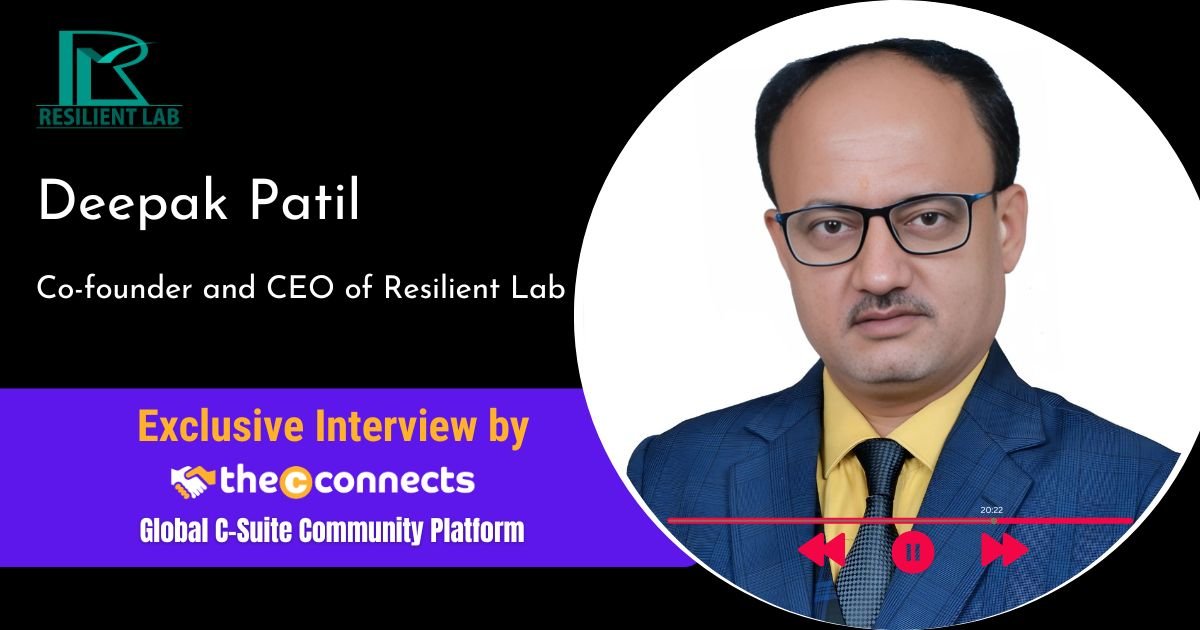

TheCconnects: Deepak, thank you for joining us today. Your journey in the tech industry is inspiring. Can you walk our readers through how you went from your early days in IT to becoming the CEO of Resilient Lab?
Deepak Patil: Thanks for having me! My journey started in the early 2000s when India’s tech scene was just beginning to take off. I began as a Team Leader at Magnet Technologies, diving into the nitty-gritty of software development during the dial-up era. It was a time when every project felt like a puzzle, limited infrastructure, nascent internet, but endless possibilities. Over the years, I moved through roles in engineering, R&D, and policy advisory, which gave me a front-row seat to India’s digital transformation. By the mid-2010s, I saw a gap in how technology was addressing real-world challenges, especially in rural and underserved areas. That’s when I co-founded Resilient Lab in 2016 with a mission to make deep-tech accessible, inclusive, and impactful. It’s been a wild ride, but every step, from coding late nights to advising on national initiatives, has shaped my approach to building solutions that matter.
TheCconnects: That’s a remarkable trajectory. Who would you say has been the most influential figure in your life, personally or professionally, and how have they shaped your perspective?
Deepak Patil: That’s a tough one, but I’d point to my mentor from my early days at Shivaji University, Professor Anil Deshmukh. He wasn’t just an academic; he was a visionary who believed technology could bridge societal gaps. He pushed me to think beyond code, to see software as a tool for empowerment. His mantra was, “Solve for the user, not just the system.” That’s stuck with me. On a personal note, my parents’ resilience, running a small business in a small town, taught me grit and the value of community. Combining those influences, I’ve always aimed to build tech that serves people first, whether it’s a farmer in a remote village or a policymaker in Mumbai.
TheCconnects: Speaking of challenges, you’ve worked on complex projects like e-governance and smart agriculture. What’s been the biggest hurdle you’ve faced, and how did you overcome it?
Deepak Patil: One of the toughest challenges was during the early rollout of our AgriBits platform. We were piloting IoT-based soil sensors in rural Maharashtra, aiming to help farmers optimize irrigation. The tech worked beautifully in controlled settings, but in the field, we hit a wall, unreliable power, patchy connectivity, and farmers’ skepticism about “fancy gadgets.” It was a humbling lesson in over-engineering. We went back to the drawing board, simplified the interface, and designed battery-powered sensors that could function offline. We also spent months training local cooperatives, building trust. By 2018, we saw 100+ villages adopt AgriBits, with yields up by 10–15%. The takeaway? Technology must meet people where they are, not where you want them to be.
TheCconnects: That’s a powerful lesson. Over your 20+ years in the industry, what are some key insights you’ve gained that continue to guide your work?
Deepak Patil: First, empathy is non-negotiable. If your solution doesn’t resonate with the end user’s reality, it’s just noise. Second, scalability isn’t just technical, it’s cultural. You can build the most robust microservices architecture, but if your team or stakeholders aren’t aligned, it won’t stick. Third, never stop learning. The tech landscape evolves so fast, whether it’s blockchain, edge AI, or IoT, you have to stay curious. I still block out an hour every week to read papers or tinker with new tools. It keeps me grounded and forward-thinking.
TheCconnects: Let’s talk about the digital space. Brands today are navigating a crowded, fast-moving landscape. What do you see as their biggest challenge?
Deepak Patil: Trust. Consumers are bombarded with information, and they’re savvier than ever. Brands struggle to stand out without coming off as inauthentic or intrusive. The challenge is building digital experiences that feel personal yet secure. Take our PropProof platform, it uses AI and blockchain to verify property documents, giving users confidence in a process that’s often opaque. Brands need to prioritize transparency and user control, especially with data privacy concerns on the rise. If you’re not solving a real pain point with integrity, you’re just adding to the noise.
TheCconnects: That ties nicely into Resilient Lab’s work. Can you share how your solutions, like PropProof or eJalVidyut, address specific customer pain points?
Deepak Patil: Absolutely. Our solutions are built around real-world problems. PropProof, for instance, tackles the headache of property fraud, a massive issue in India. By combining OCR, NLP, and blockchain, it automates deed verification, cutting down weeks of manual checks to minutes while ensuring tamper-proof records. For citizens, it’s peace of mind; for officials, it’s efficiency. Similarly, eJalVidyut addresses rural infrastructure woes. Manual streetlight maintenance in villages is costly and inconsistent. Our IoT controllers enable remote monitoring, saving up to 30% in energy costs. Each product starts with a question: “What’s keeping people up at night?” Then we engineer backward from there.
TheCconnects: Your work spans urban and rural challenges. How do you balance innovation with accessibility, especially for underserved communities?
Deepak Patil: It’s about designing with constraints in mind. In rural areas, you can’t assume 5G or constant power. Our AgriBits toolkit, for example, uses low-bandwidth GIS mapping and offline-capable sensors to ensure farmers can access insights without a stable internet connection. We also partner with local NGOs to train users, making tech feel less intimidating. In urban settings, like with SwitchLink for micro-enterprises, we focus on plug-and-play simplicity. The goal is to democratize tech, whether it’s a farmer in Solapur or a shopkeeper in Mumbai, the solution should feel intuitive and affordable.
TheCconnects: You’ve mentioned “Viksit Bharat 2047” as a guiding vision. How does Resilient Lab align with this long-term goal?
Deepak Patil: “Viksit Bharat” is about inclusive, sustainable growth, and that’s at the heart of Resilient Lab’s mission. Our JiNiS platform, for instance, supports transparent governance by giving district planners real-time data to track projects. We’re now scaling it across Maharashtra to empower data-driven decisions. Similarly, our smart-energy solutions like eJalVidyut align with sustainable urban and rural development. By 2047, we envision a network of resilient microgrids and AI-driven farming systems that uplift communities while minimizing environmental impact. It’s about building tech that doesn’t just grow businesses but strengthens ecosystems.
TheCconnects: Outside of your demanding role, what do you do to unwind or spend your free time?
Deepak Patil: I’m a bit of a history buff, I love reading about ancient Indian architecture and how it solved engineering challenges with limited resources. It’s humbling and inspires my work. I also enjoy trekking in the Sahyadris; there’s something about nature that resets your perspective. On quieter days, I tinker with Raspberry Pi projects at home, my kids love it when I turn our living room into a mini smart-home lab!
TheCconnects: That sounds like a great balance! For aspiring entrepreneurs in deep-tech or IT, what advice would you share?
Deepak Patil: Start with a problem, not a product. Too many startups chase shiny tech without understanding the user’s pain. Second, build a team that complements your blind spots, diverse skills and perspectives are your superpower. Third, don’t fear failure. My first IoT pilot crashed spectacularly, but it taught me more than any success could. Finally, stay purpose-driven. If your goal is just profit, you’ll burn out. Aim to solve something meaningful, and the rest will follow.
TheCconnects: One last question, where do you see Resilient Lab in the next five years?
Deepak Patil: We’re doubling down on edge AI and smart-energy solutions. I see us scaling platforms like JiNiS to more states, making governance more transparent nationwide. We’re also exploring urban microgrids to power sustainable cities. My dream is for Resilient Lab to be a catalyst for inclusive tech, where a farmer, a small business owner, or a policymaker can leverage our solutions to thrive in a digital-first world. Collaboration will be key, so we’re open to partnering with startups, governments, and global innovators to make that happen.
TheCconnects: Deepak, your passion for impactful tech is truly inspiring. Thank you for sharing your insights with us!
Deepak Patil: My pleasure. Let’s keep pushing the boundaries of what tech can do for people.