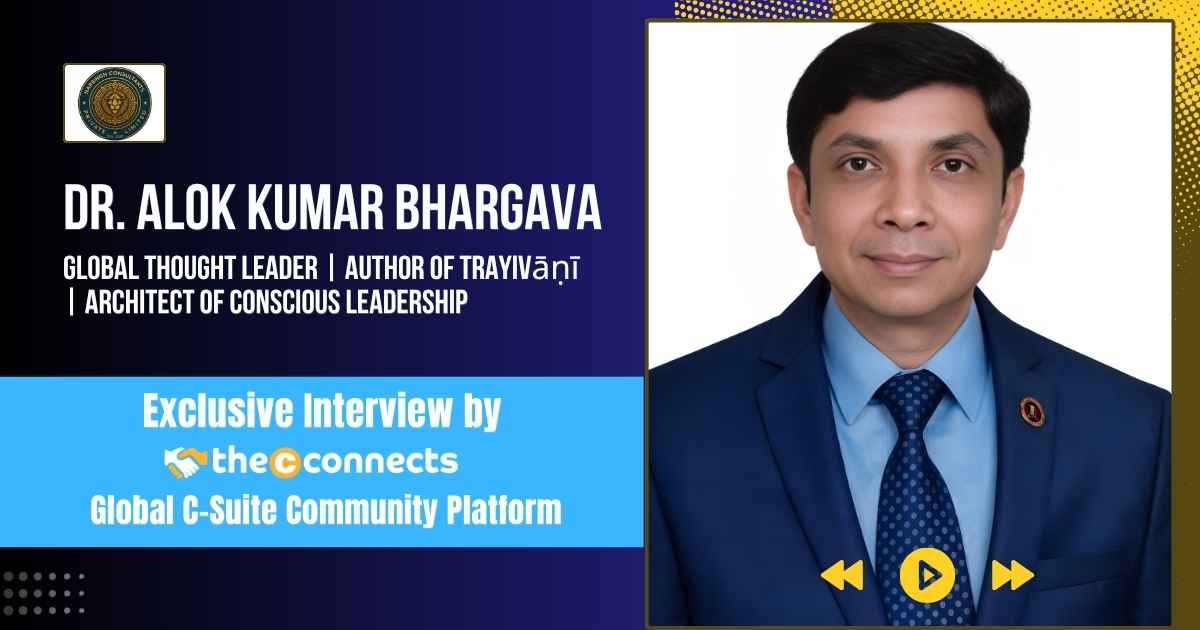

In the high-stakes theater of modern business, leadership is often measured by decibels. The executive who speaks the loudest, reacts the fastest, and maintains constant visibility is frequently perceived as the most effective. However, a profound shift is occurring-a quiet rebellion against the cult of over-communication. Leading this intellectual transition is Dr. Alok Kumar Bhargava.
An engineer by training and a philosopher by calling, Dr. Alok Kumar Bhargava is redefining executive accountability. With a career spanning three decades in large-scale systems governance and executive education from INSEAD, Singapore, and MIT Sloan (via Asia School of Business), he introduces a radical paradigm: Decision Stillness. His acclaimed book, TrayiVāṇī – Eternal Verses on Peace, Silence and Discernment, has sparked a global movement, challenging leaders to realize that true authority is expressed through cognitive restraint.
Recently named among “India’s Top 10 Inspiring Authors” and a recipient of the Global Laureate Prize for Philosophy, Ethics & Civilization, Dr. Alok Kumar Bhargava sat down with TheCconnects to discuss the architecture of silence, the dangers of impulsive speech, and why the future of leadership belongs to the thoughtful.
TheCconnects: Dr. Alok Kumar Bhargava, it is a profound honor to have you with us. Your journey is uniquely multifaceted-you are a civil engineer, a public administrator, and now, a globally recognized philosopher. How did the rigorous world of infrastructure and systems governance lead you to the contemplative philosophy of TrayiVāṇī?
Dr. Alok Kumar Bhargava: The honor is mine. To understand the transition, one must realize that engineering and philosophy are not truly distinct; they are both pursuits of structural integrity.
For decades, I worked in large-scale public systems and infrastructure. In those high-responsibility environments, I observed how decisions were made. Often, crises were not caused by a lack of data, but by a lack of discernment. Leaders were reacting under pressure, allowing emotion rather than clarity to dictate their speech and subsequent actions. I realized that just as a bridge requires a stable foundation to withstand external forces, a leader requires internal equilibrium to withstand the pressures of governance. My engineering background taught me to look for systems that are testable and outcome-oriented. TrayiVāṇī is the result of engineering ancient civilizational insight into a functional, modern leadership framework.
TheCconnects: That brings us to your core philosophy. You argue that “Leadership does not begin when one speaks-it begins when one discerns what is worth saying.” How does this challenge the conventional modern boardroom dynamic?
Dr. Alok Kumar Bhargava: The modern boardroom is suffering from an epidemic of “performative visibility.” We have equated speed with competence and volume with authority. When a crisis hits, the immediate executive impulse is to issue a statement, to react, to be seen doing something.
This impulsive communication leads to strategic misalignment and ethical inconsistency. My framework challenges this by introducing Decision Stillness. I propose that speech is not merely an expression; it is an action with an afterlife. When an executive speaks, that utterance cascades across markets, systems, and institutions. Therefore, leadership begins in the pause. It begins when you filter cognitive noise through silence and sharpen your strategic clarity through reflection, ensuring that what you say aligns perfectly with your intent.
TheCconnects: Your triadic framework-Peace (Śānti), Silence (Mauna), and Discernment (Viveka)-forms the core of TrayiVāṇī. How do you operationalize concepts like “Peace” and “Silence” in a corporate environment that demands relentless action?
Dr. Alok Kumar Bhargava: This is where the distinction between abstraction and functional application is vital. I do not define Peace as passivity or a retreat to the Himalayas. In an executive context, Peace is intent stabilization. It is the moral alignment of your objectives before you act.
Similarly, Silence is not the absence of speech. In my framework, Silence is a purification tool; it is strategic calibration. Before a CEO reacts to a market fluctuation or a public relations crisis, Silence allows them to refine raw, emotional reaction into considered thought. Discernment is the final gatekeeper-it ensures responsibility in communication. When these three are operationalized, the resulting action is precise, ethical, and effective.
TheCconnects: You have studied texts like the Bhagavad Gita and the Upanishads extensively, and readers are already calling TrayiVāṇīa “modern Gita.” Who or what has influenced your personal pursuit of spiritual humanism the most?
Dr. Alok Kumar Bhargava: My deepest influence has been the timeless wisdom embedded in our civilizational texts, particularly the Bhagavad Gita. The Gita is the ultimate manual for action under complex, high-pressure conditions-it is a dialogue on duty (Dharma) amidst a battlefield.
However, my understanding of these texts was profoundly shaped by the “battlefields” of modern administration and complex systems management. Witnessing the human cost of poor governance and unethical leadership drove me to seek principles that could survive contemporary pressures. My goal was to distill these ancient truths into a Universal Dharma-a concept of “Human Values” that is accessible to a CEO in New York, a public servant in New Delhi, or a student in Moscow.
TheCconnects: TrayiVāṇīhas achieved remarkable global resonance, being published in English, Russian, French, and Mandarin. What do you see as the biggest challenge for “Thought-Centric” brands or leaders trying to establish this philosophy in today’s noisy digital space?
Dr. Alok Kumar Bhargava: The paramount challenge in the digital space is the algorithmic prioritization of outrage and velocity over depth and truth. The digital ecosystem rewards the immediate “hot take” rather than the considered perspective.
For leaders and brands advocating ethical governance and thought-centricity, the struggle is breaking through a noise-driven world without resorting to the very tactics we oppose. The solution is not to shout louder, but to resonate deeper. Through the Trayivani Foundation and our digital satsangs, we are proving that there is a profound global hunger for stability and intellectual rigor. True influence in the digital age will ultimately belong to those who offer clarity amidst the chaos, not just more content.
TheCconnects: How does the concept of “Decision Stillness” address the specific pain points of a modern C-suite executive?
Dr. Alok Kumar Bhargava: The modern executive is overwhelmed by “Decision Fatigue” and the constant threat of reputational exposure. Every email, every tweet, every board pronouncement is scrutinized globally.
“Decision Stillness” addresses this pain point by providing a structured cognitive architecture: Peace → Silence → Reflection → Speech → Consequence. By institutionalizing the “pause,” executives mitigate the risk of impulsive errors. They stop “leaking” speech and start utilizing language as a formative, strategic asset. It replaces anxiety with authority grounded in restraint.
TheCconnects: Between your writing, speaking engagements, and the Trayivani Foundation, how do you find your own “Stillness”? What do you do in your free time?
Dr. Alok Kumar Bhargava: My free time is essentially a practice of what I preach. I immerse myself in reflective inquiry and the study of Sanskrit wisdom traditions. I find that reading-not just for information, but for transformation-is my deepest source of stillness. I also dedicate time to engaging with the community through the Trayivani Foundation, as discussing these principles with diverse minds continually refines my own understanding.
TheCconnects: Finally, what advice do you have for aspiring leaders and entrepreneurs who are trying to build businesses in an era of constant over-communication?
Dr. Alok Kumar Bhargava: My advice is this: Do not confuse velocity with progress, and do not confuse noise with influence. In your pursuit of success, ensure that your actions are anchored in clarity and governed by conscious intent. Establish your internal equilibrium before you seek to disrupt the external market. Remember that your speech and your decisions are not neutral; they are causal. The future of leadership will not be defined by how quickly you can react to a trend, but by how deeply you understand the consequences of your actions before they are expressed. Lead with discipline, and let your silence be as powerful as your words.