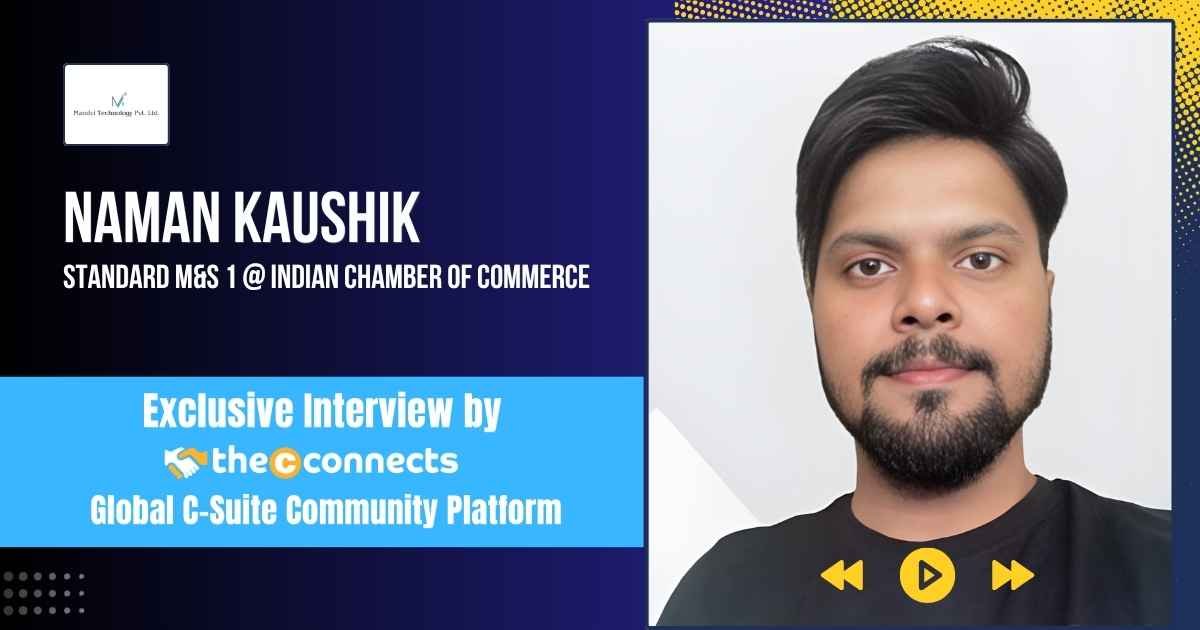

In the high-velocity corridors of Indian industry, where legacy institutions meet the disruptive force of the digital era, Naman Kaushik has carved out a singular niche. As Standard M&S 1 for Strategic Management at the Indian Chamber of Commerce (ICC) and the visionary behind Mandvi Technology Private Limited, Naman operates at the vital intersection of technological innovation and regulatory discipline.
Whether he is leveraging Microsoft Azure and Power BI to drive data-centric strategies at the ICC or overseeing critical software development for defense giants like HAL and DRDO, Naman’s philosophy remains consistent: speed is a commodity, but credibility is the ultimate brand asset. Through his two primary brands-IINVINCIBLE (Technology) and Kaushikii (Compliance)-he is effectively rewriting the playbook on how Indian enterprises can scale without losing their ethical compass.
Today, TheCconnects sits down with Naman Kaushik to discuss the evolution of strategic management, the “trust deficit” in the digital space, and why he believes the future of business belongs to those who build systems that work “at scale.”
TheCconnects: Kaushik, it is a pleasure to have you. You have a background that spans a Bachelor of Engineering and a PGDBM from SVKM’s NMIMS. Most professionals choose a side-either the technical “how-to” or the management “why.” You seem to have fused them. How did your journey lead you to this dual role at the Indian Chamber of Commerce and your own ventures?
Naman Kaushik: Thank you for having me. My journey was essentially a response to a persistent observation I made early in my career: technology and compliance were living in silos. I saw brilliant engineers building software that failed because it didn’t meet regulatory benchmarks, and I saw brilliant auditors who couldn’t understand the digital systems they were supposed to govern.
Coming from a technical background in Bhopal and then NMIMS, I realized that Strategic Management is the glue between these two worlds. My current role at the Indian Chamber of Commerce allows me to apply these data-driven strategies at a macro level, helping shape the landscape of Indian business. Simultaneously, founding Mandvi Technology was about creating a laboratory where we could prove that tech-compliance integration isn’t just a hurdle-it’s a competitive advantage. I didn’t want to choose a side; I wanted to build the bridge.
TheCconnects: You’ve often said, “I don’t build companies to chase scale-I build systems that can be trusted at scale.” That is a bold statement in a startup culture obsessed with “hyper-growth.” Where did this philosophy originate?
Naman Kaushik: It comes from a deep respect for governance. If you look at high-trust institutions-the defense sector, for example-they don’t care if you grew 300% last quarter if your security protocol has a 1% failure rate.
Working with organizations like HAL (Hindustan Aeronautics Limited) and DRDO reinforces this every day. When the stakes are national security or institutional integrity, “moving fast and breaking things” is a recipe for disaster. My influence hasn’t just been people, but the rigorous standards of these institutions. I realized early on that if you build a system with integrity at its core, scale becomes a natural, sustainable byproduct. Trust is the most expensive thing you can buy; you might as well build it into the foundation.
TheCconnects: Let’s talk about Mandvi Technology. You have IINVINCIBLE for tech and Kaushikii for compliance. To a layperson, these seem like two different businesses. How do they actually work together to solve client pain points?
Naman Kaushik: They are two sides of the same coin. Consider a modern enterprise or a government body. Their biggest pain point isn’t “writing the code”-it’s ensuring that the code complies with evolving taxation laws, data privacy acts, and auditing standards.
Through IINVINCIBLE, we handle the software development and digital innovation. Through Kaushikii, we provide a robust network of professionals-Chartered Accountants, Company Secretaries, Lawyers, and Bankers-across India. Most companies have to hire a tech firm and then a separate legal/compliance firm, and then they spend months trying to get them to talk to each other. We remove that friction. We give them an integrated ecosystem where the technology is “compliance-by-design.”
TheCconnects: You’ve achieved empanelment with HAL and DRDO-no small feat for a private enterprise. What were the biggest challenges Naman Kaushik faced in achieving that level of credibility?
Naman Kaushik: The biggest challenge was the “Credibility Gap.” When you are a private entity entering the defense and institutional strategy space, your processes are scrutinized under a microscope. We had to prove that our internal governance was as robust as the systems we were proposing to build.
We overcame this by double-downing on technical excellence. We leveraged Microsoft Azure for secure cloud architecture and Power BI for transparent, data-driven reporting. We didn’t just tell them we were secure; we showed them the data. It required a shift in mindset from “being a vendor” to “being a strategic partner.” It took time, but in the institutional world, time is the currency of trust.
TheCconnects: As someone deeply involved in Strategic Management at the ICC, what do you see as the single biggest challenge for Indian brands in the digital space today?
Naman Kaushik: The “Trust Deficit” created by automation. We are living in an era where AI can generate anything, but it can’t always generate accountability. Brands are rushing to automate their customer service and sales, but they are losing the “human-in-the-loop” governance that builds long-term loyalty.
In the digital space, partners and institutions are becoming increasingly wary. The challenge for brands is to use tech to enhance their service, not to hide behind it. You need to be able to show the “how” and “why” behind your digital decisions. Strategic management in 2026 is about finding the balance between being high-tech and high-trust.
TheCconnects: Beyond the boardroom, you are the President of the Naman Kaushaly Foundation. How does your experience in compliance and strategic management influence your philanthropic work?
Naman Kaushik: Philanthropy often suffers from the same silos as business-plenty of heart, but sometimes lacking in “system.” The Naman Kaushaly Foundation supports seven key projects, from Robotics and Education to Healthcare and Anti-trafficking.
I apply the same “HAL-empaneled” discipline to our foundation. Whether it’s the Pyari Kali project or our work with defense families, we use data to track impact. For me, “nation-building” isn’t a vague sentiment; it’s a strategic project that requires skill development, sustainability, and transparency. Both profit and purpose must coexist under the same roof of compliance.
TheCconnects: With such a multidisciplinary life, how do you spend your free time? How does Naman Kaushik “unplug”?
Naman Kaushik: (Laughs) It’s hard to completely “unplug” when your brain is wired to look for systems. However, I find immense peace in learning. I spend a lot of time staying updated on advanced technical shifts-Azure capabilities, Power BI analytics, and Robotics. But I also believe in the power of community. Spending time understanding ground-level challenges in education or healthcare through the foundation keeps me grounded. It reminds me why we build these systems in the first place.
TheCconnects: Finally, for the aspiring entrepreneurs in the technology and compliance sectors, what is your “Golden Rule” for success?
Naman Kaushik: Prioritize discipline over speed. The market is full of “unicorns” that burned out because their foundations weren’t compliant or scalable.
Don’t look for shortcuts in governance. If you are building a tech product, understand the laws that govern it. If you are a consultant, understand the technology that drives your clients. Be a multidisciplinary thinker. Most importantly, focus on building a reputation that precedes you. In the world of high-stakes business, your credibility is more valuable than your seed round.
TheCconnects: Naman Kaushik, thank you. This conversation has been a masterclass in why “Strategic Management” is the most critical skill set for the next decade of Indian innovation.
Naman Kaushik: Thank you. It was a pleasure sharing the vision. Let’s keep building systems that the nation can trust.