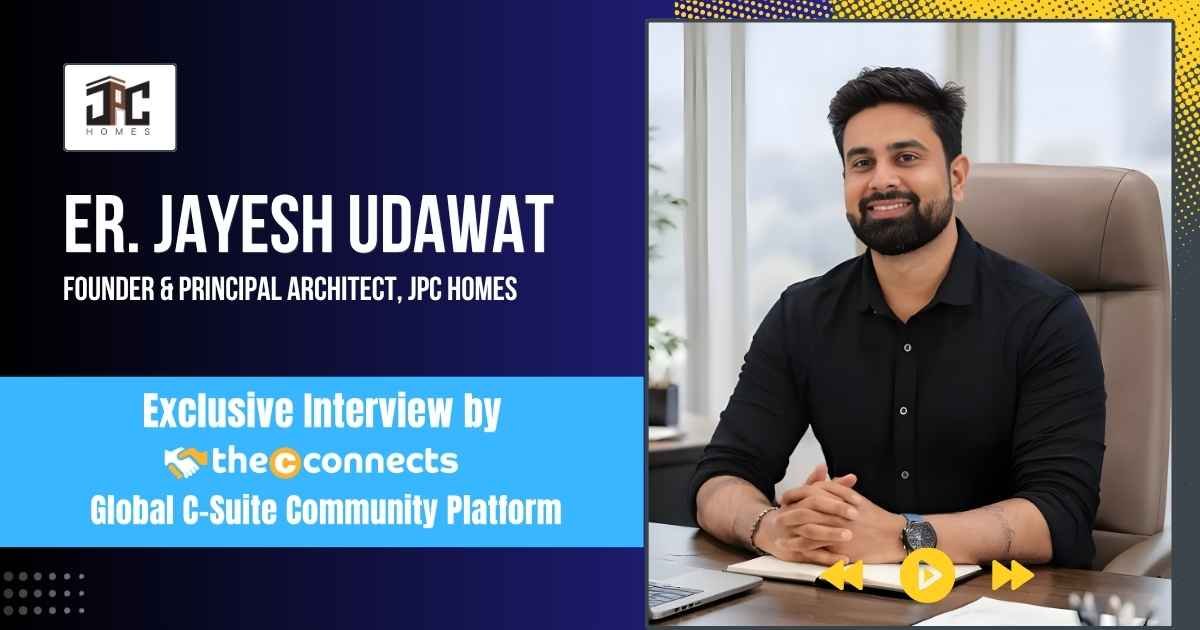

In the city of lakes, Udaipur, where heritage stone meets modern glass, the architectural landscape is undergoing a quiet yet profound transformation. At the center of this change is Er. Jayesh Udawat, the visionary founder of JPC Homes – Architecture & Interior Design Studio.
Since 2012, Jayesh has bridged a gap that many in the industry struggle with: the divide between the technical rigor of civil engineering and the fluid creativity of architectural design. With over 800 projects under his belt and a career spanning 14 years, he has turned JPC Homes into a powerhouse of Vastu-compliant, future-ready spaces. Accompanied by the award-winning Ar. Deepti Jain, the studio has become synonymous with “functional luxury.”
Today, TheCconnects sits down with Jayesh Udawat to discuss the grit behind those 800 projects, the evolution of Udaipur’s skyline, and why a house isn’t finished until the structural soul matches the aesthetic skin.
TheCconnects: Jayesh, it’s a pleasure to have you. You started JPC Homes in 2012 with a background in Civil Engineering. In an industry where “architect” and “engineer” are often seen as separate silos, how did you manage to fuse these two identities into one successful practice?
Er. Jayesh Udawat: It’s a pleasure to be here. You’ve touched on exactly why I started JPC Homes. In my early days, I noticed a recurring friction: an architect would design a beautiful, “impossible” curve, and the engineer would spend the next month explaining why it couldn’t stand up. Or, an engineer would build a fortress that had no soul or light.
I wanted to eliminate that friction. By combining civil engineering with architectural planning, I could ensure that every creative sketch had a structural backbone from minute one. My journey wasn’t about choosing one over the other; it was about realizing that a great building is a conversation between strength and beauty. We started small in Udaipur, but the goal was always to provide a “turnkey mindset” where the client doesn’t have to mediate between the artist and the builder.
TheCconnects: You’ve successfully delivered over 800 projects. That is a staggering number for a 14-year span. Looking back, what was the biggest challenge in scaling JPC Homes from a local startup to a pan-India service provider?
Er. Jayesh Udawat: The biggest challenge was Consistency at Scale. When you are doing five projects, you can oversee every brick yourself. When you hit 800, you have to build a system of quality that survives without you being on-site every hour.
We overcame this by focusing on “Detail-Driven Execution.” We standardized our design language and our structural protocols. Another challenge was the shift in client expectations. In 2012, people wanted a house; today, they want an experience. They want natural light, Vastu alignment, and “Instagrammable” corners without compromising on the budget. Transitioning the firm into a full-service consultancy that handles everything from the first 3D visualization to the final interior finish was our way of overcoming the fragmented nature of the construction industry.
TheCconnects: Ar. Deepti Jain joined JPC Homes in 2023 and has already made a massive impact, even winning the “Women of Substance” award. How has her design leadership influenced the “JPC Signature” in recent years?
Er. Jayesh Udawat: Deepti has been a breath of fresh air. While I bring the structural precision and 14 years of ground experience, Deepti brings a refined, user-centric aesthetic that focuses heavily on the lifestyle within the space.
She has a remarkable eye for material coordination and functional planning. Architecture is no longer just about the exterior elevation; it’s about the flow of energy. Her leadership in interior design has allowed us to offer a more holistic product. We now look at a project like the Kadamb Residence not just as a structure, but as a living ecosystem. Her presence has truly elevated JPC from being a “design firm” to a “lifestyle studio.”
TheCconnects: Vastu is often seen as a constraint by modern designers. However, JPC Homes lists Vastu-compliant layouts as a core service. How do you balance ancient wisdom with modern, minimalist aesthetics?
Er. Jayesh Udawat: I don’t see Vastu as a constraint; I see it as a Climatological Framework. If you look at Vastu scientifically, it’s about the sun’s path, wind directions, and the magnetic field.
Our approach is to integrate Vastu at the concept stage, not as an afterthought. We don’t just “fix” a room by adding a mirror; we design the layout so that the kitchen is in the southeast for better light and the master bedroom is in the southwest for stability. Modern minimalism and Vastu actually go hand-in-hand-both value clutter-free spaces and the flow of natural energy. It’s about making the house “breathe” in the right direction.
TheCconnects: Every leader has a “North Star.” Who has influenced your architectural and business philosophy the most?
Er. Jayesh Udawat: My influences are a mix of traditional Indian grit and modern global thinkers. But if I had to pin it down, it’s the People of Udaipur. This city is a living museum. Seeing how centuries-old structures like the City Palace have managed to stay relevant and structurally sound influenced my philosophy of “Timeless Durability.”
From a business perspective, I admire the “Turnkey Giants” who showed that accountability is the best marketing. My father taught me the value of transparency-in an industry often plagued by hidden costs, our growth is built on the simple influence of being honest with a client’s budget.
TheCconnects: Digital transformation is hitting every industry. What do you see as the biggest challenge for architectural brands in the digital space today?
Er. Jayesh Udawat: The challenge is “The Reality Gap.” In the digital space, anyone can download a beautiful 3D render from the internet and call it their own.
Clients see these “Pinterest-perfect” homes and expect them in reality. The challenge for real brands like JPC Homes is to prove that our renders are backed by structural engineering. We use 3D visualizations not just for “pretty pictures,” but as a diagnostic tool. In the digital space, the “Trust Deficit” is high. Brands must move away from just showing “content” and start showing “context”-the site visits, the material testing, and the finished 800+ projects that prove we can deliver what we draw.
TheCconnects: JPC Homes offers “Turnkey Construction.” How does this specifically address the pain points of a modern homeowner who is already overwhelmed with their professional life?
Er. Jayesh Udawat: The biggest pain point for a homeowner is “The Multi-Vendor Headache.” They have to hire an architect, then find a contractor, then a plumber, an electrician, and an interior designer. Then they spend their weekends acting as a referee between them.
We solve this by taking Single-Point Accountability. With our Turnkey model, the client only talks to us. We handle the labor, the materials, the structural integrity, and the design execution. We address the pain point of “Uncertainty”-uncertainty of budget, timeline, and quality. Because we have our own engineering and design teams, there is no “blame game.” If something isn’t right, it’s on us to fix it.
TheCconnects: With 800 projects completed, your schedule must be relentless. What does Jayesh Udawat do to “unplug” and find fresh inspiration?
Er. Jayesh Udawat: I return to the site-but without the blueprints. Sometimes, just sitting in a completed project like Aakar (one of our farmhouse projects) and watching how the light hits the walls at sunset provides more inspiration than any design magazine.
I also enjoy traveling across Rajasthan. There is so much “passive design” wisdom in our old Havelis-how they stay cool in 45°C heat without air conditioning. “Unplugging” for me is about observing the world without the pressure of a deadline. It’s in those quiet moments that the best structural solutions often appear.
TheCconnects: Finally, what is your “Golden Rule” for young architects and entrepreneurs starting their journey in 2026?
Er. Jayesh Udawat: Master the Foundation before the Elevation. Don’t just focus on making things look “cool.” Understand how the load transfers to the ground. Understand the cost of the materials you are specifying.
My golden rule is to be Client-Centric, not Ego-Centric. A house is a client’s dream and a life’s savings; it is not your personal canvas for a “design experiment.” Build with transparency, build with technical strength, and the aesthetics will follow. If you can deliver quality and trust, the 800 projects will come to you-you won’t have to chase them.
TheCconnects: Jayesh, thank you for such a grounded yet inspiring conversation. It’s clear that JPC Homes isn’t just building houses; you’re building the structural legacy of modern Udaipur.
Er. Jayesh Udawat: Thank you. It was a pleasure sharing our journey. We look forward to shaping many more dreams across India.